
History
Discover Hotel Boulderado, which was Boulder’s first luxury hotel and its name was created by merging together Boulder and Colorado.
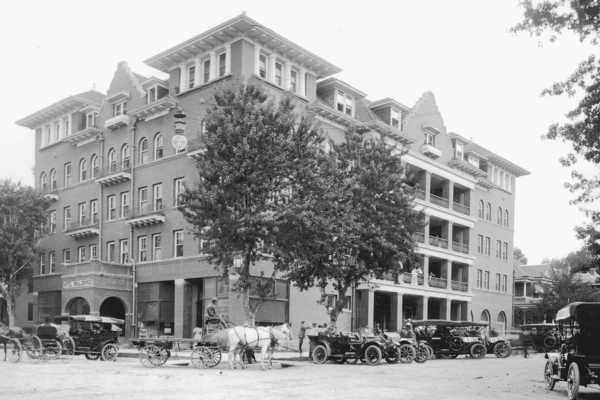
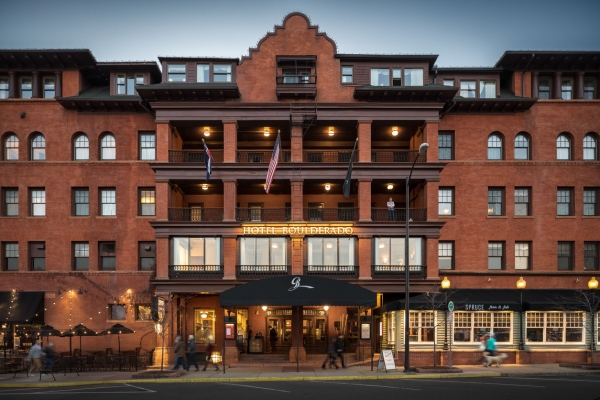
Listed on the National Register of Historic Places, the Hotel Boulderado stands today as one of the most celebrated landmarks in downtown Boulder, Colorado. The historic hotel in Boulder, CO, can trace its origins to the City of Boulder itself, for its rapid economic growth in the first decade of the 1900s led to its creation. Boulder had undergone something of a cultural renaissance, as most of the local businesses were thriving, unlike ever before. Merchants subsequently traveled to the city in ever greater numbers, arriving daily along the Central Colorado and Denver & Boulder Valley Railroads. The local University of Colorado Boulder attracted scores of people as well, with some 6,000 students residing within the community at the start of the century. Boulder had thus become one of Colorado’s most often visited destinations. As such, many civic leaders inside the city feared that the absence of a spectacular hotel would eventually discourage people from visiting in the future. In 1905, the Boulder Commercial Association began the project by raising the necessary funds to finance its completion. It subsequently sold stocks locally at $100 per share, as opposed to using various private investors. By April of the following year, the community had spent some $75,000 on stock. Furthermore, a few subscribers pooled their own resources together and created the Boulder Hotel Company with James Moorhead as its president. The company immediately set about constructing the new hotel, hiring the architectural firm “Redding & Sons” to design its entire layout. Its team of architects proceeded to create an absolute masterpiece, crafting a five-story brick building that featured a brilliant blend of Italian Renaissance Revival and Spanish Colonial Revival-style aesthetics.
Many throughout Boulder hailed the business’ arrival when it finally debuted on New Year’s Day in 1909. (It would take a few more months to construct the final, fifth floor, however.) The Boulder Hotel Company had decided to christen the structure as the “Hotel Boulderado,” combining the words “Boulder” and “Colorado” to create the latter half of the new name. Hotel Boulderado immediately became the most luxurious hotel in the community, offering daily rates of anywhere between $1 and $2.50 per night. Despite its expensive price tag, people all over town fought to buy a room had dinner inside the beautiful structure. Many branches of local organizations—such as the Lions, the Rotary, and the Kiwanis Club—all hosted weekly meetings at the Hotel Boulderado, such as grand dances and soirees. Shop owners displayed their goods on the fifth floor regularly, while two enterprising businesspeople—Florence Molloy and Mabel MacLeary—operated a taxi company from the hotel. Soon enough, guests all over the nation started to reserve guestrooms in large quantities. Among their number were some of the most illustrious figures of the age, including the likes of Clarence Darrow, Billy Sunday, Helen Keller, Robert Frost, and Louis Armstrong. Overseeing the hotel’s success was the hotel’s management company, Wallace & Sons, and its successors, F.F. Thatcher and Hugh Mark. Business proved to be so great that the Boulder Hotel Company managed to retire its debt in 1925 and paid its first dividends some four years later.
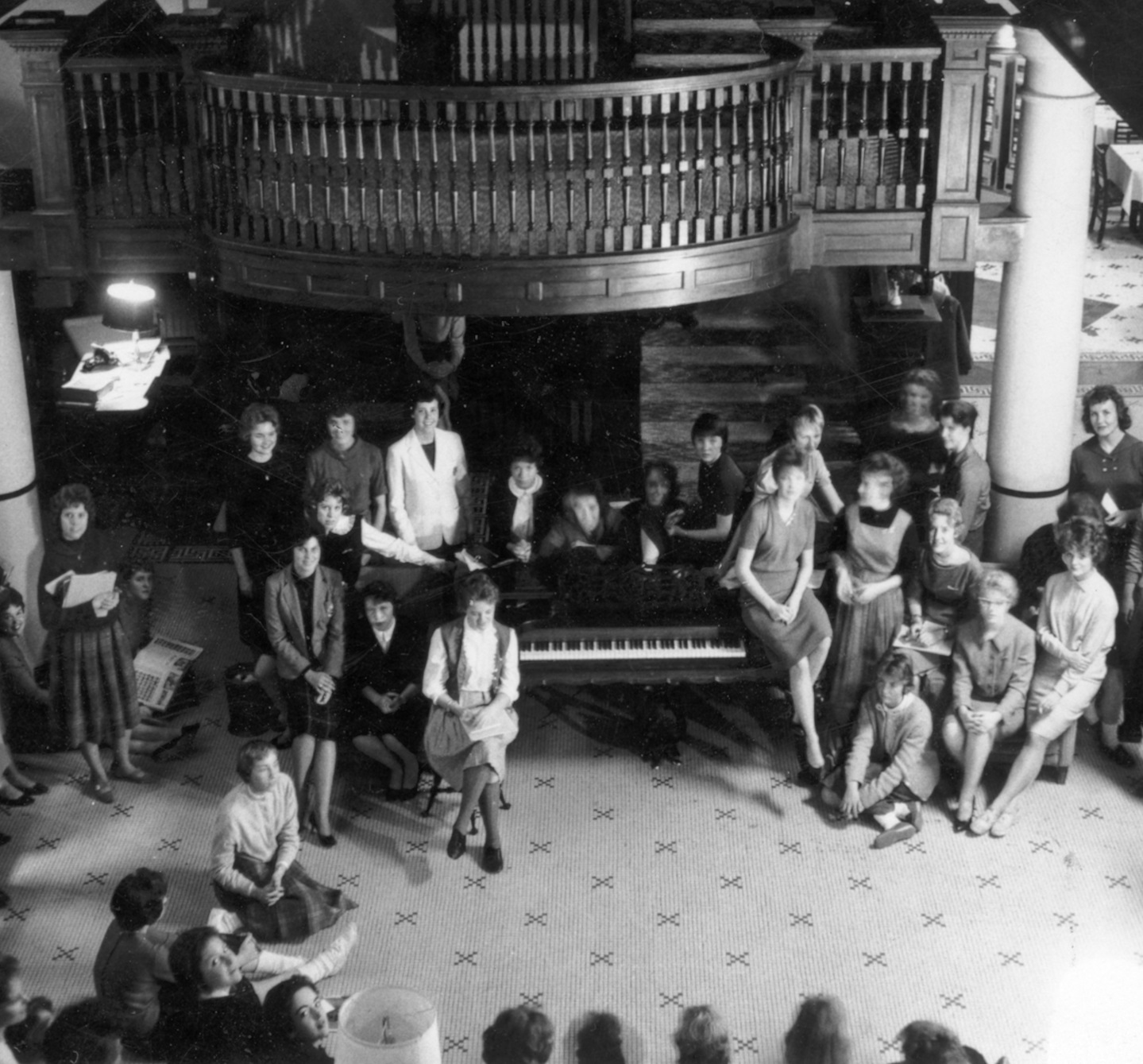
The onset of the Great Depression unfortunately brought Hotel Boulderado’s prosperity to a crashing halt. It struggled immensely to fill its guestrooms, many of which remained empty throughout the duration of the crisis. To make matters worse, the Boulder Hotel Company encountered great financial hardship, despite the efforts of its second president—C.G. Buckingham—to keep it afloat. When Buckingham died in 1940, his nephew, C.E. Buckingham, took over and quickly dissolved the business. Yet, bluer skies were on the horizon for the Hotel Boulderado. William Huston and his son, William Jr., purchased the building shortly thereafter through their own business, the Huston Hotel Company. They invested heavily in the building’s restoration, sparing no expense on improving the entire structure. The Hotel Boulderado immediately returned to being the most luxurious place to stay in downtown Boulder, even opening the upscale “Catacombs Restaurant and Bar” in 1969. (The Hotel Boulderado became the first institution to operate a liquor license in the city once local ordinances enforcing prohibition were overturned in the middle of the century.) The Hotel Boulderado also underwent another major period of renovations in the early 1980s that converted many of the smaller guestrooms into much larger spaces. The architectural firm “Junge Reich Magee” then constructed two annexes that increased the total guestroom amount up to 160. Today, the Hotel Boulderado still maintains its status as Boulder’s most exclusive getaway. A member of Historic Hotels of America since 1996, its magnificent architecture and wonderful institutional history continues to charm all who step inside.
Hotel Timeline
The Location
In the early 19th century, various American explorers—including Zebulon Pike, Stephen Harriman Long, and John C. Fremont—had spent years navigating the greater Boulder area. In fact, it was one of John C. Fremont’s men, William Gilpin, who first noticed that the region contained vast amounts of natural resources, specifically deposits of gold. When word reached the eastern United States of Gilpin’s discovery, hundreds of American pioneers hitched their wagons and headed west toward the Colorado Rockies. As such, the site of present-day Boulder and its surrounding environs became the epicenter for the subsequent “Colorado Gold Rush.” The first settlers to arrive were a band of prospectors led by Thomas Aikins and his son, James. They immediately went to work establishing a mining camp called “Gold Hill” near Boulder Creek, which accessed a massive buildup of gold. Then, several months later, another prospector named David Horsfal found an even larger lode nearby. News of their success inspired many more people to try their luck, and small, isolated settlements began to emerge in the wilderness among the roaming bands of Native Americans. But in 1859, one of the pioneers—A.A. Brookfield—formed a partnership with Thomas Aikins and some 50 other men to create a town that could cater to the disparate group of miners. Through their Boulder City Town Company, the group began platting a nascent community at the mouth of a canyon. The Boulder City Town Company gradually developed the City of Boulder over the course of the following year, with Brookfield serving as its first president. He specifically presided over the distribution of some 1,200 acres of land, which he parceled out among the shareholders of the Boulder City Town Company.
By the time of the American Civil War, Boulder’s size remained relatively minuscule. Only around 70 rustic log cabins constituted the core of Boulder, with little landscaping present anywhere in the center of town. Undeterred, its earliest residents nonetheless tried to improve upon their new community. They quickly financed the creation of a municipal water system and created the foundations of a modern public-school program. The locals even managed to successfully petition Colorado’s legislature to create a branch of the University of Colorado within the city limits. Mining also continued to play an important role in Boulder, inspiring many enterprising individuals to relocate to the city in spite of its expensive real estate. Prospectors continued to expand their operations well into the late 1800s, discovering additional gold and silver deposits on the outskirts of town. Yet, many merchants and farmers moved into the region, too, encouraged by the town’s prosperous local economy. Chinese and black families were among the new arrivals as well, carving out unique communities for themselves all over Boulder. The settlement was well on its way toward becoming a modern city, especially after the railroads and electricity appeared in the city in the 1870s and 1880s. Perhaps the development that most residents adored was Boulder’s “Chautauqua.” Opened as the “Colorado Chautauqua” in 1898, it was the brainchild of a group of Texans that had moved into Boulder as a means of escaping the sweltering summer heat of their home state. The Chautauqua subsequently offered the Texans a place to vacation in peace with their families, while also promoting self-improvement through a series of social classes held on-site. Today, the Boulder Chautauqua is the only remaining facility of its kind west of the Mississippi and is also recognized as a National Historic Landmark by the U.S. Department of the Interior.
By 1900, the residents of Boulder had taken to calling their town the “Athens of the West.” Its population had now started to explode, with some 6,000 students residing at the University of Colorado Boulder alone. Many new facilities debuted at the school over the next several decades, including dormitories, a library, and a house for its president. Even several military buildings debuted on campus after the outbreak of World War I, which hosted officers affiliated with the university’s Reserve Officer Training Corps. The University of Colorado Boulder continued to be a fixture throughout the rest of the century, eventually numbering well over 20,000 students by the late 1980s. New industries also debuted in Boulder, having long supplanted the historic mining operations that once dominated the local economy. Companies like IBM and Ball Aerospace moved into the city and created thousands of new jobs for its inhabitants. Many more people relocated to Boulder as a result, with some 103,000 residents eventually calling the city home at the start of the 21st century. Today, Boulder continues to be one of Colorado’s most celebrated destinations. It is currently home to many outstanding cultural attractions, such as the University of Colorado Museum of Natural History, Flagstaff Mountain, and the Flatirons. It is close to many more fascinating sites as well, including the Rocky Flats National Wildlife Refuge, the Carolyn Holmberg Preserve at Rock Creek Farm, and the Arapaho and Roosevelt National Forests.
The Architecture
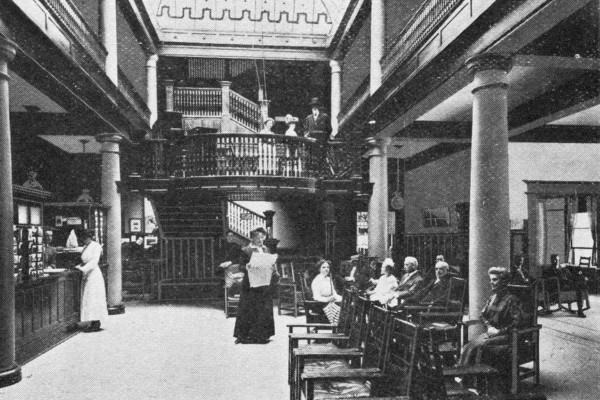
Work on the historic Hotel Boulderado began in the fall of 1906, once the Boulder Hotel Company and its president—James Moorhead—raised the necessary finances to fund its construction. That November, the firm Shinkle and Franklin began the project by laying the hotel’s sandstone foundation. Construction continued for the next two years, with another company—Geranson and Beckstrom—providing the labor. (Yet another business, Larimer Heating and Plumbing, oversaw the installation of its heating, plumbing, and gas systems.) All of the contractors had followed the designs of local architects William Redding, Floyd Redding, and James Cowie. Members of the architectural firm Redding & Sons, the three men had already developed a reputation for their work on the University Hill School, the Boulder Preparatory High School, and the Hagman and Whiteley houses. They envisioned a five-story rectangular building that mirrored the appearance of San Francisco’s renowned Palace Hotel (also a member of Historic Hotels of America). Thick walls layered four bricks deep gave the building a much-needed source of stability and insulation, while a wood and asphalt roof provided protection from the elements. Its exterior featured stunning examples of Italian Renaissance architecture, the most notable of which was its protruding towers. But the façade also incorporated aspects of Spanish Colonial Revival aesthetics, including curvilinear gables, arched windows, and the use of a central courtyard. Inside, Redding & Sons crafted a mesmerizing interior that contained many ornate guestrooms and public spaces. Perhaps the greatest feature of the building’s floor plan was its lobby and mezzanine. A fascinating stained-glass ceiling sat atop the space, designed to replicate the one that had existed within the Palace Hotel prior to the Great San Francisco Earthquake of 1906. The architects spared no expense creating the structure, as they imported its cathedral glass directly from Italy. Another stunning component inside the building was its cantilevered, cherrywood staircase, which extended all the way up to the top floor from the basement!
Both Italian Renaissance and Spanish Colonial Revival-style architecture influence the appearance of the Hotel Boulderado. Renaissance Revival architecture itself is a group of architectural revival styles that date back to the 19th century. Neither Grecian nor Gothic in their appearance, Renaissance Revival-style architecture drew inspiration from a wide range of structural motifs found throughout Early Modern Western Europe. Architects in France and Italy were the first to embrace the artistic movement, who saw the architectural forms of the European Renaissance as an opportunity to reinvigorate a sense of civic pride throughout their communities. Those intellectuals incorporated the colonnades and low-pitched roofs of Renaissance-era buildings, with the characteristics of Mannerist and Baroque-themed architecture. Yet, the nebulous nature of Renaissance Revival architecture meant that its appearance varied widely across Europe. As such, historians today often find it difficult to provide a specific definition for the architectural movement. On the other hand, Spanish Colonial Revival-style architecture is a replica of themes typically seen in early Spanish colonial settlements. Original Spanish colonial architecture borrowed its design principles from Moorish, Renaissance, and Byzantine forms, which made it incredibly decorative and ornate. Architect Bertram Goodhue was the first to widely popularize Spanish Colonial architecture in the United States, spawning a movement to incorporate the style more broadly in American culture at the beginning of the 20th century. Goodhue received a platform for his designs at the Panama-California Exposition of 1915, in which Spanish Colonial architecture was exposed to a national audience for the first time. His push to preserve the form led to a revivalist movement that saw widespread use of Spanish Colonial architecture throughout the country, specifically in California and Florida. Spanish Colonial Revival-style architecture reached its zenith during the early 1930s, although a few American businesspeople continued to embrace the form well into the 20th century.
Famous Historic Guests
- Ethel Barrymore, American actress regarded as "The First Lady of the American Theatre."
- Douglas Fairbanks, actor known for his roles in The Thief of Baghdad, Robin Hood, and The Mark of Zorro.
- Billy Sunday, American baseball player who became the most influential American evangelist during the first two decades of the 20th century.
- Clarence Darrow, American lawyer known for his involvement in the famous Scopes Trial.
- Helen Keller, deaf-blind American author and activist.
- Robert Frost, poet and author best remembered for his four Pulitzer Prizes in Poetry.
- Benny Goodman, jazz clarinetist and band leader remembered to history as the “King of Swing.”
- Louis Armstrong, renowned Jazz musician regarded as one of the most influential figures in the genre.
- Enos Mills, American naturalist who was the main figure behind the creation of Rocky Mountain National Park.
Film, TV and Media Connections
Boulder International Film Festival (BIFF): The Hotel Boulderado has been a proud supporter of the Boulder International Film Festival, as the two have formed a close partnership over the years. The festival itself was founded in 2004 by two sisters from Boulder—filmmakers Kathy and Robin Beeck. Having traveled the world extensively to attend similar festivals, the two felt as if their hometown was well suited to host such an event. Together with the Colorado Film Society, the sisters subsequently debuted what they eventually called the “Boulder International Film Festival” to great acclaim. It has since evolved into one of the leading conferences in the entire movie industry, with MovieMaker Magazine declaring it to be one of the “25 Coolest Film Festivals” in existence. Held annually on President’s Day Weekend, the gathering attracts more than 25,000 film enthusiasts ever year. Many film experts attended the conference, too, ranging from independent directors to some of the biggest critics. Among the guests to travel to the BIFF in the past have included the likes of William H. Macy, Peter Fonda, Chevy Chase, Lawrence Kasdan, Oliver Stone, Martin Sheen, and Shirley McLane. Even the late statesmen and civil rights activist John Lewis made an appearance at the Boulder International Film Festival.
Women in History
Helen Keller: Helen Keller was one of the many historic guests to visit the Hotel Boulderado over the years. Keller herself was the first deaf-blind person in American history to successfully earn a college degree. According to her biographers, Keller had become afflicted with an unknown illness as a toddler, which greatly impacted her sight and hearing. Her family stopped at nothing to get her the best help available, travelling all the way from their native Alabama to meet with eye, ear, and nose physicians in Baltimore. They, in turn, directed the Kellers to inventor Alexander Graham Bell, who had been working with deaf and blind children at the time. Bell informed the Kellers of a school called the Perkins Institute for the Blind in Boston that would provide the best education for Helen during her youth. Helen Keller was then paired with an alumnus of the academy named Anne Sullivan, who would guide the young girl through her lessons. It was the start of a historic relationship that would be immortalized in a series of films known as The Miracle Worker. Sullivan managed to aid Keller in learning how to communicate through sign language, with her first word being “water.” Keller quickly became proficient at reading sign language with her hands, as well as braille. As she got older, Keller enrolled in The Cambridge School for Young Ladies, and then Harvard University’s Radcliffe College. Keller graduated with top honors from Harvard, leaving the school as a member of Phi Beta Kappa. She then went on to establish a career as an author and motivation speaker that was hailed throughout the world. Keller also had an active political career, becoming a champion for such causes as global pacifism and women’s suffrage. She even helped found the American Civil Liberties Union in 1920. Yet, the cause that Keller is best remembered is her tireless campaigning for the rights of Americans who experienced some form of physical disability. Keller has since received numerous accolades for her work toward the end of her life, including the Presidential Medal of Freedom and a place in the National Women’s Hall of Fame.
Guest Historian Series
The Hotel Boulderado name was created with the combination of city of Boulder and the state of Colorado, a memorable mutation of a state and host city that captures the best of both locations. In the early 1900s, when Boulder was evolving from a dusty frontier town into a small city, many of its residents realized the need for a substantial hotel. In 1905, Boulder was the home to 8,000 residents, the University of Colorado, one of the Chautauqua cultural and educational resorts and twenty-six automobiles. As a newly-created railroad hub, the city needed additional hotel rooms.
What Boulder lacked in population, it made up in civic-based enthusiasm. Its local paper, the Daily Camera wrote, “Enthusiasm, much more than any other outward evidence inspires confidence in the success of this most important undertaking.” One resident wrote, “Now that the football season is over, let us get down to our studies at school and our determination to build a splendid hotel. Let us hit the line hard for Boulder, just as we hit the (Haskell, Kansas) Indians. Teamwork is all that is required. Our Commercial Association has the head work all right, but in chasing the ball of Boulder’s opportunity, it needs teamwork, a right and left tackle, and a college yell for the hotel.”
Continue Reading