History
Discover Château de Mazan – Handwritten Collection, which was once the magnificent palatial residence of the Sade family, French aristocrats who possessed deep connections to the wider Provencial artistic community.
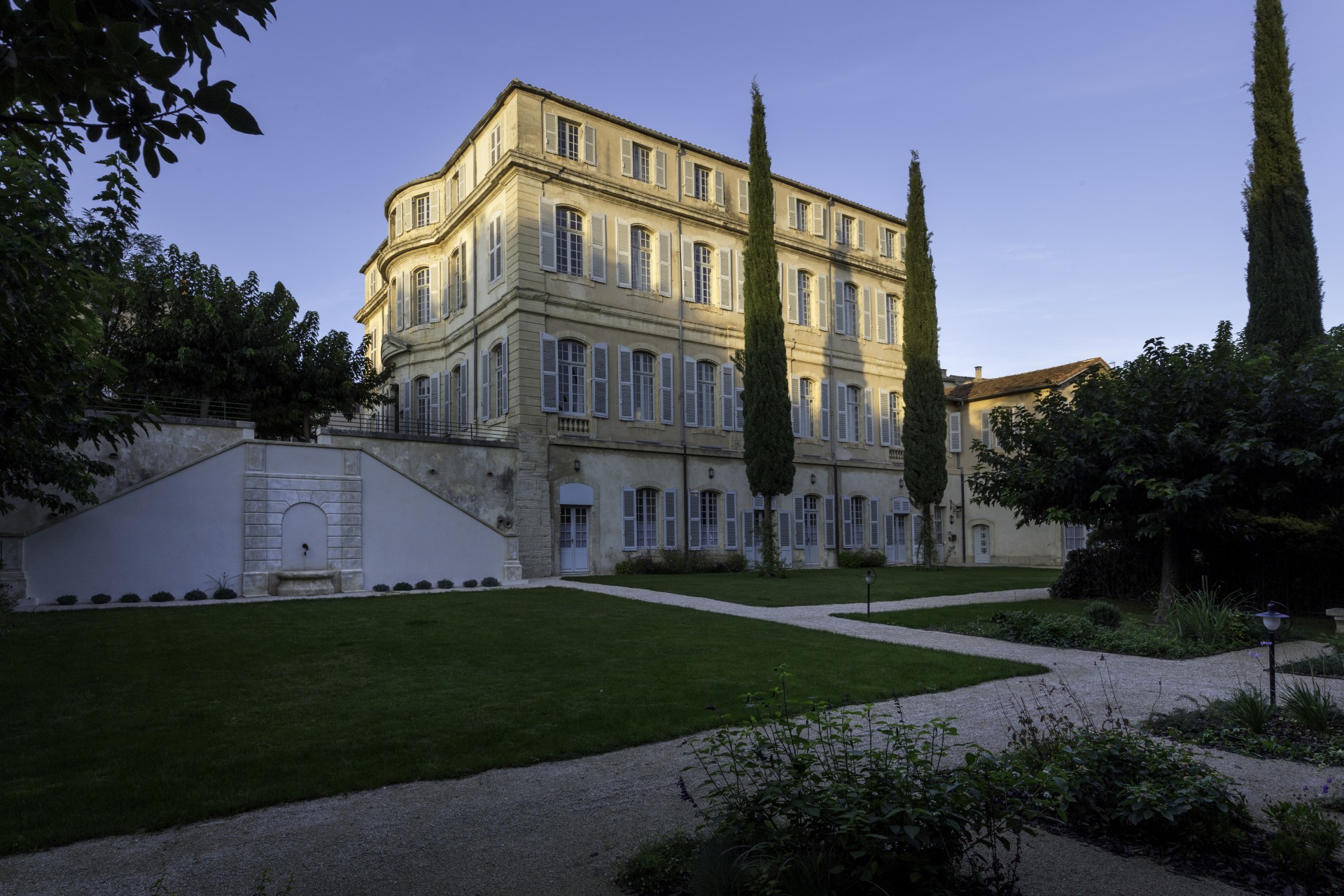
The story of the Château de Mazan – Handwritten Collection is inseparable from that of one of Provence’s most famous noble families, the Sades. Although the family was related to the Provencial town of Mazan since the Middle Ages, the current château traces its origins all the way back to the 17th century. More specifically, the aristocratic Jean-Baptiste de Sade purchased a house on the present site of Château de Mazan – Handwritten Collection from Esprit de Boutin in 1634, relocating his family away from their earlier home near the village church. (Known as the “Tour de Sade,” this incredible medieval residence still stands in Mazan today.) Jean-Baptiste de Sade proceeded to gradually enlarge the building, establishing it as one of his principal seats of power in the region. But during the 18th century, Jean-Baptiste’s descendants decided to replace the edifice, constructing in its place an even more refined château capable of representing the growing prestige of their lineage. Designed by the Franque brothers—among the finest architects working in Provence at the time—the new residence was constructed of local Crillon limestone and reflected the elegance of the Regency and early King Louis XV eras. Built on three principal levels above service areas and kitchens, the château in turn became a refined aristocratic residence that truly embodied the elite reputation of its owners.
Referred to as merely the “Château de Mazan,” the gorgeous mansion would eventually pass into the care of Donatien Alphonse François de Sade. His father had occupied the residence for many years prior to dying in 1767, after which the Marquis inherited the regal estate. Donatien subsequently invested heavily to safeguard the structure, turning it into a comfortable, secluded retreat in the process. Perhaps the most celebrated episode in the château’s history occurred amid his time as owner in 1772. Donatien had commissioned a theater within the surrounding garden and assembled a troupe of accomplished actors from Marseille to perform there. Between May and October, audiences attended performances of works by writers such as Voltaire, Regnard, and Destouches. In fact, Château de Mazan’s own historical records describe those festivities as the origin of the first theater festivals in all France. The estate thus became not merely a private residence but a center of Enlightenment-era cultural life. Nevertheless, the onset of the French Revolution around the end of the century brought ruin to the Sade family. As hostility toward the nobility intensified, Château de Mazan emerged as a target for regional revolutionaries given its affiliation to the powerful Sades. Attacked and looted, the historic château was unfortunately rendered inhospitable by 1792.
While the Sade family still retained ownership for many decades thereafter, the building never again served as the vibrant aristocratic residence it had once been. Indeed, the Sade family ultimately chose to sell the estate to Clothilde Deymier, the wife of Mazan’s mayor, in 1854. It subsequently passed to different owners over the next century, coming to act as a Christian school, hospice center, and retirement home. But the true rebirth of the château began when it was acquired by the Lhermie family and converted into a hotel in the early 21st century. This adaptive reuse restored public interest in the site’s fascinating architecture and history while providing a sustainable future for the building. The former residence continued to evolve as a revered holiday destination, too, alluring countless travelers due to its unique blend of Provençal heritage and hospitality. Then in 2019, Château de Mazan was momentously acquired by the French hotel group Elegant Properties Collection. Under the direction of Franck Jaulneau and architect Claire Annicchiarico, an extensive renovation was undertaken that took two full years to complete. Seeking to recover the historical atmosphere of the château, the team endeavored to restore the architectural integrity of the entire structure. Now named “Château de Mazan – Handwritten Collection,” this four-star heritage hotel continues to be one of the most fascinating places to visit in all Provence.
Hotel Timeline
The Location
Located a little over a half-hour away from Mazan, the Provencial metropolis of Avignon possesses an incredibly rich heritage. Originally settled by Celtic tribes, the site later became an important community known as “Avennio.” When the Romans expanded into Gaul, they recognized the strategic value of the location and incorporated it into their growing empire. Under Roman rule, Avignon developed into a prosperous urban center connected to regional trade networks and transportation routes that linked the Mediterranean world with inland Europe. Following the decline of the Western Roman Empire in the 5th century, Avignon experienced the political instability that affected much of southern France. Control of the city shifted among various powers, including the Burgundians, Ostrogoths, and Franks. During the early Middle Ages, Avignon gradually rebuilt its importance as a commercial and religious center. Indeed, its position along the Rhône River encouraged trade, while the growth of Christianity brought churches, monasteries, and ecclesiastical influence. By the 12th century, the city had developed a degree of independence and prosperity, governed for a time as a commune influenced by the broader movement of urban self-government that was emerging across medieval Europe.
The defining chapter in Avignon’s history began in the early 14th century. In 1305, the French-born Pope Clement V was elected amid a period of intense conflict between the papacy and the French monarchy. Political unrest throughout the neighboring Italian Peninsula and pressure from King Philip IV of France contributed to Clement’s decision not to establish himself permanently in Rome. Instead, he moved the papal court to Avignon four years later in a bid to insulate himself from further trouble. This decision ultimately transformed what had been an important regional city into the administrative center of the Roman Catholic Church. The newfound papal influence expanded Avignon’s bureaucracy, promoted education, and conducted church affairs that extended across Europe. Terrific construction projects commenced all over the city, including the magnificent Palais des Papes. But, the city's prominence brought controversy. Critics viewed the Avignon Papacy as excessively influenced by French interests, and resentment toward the arrangement grew throughout the continent. In 1377, Pope Gregory XI returned the papal court to Rome, hoping that its relocation would temper the rising tension. But disputes surrounding papal succession continued nonetheless, ultimately contributing to the Great Western Schism, during which rival claimants to the papacy emerged.
Avignon became the seat of antipopes who challenged the authority of Rome-based pontiffs. Those subsequent conflicts damaged the prestige of the medieval Church and marked a turbulent chapter in European religious history. Even after its political influence declined, Avignon continued to enjoy special status. In fact, the city remained under papal control for centuries thereafter rather than becoming fully integrated into the Kingdom of France. This unusual arrangement lasted until the era of the French Revolution though, when revolutionary forces finally annexed Avignon during the 1790s. Avignon evolved into a regional cultural and economic center over the following centuries, with much of its skyline adopting a more modern appearance. However, the community rallied around many extensive preservation efforts to protect the city’s impressive history, focusing on important landmarks like the Palais des Papes. Perhaps the greatest sign to the effectiveness of their efforts was the decision to combine several of those structures into a single UNESCO World Heritage Site in 1995.Today, Avignon is celebrated not only for its papal history but also for its annual arts festival, such as the renowned Festival d’Avignon, which attracts performers and audiences from around the world. Many of its surviving historical structures attract countless cultural heritage travelers every year, reflecting the enormous interest that its history continues to resonate throughout the globe.
The Architecture
Although many unique architectural styles are present throughout Château de Mazan – Handwritten Collection today, the most prominent shown is a form known as “French Classical.” French Classical architecture emerged as an expression of order, authority, and intellectual rigor amid a period when the France’s monarchy sought to project its power through the built environment. Drawing inspiration from the architecture of ancient Greece and Rome,as well as from the principles of the Italian Renaissance,French architects developed a distinctive style that valued symmetry, proportion, and disciplined composition. While earlier French architecture had been characterized by the verticality and ornamentation of Gothic traditions, the Classical movement marked a deliberate shift toward clarity, balance, and rational design. The reign of Louis XIII witnessed the gradual adoption of Classical ideas, but it was under Louis XIV, the “Sun King,” that the style reached its fullest expression. Architecture became a powerful instrument of the state, embodying the ideals of centralized royal authority. Architects such as Louis Le Vau, Jules Hardouin-Mansart, and Claude Perrault helped define the architectural language, with their work emphasizing harmonious façades, geometric planning, and the careful use of Classical orders derived from antiquity. Rather than pursuing the dramatic effects associated with the Baroque architecture of Italy, French designers generally preferred restraint and regularity, creating buildings that conveyed dignity and permanence.
The Palace of Versailles was perhaps the most celebrated structure to use French Classicism. Expanded throughout the late 17th century, it combined monumental scale with strict symmetry and carefully organized spaces. Its long façades, rhythmic arrangement of windows, and formal relationship to the surrounding gardens exemplified the Classical ideal that architecture should impose order upon nature. Similar principles appeared in civic and religious buildings, including the eastern façade of the Louvre and Les Invalides in Paris, where grandeur was achieved through measured composition rather than excessive decoration. During the 18th century, French Classical architecture continued to evolve. Architects increasingly studied ancient monuments and archaeological discoveries, leading to a more scholarly interpretation of Classical forms. This development laid the foundation for Neoclassicism, which emphasized simplicity, linear purity, and historical accuracy. Yet the essential characteristics established in the previous century remained influential: symmetry, balanced proportions, axial planning, and the use of ancient patterns. The legacy of French Classical architecture has since extended far beyond France though, as its principles shaped royal palaces, government buildings, and urban planning throughout Europe and the Americas. By combining Classical inspiration with a distinctly French sense of order and grandeur, the style created an enduring architectural tradition that became synonymous with elegance, authority, and cultural refinement.
Famous Historic Events
Marquis de Sade’s French Theater Festival (1772): Marquis de Sade had a passion for the stage and the French literary works of the 17th and 18th centuries. The nobleman prepared a series of performances throughout 1772 that is now widely regarded as the first French theater festival. The opening event was held at the Sade family’s Château de Lacoste and debuted a comedy written by the Marquis himself. The summer events were held in the gardens of the Château de Mazan. Between May and October, audiences attended performances of works by writers such as Voltaire, Regnard, and Destouches in the grounds surrounding the residence.