
History
Discover the Fairmont Palliser, which was once one of the leading hotels for the Canadian Pacific Railway.
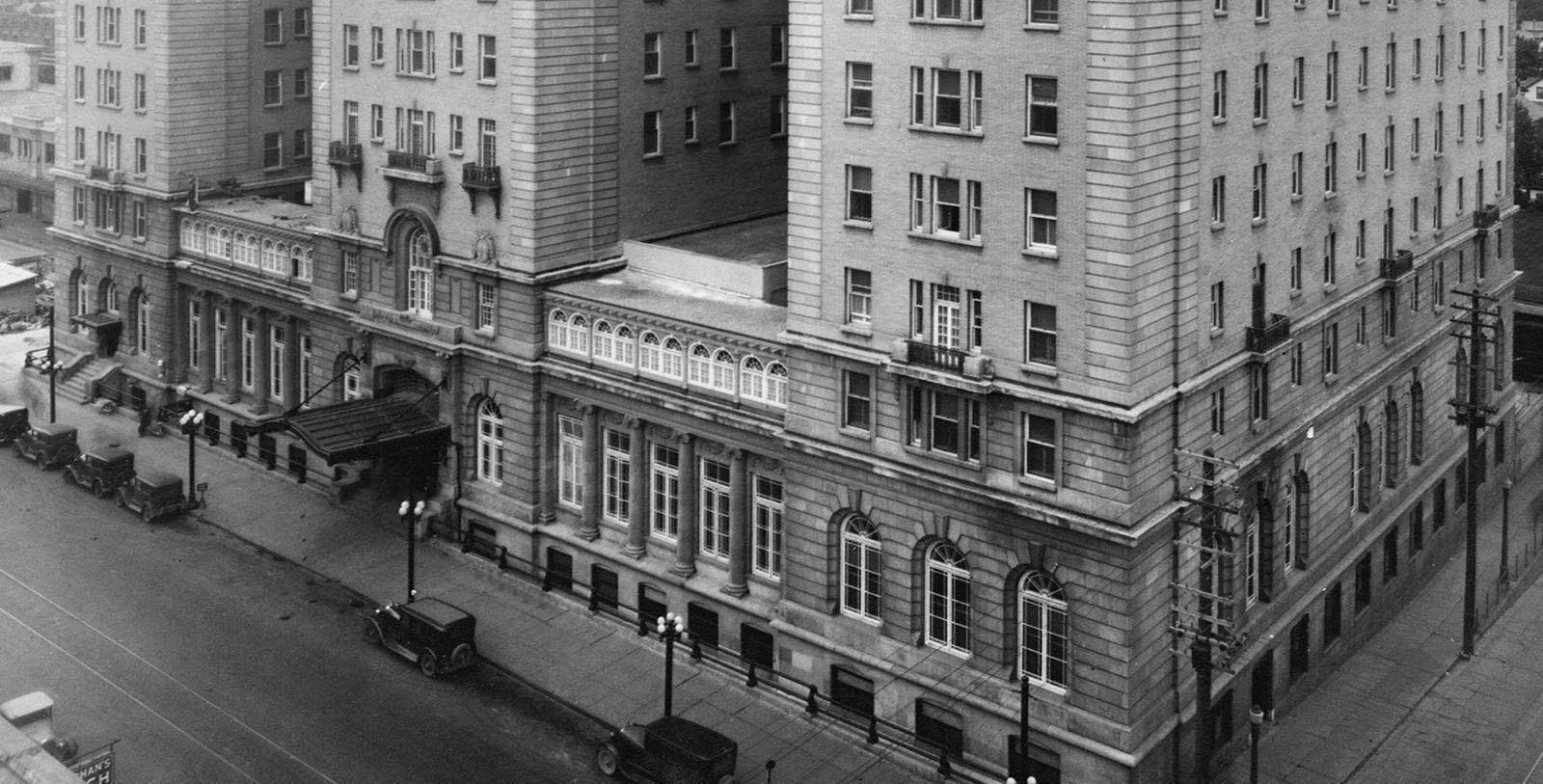
Fairmont Palliser first debuted in downtown Calgary in June 1914, the result of the Canadian Pacific Railway’s intent on growing westward. The company’s president, William Van Horne, specifically decided to create the Fairmont Palliser, due to the influx of tourists into the city caused by his railroad at the height of the Victorian Era. Called “The Palliser” in the early days, it was named after a local explorer in the 1850s named Captain John Palliser. Architect Lawrence Gotch designed the hotel’s overall appearance, which he cast In Chicago Commercial-style architecture. Yet, he also borrowed heavily from local architectural design aesthetics, as Alberta’s prairie grain elevators served as a major source of inspiration, too. The service floors—shaped like the letter “E”—were designed to receive natural sunlight, while all the guestrooms had access to indoor plumbing and wonderful brass beds. The hotel’s eight floor proved to be its most spectacular, as it contained brilliant oak paneling, candelabras, and marble flooring. But Gotch relied upon different architectural styles to create some of The Palliser’s iconic event spaces. Originally called “The Rotunda,” Renaissance Revival-style architecture defined the lobby and its special gray Tennessee marblework. And the Crystal Ballroom—now the Palliser Room—displayed some of the finest Louis-XIV-inspired design elements throughout all of Canada.
The Palliser only continued to grow throughout the 20th century, as illustrious individuals from across the world sojourned to the hotel. Among the first notable guests to stay at The Palliser was Canadian Prime Minister R.B. Bennett, who periodically spent long periods of time inside the hotel starting in 1922. Many other spectacular guests soon frequented The Palliser, including the star of Alfred Hitchcock’s thriller North by Northwest—Cary Grant. Members of the British Royal Family also grew an affinity for the hotel, such as Edward VIII, King George VI, and Queen Elizabeth The Queen Mother. Perhaps the greatest moment in which a British monarch graced the hotel with their presence was the arrival of Queen Elizabeth II and her husband, Prince Philip, in 1993. The royal couple had so thoroughly enjoyed their stay that they bestowed The Palliser with a Heraldic Badge—the first time such an honor had ever been given to a hotel! The crest displayed the provincial flowers of Alberta, as well as the contours of the Bow and Elbow River. A member of Historic Hotels Worldwide, The Palliser today is now proudly operated by Fairmont Hotels and Resorts as the “Fairmont Palliser.” This fantastic historic hotel continues to be among the best places to vacation in all of Canada.
Hotel Timeline
The Location
Calgary’s origins trace back to a remote frontier post known as Fort Brisebois. Founded in 1875, the fort was garrisoned by a company of officers enlisted in the mounted police. Soon enough, a small rural settlement emerged around fort and it was rechristened as “Fort Calgary” a year later. But the area had been explored two decades earlier, though, by an Irish geographer named as John Palliser. He had originally arrived in the region at the head of a major party of explorers known as the “British North American Exploring Expedition.” The main function of Fort Calgary was to regulate the illegal trade of whiskey that had begun to run rampant among the isolated communities of fur trappers that had begun to appear throughout the countryside. Yet, Calgary and the surrounding localities remained under-developed until the arrival of the Canadian Pacific Railway in the early 1880s. It managed to firmly link Calgary to Canada’s eastern and western coasts, leading to an unprecedented amount of people and goods flowing into the community. As such, the size of Calgary grew exponentially by the end of the 19th century.
Calgary finally became a city in 1894, following its formal incorporation as a town a decade prior. Additional businesses started to emerge in the city around the same time, the most prominent of which was the Calgary and Edmonton Railway Company. It provided a supplementary service to the Canadian Pacific Railway by connecting various the various villages around the city to the main CPR railroad. The Canadian Pacific Railway itself emerged as one of the dominant economic forces in the area at the height of the Victorian Era, as it had come to own large tracts of land surrounding Calgary. The company then leased those parcels to farmers and developed an intricate irrigation system to protect those individuals from droughts. Calgary thus emerged as a prominent agricultural center within the first few years of the 1900s. Many additional industries appeared alongside the area’s commercialized farming, including largescale cattle-ranching. Dozens of tanneries, slaughterhouses, and meat-processing plants subsequently emerged, as well, giving Calgary its enduring legacy as the “Cowtown.”
More economic developments during the middle of the century further transformed Calgary into a leading commercial center. The discover of natural gas at nearby Turner Valley ushered in a new period of prosperity, as new petroleum refineries popped up across the region. New companies specializing in the distribution of natural gas and crude oil quickly emerged in Calgary, as well as a number of additional industries that serviced those endeavors. Factories that manufactured all sorts of drill rigs, pipelines, and oil tankers quickly became common sights across Calgary. The opening of Leduc up in neighboring Edmonton helped solidify Calgary’s role in Canada’s oil and natural gas industries, giving it a new, robust market in which it could market its products. Calgary is now one of Canada’s most influential cities. It is currently home to many distinctive cultural attractions, such as the Glenbow Museum, Studio Bell, and the Calgary Zoo. Perhaps its greatest local landmark is the Calgary Tower, which has dominated the city’s skyline since 1968.
The Architecture
Fairmont Palliser displays some of the finest Chicago Commercial-style architecture in all of Canada. Commonly known as “Chicago School,” this unique architectural form first emerged in America’s Windy City at the height of the Gilded Age before heading north into Canada. While no actual “school” existed in Chicago that taught the aesthetic, historians today agree that a common set of design principles unified the city’s architects around the turn of the 20th century. Among the most well-known features of Chicago Commercial-style buildings involved the use of steel frames clad in masonry (usually terra cotta). The reliance upon steel and durable masonry came about following the aftermath of the Chicago Fire of 1871, when most of the city’s preexisting structures were destroyed in the calamity. But the building materials also allowed for architects to install many large plate-glass windows throughout the façade. Called the “Chicago window,” thee fixtures consisting of three-parts centered along a panel that was flanked by two smaller sash windows. The arrangement resembled a grid, in which some spaces projected out from the exterior and formed bay windows.
Yet, the architects within the Chicago Commercial-style school of thought also believed that their buildings should reflect the prosperity and technological progress of the Industrial Revolution. As such, the structures borrowed several powerful aspects of Neoclassical architecture. Chicago Commercial-style skyscrapers were typically divided into the three distinctive sections that have historically formed what is known as the “classical column.” The lowest parts of the building acted as the base, where the most ornate architectural elements appeared. Much of the detailing occurred around the entryways, as well as any nearby windows. The middle floors of the structure often featured far less detail, which functioned as the “shaft” of the column. The grand ornamentation returned toward the final two stories, though, creating what architects called the “capital.” The “capital” was typically defined by its flat roof and brilliant cornice, as well. Many buildings across Chicago brilliantly encapsulated this architectural approach, such as the Reliance Building, the Chicago Building, and the Rookery Building.
Famous Historic Events
Royal Tour of Canada (1939): King George VI of the United Kingdom and his wife, Queen Elizabeth The Queen Mother, went on a grand journey of Canada prior to World War II. Their trip was part of a great strategy to reinforce the cultural ties that bound Canada and the United Kingdom together, as well as to emphasize the former’s increasing independence from the latter. While many other royal tours had occurred in Canada previously, this one was unprecedented in its size and scale. Thousands lined the streets of every major city that the royal entourage visited, with entire roads shutdown just to manage the crowds. King George IV and Queen Elizabeth arrived in Québec City on May 17 and started traveling west along the Canadian Pacific Railway. The Royal Family had managed to traverse the whole country, reaching British Columbia by the end of the month. Afterward, the King and Queen headed east to visit additional cities and towns in Atlantic Canada, as well as Newfoundland. On their way back to the eastern side of the country, the royal couple briefly passed through Calgary. The monarchs decided to visit The Palliser during their tour of the city, before continuing their journey.
Famous Historic Guests
- Cary Grant, actor known for his roles in such films like To Catch a Thief, Charade, and North by Northwest.
- R.B. Bennett, Prime Minister of Canada (1930 – 1935)
- Pierre Trudeau, Prime Minister of Canada (1968 – 1979; 1980 – 1984)
- Mikhail Gorbachev, General Secretary of the Communist Party of the Soviet Union (1985 – 1991)
- King Edward VIII of the United Kingdom (1936)
- King George VI of the United Kingdom (1936 – 1952)
- Queen Elizabeth II of the United Kingdom (1952 – 2022)
- Prince Philip, Duke of Edinburgh (1952 – present)
Film, TV and Media Connections
- Agent of Influence (2002)
- The Assassination of Jesse James (2007)
- The Great Goose Caper (2011)