History
Discover Hotel Palácio do Estoril, Golf & Wellness, which may very well have been the birthplace for Ian Fleming’s legendary literary character, James Bond.
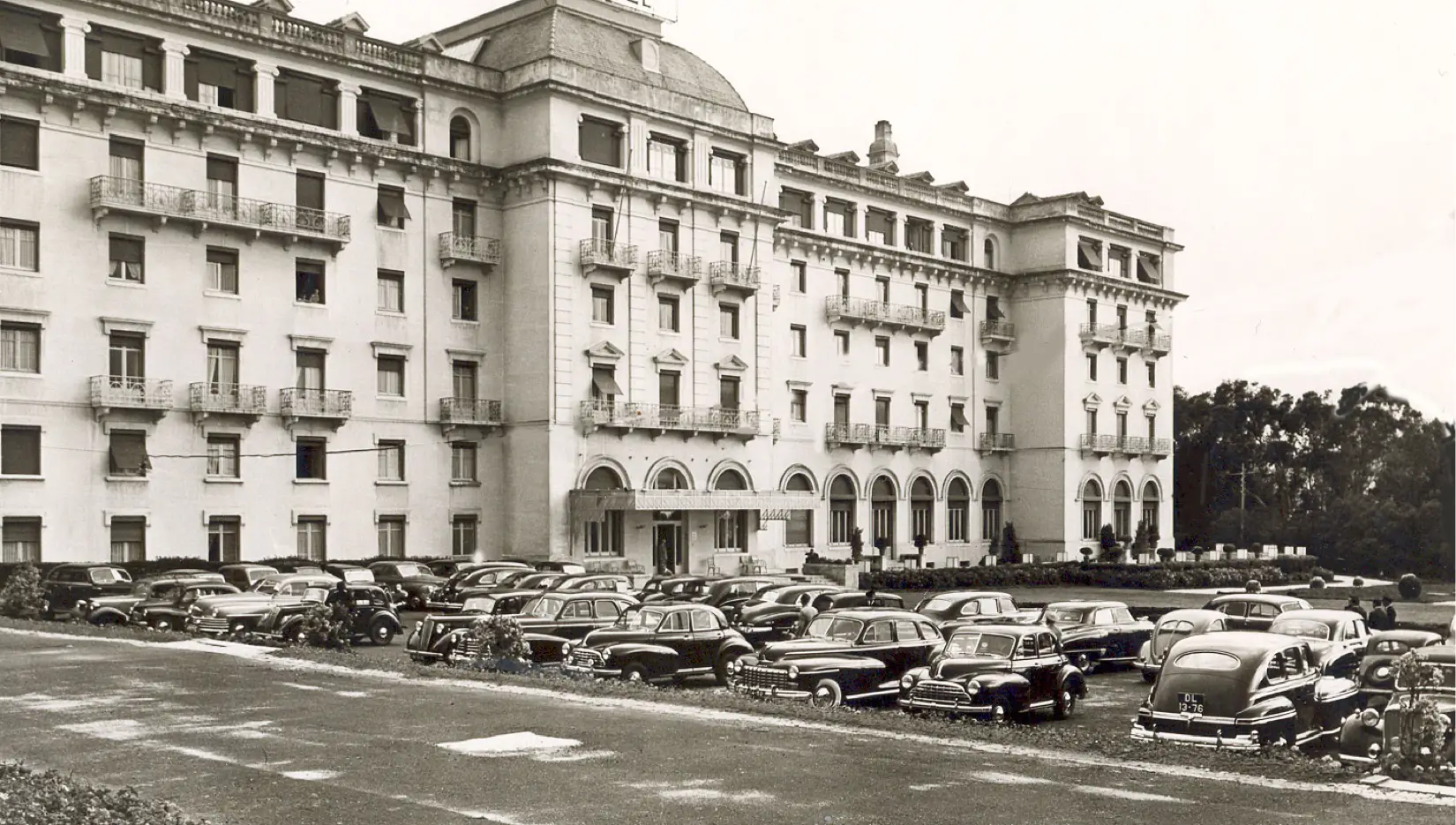
The Hotel Palácio do Estoril, Golf & Wellness has been a destination where glamour and intrigue have intertwined so naturally that its story reads like a product of pure fiction. When its founder, Fausto Figueiredo, first envisioned transforming the surrounding seaside village of Estoril into a world‑class resort community, few could have imagined the magnitude of his success. He specifically pressed forward with his ambitious plan during the 1920s, helping to secure a railway line that connected Estoril to the broader European network—a project that introduced a steady flow of excited visitors to the area. To give his majestic oasis an attraction worthy of their patronage, Figueiredo commissioned French architect Henri Martinet to design a grand hotel that would blend sophistication with the serenity of the Atlantic coastline nearby. The result was the “Hotel Palácio do Estoril,” which opened its doors to fanfare in 1930. Almost immediately, the edifice’s gleaming white façade and manicured gardens evoked a sense of magnificence and exclusivity. Martinet’s expertly crafted neoclassical aesthetics set the tone for an establishment that knew exactly what it wanted to be: timeless.
From its earliest days, the hotel cultivated an atmosphere of effortless prestige. Guests of significant social standing wandered through the building frequently, making it a bustling cultural hub despite its tranquil setting. However, it was the onset of World War II that would irrevocably alter the hotel’s legacy. Because Portugal had maintained official neutrality throughout the conflict, Estoril emerged as a haven for exiled aristocracy seeking refuge from the turmoil transpiring across the continent. Many chose the Hotel Palácio do Estoril as their temporary residence, turning its drawing rooms into the quiet enclaves of Europe’s displaced courts. But the seclusive nature of the building also invited episodes of espionage. The hotel was a crossroads for intelligence operatives from both the Allied and Axis sides, its bar at an unassuming stage for coded conversations and secret exchanges. Among the most famous of its wartime guests was celebrated author Ian Fleming, then a British naval intelligence officer. In fact, Fleming stayed on-site while consulting with Serbian double-agent Duško Popov, whose persona is widely believed to have inspired the legendary literary character—and eventual movie icon—James Bond.
Hotel Palácio do Estoril’s reputation for elegance continued well after the war ended, too, reinforced by a steady procession of politicians, intellectuals, and entertainers who contributed to its growing legend in some way. For instance, the hotel served as the filming location for On Her Majesty’s Secret Service (the sixth James Bond movie), released in 1969. Scenes shot by the pool, in the lobby, and on upper‑floor balconies went on to momentously immortalize the hotel’s stately beauty on the silver screen. Furthermore, cast members such as George Lazenby and Diana Rigg lived inside several of its suites amid the film’s production run the year prior! Now known as the “Hotel Palácio do Estoril, Golf & Wellness,” today, contemporary guests can still feel this incredible mystique whenever exploring its sweeping staircases and distinctive décor. In the end, the tale of the Hotel Palácio do Estoril, Golf & Wellness is one of elegance in motion, of a single hotel that has mirrored Europe’s shifting landscape while maintaining its own grandeur. Whether visited for leisure or creative inspiration, this incredible historic hotel has since remained a place where history does not simply linger but continues to unfold.
Hotel Timeline
The Location
Hotel Palácio do Estoril, Golf & Wellness is just a short drive away from Lisbon, Portugal’s ancient capital city. While Lisbon is among the most historic metropolises in Europe, its origins are a bit of a mystery. Historical evidence is scant regarding its founding, although recent archeological findings suggest the region was inhabited as far back as the Iron Age. Additional excavations in the heart of Lisbon have uncovered more artifacts that indicate a Phoenician presence dating back to the 12th century B.C. Those objects have enabled scholars to determine that Lisbon formed as a Phoenician trading post that existed under the name “Olisipo.” Even though no record specifically cites the reasoning behind the title, some think that it was an homage to the legendary Greek hero Odysseus. Historians further believe that the village gradually grew into a massive city called “Felicitas Julia” following the Roman conquest of the Iberian Peninsula. The community served as the main bastion of power for the Roman Empire in the area, who developed imposing fortifications along the local waterway, the Tagus River. Those battlements specifically safeguarded the deep-water port at the river’s mouth, which had begun to flourish under Roman rule. But when the Roman Empire collapsed during the 5th century, A.D., the settlement passed through various hands before finally getting captured by the Visigoths. They lost control of the city to the Moors several centuries later. The Moors reinforced the city’s defenses, transforming the locale into an imposing bastion against European knights who wished to take it back. Their work reinforcing Lisbon was masterful, as the fortifications were able to blunt numerous attacks for decades.
In 1147, the Moorish defenses were put to the ultimate test when the Portuguese king Afonso I attempted to seize the city amid the Second Crusade (and the greater Portuguese Reconquista). At the head of a massive army, Afonso I managed to wrestle control away from the Moors following a dramatic four-month-long siege. Now known as “Lisbon,” the city quickly emerged as an important commercial center in the nascent Kingdom of Portugal. Despite its rising economic status, the Portuguese Royal Family held its official court several hundred miles away in Coimbra. But King Afonso III decided to move the royal residence to Lisbon in the mid-13th century, making it the capital for the entire kingdom. Lisbon thrived due to its newfound political significance, with successive generations of Portuguese monarchs investing heavily into its continued development. Some of the most notable projects involved King Dinis I’s creation of the Studium Generale and the massive renovations that King Fernando I did to the ancient Castelo de São Jorge. The greatest work to transpire occurred during the reign of King Manuel I, who oversaw the widespread urbanization of Lisbon. Among the best structures that he commissioned at the time included the Torre de Belém (Belém Tower) and the Paço da Ribeira (Ribeira Palace). Manuel had obtained much of the wealth to finance the construction via the great riches that had begun to flow into Lisbon’s harbor from Portugal’s newly created distant colonies. The amount of trade conducted became so great that Lisbon eventually established itself as one of Europe’s greatest cities by the end of the 16th century.
This renaissance came to an unfortunate end when a massive earthquake caused catastrophic damage throughout the city in 1755. Undeterred, the residents banded together to rebuild most of Lisbon in a matter of years. Spearheading the revitalization efforts was Sebastião José de Carvalho, Portugal’s prime minister. He worked closely with a team of architects to redesign much of Lisbon’s historic districts, creating many new buildings in a simple, yet gorgeous style of Baroque architecture that became known as “Pombalino.” (The moniker was an homage to Carvalho, whose royal title was the Marques de Pombal.) Lisbon resumed its place as a prominent European community for many years, even as war, political instability, and economic depression periodically impacted Portugal in the 19th and 20th centuries. In fact, the city only continued to grow, as epitomized by the creation of a magnificent new thoroughfare that bisected the heart of Lisbon called the “Avenida de Liberdade.” (The boulevard specifically debuted at the height of Europe’s Belle Epoque period in the 1890s.) Following the country’s integration into the European Union at the start of the 21st century, Lisbon has solidified its standing as an elite, internationally renowned metropolis. Its rich character has inspired thousands of contemporary travelers to visit every year, placing it on par with other popular destinations throughout the Mediterranean Basin like Venice and Rome. Indeed, Lisbon’s many fascinating historic sites, including the Torre de Belém, the Paço da Ribeira, and the Castelo de São Jorge, have been essential toward maintaining this incredible international interest. Most of those historic sites have also contributed to the creation of Lisbon’s spectacular UNESOC World Heritage Site, which encompasses large tracts of its downtown core.
The Architecture
Although Hotel Palácio do Estoril, Golf & Wellness displays a wealth of unique architectural styles, the use of Classical Revival motifs is among the most prevalent. Also known as “Neoclassical,” Classic Revival architecture itself is among the most common architectural forms seen throughout the world today. This wonderful architectural style first became popular in Paris, specifically among French architectural students that studied in Rome in the late 18th century. Upon their return, the architects began emulating aspects of earlier Baroque design aesthetics into their designs, before finally settling on Greco-Roman examples. Over time, the embrace of Greco-Roman architectural themes spread across the world, reaching destinations like Germany, Spain, Great Britain, and even Norway. As with the equally popular Revivalist styles of the same period, Classical Revival architects found an audience for its more formal nature. It specifically relied on stylistic design elements that incorporated such structural components, like the symmetrical placement of doors and windows, as well as a front porch crowned with a classical pediment.
Architects would install a rounded front portico that possessed a balustraded flat roof. Pilasters and other sculptured ornamentations proliferated throughout the façade of the building, as well. The most striking features of buildings designed with Classical Revival-style architecture were massive columns that displayed some combination of Corinthian, Doric, or Ionic capitals. With its Greco-Roman temple-like form, Classical Revival-style architecture was considered most appropriate for municipal buildings like courthouses, libraries, and schools. But the form found its way into more commercial uses over time, such as banks, department stores, and of course, hotels. Yet, the form found its way into more commercial uses over time, such as banks, department stores, and of course, hotels. Examples of the form can be found throughout many major cities, including London, Paris, and New York City.
However, Hotel Palácio do Estoril, Golf & Wellness also displays a wonderful array of Art Deco aesthetics. Art Deco architecture itself is among the most famous architectural styles in the world. The form originally emerged from a desire among architects to break from the past architectural precedents that had dominated. Instead, professionals within the field aspired to forge their own design principles. More importantly, they hoped that their ideas would better reflect the technological advances of the modern age. As such, historians today often consider Art Deco to be a part of the much wider proliferation of cultural “Modernism” that first appeared at the dawn of the 20th century. Art Deco as a style first became popular in 1922, when Finnish architect Eliel Saarinen submitted the first blueprints to feature the form for contest to develop the headquarters of the Chicago Tribune.
While his concepts did not win over the judges, they were widely publicized, nonetheless. Architects in both North America and Europe soon raced to copy his format in their own unique ways, giving birth to modern Art Deco architecture. The international embrace of Art Deco had risen so quickly that it was the central theme of the renowned Exposition des Art Decoratifs in Paris a few years later. Architects the world over fell in love with Art Deco’s sleek, linear appearance as defined by its series of sharp setbacks. They also adored its geometric decorations that featured motifs like chevrons and zigzags. But despite the deep admiration people felt toward Art Deco, interest in the style gradually dissipated throughout the mid-20th century. Many examples of Art Deco architecture survive today though, with some of the best located in such places as New York City, London, and Paris.
Famous Historic Guests
- George Lazenby, model and actor best remembered for playing James Bond in the film, On Her Majesty’s Secret Service.
- Diana Rigg, actress known for her roles in The Avengers (1965 – 1968), Rebecca, and On Her Majesty’s Secret Service.
- Orson Welles, film director known for such movies as Citizen Kane, Touch of Evil, and The Magnificent Ambersons.
- Rock Hudson, actor known for his roles in movies like Magnificent Obsession, All That Heavan Allows, and Giant.
- Gina Lollobrigida, model and actress known for her roles in films like Beat the Devil, Never So Few, and Trapeze.
- Pedro Almodóvar, director known for filming movies like All About My Mother, Talk to Her, and Women on the Verge of a Nervous Breakdown.
- Amália Rodrigues, singer best remembered for her rendition of “Rainha do Fado.”
- Charles Trenet, singer best remembered for songs like “Le Fou Chantant” and “La Mer.”
- Diana Ross, lead singer of The Supremes known for songs like “Ain’t No Mountain High Enough” and “I’m Coming Out.”
- Joan Baez, musician and activist known for songs like “Diamond & Rust,” “Farewell, Angelina,” and “Forever Young.”
- Ian Fleming, author best remembered for penning the renowned James Bond book series.
- Graham Greene, author known for publications like The Power and the Glory and The Quiet American.
- Antoine de Saint‑Exupéry, aviator and author best remembered for writing the novella, The Little Prince.
- Paul Reynaud, Prime Minister of France (1940).
- Tony Blair, Prime Minister of the United Kingdom (1997 – 2007).
- Princess Grace Kelly of Monaco, film actress known for starring in Mogambo, and wife of Prince Rainier III.
- Prince Rainer III of Monaco (1949 – 2005).
- Nobuhito, Prince Takamatsu of Japan .
- Victoria Eugenie of Battenberg, Queen consort of Spain (1906 – 1931).
- King Caroll II of Romania (1930 – 1940).
- King Edward VIII of the United Kingdom (1936; abdicated and became Duke of Windsor).
Film, TV and Media Connections
- On Her Majesty’s Secret Service (1969) .