
Golf
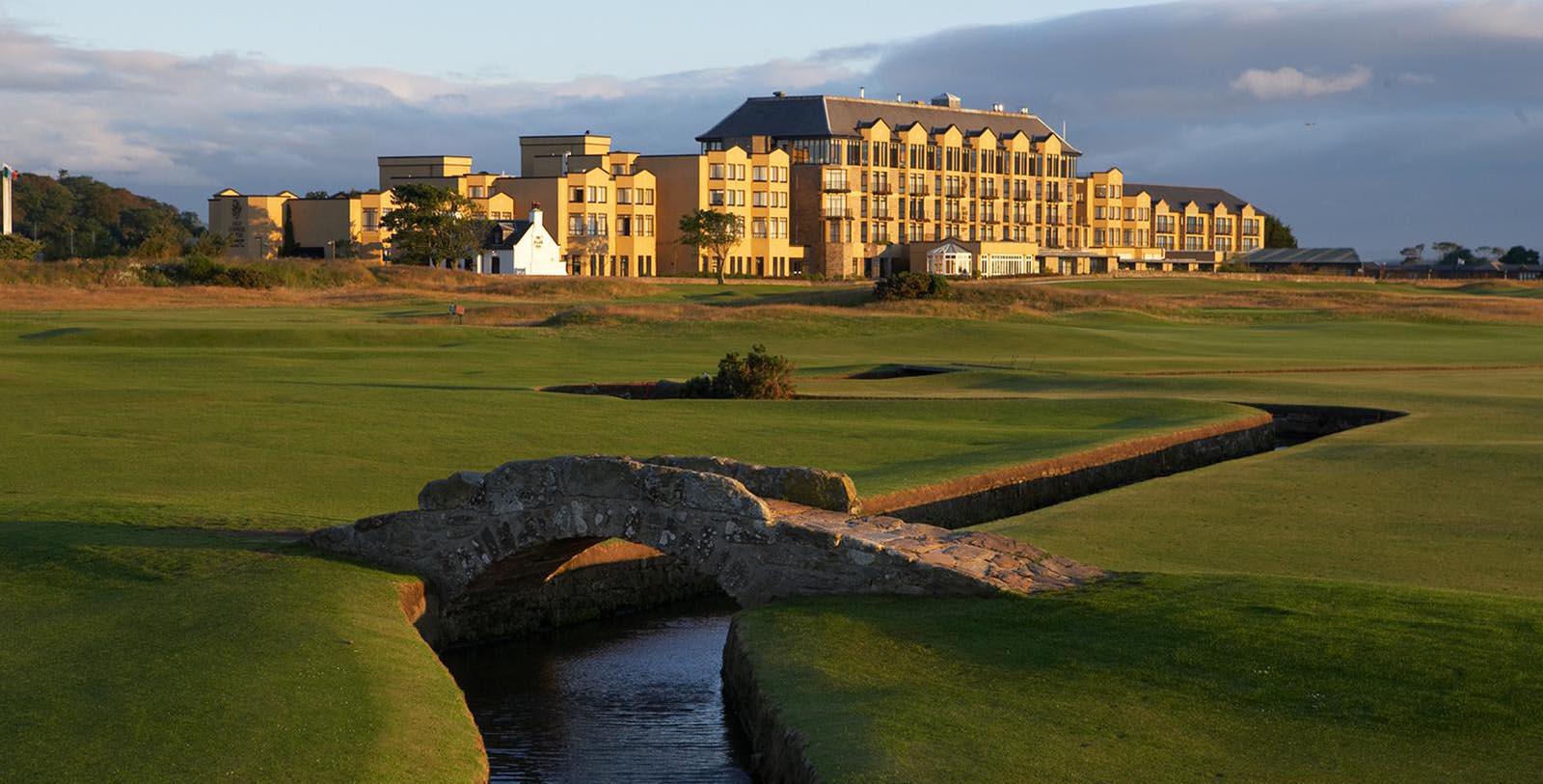
Discover the St Andrews Links next door, regarded by many as the "Home of Golf."
Old Course Hotel, overlooks the 17th hole of one of Scotland’s most celebrated golf courses—the St Andrews Links. Known throughout the world as the “Home of Golf,” the area has entertained golfers from across Scotland since at least the 15th century. The links rose from rather humble origins, though, as it originally started as a single, rustic course that cut through the rugged terrain surrounding St Andrews. Over time, this simple track was referred to as the “Old Course” by the hundreds of golfers who had traveled to the region. But the Old Course was exclusively meant for Scottish noblemen at the time. Golf was quickly becoming a national pastime among the country’s ruling elite, often subverting interests with most traditional athletic activities. The sport’s popularity had become so great that King James II of Scotland eventually banned it in 1457 for fear that it was becoming a major social distraction. King James even believed that golf ran the risk of preventing his aristocrats from refining their martial skills. The restrictions remained in place for generations until his grandson—King James IV—became an avid golfer himself.
The Old Course was finally made public when Archbishop John Hamilton granted all of the townspeople of St. Andrews the right to play on the links in the 16th century. This eventually enabled a body of nearly two dozen noblemen, professors, and landowners to create the “Society of St. Andrews Golfers” in 1754. United by their shared passion for the game, the group co-owned the Old Course with the local town council for the next four decades. By this point, the Old Course had grown to consist of 22 holes divided evenly between its front and back halves. Interestingly, golfers had to play toward the same hole regardless of which side they had originally started, save for the 11th and 22nd holes. To make the flow of play on the Old Course more fluid, the members of the Society of St. Andrews Golfers merged the eight holes on both ends of the course into four, much larger fairways. The number of holes per round thus dropped down to 18, setting a standard layout that nearly every other course modeled throughout Scotland.
But there was a time when the fate of the Old Course was far from certain. In 1797, the St. Andrews Town Council went bankrupt and sold its rights to the Old Course to a group of local merchants. Those merchants, in turn, decided to use their access to the land to raise a series of rabbit farms. The members of the Society of St. Andrews Golfers—who still controlled half of the ownership rights to the course—fervently denounced the notion. What followed next was a prolonged period of legal—and even physical—battles between the businessmen and the golfers. After 20 years of pitched fighting, the Society of St. Andrews Golfers emerged victorious when one of its members, James Cheape, bought out the merchants completely. Golf quickly returned in force to the Old Course upon Cheape’s acquisition of the links. It soon resumed its status as Scotland’s most preeminent golfing destination by the middle of the 19th century. The Old Course had quickly become overcrowded, as such, which led the Society of St. Andrews Golfers to consider ways to modify it. To solve the problem, the Old Course’s greenkeeper, the legendary Old Tom Morris, decided to cut two holes on each green with white flags for the outward holes and red flags for the inward holes. This was the origin of the famous double greens that still exist today.
The influence of the Old Course continued to grow within the sport as ever-increasing numbers of golfers descended upon the links at the height of the Victorian Era. And as its significance expanded, so too did that of its august governing body. Reorganized as “The Royal and Ancient Golf Club in 1834,” it was quickly becoming the most astute authority on golf in not just Scotland, but the world as a whole. Soon enough, The Royal and Ancient Golf Club was asked to help host the Open Championship for in 1873. Since then, the Old Course has hosted some 28 other Open Championships—more than any other location. (The Open Championship is also known today as the “British Open.”) Some of the world’s most legendary golfers subsequently played on the course since then, including Jack Nicklaus, Arnold Palmer, Gary Player, Bobby Jones, Ben Hogan, Sam Snead, and Tiger Woods. The Old Course itself was joined by nearly a dozen other tracks, too, such as the Jubilee Course, the Eden Course, and the New Course. Together, they form the St. Andrews Links, which British Parliament created through the First Links Act of 1894. Few places today can rival the rich history of the prestigious Old Course and its surrounding environs.
Golf Timeline
The Location
The Town of St Andrews dates back to at least the mid-8th century when the Pictish King Óengus I dedicated a new church in the area to Andrew the Apostle. Also known as “St. Andrew,” some his bones were supposedly transported to the area by Greek monk. As such, King Óengus I commissioned the construction of an imposing monastery that would adequately protect the remains. Soon enough, the church became a popular pilgrimage site for the religious in medieval Scotland. A small, yet vibrant, community emerged around the building, which serviced the throngs of pilgrims who descended upon the locale every year. At first, this rustic little village was known by the names of “Mucross” and “Kilrymont” before becoming permanently referred to as “St Andrews.” The Catholic Church also established its primary headquarters in the town at the height of the Middle Ages, making St Andrews the ecclesiastical capital for the Vatican in Scotland. Given the town’s newfound place within the Catholic faith, church officials began constructing a magnificent cathedral at the beginning of the 1100s. Work on the spectacular structure lasted for some two centuries, concluding with its consecration in 1318. Christened as St Andrews Cathedral, it quickly became the grandest church of its kind throughout the land. The building displayed an interesting assortment of Gothic and Norman-style architecture, reflecting the unique time period during which it was constructed. By the end of the 15th century, St Andrews’ Cathedral had become its own archbishopric due to the great religious influence it had come to wield.
The town itself had grown considerably since the dedication of St Andrews Cathedral. Upon the invitation of Bishop Robert, a small community of Augustinian monks had formed in St Andrews around the mid-12th century. They were then joined by two more religious orders: the Dominicans and the Franciscans. Construction also started on the imposing St Andrews Castle, which functioned as the home of the local bishop. Given the constant warfare between Scotland and England at the time, the church deemed that a heavily fortified bastion was necessary for the diocese’s survival. Much of the town’s secular expansion in that regard had transpired under the watch of King Malcom IV, who had decreed it a royal burgh in 1160. Many additional institutions appeared in St Andrews as a result, the most notable of which being schools. As such, St Andrews developed a scholastic reputation that was on par with its religious one. St. Salvador’s College and St Andrews University were among the first to open in St Andrews. Amazingly, one of those universities—St. Mary’s College—is still in operation today. St Andrews, thus, became one of the largest settlements in medieval Scotland by the dawn of the 13th century. It was soon known as a thriving medieval market town, defined by its prosperous fishing industries and annual fairs.
St Andrews acted as the epicenter for some of the most significant developments of the Scottish Reformation. Catholics and Protestants quarreled for control over the are throughout the 16th century, with St Andrews Castle being the ultimate prize. Several martyrs were made of religious figures on both sides as the town exchanged hands numerous times. St Andrews suffered greatly from the conflict. Nowhere was this more evident than St Andrews Cathedral, which had been reduced to ruins. St Andrews religious prominence had come to an unfortunate end. Sliding into a period of serious decline in the 18th century, it took the leadership of Hugh Lyon Playfair to revitalize the community. Playfair managed to restore St Andrews’ status as a center for learning, while also making it into a prominent holiday destination. Golf had thoroughly ingrained into the cultural identity of the town, as well, starting with the debut of The Royal and Ancient Golf Club in 1754. The club governed four historic courses, with the Old Course being its most famous. Over time, St Andrews earned international repute for the tranquility of its fairways. The golf courses began hosting the Open Championship in the late 18th century, which grew into an international professional tournament known as the “British Open.” Today, the Open Championship is the world’s most historic competition and is one of the four main international tournaments played every year.
The Architect
Old Tom Morris: While many noteworthy golf course architects have worked at St Andrews Links throughout its extensive history, none of been more influential than “Old” Tom Morris. Known today as the “Grandfather of Golf,” Morris’ impact on the sport cannot be understated. Morris was born in St Andrews to a family of weavers at the beginning of the 19th century. Educated at Madras College downtown, he seemed destined to follow his in family’s footsteps for a life of making textile goods. But upon graduating in 1837, Morris quickly found work as an apprentice under professional golfer Allan Robinson. Morris had long been fascinated with golf, having picked it up a year earlier as a young boy. Hailed as Scotland’s greatest golfer at the time, the chance to study underneath Robertson seemed too good to pass up. Since Robertson also operated the St Andrews Links, too, Morris had ample opportunity to practice what he learned. Morris subsequently worked together with Robertson for more than a dozen years, until Robertson fired him over a dispute regarding the preferences over golf balls. A significant portion of Robertson’s own work involved operating a shop that sold featherie balls, which he manufactured himself. Meanwhile, Morris had developed an affinity for the newer guttie ball. Feeling betrayed, Robertson demanded that Morris stop using the alternative balls or risk losing his job. Morris did not relent, however, and Robertson fired him unceremoniously in 1851.
Thankfully, Tom Morris quickly found work at Prestwick Golf Club, whose members commissioned him to serve as its resident professional. They gave Morris free reign to supervise its golfing operations, ranging from the manufacture of its own equipment to offering instructional lessons. He was also left in charge of both designing and maintaining the club’s course layout, which he adopted with particular zeal. He invented most of today’s modern groundskeeping techniques while at Prestwick, including the idea of “top-dressing” greens with sand to better cultivate the turf. (Other concepts he introduced were managing the course hazards and instituting yardage markers.) But in 1859, his former colleague Allan Robertson died. With the mantle of Scotland’s best golfer vacant, Morris became one of many to compete for the title. In fact, Morris helped James Fairlie—one of Prestwick’s more active members—to arrange a tournament to settle the issue. In 1860, Morris entered the first ever British Open, becoming one of its co-founders. While Morris finished second that year, he would later win the championship four times over the next seven years. His triumphs at the British Open—along with his stewardship of Prestwick Golf Club—succeeded in establishing Morris as Scotland’s preeminent professional golfer by the end of the decade.
Amid his ascent in the world of golf, Morris managed to get his previous job back as the greenskeeper for St Andrews Links. Upon his return in 1865, he proceeded to use the landscaping practices that he had developed at Prestwick all over the Old Course. But Morris also implemented new changes, too, such as widening its fairways and establishing separate teeing areas for each hole. Morris created two new courses on the Old Course as well, which still exist as the 1st and 18th holes. As word spread of Morris’ work, many other golf clubs throughout Scotland requested his services. As such, Morris eventually created 75 other golf courses across Scotland, with some of the best being Muirfield, Royal Dornoch, and the Askernish Golf Club. Nevertheless, his greatest love remained his work in St Andrews—a post he kept for the rest of his life. Indeed, Morris continued to serve the courses diligently, even going as far as to create two new ones—the New Course and the Jubilee Course—during the 1890s. Morris continued to play golf professionally, too, competing in every single British Open until 1895. His presence in the golfing world was so great that tributes poured into Scotland following his death in 1908. Immortalized in the World Golf Hall of Fame, Morris’ shadow over the St Andrews Links—and the sport of golf itself—still looms larger than ever.
Famous Historic Tournaments
The Open Championship: Otherwise known as the “British Open,” the Open Championship is one of the world’s four major golf competitions alongside the Masters Tournament, the U.S. Open, and the PGA Championship. The very first Open Championship was specifically played at Prestwick Golf Club in 1860. Willie Park, Sr. won the inaugural tournament, which consisted of a small group numbering no more than eight players. With just 12 holes, the course itself was also far less intricate than those that define the current iteration of the tournament. Park received a silver-bucked leather belt referred to as the “Challenge Belt,” that he would keep until the start of the next Open Championship. This prize was later joined by a monetary prize of six pounds, while those who came in second, third, and fourth shared a pot of 10 pounds. Shortly thereafter, amateurs got the chance to participate in the competition, which enhanced its appeal significantly. At this time, Tom Morris, Jr., the son of legendary golfer Old Tom Morris, started his reign as the undisputed champion of the competition. Celebrated as “Young Tom Morris,” he went on to win three consecutive titles from 1868 to 1870. As such, Morris was allowed to keep the Challenge Belt permanently. In its place, the governing body of the Open Championship created the Champion Trophy, which is known today as the “Claret Jug.”
Following a one-year hiatus, the Open Championship resumed its normal schedule in 1872. By this point, the tournament was no longer exclusively hosted by the Pestwick Golf Club. The organization had reached an agreement with the Honourable Company of Edinburgh Golfers and The Royal and Ancient Golf Club to rotate the duties of accommodating the competition annually. As such, the Open Championship arrived for the first time at the Old Course a year later. Consisting of two rounds of 18-hole golf, the tournament was attended by 27 players. A native of St. Andrews, Tom Kidd, won the contest in a fierce competition with Jamie Anderson. Their match was so close that their game was decided by just a single stroke. The Open Championship returned to the Old Course every four years right up until 1910. The tournament was also nearly dominated by professional golfers during this time, with barely half a dozen amateurs walking away with the Claret Jug. Perhaps the greatest amateur golfer to win the Open Championship in its early days was the American Bobby Jones, who won the entire competition twice during the 1920s. His second victory even transpired at the Old Course in 1927, where he defended his title from established professionals like Aubrey Boomer and Fred Robson. Jones would go on to win all the major tournaments that year in what would be remembered as his “Grand Slam.”
By the middle of the century, the ever-growing interest in golf had made the Open Championship one of the most significant cultural events in the West. Its prestige was augmented by a number of memorable competitions among some of the game’s greatest players. The Open Championship saw its Claret Jug go to many legendary competitors at the time, such as England’s Sir Henry Cotton, South Africa’s Bobby Locke, and Australia’s Peter W. Thomson. Yet, the period was defined by the unrivaled success of the United States, as American golfers won the trophy 12 different times in 14 years. Some of the country’s most celebrated professionals came in first, including Arnold Palmer, Tony Lema, and Tom Watson. In fact, Watson himself won the tournament five different times in the late 1970s and early 1980s. The legendary Jack Nicklaus also finished first at the Open Championship on three separate occasions, as well, with two of his victories happening at the Old Course. Eventually, American dominance gave way to toward the end of the century, with just one winning the Claret Jet within the span of a decade. Instead, the likes of Spain’s Seve Ballesteros, Australia’s Greg Norman, and England’s Nick Faldo basked in the spotlight.
Even though the PGA Tour primarily catered to professional golfers from North America, the Open Championship became a part of its annual rotation as the “British Open” in 1995. American golfer John Daily defeated Costantino Rocca that year at the Old Course, which began another period of American ascendency at the Open Championship. The Claret Jug went to numerous golfers from the United States ten different times, including three-time champion Tiger Woods. More recent years has seen a diverse group of professionals win the Open Championship, such as the likes of Louis Oosthuizen, Phil Mickelson, Rory McIlroy, Henrik Stenson, and Jordan Spieth. Today, the Old Course is one of nine courses that currently host the Open Championship, although it had hosted the most by far. Since its creation more than a century ago, the Old Course has held the tournament a total of 29 times! The Open Championship continues to be one of the most iconic events in modern golf and has a special place in the hearts of both professional and amateur golfers alike.
Famous Historic Golfers
- Jack Nicklaus, winner of 18 major golf championships—the most of any professional golfer.
- Arnold Palmer, winner of seven major golf championships that include the PGA Championship and the Masters Tournament.
- Gary Player, winner of nine major golf championships that include all four of the major tournaments.
- Sam Snead, winner of seven major golf championships that include the PGA of America and Senior PGA Tour
- Ben Hogan, winner of nine major golf championships that include his famous “Triple Crown” season.
- Bobby Jones, winner of 13 major golf championships who is regarded as one of the most influential figures in the sport.
- Tom Watson, winner of eight major golf championships who was the fierce rival of Jack Nicklaus.
- Thomas Mitchell Morris, legendary golfer from St. Andrews otherwise known as “Old Tom Morris.”
- Thomas Morris Jr., considered one of the pioneers of professional golf and otherwise known as “Young Tom Morris.”
- Harry Vardon, six-time winner of the Open Championship (the most) and member of the Great Triumvirate.
- J.H. Taylor, five-time winner of the Open Championship and member of the Great Triumvirate.
- James Braid, five-time winner of the Open Championship and member of the Great Triumvirate.
- Seve Ballesteros, winner of five major golf championships who is regarded as one of the most influential golfers of his generation.
- Greg Norman, winner of two major golf championships who spent 331 consecutive weeks as the best ranked golfer in the world.
- Nick Faldo, winner of six major golf championships that include the Masters Tournament and the Open Championship.
- Phil Mickelson, winner of five major golf championships, including the Masters Tournament and the PGA Championship.
- Tiger Woods, winner of 15 major golf championships and winner of the PGA Player of the Year a record 11 times.
- Vijay Singh, winner of three major golf championships that include the Masters Tournament and the PGA Championship.
Film, TV and Media Connections
- Bobby Jones: Stroke of Genius (2004)
- Tommy’s Honour (2017)