
History
Discover the Omni King Edward, which was designed by architects Henry Ives Cobb and E.J. Lennox.
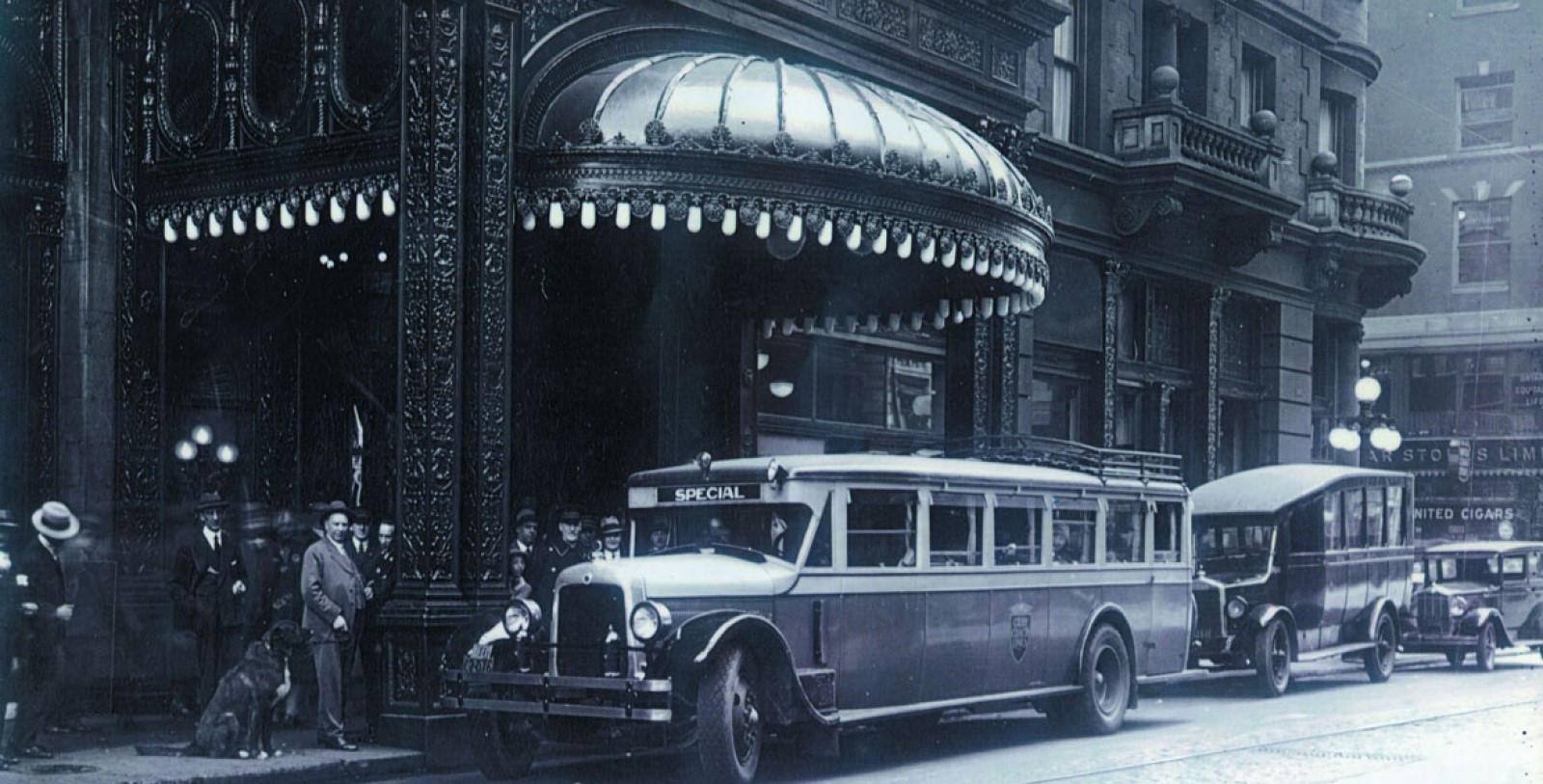
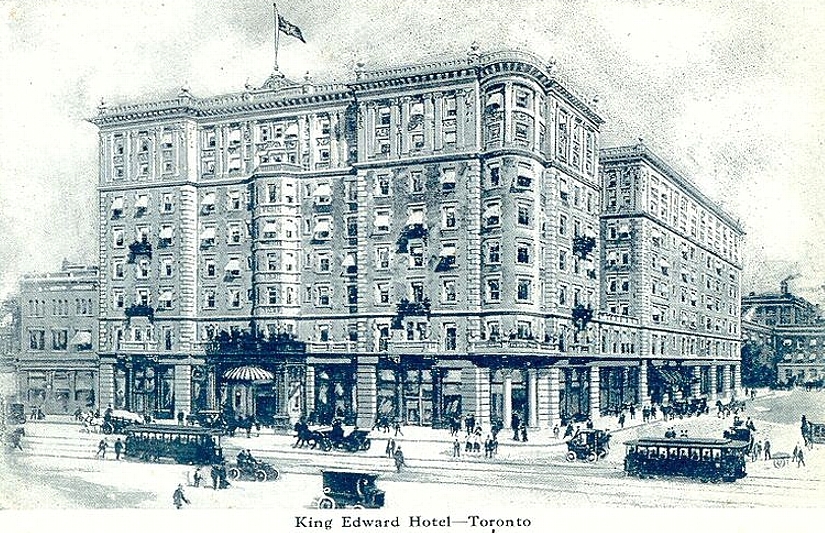
A member of Historic Hotels Worldwide since 2013, the Omni King Edward has been a renowned local landmark in downtown Toronto for more than a century. Local entrepreneur George Gooderham funded its construction at the turn of the 20th century, desiring a way to profit from the growing number of people who had begun to travel to The Queen City on a regular basis. To that end, Gooderham financed the construction of a gorgeous eight-story hotel with the help of his fellow colleagues at the Gooderham and Worts distilling company. For the project, the group selected the site of the former Golden Lion Clothing Store in St. Lawrence, which had gone bankrupt in 1899. The men initially held a contest to see who would win the rights to design the new building. While American architect Henry Ives Cobb initially won the competition, Gooderham and his cohorts would eventually employ local designer E.J. Lennox. Nevertheless, their unique architectural aesthetics introduced in both plans were melded together to form one homogeneous design. What Lennox—and by extension Cobb—had managed to achieve was nothing short of spectacular. When the building finally debuted in 1903, it stood as one of the finest examples of Edwardian-era architecture in all of Toronto.
Gooderham and his associates had originally intended to name the business after Queen Victoria of the United Kingdom. Yet, when the monarch unexpectedly died in 1901, they decided to commemorate the hotel after her heir, King Edward VII. The opening ceremony for the new “King Edward Hotel” was an absolute extravaganza. Hundreds of people attended a magnificent ball that lasted throughout the night. Among the distinguished guests to arrive at the hotel that day was the Governor-General of Canada, Lord Gilbert John Elliot-Murray-Kynynmound, and his wife. In essence, the couple represented the will of the British Crown in Canada. As the hotel’s patrons entered the building for the first time that evening, they were completely awestruck by what they saw. Priceless antique furniture filled each space, while some C$75 million dollars of beautiful artwork lined its walls. The most cutting-edge amenities were featured inside every one of the hotel’s original 400 guestrooms, including indoor plumbing and private bathrooms. The King Edward Hotel was also entirely fireproof—a rare achievement for buildings of the age.
The King Edward Hotel became a sensation seemingly overnight. Luminaries from around the world flocked to the hotel, which made the building one of the most celebrated holiday destinations in all of Canada. Among the most prestigious guests to visit the hotel within this period of time were two future British monarchs—Edward, Prince of Wales, and his brother, Prince George. To meet such demand, Gooderham had to construct a massive, 18-story wing onto the building in 1921. The construction nearly doubled the number of available guestrooms, while also installing several new outstanding facilities. Perhaps the greatest of those spaces was the brilliant Crystal Ballroom. Named after the beautiful chandeliers that hung from its ceiling, the Crystal Ballroom would go on to become the most iconic space within the entire hotel. This amazing space entertained countless galas and soirees over the next several decades, as the hotel’s celebrated band—Luigi Romanelli and the Radio Syncopators—played before packed crowds night after night.
The King Edward Hotel continued to host all sorts of prominent intellectuals, Hollywood celebrities, and international dignitaries. Some of the world’s most prestigious entertainers graced the halls of the King Edward Hotel, such as Paul Newman, Louis Armstrong, Elvis Presley, Shirley Temple, and Mickey Rooney. Celebrity power couple Elizabeth Taylor and Richard Burton often frequented the hotel, too, in their attempts to hide from the prying eyes of the paparazzi. John Lennon and Yoko Ono even staged part of their famous “Bed-Ins for Peace” at the hotel in 1969. A few heads of state—such as French President Charles De Gaulle, British Prime Minister Margaret Thatcher, and U.S. President Theodore Roosevelt—have stayed at the hotel, as well. Dozens of European nobles have also followed in the footsteps of King Edward VIII and King George VI, too, as the hotel has hosted the likes of King Juan Carlos I of Spain, King Carl XVI Gustaf of Sweden, and Queen Elizabeth The Queen Mother. Now operated as the “Omni King Edward” by Omni Hotels and Resorts, this fantastic historic destination is still among the most wonderful places to vacation in all of Canada.
Hotel Timeline
The Location
The neighborhood of St. Lawrence is part of what Torontonians today call “Old Toronto.” As its name implies, Old Toronto is the most historic part of the city. It harkens back to 1793, when Colonel John Graves Simcoe, Lieutenant Governor for the Colony of Upper Canada, first began developing the site. Naming it the “Town of York,” Graves intended for his nascent community to serve as the capital for the entire colony. Over time, Old Toronto evolved from a frontier outpost to a bustling commercial community, as the Erie Canal and several important railroads linked the settlement with other important economic hubs in Québec and the northeastern United States. A boom in population ensued, leading to York’s formal incorporation as a city in 1834. As such, the settlements’ name changed from “York” to “Toronto.” Toronto’s growth continued unabated for some time. By the time of Canada’s federation in 1867, Old Toronto was the largest metropolitan center throughout the entire country. Today, this region of Toronto is protected, in part, by the Union Station Heritage Conservation District. Created by the Ontario Heritage Act in 2006, the district will protect many of the surviving historic buildings for future generations to appreciate.
St. Lawrence itself grew exponentially along with the rest of the historical nucleus of the city throughout the 19th century. Its growth was specifically centered around a local landmark called “Market Square.” The square’s name was derived from the quaint farmers’ markets that opened in the area at the beginning of the century. Over time, these small vendors gradually moved their respective businesses into two magnificent structure known as the “North Market” building and the “South Market” building. They were eventually joined by the city’s first town hall in 1834, although it later damaged along with the rest of the neighborhood during the Great Fire of Toronto of 1849. City officials then built St. Lawrence Hall upon the site of city hall, while also opening a new one a couple blocks away. Constructed in 1845, this new city hall would serve as the municipal center of government for the next 50 years. When the city government relocated its offices once more to the Old City Hall at the turn of the 20th century, the older structure was merged into the South Market building. As such, the two buildings debuted as a new entity known as “St. Lawrence Market South.” This fantastic destination is still in operation today as a public market building.
The neighborhood’s proximity to Toronto’s waterfront also rendered it an important hub for local commerce. By the middle of the 1800s, businesspeople from across the city had raised a number of wharves that serviced the ever-growing numbers of merchant vessels that traveled across Lake Ontario. This real estate boon was further driven by the arrival of the Esplanade—a 100-foot-wide road that allowed unprecedented amounts of carriages to transport goods to-and-from the harbor. Railroads eventually supplanted the use of carriages along the Esplanade, which was converted into a major railway in the 1860s. The commercial activity along the waterfront continued to flourish unabated well into the next century, serving as a vital economic engine for the city as it came of age. As such, dozens of skyscrapers soon dotted St. Lawrence’s skyline, seamlessly integrating it with that of downtown Toronto’s. Yet, this prosperity was not to last, as various transport companies directed their operations to other areas in the city in the mid-20th century. The next several decades saw the community’s revival, though, with the transformation of the neighborhood into a vibrant residential area defined by rowhouses and low-rise apartments. Today, St. Lawrence is one of Toronto’s most celebrated historic neighborhoods that is ripe for exploration.
The Architecture
Architects Henry Ives Cobb and E.J. Lennox originally designed the Omni King Edward with a beautiful blend of design aesthetics that were very popular during Canada’s Edwardian period. When King Edward VII assumed the throne upon the death of his mother, Queen Victoria, it marked the beginning of a momentous—albeit brief—period of dynamic cultural expression for English society. Historians today refer to his reign as the “Edwardian Era,” which lasted from 1901 right up to the outbreak of World War I. Among the advances in art that defined the age was the wholesale embrace of new architectural forms. Architects and engineers throughout the United Kingdom were eager to utilize different design philosophies of the artistic tastes that characterized the previous century. Looking back to the Enlightenment, those building professionals started borrowing the structural aesthetics of Neoclassicism and Georgian architecture once again, infusing it with their preexisting concepts of Victorian architecture. As such, most buildings constructed throughout the Edwardian Era featured recognizable structural elements like frames of half-timbered exteriors that were typically filled with some form of brick or plaster. Sometimes, architects would fill the frame with a mixture known as “pebbledash,” which consisted of lime, sand and stone. The layout of the wood was so pronounced in a few cases that it made the structures resemble something developed at the time of the Tudors. Paneled doors outfitted with ornate stained glass were also commonplace, as was the presence of painstakingly carved wooden porches. Popular in the 18th century, the multipaned sash window became widespread once more, which allowed natural light to flood a building’s many open spaces. Bay windows—another holdover from the Georgian Era—would have been used frequently, too.
Famous Historic Events
“Bed-Ins for Peace” (1969): While the hotel had hosted all sorts of international luminaries over the years, its most famous tenants were ex-Beatle John Lennon and his wife, Yoko Ono. The two stayed at the Omni King Edward on May 25, 1969, before traveling north to Montréal. The arrival in Canada marked the beginning of a major experimental protest that they called the “Bed-Ins for Peace.” Inspired by the sit-ins of the Civil Rights Movement, the “Bed-Ins for Peace” were an experimental form of non-violent protest that denounced the Vietnam War. They had already held a prior “bed-in” at the Hilton Amsterdam in March before coming over to North America. Upon being denied entry into the United States shortly thereafter, they redirected their travel plans to Toronto and then Montréal. When the couple arrived in the Québécoise city at the end of the month, they moved into The Queen Elizabeth (which is also another member of Historic Hotels Worldwide). It was inside Room 1742 at The Queen Elizabeth that John Lennon and Yoko Ono recorded their celebrated song “Give Peace a Chance.” Quickly becoming the anthem to the anti-Vietnam War movement, it peaked at #14 on the U.S. Billboard Hot 100 chart.
Famous Historic Guests
- Rudolph Valentino, actor known for such films like The Sheik, The Four Horsemen of the Apocalypse, and Blood and Sand.
- Mary Pickford, actress known for her role in the silent film Coquette.
- Douglas Fairbanks, actor known for his roles in The Thief of Baghdad, Robin Hood, and The Mark of Zorro.
- Shirley Temple, child actress known for her role in Bright Eyes and The Little Princess.
- Elizabeth Taylor, actress known for her roles in Cleopatra and The Taming of the Shrew.
- Richard Burton, famous actor known for his roles in Cleopatra and Where Eagles Dare.
- Paul Newman, actor known for his roles in such films like Cool Hand Luke, The Sting, and Butch Cassidy and the Sundance Kid.
- Mickey Rooney, actor known for his roles in such films like A Midsummer Night’s Dream, Boys Town, and Babes in Arms.
- Enrico Caruso, renowned Italian operatic tenor.
- Julie Andrews, actress known for her roles in movies like The Princess Diaries, Mary Poppins, and The Sound of Music.
- Louis Armstrong, Jazz musician regarded as one of the most influential figures in the genre.
- Elvis Presley, rock star celebrated as the “King of Rock and Roll.”
- Paul McCartney, lead vocalist and bassist for the legendary rock band, The Beatles.
- George Harrison, vocalist and lead guitarist for the legendary rock band, The Beatles.
- Ringo Starr, drummer for legendary rock band, The Beatles.
- John Lennon, lead vocalist and rhythm guitarist for the legendary rock band, The Beatles.
- Yoko Ono, famous musician and wife of John Lennon.
- Liberace, musician known for his extravagant performance in Las Vegas.
- Rudyard Kipling, author best remembered for The Jungle Book.
- Mark Twain, author known for writing The Adventures of Tom Sawyer and Adventures of Huckleberry Finn.
- Ernest Hemingway, author known for writing such books like A Farwell to Arms and The Old Man and the Sea.
- Anna Pavlova, Russian prima ballerina who performed in the Imperial Russian Ballet.
- J.P. Morgan, financier and founder of J.P. Morgan and Company.
- Charles De Gaulle, World War II freedom fighter and President of France (1959 – 1969)
- John Diefenbaker, Prime Minister of Canada (1957 – 1963)
- Brian Mulroney, Prime Minister of Canada (1984 – 1993)
- Margaret Thatcher, Prime Minister of Great Britain (1979 – 1990)
- King Juan Carlos I of Spain (1975 – 2014)
- King Carl XVI Gustaf of Sweden (1973 – present)
- King Edward VIII of the United Kingdom (1936; abdicated and became Duke of Windsor)
- King George VI of the United Kingdom (1936 – 1952)
- Queen Elizabeth II of the United Kingdom (1952 – 2022)
- Queen Elizabeth of the United Kingdom, The Queen Mother
- Prince Philip, Duke of Edinburgh and consort to Queen Elizabeth II of the United Kingdom
- Princess Margaret, Countess of Snowden
- Theodore Roosevelt, 26th President of the United States (1901 – 1909)
Film, TV and Media Connections
- I am a Hotel (1983)
- American Psycho (2000)
- Bait (2000)
- Nikita: Pilot Episode (2010)
- Orphan Black: Ipsa Scientia Potestas Est (2014)