History
Discover the Raffles Singapore, which has been among Southeast Asia’s most distinguished holiday destinations since the 1880s.
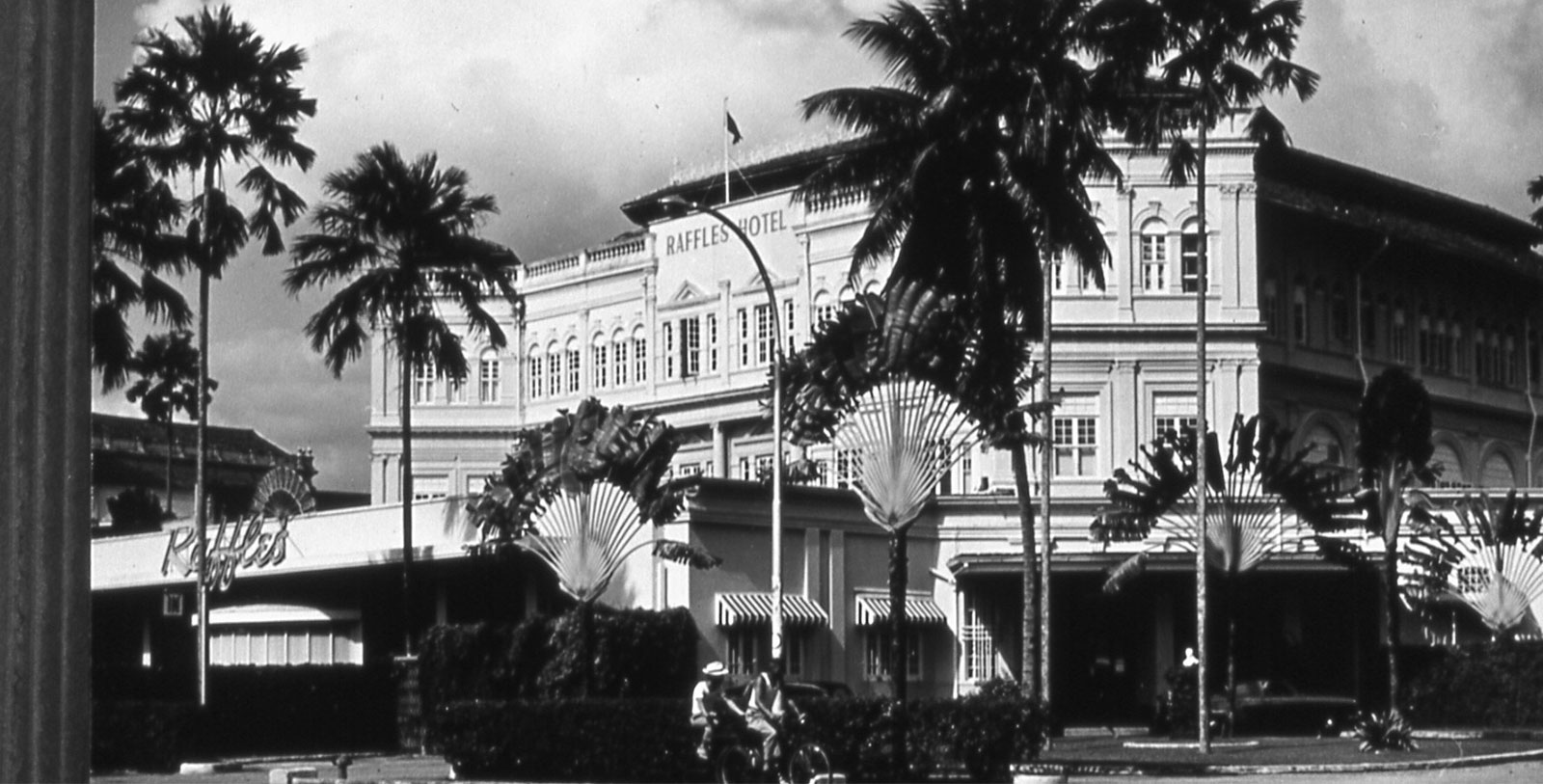
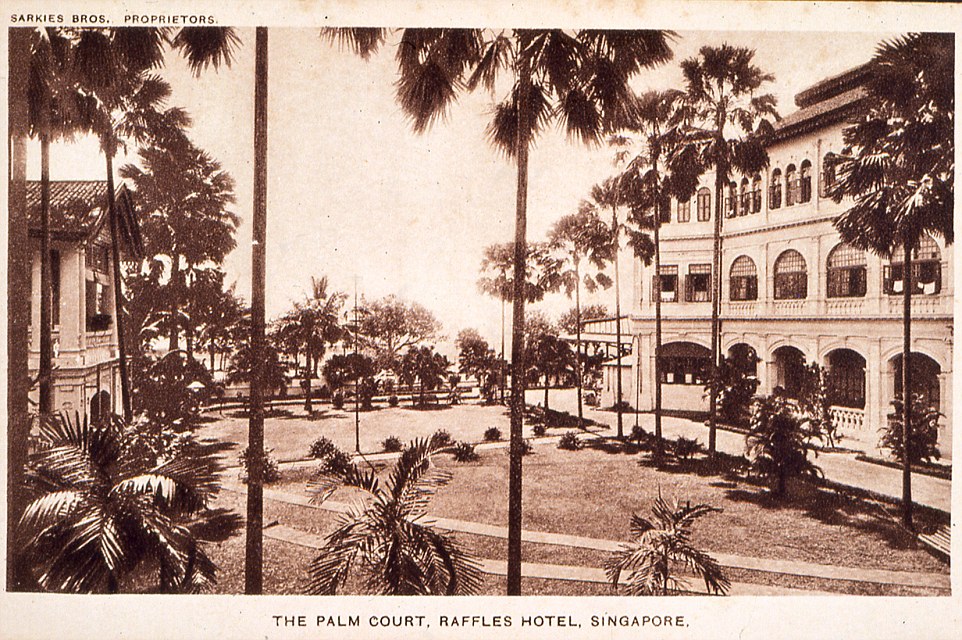
The storied history of the Raffles Singapore begins with a charming beach house that Dr. Charles Emerson leased in 1878. An enterprising hotelier, Emerson converted the quaint estate into a seaside hotel. But his dreams were short-lived as he died five years later. As such, the hotel closed shortly thereafter. It was not until the arrival of the famous Sarkies Brothers that the little hotel would see life again. Proprietors of the wildly successful Eastern & Oriental hotel in Penang, the Sarkies had long sought to open a luxurious hotel in Singapore. Thus, in September of 1887, the brothers settled on the old Emerson Hotel as the site of their new establishment. After an extensive renovation, the Sarkies reopened the building as the “Raffles Hotel,” which they named in honor of Singapore’s founder, Sir Stamford Raffles.
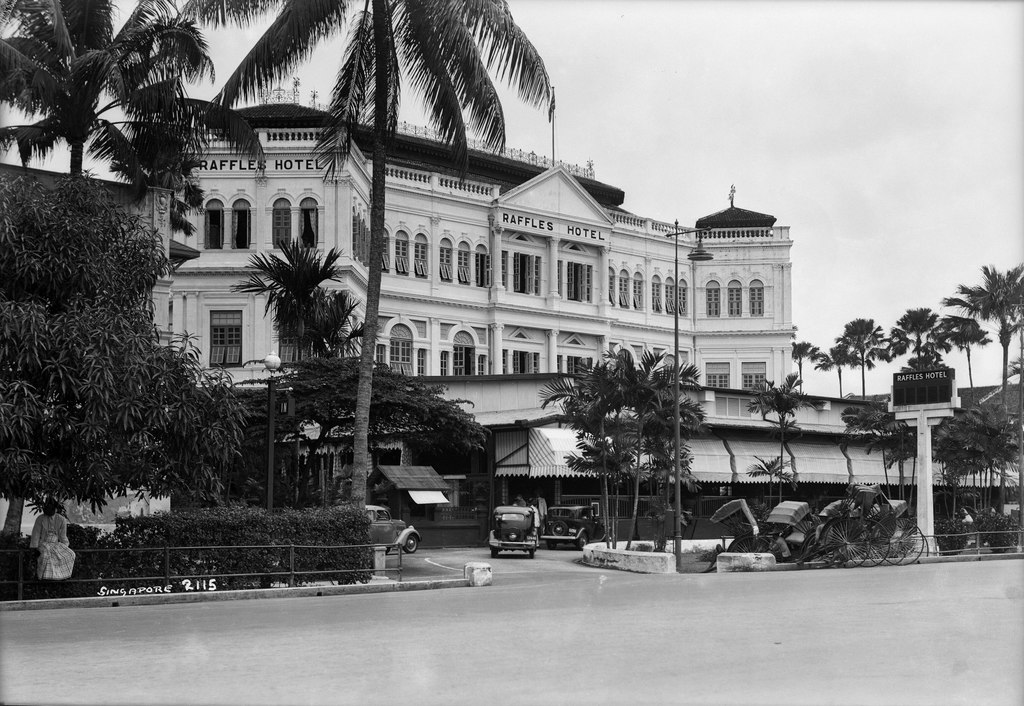
It did not take long for the Raffles Hotel to rise in popularity. Within the first decade of opening, the Sarkies added three new buildings onto the existing structure in an attempt to meet the demand for more accommodations. The number of available rooms exploded from 10 to 75 in a matter of years. Soon, the Raffles Hotels boasted a veranda, a ballroom, and a billiards hall. The Sarkies also outfitted each guestroom with the finest amenities for the era, including electric-powered lights and ceiling fans. By the late 1890s, the desire among travelers to stay at the Raffles Hotel grew to such an extent that the brothers realized they had to expand upon the original building once more. They hired the talented architect Regent Alfred John Bidwell to rebuild the space in 1899. What Bidwell achieved was nothing short of a masterpiece. When the hotel debuted after the construction, it’s new, brilliant Neo-Renaissance-style architecture met with thunderous applause. By the turn of the century, the Raffles Hotel had emerged as one of Southeast Asia’s most preeminent destinations.
As it grew in importance, a number of famous luminaries began to spend considerable amounts of time at the Raffles Hotel. Among its earliest visitors was Joseph Conrad, who would later write the novel Heart of Darkness. Not long thereafter, Rudyard Kipling, author of The Jungle Book, resided at the hotel. Kipling would use his time at the Raffles Hotel as the inspiration for his story, “Feed at Raffles.” Other wealthy clients quickly followed in their footsteps, driven by the hotel’s high-quality hospitality, lavish accommodations, and proximity to the beach. Individuals like W. Somerset Maugham began to regularly visit the hotel. Rumor has it that many of the conversations that Maugham overheard while staying at the Raffles Hotel spawned many of his fascinating stories.
Yet, storm clouds were brewing on the horizon for the Raffles Hotel. When the Great Depression hit at the end of the 1920s, the hotel endured extreme financial hardships. The last surviving Sarkies brother eventually had to file for bankruptcy, as the business left him several million dollars in debt. Under new ownership, the Raffles Hotel recovered somewhat until the outbreak of the Second World War. Trouble rematerialized with the Japanese invasion and subsequent occupation of Singapore. As the Japanese Imperial Army descended upon the city, the hotel’s staff desperately set about saving as many of its assets as they could protect. They even buried the business’s supply of silver within its famous Palm Court. Legend has it that the Raffles Hotel held one last waltz to distract the Japanese soldiers while the silver was hidden in their midst.
Fortunately, the Raffles Hotel became prosperous once more with the end of the war. Reverting to private ownership, the building quickly resumed its place as Singapore’s primer luxury hotel. Many international celebrities returned to the Raffles Hotel, including Charlie Chaplin, Elizabeth Taylor, and Ava Gardner. Its magnificence reached new heights in 1967 when Guy Green filmed much of Pretty Polly inside the building. For its historical significance, the government of Singapore declared the Raffles Hotel a National Monument in the 1980s. Celebrated today as the Raffles Singapore, the Raffles Hotel is now a cherished member of AccorHotels. Now a member of Historic Hotels Worldwide, the Raffles Hotel Singapore is among the most prestigious hotels throughout the entire world.
Hotel Timeline
The Location
The Raffles Singapore is centrally located in Singapore’s vibrant Downtown Core. Divided by the Singapore River, the region features several iconic bridges that thousands of visitors walk upon every year. Among the most historic of these structures is the Cavenagh Bridge, which is situated just beyond the hotel’s front door. The Downtown Core constitutes Singapore’s main historic district, as British colonists organized the first colonial neighborhoods in the area. Yet, the name “Downtown Core” is rarely used by native Singaporeans, who instead refer to the region as the “Central Business District.” The city’s financial center, numerous international corporations call the Downtown Core home. Among the most noteworthy of these businesses is the storied Singapore Exchange. Nearly all of Singapore’s major government offices occupy the area as well, including the Supreme Court of Singapore and the Parliament of Singapore. Dozens of fascinating cultural attractions are in the Downtown Core, too, such as the Asian Civilizations Museum and the National Gallery Singapore.
Singapore itself possesses an extensive history. Dating to 1819 the city’s origins trace back to Sir Stamford Raffles of the British East India Company. While the island was under the influence of the Dutch from their colonial powerbase in Indonesia, Raffles and his subordinates successfully created a small colonial outpost on the island. Singapore formally fell within the colonial jurisdiction of the British Empire following the Anglo-Dutch Treaty of 1824, as the island was combined with the colonies of Penang and Melaka to for the Straits Settlements. The East India Company continued to operate the city until it lost its monopoly on regulating British trade coming out of China in 1833. Further disincentivizing the company’s continued management of the Straits Settlements was the emergence of several other Western-controlled coastal cities, including Hong Kong and Saigon. As such, the colony was governed directly by various colonial offices in British India, before becoming its own Crown Colony in 1867.
Nevertheless, the city and its neighboring colonies in the Straits Settlements continued to grow exponentially throughout the 19th century. Singapore gradually became one of the region’s most prominent ports, especially after the discovery of rubber plants on several nearby islands. It also functioned as the vital link connecting Britain’s colonial outposts in China to India, and eventually, Europe. As such, the island quickly assumed a very important strategic role within the British Empire by the early 1900s. The British armed Singapore with a myriad of imposing costal defenses and created a massive naval base within the city limits in 1921. Yet, the island’s geopolitical relevance made it the target of Japanese aggression during World War II, as Japan invaded the region in December 1941. After a brief but fierce struggle with Allied forces in the Malayan Peninsula, the Japanese besieged Singapore in early 1942. The British finally surrendered the island that February, marking one of the largest military defeats in the nation’s history. Singapore would remain under Japanese control until it finally surrendered unconditionally to the Allies in 1945.
Singapore resumed its place in the British Empire after World War II, although the experiences of its citizens ignited a strong desire for independence. After it became its own colony in 1946, local legislators began pushing for the creation of a separate constitution that would allow for home rule. A newly founded Legislative Assembly began passing its own laws roughly a decade later, too, except for political issues relating to foreign policy and local defense. While Singapore eventually joined the Federation of Malaysia in 1963 as a founding member, internal political divisions at home regarding its membership forced the island to leave a year later. Shortly thereafter, Singapore became its own independent republic in in 1965 with Lee Kuan Yew serving as its first Prime Minister. The British also officially withdrew its military forces by the beginning of the 1970s, following the termination of the Anglo-Malayan Defence Agreement. Instead, Singapore joined together with the United Kingdom, Australia, New Zealand, and Malaysia to form more equal defense pact.
Despite encountering a brief period of economic turmoil following its independence, Singapore has since become one of the Asia’s most prosperous nations. It has also emerged as one of the region’s leading diplomatic powers, having helped create the Association of Southeast Asian Nations (ASEAN) in 1967. It is also a prominent member of the Asia-Pacific Economic Cooperation, Pacific Economic Cooperation Council, the East Asia Summit, among other prestigious regional organizations. Today, the republic has one of the highest standards of living on the continent, as well as one of its most stable forms of government. As a city, it is regarded as an “Alpha+ global city” by the Global Power City Index, making its cultural influence on par with places like London and New York City. UNESCO has even identified the Singapore Botanical Gardens as one of its World Heritage Sites. Singapore is truly among the most fantastic places in the world to visit.
The Architecture
Renowned architect Regent Alfred John Bidwell created the iconic façade of the Raffles Hotel, using a brilliant blend of what would become known as Singapore’s unique colonial architecture for the design. Bidwell had rose to prominence in the city for creating the blueprints for countless municipal offices throughout colonial Singapore. He conducted most of his work as part of the architectural firm, Swan & Maclaren. Bidwell had joined the company in 1897, after serving a brief stint with the Public Works Department in Kuala Lumpur. The first professionally trained architect to operate in the city since its founding in the 1820s, Bidwell quickly made Swan & Maclaren the most successful architectural firm in all of Singapore. He constructed many wonderful buildings over the next 14 years, such as the Teutonia Club, the Stamford House, and the Victoria Memorial Hall. But perhaps his greatest achievement was his work on the Sarkies’ magnificent Raffles Hotel. Many of Bidwell’s structures still exist and are recognized by the Singaporean government as National Monuments. Swan & Maclaren itself was originally founded by engineers Archibald Swan and James Waddell Boyd Maclaren in 1892. The largest architectural firm in Singapore since the start of the 20th century, it remains in operation today.
The European colonial architecture that defined many of the Western-inspired building of Singapore’s early days can trace their lineage back to George Drumgoole Coleman. An Irish expat, Coleman was the city’s first classically trained professional engineer. Having arrived in the colony shortly after its founding, he quickly became the area’s foremost colonial architect. As such, the local authorities made him the settlement’s surveyor and superintendent of public works. They specifically charged Coleman with the development of Singapore’s overall design. Coleman held a deep admiration for the elegant aesthetics of Palladian-style architecture, with particular reverence given to the designs of 16th-century Italian architecture Andrea Palladio. He brilliantly incorporated various aspects of the form into his earliest buildings, such as high Doric columns, spacious rotundas, and exquisite porticos. Coleman also made regular use of wide verandas with overhanging eaves, which were well suited to reflect the tranquility of the island’s tropical climate. Most of Coleman’s work still exists today within Singapore’s Colonial District, otherwise known as its “Downtown Core.” Examples of his designs are seen in such buildings like the Armenian Church, the Caldwell House, and the Old Parliament House. His legacy manifested in other ways beyond his work, though. Many future architects—including Regent Alfred John Bidwell—used his designs as the source of their own inspiration throughout the remainder of the 19th century.
Famous Historic Events
Battle of Singapore (1942): The Battle of Singapore was the showdown between Japanese and Allied forces during the Malayan Campaign of World War II. The Imperial Japanese Army had targeted the region for its strategic access to the Indian Ocean and the lands beyond. Launching their initial assault upon northern Malaya on December 7, 1941—the same day as the attack on Pearl Harbor—the Japanese proceed to force the Allies out of the region in a matter of two months. By February of 1942, some 85,000 Allied personnel were trapped defending Singapore from the Japanese. Despite its inferior numbers, the Japanese had worn down their adversaries through the cunning use of air power and ground tactics. Allied casualties continued to mount, forcing large structures like The Fullerton Building to serve as temporary field hospitals.
The situation had grown dire for the Allies during the second week of February. With no friendly relief in sight, Lieutenant-General Arthur Percival decided to surrender the city’s entire garrison. He spent some time meeting with Governor Sir Shenton Thomas at the Singapore Club, which was a tenant of the nearby The Fullerton Building (now operating as another member of Historic Hotels Worldwide known as The Fullerton Hotel). On February 15, 1942, the Allies finally capitulated before the Japanese onslaught. Legend persists of how several Japanese soldiers encountered the hotel’s patrons forlornly dancing to one final waltz. The British expats inside the hotel at the time also took the opportunity to let out a stunning rendition of “There Will Always Be an England.” Those actions, though, were merely more than just a way to cope with the defeat—it also acted as a clever ruse. The dance party bought the staff enough time to successfully hide the hotel’s copious amount of silver from the marauding Japanese military.
The hotel was operated by the Japanese occupational forces as the “Syonan Ryokan” for the duration of the war. It did not return to its original state until the United Kingdom managed to liberate Singapore following Japan’s unconditional surrender to the Allied Powers on September 2, 1945. Led by Admiral Louis Mountbatten, the Navy proudly sailed into the city’s central harbor as part of the British plan to reoccupy Singapore known as “Operation Tinderace.” A sailor named Stanley Redington specifically raised the Union Jack over the building to commemorate the event. Afterward, the hotel briefly served as a way station for the thousands of recently released Allied prisoners of war that were stationed throughout nearby Malaya before completely reverting to its original identity as the Raffles Hotel.
Famous Historic Guests
- Charlie Chaplin, actor known for his silent roles in The Kid and A Woman of Paris.
- Elizabeth Taylor, celebrated actress known for her roles in Cleopatra and The Taming of the Shrew.
- Ava Gardner, renowned actress known for her roles in Mogambo, The Killers, and The Barefoot Contessa.
- Maurice Chevalier, actor known for his roles in The Love Paradise and The Smiling Lieutenant.
- Jean Harlow, actress known for her roles in such films like Red Dust, Dinner at Eight, and Hell’s Angels.
- Michael Jackson, singer best remembered for such albums like Off the Wall, Thriller, and Dangerous.
- Noël Coward, playwright known for such works like Hay Fever and Private Lives.
- W. Somerset Maugham, author known for publications like Of Human Bondage.
- Rudyard Kipling, author best remembered for his novel, The Jungle Book.
- Queen Elizabeth II of the United Kingdom (1952 – 2022)
Film, TV and Media Connections
- Pretty Polly (1967)
- Tenko (1984)
- Paradise Road (1994)
- Crazy Rich Asians (2018)