History
Discover The Fullerton Hotel Singapore, which resides on a site that once housed an imposing fortress from the early 19th century.
A member of Historic Hotels Worldwide, The Fullerton Hotel Singapore today stands as one of the island nation’s greatest cultural landmarks. It rests on the site of Fort Fullerton, which British colonials constructed in 1829 shortly after Sir Stamford Raffles claimed the area for Great Britain. Fort Fullerton bore the name of Sir Robert Fullerton, who served as Singapore’s first colonial governor. The citadel guarded the region for many decades until the colonial government decided that it had become obsolete. By 1873, Fort Fullerton had been demolished and its garrison relocated to another series of fortifications nearby.
But from those ashes rose Fullerton Square, which local officials and real estate developers rushed to create throughout the latter-half of the 19th century. Dozens of administrative agencies and civilian organizations alike populated the new neighborhood, including the Chamber of Commerce, the Exchange Building, and the General Post Office. Fullerton Square was rapidly emerging as one of the most important places in Singapore, as it became surrounded by many other political and financial institutions. The creation of Collyer Quay and the historic Cavenagh Bridge introduced more traffic to the area, which transformed Fullerton Square as the city’s main focal point.
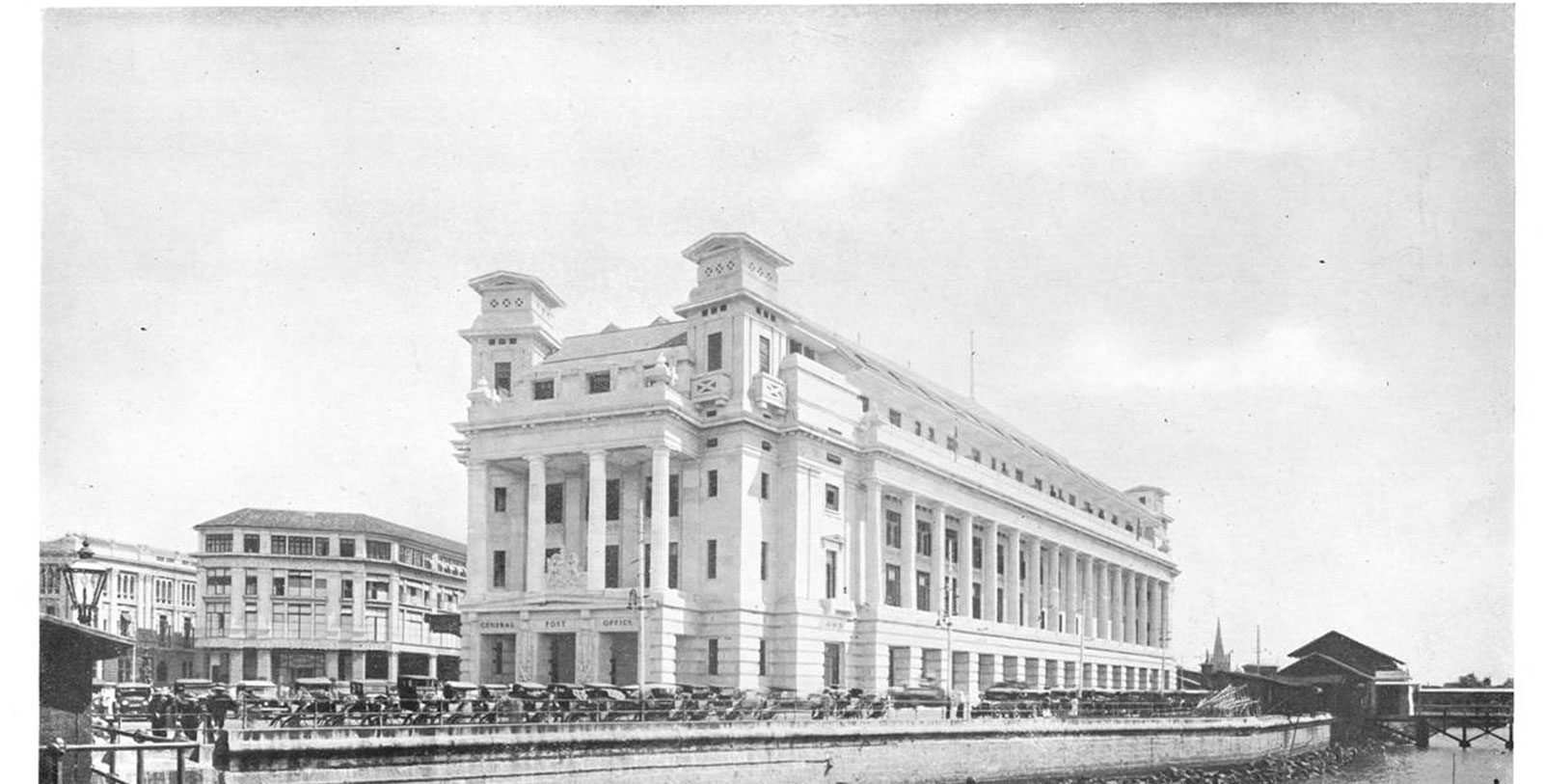
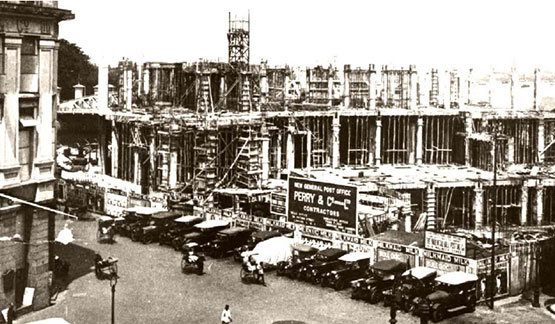
To commemorate the centennial anniversary of Singapore’s founding, Sir Laurence Guillemard—then the island’s colonial governor—commissioned the creation of a magnificent municipal building. He hired a British architectural firm based out of Shanghai called Keys & Dowdeswell to create its brilliant design. Construction began in 1924 and took around four years to complete. When the building finally debuted for the first in on June 27, 1928, it was a masterpiece of Neoclassical architecture. Named “The Fullerton Building,” it soon attracted many tenants from the surrounding area, like the Singapore Club and the Marine Department. The General Post Office occupied much of the space as well, covering the two lowest floors of the structure.
The Fullerton Building briefly found itself embroiled in the middle of World War II, when the Imperial Japanese Army besieged Singapore in 1942. The city had served as the headquarters of the Malaya Command, which had coordinated the defense of British Malaya and Singapore since the 1920s. Considered by many at the time to be the “Gibraltar of the East,” Japan nevertheless targeted Singapore for its strategic proximity to the Indian Ocean. When the fighting finally arrived at the city’s doorstep, The Fullerton Building served as a makeshift hospital for wounded Allied soldiers. It was also the place where the commanding British general, Sir Arthur Percival, informed Governor Sir Shenton Thomas that he intended to surrender. As a result, The Fullerton Building became the command center for the Japanese occupational forces in Singapore.
Once the war had ended, the Fullerton Building returned to its primary function as a municipal office complex. Yet, the structure did not become a hotel until the end of the century, when a Hong Kong-based real estate company called Sino Land acquired it in 1997. Following a three-year-long renovation that cost some $300 million to complete, Sino Land debuted The Fullerton Building as “The Fullerton Hotel Singapore” to great acclaim. It has since been the recipient of many esteemed travel awards, including Conde Nast Traveler’s Gold List Award and the Singapore Government’s Architectural Heritage Award. The hotel even earned the coveted designation as a National Monument of Singapore in 2015. As such, The Fullerton Hotel Singapore is among the best places for cultural heritage travelers to experience something truly memorable.
Hotel Timeline
The Location
The Fullerton Hotel Singapore rests on the site of the historic Fort Fullerton, which British colonials first constructed in 1829. The fort was quite imposing despite its rudimentary appearance, consisting of an artillery barracks and a single 68-pound gun that guarded the Singapore River estuary. It bore the name of Sir Robert Fullerton, who served as the nascent colony’s first colonial governor from 1826 to 1830. The British military subsequently expanded the fort over the next four decades, extending its borders all the way down to the spot of present-day Johnson’s Pier. The colonial government even uncovered a rare, 13th-century artifact dubbed the “Singapore Stone” amid the new construction. (The only surviving fragment is now on display at the National Museum of Singapore). Yet, colonial officials eventually deemed the fort obsolete by the mid-1800s and began transferring its garrison to another citadel on Sentosa Island. They started demolishing Fort Fullerton afterward, which paved the way for Fullerton Square and The Fullerton Building.
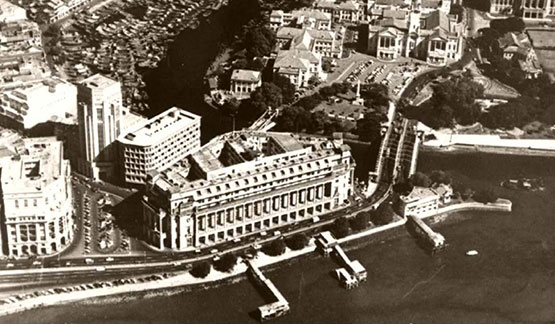
The Fullerton Hotel is also centrally located in Singapore’s vibrant Downtown Core. Divided by the Singapore River, the region features several iconic bridges that thousands of visitors walk upon every year. Among the most historic of these structures is the Cavenagh Bridge, which is situated just beyond the hotel’s front door. The Downtown Core constitutes Singapore’s main historic district, as British colonists organized the first colonial neighborhoods in the area. Yet, the name “Downtown Core” is rarely used by native Singaporeans, who instead refer to the region as the “Central Business District.” The city’s financial center, numerous international corporations call the Downtown Core home. Among the most noteworthy of these businesses is the storied Singapore Exchange. Nearly all of Singapore’s major government offices occupy the area as well, including the Supreme Court of Singapore and the Parliament of Singapore. Dozens of fascinating cultural attractions are in the Downtown Core, too, such as the Asian Civilizations Museum and the National Gallery Singapore.
The Architecture
Major P.H. Keys of the architectural firm Keys & Dowdeswell created the design of The Fullerton Building in 1924. The firm had eventually won the project through a highly competitive architectural design competition. A British company based out of Shanghai, Key & Dowdeswell designed many other outstanding structures throughout Southeast Asia, including the Singapore General Hospital and The Capitol Theatre. Over the next four years, Keys and his team of architects helped develop The Fullerton Building. To construct the building’s iconic appearance, Keys & Dowdeswell chose to use a special kind of stone known as grey Aberdeen granite. They crafted the entire façade of the structure in the style of Neoclassical architecture, complete with fluted Doric colonnades and lofty porticos. Major Keys even hired Italian artist Cavaliere Rudolfo Nolli to carve a beautiful rendition of the British Royal Coat of Arms above the main entrance.
Key & Dowdeswell continued to craft the building’s interior with Neoclassical design aesthetics, as well. Guests today can find the greatest example of the firm’s talent inside The Straits Room. Previously the billiard room for the prestigious Singapore Club, The Straits Room was where the local British leaders discussed its plans to surrender to the Japanese during World War II. It still features many of its trademark architectural elements, including its wall motifs and barrel-vaulted coffered ceiling. The ceiling was created by Cavaliere Rudolfo Nolli and is the only structure of its kind throughout Singapore.
In 1958, local officials decided to construct a lighthouse atop The Fullerton Building due to its proximity to the Singapore Strait. The Fort Canning Lighthouse had previously served as the primary naval beacon for more than a century, but the city’s rising skyline had started to prevent its light from reaching the ocean. An English company called Stone-Chance led the construction work, installing a 540-candela aerobeacon onto The Fullerton’s Building roof. Known as the Fullerton Light, its beams were so bright that ships more than 20 miles out at sea could easily spot it. After guiding ships safely to port for the better part of three decades, the Fullerton Light ceased operating in 1979. Today, it functions as the main venue for The Lighthouse Restaurant.
The Fullerton Building experienced a comprehensive renovation when Sino Land began converting it into a luxury hotel in 1998. While a team of professionals from Architects 61 and DP Consultants supervised the overall redesign of the structure, Hirsch Bender Associates spearheaded the creation of its 400 new accommodations. Facing either the atrium courtyard or the Singapore cityscape, these unique spaces featured some of the finest amenities a hotel could possibly offer. The hotel debuted with dozens of first-class facilities as well, including an infinity swimming pool, a fitness center, and a serene spa. But Sino Land endeavored to preserve as much of the building’s historical character as possible. The company managed to restore most of its iconic characteristics, such as its marvelous interior verandas and magnificent wall carvings. Sino Land’s efforts were not in vein either, as the Singapore Government identified the structure as a National Monument of Singapore in 2015.
Famous Historic Events
Battle of Singapore (1942): The Battle of Singapore was the showdown between Japanese and Allied forces during the Malayan Campaign of World War II. The Imperial Japanese Army had targeted the region for its strategic access to the Indian Ocean and the lands beyond. Launching their initial assault upon northern Malaya on December 7, 1941—the same day as the attack on Pearl Harbor—the Japanese proceed to force the Allies out of the region in a matter of two months. By February of 1942, some 85,000 Allied personnel were trapped defending Singapore from the Japanese. In spite of its inferior numbers, the Japanese had worn down their adversaries through the cunning use of air power and ground tactics. Allied casualties continued to mount, forcing large structures like The Fullerton Building to serve as temporary field hospitals.
The situation had grown dire for the Allies during the second week of February. With no friendly relief in sight, Lieutenant-General Arthur Percival decided to surrender the city’s entire garrison. He spent some time meeting with Governor Sir Shenton Thomas at the Singapore Club, which was a tenant of The Fullerton Building at the time of the battle. On February 15, 1942, the Allies finally capitulated before the Japanese onslaught. Many political leaders throughout the West were utterly shocked by the defeat, with British Prime Minister Winston Churchill declaring it the worst disaster in British military history. Thousands of Allied soldiers were marched into prisoner of war camps, while Singapore became a bastion for the Imperial Japanese military in Southeast Asia. Japanese officers then requisitioned The Fullerton Building, turning it into the headquarters for their infamous occupational forces throughout the remainder of the conflict.
Famous Historic Guests
- Lieutenant-General Arthur Ernst Percival, commander of Allied forces at the Battle of Singapore (as The Fullerton Building).
- Governor Sit Shenton Thomas, colonial governor of Singapore during World War II (as The Fullerton Building).