History
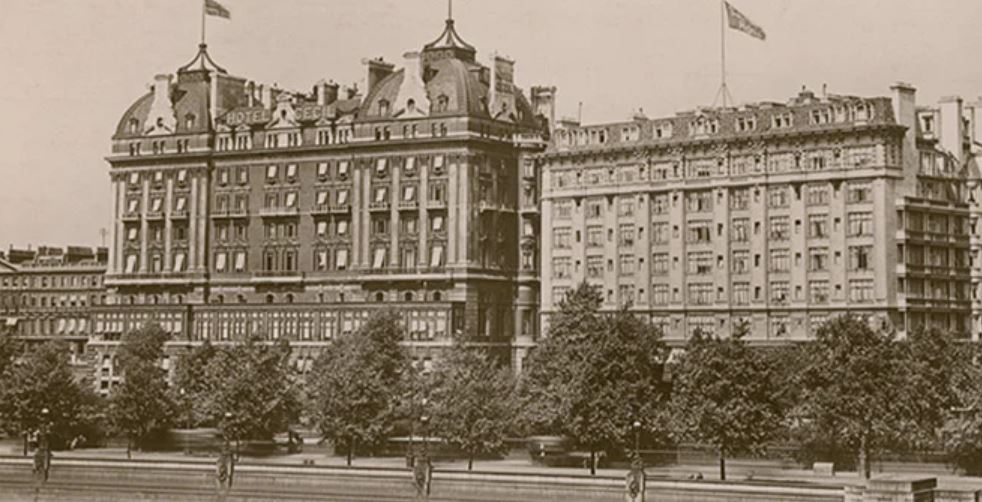
Discover The Savoy London, which originally opened in 1889 by the renowned impresario Richard D’Oyly Carte.
Impressed by the America hotels he had seen at the height of the Victorian Era, entrepreneur Richard D’Oyly Carte decided to build his own in the heart of London. He specifically selected a plot of land directly next to his celebrated Savoy Theatre. Called simply as “The Savoy” in honor of the area’s medieval heritage, the hotel was designed by Thomas Edward Colcutt and took five years to build. Carte had managed to finance the entire project through the profits generated by the shows at the Savoy Theatre, specifically a play known as The Mikado. When it finally debuted in 1889, The Savoy set a new standard for technology, comfort, and luxury. First to be lit by electricity, The Savoy was also the first to feature electric lifts known as ascending rooms. Guestrooms were connected by speaking tubes to various parts of the hotel, including the valet, maid, and floor waiter. The Savoy later became the first hotel to provide most of its guestrooms with private baths, which became famous for their cascading shower and quick filling bathtub. Innovative and persuasive, D’Oyly Carte tempted the well-known hotel manager César Ritz to join his new wonder hotel, and he brought in Auguste Escoffier—the leading celebrity chef of his day—to run the kitchens. In the early years, Savoy guests included Sarah Bernhardt and Dame Nellie Melba, for whom Escoffier famously created the “Melba Toast” and the “Pêches Melba.”
The 1900s were years of extravagance and exuberance for The Savoy, as its grand parties and galas became legendary throughout London. American millionaire George A. Kessler hosted a "Gondola Party," where the central courtyard was flooded to a depth of up to four feet and surrounded by custom scenery. Costumed staff and guests acted as ordinary Venetians touring the city’s famous canals. The two dozen guests even dined in an enormous gondola. After dinner, Italian tenor Enrico Caruso sang, while a baby elephant brought in a five-foot birthday cake. By 1904, the hotel was such an enormous success that Thomas Edward Collcutt constructed a new addition along the Strand that featured a new entrance and reception area. The building’s owners also moved the American Bar and Savoy Grill into this new part of the hotel. The First World War brought small privations to The Savoy, but morale remained high despite the severe shortage of vital supplies. Bombs even fell close nearby, although the hotel was spared from any damage. The postwar years brought a determination to embrace the new and innovative. Everybody danced at The Savoy, from Fred and Adele Astaire to the entire Ballets Russes. The Ballets Russes would return to the hotel upon several other occasions, following their performances on the Strand. Tales persist of how those talented dancers pranced about the hotel’s darkened public rooms by candlelight.
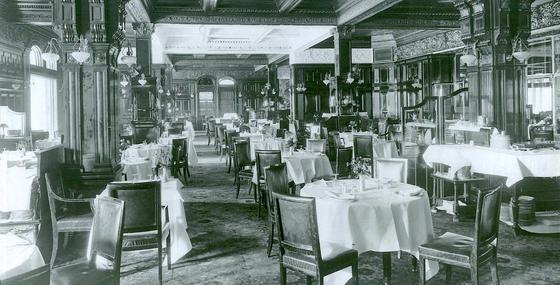
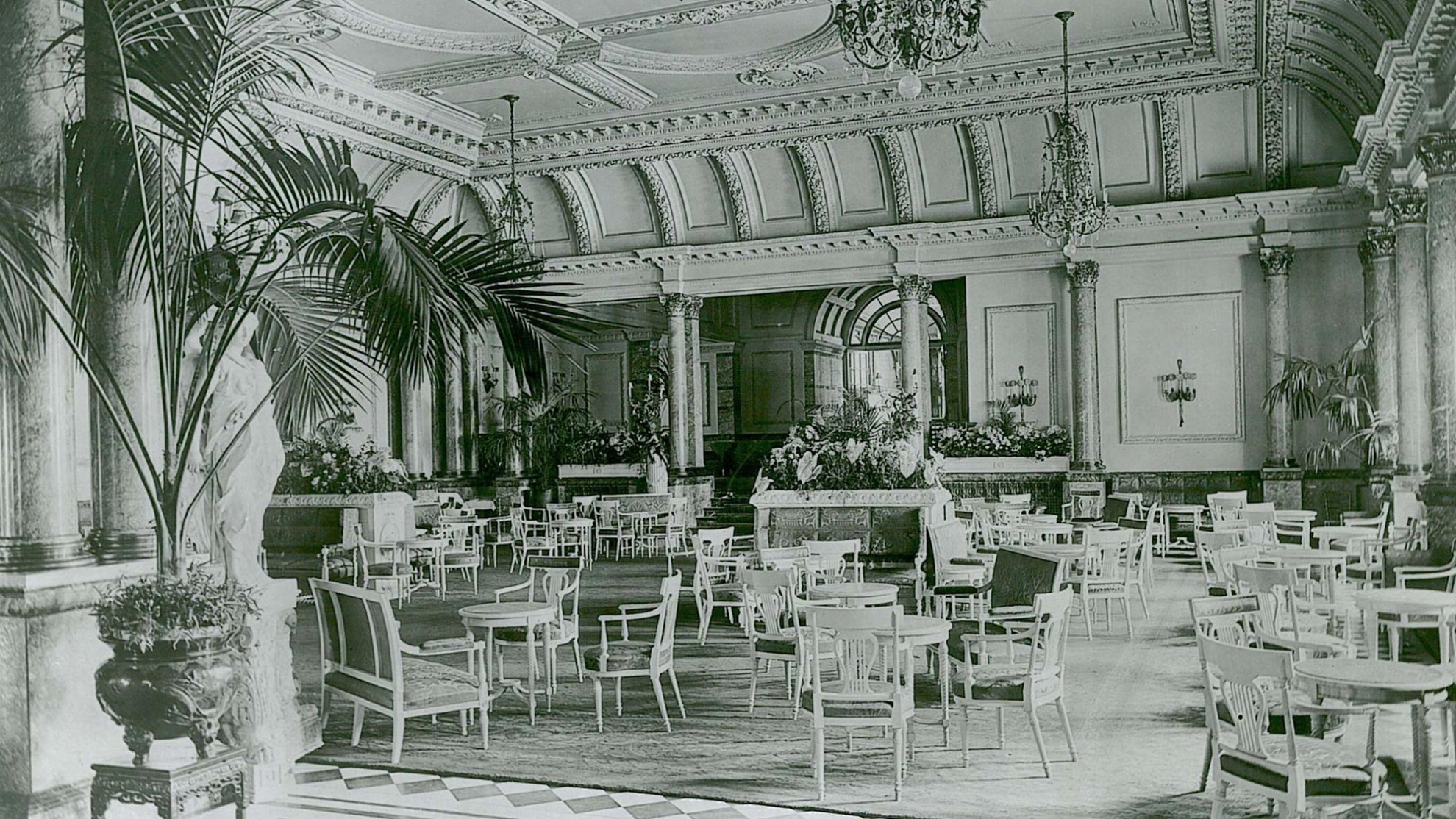
The Savoy embraced the Art Deco movement enthusiastically amid the Roaring Twenties. Art Deco décor was installed throughout the building, beautiful contemporary artwork graced its hallways. Sir Howard Robertson crafted the hotel’s iconic stainless-steel Savoy sign, too, which still resides above the Savoy Court. And as for jazz, the hotel also imported some of the finest musicians to play in its renowned Savoy Bands. Those groups performed in the revamped Thames Foyer, where a stage and a dance floor were permanently installed. Underneath the space was a hydraulic system that allowed a portion of the dance floor to temporarily serve as a large stage for cabaret acts. The operations of the hotel carried on even as war and economic hardship struck Great Britain over the course of the next two decades. The Savoy even provided a subterranean air-raid shelter for guests in what had been the Abraham Lincoln banqueting suite during World War II. One night amid The Blitz, a bomb blast on the Strand sent bandleader Carroll Gibbons flying of the bandstand. While Carroll regained his composure, cabaret performer and English playwright Noël Coward came up from the audience and sat at the piano to belt out a selection of his own hit songs. But the hotel had also become immensely popular among several leading Allied leaders, nevertheless, including General Charles de Gaulle, Admiral Louis Mountbatten, Sir Archibald Wavell, and Prime Minister Winston Churchill.
The Savoy swung into the 1960s with guests ranging from The Beatles and Bob Dylan to Louis Armstrong, Marlon Brando and Jane Fonda. The post-premiere party for Elizabeth Taylor and Richard Burton’s film Cleopatra featured a pyramid-shaped dessert so spectacular that it had merited description in the Encyclopedia Britannica. Yet, the hotel had always been a hotspot for celebrity sightings. From its earliest days, the stars of stage and screen had loved The Savoy. England’s own Vivien Leigh was first introduced to her future husband Laurence Olivier in the hotel. From America came Hollywood greats such as Al Jolson, Errol Flynn, and Katharine Hepburn, while Josephine Baker arrived from France. Princess Elizabeth was first seen with Lt. Philip Mountbatten—the future Prince Philip, Duke of Edinburgh—at a reception inside The Savoy. And when the Princess became Queen Elizabeth II a few years later, The Savoy threw an incredibly lavish coronation ball in her honor. Some 1,400 people attended the event, with many luminaries among their number. Sixteen Yeomen Warders from the Tower of London even lined the entrance staircase for additional flair.
The Savoy entered its second century with the same style and enthusiasm that had characterized its first. In 2007, The Savoy eventually closed its doors for the first time to conduct an extensive refurbishment project. Everything that had been added to the beautiful Edwardian interior over the last century was removed, and the hall with its original light fittings was carefully restored to its former glory. Much of the original Savoy’s antique furnishings and fixtures were rehabilitated, as well. In the Front Hall, for example, conservationists restored the stunning mahogany paneling to show the natural beauty of the wood’s grain. Artists also restored the details of Bertram Pegram’s frieze, An Idyll of a Golden Age, which now shines once more with its original splendor. Many of the hotel’s historic venues received some much—needed attention, too. The glass dome above the Thames Foyer was uncovered for the first time since the Second World War, while the historic River Restaurant—known today as the Savoy Restaurant—had most of its historic Art Deco-themed architecture preserved. But the construction also installed several new facilities, as well, including the Beaufort Bar and a teashop named “Savoy Tea.” A glass-enclosed health center and a rooftop swimming pool even appeared above the Savoy Theatre. The hotel finally reopened to great acclaim October 10, 2010. A few weeks later, the official party to mark the grand relaunch of the hotel was hosted by both Prince Alwaleed and the Prince of Wales, who unveiled a plaque to commemorate the occasion. Now managed by Fairmont Hotels and Resorts, this fantastic historic destination has been recognized as a Grade II Listed Building by Heritage England for its outstanding institutional history. A member of Historic Hotels Worldwide since 2011, few places are better in all of London for a memorable vacation than The Savoy.
Hotel Timeline
The Location
When Richard D’Oyly Carte first debuted his wonderful new hotel in downtown London, he named it after the Count Peter of Savoy. Peter was a descendant of Humbert I, who established the noble House of Savoy at the beginning of the 11th century. The counts ruled over a domain just south of Lake Geneva in modern-day France. Yet, Peter was the paternal uncle of Eleanor of Provence, who was then queen-consort to King Henry III of England. King Henry III made Peter the Earl of Richmond and granted him land upon the banks of the Thames River when he arrived in London with Eleanor in the mid-13th century. The new Earl quickly set about constructing a magnificent estate that he called the “Savoy Palace.” But Peter did not use it for long, as he soon sold the building to the Congregation of the Canons of the Great Saint Bernard. They, in turn, temporarily transformed the palace into a medical facility known as the “Great Hospital of St. Bernard de Monte Jovis.” Queen Eleanor eventually reacquired the complex on behalf of her family, granting the estate to her second son, Edmund, Earl of Lancaster.
The palace remained in Edmund’s particular line of the English Royal Family for the next several generations, falling into the hands of his great-granddaughter, Blanche. Blanche was married to John of Gaunt, the founder of the historic House of Lancaster. A son of King Edward III of England, John was a principal advisor to his nephew, King Richard II. Richard himself was far too young to rule England when he inherited the throne upon Edward’s death in 1377, so John rapidly assumed many of his responsibilities until he came of age. Unfortunately, John and his fellow advisors on the regency council encountered great unrest, which eventually spawned a massive uprising known as the Peasants’ Revolt of 1381. Led by Wat Tyler, common folk from across southeastern England rebelled against Gaunt’s government, hoping to remove the noblemen on the grounds of corruption. When Tyler’s rebels finally arrived outside London that June, they torched John and Blanche’s home—Savoy Palace.
The area was gradually redeveloped over the next two centuries, culminating with the establishment of a spectacular hospital in 1512. Commissioned by King Henry VII of England, the facility was placed directly on the ruins of the Savoy Palace. King Henry VII’s hospital operated well into the 17th century but was constantly beset by poor management. British Parliament finally dissolved the enterprise in 1702, as such, using the complex for a variety of other purposes. A fire destroyed most of the grounds, though, in the mid-1800s, leaving only the stone foundation and a small structure known as the “Savoy Chapel.” Richard D’Oyly Carte fortunately saved the area from further decay when he bought it in the 1880s. Along with a team of likeminded business colleagues, Carte immediately began investing millions of pounds into redeveloping the land. Among his first projects involved the creation of the Savoy Theatre, which would go on to operate Carte’s famous Gilbert and Sullivan operas. Those productions played a crucial role in constructing The Savoy a decade later, as their proceeds served as the project’s primary source of capital.
By the time Carte and his business allies constructed the Savoy Theatre, the entire neighborhood had been encased between two major thoroughfares: the Victoria Embankment and The Strand. Sir Joseph Bazalgette constructed the Victoria Embankment directly along the Thames River in the latter-half of the 1860s. Opening in 1870, Sir Bazalgette had named the new roadway after Great Britain’s reigning monarch at the time, Queen Victoria. It was one of three other similar structures that sought to relieve traffic congestion that had emerged as a result of London’s industrialization. Yet, the Victoria Embankment was also a way for the Metropolitan Board of Works to control the flow of sewage throughout the area, as the agency constructed a then-modern sewage system underneath the construction. The Strand, on the other hand, was far older than the Victoria Embankment. Dating to at least the Middle Ages, The Strand once hugged the banks of the Thames. But as the engineers narrowed the river to create the Victoria Embankment, it pushed The Strand closer to the center of Covent Garden. Many powerful nobles constructed their homes along The Strand, due to its ability to transport people quickly into the heart of London. For instance, Edward Seymour, Duke of Somerset, built a beautiful palatial home in 1547. Known as the “Somerset House,” it was subsequently used by the British government to house many different organizations. Today, the Somerset House is home to several amazing cultural institutions, including King’s College London.
The Architecture
While The Savoy dates to the Late Victorian Era, much of its current architecture reflects the popular design aesthetics of the 1920s. The building underwent a significant period of transformation during the Roaring Twenties, when Rupert D’Oyly Carte—the son of hotel founder Richard D’Oyly Carte—instituted a rolling series of major renovations. As such, The Savoy displays the structural features of the Art Deco movement, which first appeared at the start of the decade. Short for “Arts Décoratifs,” the name “Art Deco” originated from the Exposition Internationale des Arts Décoratifs et Industriels Modernes that was held in Paris in 1925. It was here that the iconic features of Art Deco design formally debuted before the world. Yet, a few architects in Chicago had actually used the design several years prior, starting with the Finnish architect Eliel Saarinen in 1922. Saarinen had used what would become Art Deco architecture to create blueprints for the Chicago Tribune’s new office building. But while Saarinen’s plans were ultimately rejected, they inspired many more architects to embrace the Art Deco philosophy. Soon enough, Art Deco architecture quickly became the preferred style for all sorts of skyscrapers built in Chicago at the time. The movement then spread across the United States, appearing in major cities like Los Angeles, Boston, and Philadelphia. New York City itself featured several famous Art Deco structures, such as the Empire State Building, the Chrysler Building, and Rockefeller Center. Architects in many other Western nations quickly followed suit, building a myriad of similar structures in cities like London, Berlin, and Lisbon. World War II ultimately brought an end to the popular interest with Art Deco, although some architects continued to use it well into the 1960s.
Historians and architectural experts state that Art Deco is among the most recognizable styles to identify today. Buildings that feature such a design are characterized by their smooth, linear facades that are typically laid out upon a symmetrical format. Those exteriors, though, are almost always arranged by a series of setbacks that make it seem as if the building has a stepped frame. To achieve the iconic smooth appearance, architects relied upon building materials like stucco, concrete block, or glazed brick. Ornate wall decorations usually incorporated a variety of detailed wall decorations that reflected the building’s intended function or social culture. Among the most significant motifs featured within the overall design were geometric in nature. Chevrons were perhaps the most common geometric motif, in which its inverted, V-like shape helped the building achieve its stepped look. And at the ground-level, low-relief panels encompassed the main entryways, as well as roof edges and major windows. All in all, it was hoped that Art Deco’s sleek ambiance would completely capture the sense of modernity and progress that defined the Roaring Twenties. But Art Deco style gradually became more subdued in the 1930s, due to the financial hardships wrought from the Great Depression. By this point, architects had begun to use chrome plating, stainless steel, and plastic to make the building appear more modern. This decision ultimately created an offshoot movement known as “Streamline Moderne.”
Famous Historic Guests
- Al Jolson, singer and actor best remembered for his roles in The Jazz Singer, The Jolson Story, and Jolson Sings Again.
- Audrey Hepburn, actress known for her roles in films such as Breakfast at Tiffany’s, Roman Holiday, and My Fair Lady.
- Cary Grant, actor known for such roles in To Catch a Thief, Charade, and North by Northwest.
- Charlie Chaplin, actor known for his silent roles in The Kid and A Woman of Paris.
- Elizabeth Taylor, celebrated actress known for her roles in Cleopatra and The Taming of the Shrew.
- Errol Flynn, actor known for his roles in Captain Blood, The Charge of the Light Brigade, and The Adventures of Robin Hood.
- Fred Astaire, dancer and actor known for his roles in such films like Top Hat, Funny Face, and Swing Time.
- Humphrey Bogart, actor known for his roles in movies like Casablanca, The Maltese Falcon, and The Big Sleep.
- Jane Fonda, actress known for her roles in Period of Adjustment and Sunday in New York.
- Joan Crawford, actress known for her roles in Mildred Pierce and Whatever Happened to Baby Jane?
- John Wayne, actor known for his roles in The Man Who Shot Liberty Vance, True Grit, and The Longest Day.
- Josephine Baker, American-French cultural icon from the Jazz Age and renowned Civil Rights leader.
- Judy Garland, actress and singer known for her roles in A Star is Born, Meet Me in St. Louis, and Wizard of Oz.
- Julie Andrews, actress known for her roles in movies like The Princess Diaries, Mary Poppins, and The Sound of Music.
- Katharine Hepburn, actress known for her roles in The African Queen and Woman of the Year.
- Lauren Bacall, actress known for her roles in films such as The Big Sleep, Key Largo, and To Have and Have Not.
- Laurence Olivier, actor known for his roles in the film adaptations of Hamlet, Henry V, and Richard III.
- Lena Horne, actress and civil rights activist remembered for her roles in Stormy Weather, Cabin in the Sky, and The Wiz.
- Lionel Barrymore, actor remembered for his roles in A Free Soul and It’s a Wonderful Life.
- Marilyn Monroe, actress known for her roles in Bus Stop and Some Like It Hot.
- Marlene Dietrich, actress known for her roles in Morocco, Shanghai Express, and The Blue Angel.
- Marlon Brando, actor known for his roles in On the Waterfront and The Godfather.
- Nellie Melba, operatic soprano from Australia active at the height of the Late Victorian Era.
- Richard Burton, actor known for his roles in Cleopatra and Where Eagles Dare.
- Richard Harris, actor known for his roles in films such as A Man Called Horse, Unforgiven, and Gladiator.
- Sarah Bernhardt, stage actress known for her roles in plays such as La Tosca, Ruy Blas, and La Dame Aux Camelias.
- Vivien Leigh, actress known for her roles in Gone with the Wind and A Streetcar Named Desire.
- Bob Dylan, musician known for such hits as “Blowin’ In the Wind” and “The Times They Are a-Changin.”
- Enrico Caruso, renowned Italian operatic tenor.
- George Gershwin, musician known today for his opera Porgy and Bess, as well as many other productions.
- Frank Sinatra, singer and actor part of the famous Rat Pack known for selling 150 million records worldwide.
- Louis Armstrong, one of the most influential American jazz musicians to ever live.
- Jimi Hendrix, musician best remembered as the lead singer and guitarist for the rock band, The Jimi Hendrix Experience.
- Paul McCartney, lead vocalist and bassist for the legendary rock band, The Beatles.
- John Lennon, lead vocalist and rhythm guitarist for the legendary rock band, The Beatles.
- George Harrison, vocalist and lead guitarist for the legendary rock band, The Beatles.
- Ringo Starr, drummer for legendary rock band, The Beatles.
- George Bernard Shaw, playwright known for works such as Man and Superman, Pygmalion, and Saint Joan.
- H.G. Wells, author remembered for such novels as The Time Machine, The Invisible Man, and The War of the Worlds.
- Noël Coward, playwright known for such works as Hay Fever and Private Lives.
- Oscar Wilde, poet and playwright known for writing such works as The Importance of Being Earnest.
- Claude Monet, artist credited with helping to found French Impressionist art.
- Christian Dior, fashion designer known the world over for creating the company that still bears his name.
- Babe Ruth, legendary outfielder for the New York Yankees regarded today as being best baseball player ever.
- John J. Pershing, General of the Armies for the United States and commander of the American Expeditionary Force during World War I.
- Charles De Gaulle, World War II freedom fighter and President of France (1959 – 1969)
- Winston Churchill, Prime Minister of the United Kingdom (1940 – 1945; 1951 – 1955)
- Prince Philip, Duke of Edinburgh (1952 - 2021)
- King Edward VII of the United Kingdom (1901 – 1910)
- Queen Elizabeth II of the United Kingdom (1952 – 2022)
- Harry S. Truman, 33rd President of the United States (1945 – 1953)
Film, TV and Media Connections
- Kipps (1921)
- Circle of Danger (1951)
- Night of the Demon (1957)
- Life at the Top (1965)
- Don’t Look Back (1967)
- The Big Sleep (1978)
- Danger UXB (1979)
- The Long Good Friday (1980)
- French Lieutenant’s Woman (1981)
- Smiley’s People (1982)
- Annie: A Royal Adventure (1995)
- Entrapment (1999)
- Notting Hill (1999)
- I Capture the Castle (2002)
- Bright Young Things (2003)
- Five Little Pigs (2003)
- Agatha Christie’s Marple (2006)
- Death Defying Acts (2007)
- Made of Honor (2008)
- Miss Pettigrew Lives for a Day (2008)
- Gambit (2012)
- Mortdecai (2015)
The Legacy of Bartender Ada Coleman
Ada Coleman was a legendary English bartender and a pioneering figure in the world of cocktails during the early 20th century. In 1903, she was promoted to head bartender of the American Bar at London’s Savoy Hotel—a remarkable achievement at a time when women were rarely seen behind the bar. Though often described as the Savoy’s first and only female head bartender, she worked alongside another woman, Ruth Burgess, known as “Miss B,” who had started a year earlier. Despite their equal popularity with patrons, Coleman received greater recognition in the press and in later histories of bartending, in part because she refused to share her drink recipes with Burgess, leading to a silent rivalry that lasted for two decades. Coleman rose to fame as both a skilled mixologist and a charismatic hostess, winning the admiration of elite clientele such as Mark Twain, Marlene Dietrich, Charlie Chaplin, Diamond Jim Brady, and the Prince of Wales. Known affectionately as “Coley,” she was celebrated for her warmth, energy, and theatrical flair, becoming, in the words of cocktail historian Ted Hughes, the woman who “made the bar famous.” Among her most iconic creations was the “Hanky Panky,” a potent cocktail of gin, vermouth, and Fernet-Branca, crafted for actor Charles Hawtrey. A passionate fan of musical theatre, Coleman also hosted vibrant gatherings at her home, drawing a diverse and artistic crowd. Her legacy endures as a groundbreaking woman who left an indelible mark on the history of bartending.