History
Discover Capital Hotel, which was a landmark hotel in Little Rock, Arkansas situated near the first state capitol building, Old State House.
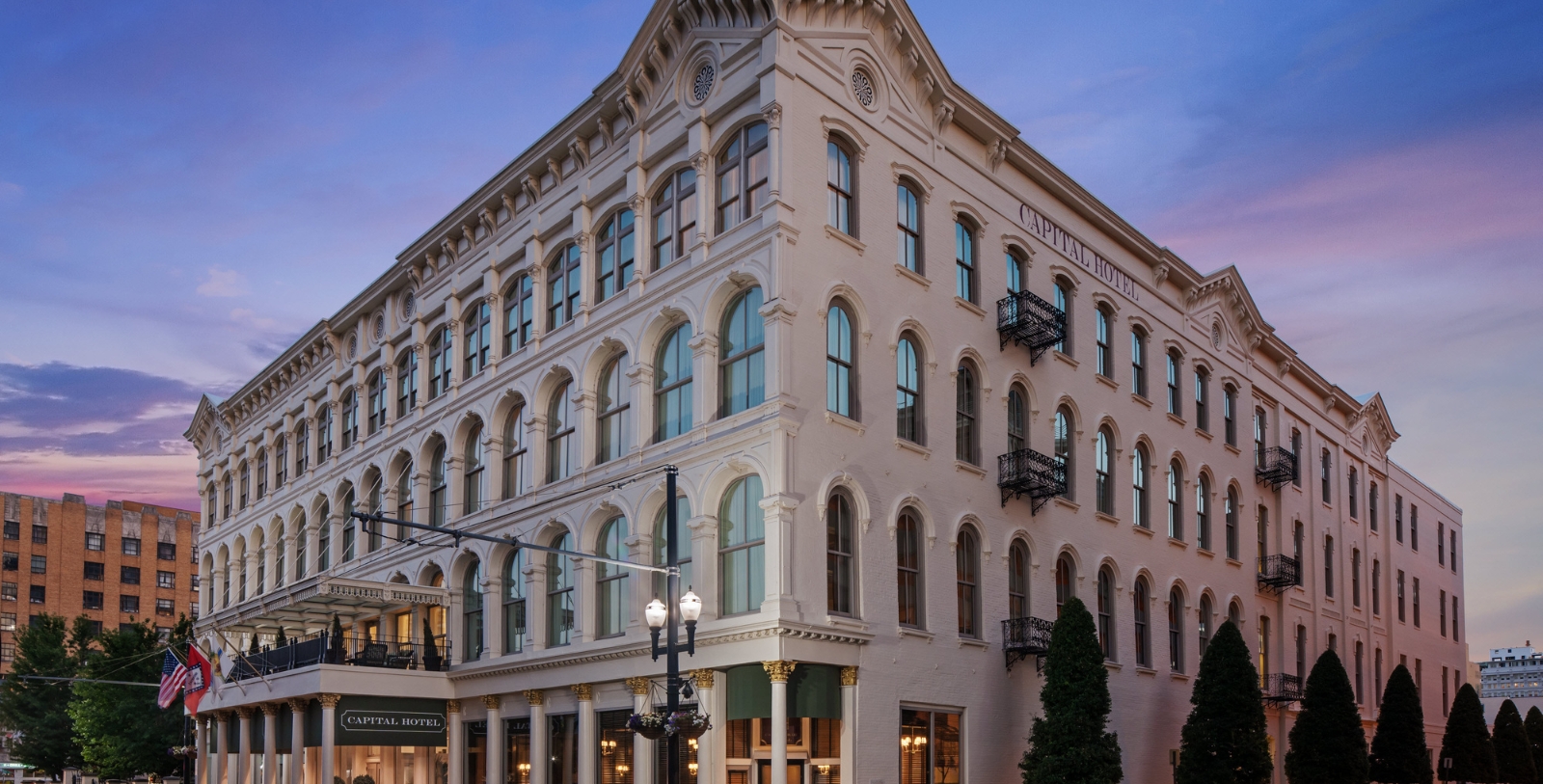
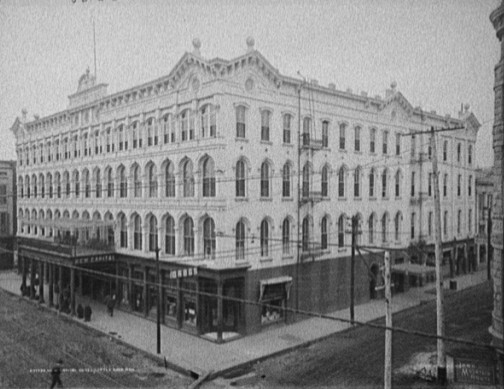
Often referred to as Little Rock’s “Front Porch,” the Capital Hotel has stood as a cherished local landmark since the height of the Gilded Age. Yet, this magnificent historic hotel was originally part of a mixed commercial complex known as the “Denckla Block.” Constructed in the 1870s, the development derived its name from its progenitor, William P. Denckla. Denckla was a wealthy New York railroad tycoon who saw great business opportunities throughout Little Rock in the years immediately following the American Civil War. The postwar economy had specifically introduced a boom in trade that arrived in the city by both rail and steamship. Little Rock was thus quickly becoming a regional center for economic activity. As such, Denckla sought to create a space that would nurture this financial revolution. To that end, he bought a plot of land to develop at the corner of Markham and Louisiana streets that was owned by Arkansas Supreme Court Justice George C. Watkins. Construction began in earnest in 1872 and lasted for nearly a year. Among the most iconic structural features grafted onto the three-story building was its beautiful cast-iron façade. Interestingly, Denckla had to purchase the material from another businessperson, A.T. Merchant, who had once planned to use the cast iron for himself. Assembled on-site, laborers painstakingly bolted the cast iron onto the building’s exterior piece by piece—a key moment in Capital Hotel Little Rock, AR history.
Yet, when the complex finally debuted in 1873, Denckla had sold it to George C. Watkins’ heirs. Denckla’s intent to manage the complex had changed over the course of its development and he decided to rid himself of its financial obligations. Nevertheless, the Denckla Block soon became a vibrant center for local commerce, hosting several lucrative businesses like Louis Ran’s Tobacco, Cigar, Wine & Liquor and Morris & Withall’s haberdashery. The third floor remained free from business activity, though, as it was largely used as a residential space advertised exclusively as a “bachelor’s quarters.” Amazingly, all of its accommodations came completely furnished! But the fate of the Denckla Block was to change forever when a massive fire destroyed the neighboring Metropolitan Hotel in 1876. Its General Manager, Colonel A.G. DeShon, vowed to create another brilliant destination that would be the pride of the city. Partnering with Major John D. Adams, the men leased the entire Denckla Block in order to transform it into a boutique hotel. The two men also planned on expanding the structure, commissioning the development of a massive addition along Louisiana Street. To christen the hotel, Major Adams chose the name suggested by Mrs. Morehead Wright. She had specifically recommended that DeShon and Adams refer to their business as the “Capital Hotel,” for it was, in her words, “a capital enterprise located in a capital building.”
Thus, the renovated complex reopened as the Capital Hotel for the first time in January 1877. It contained some of the finest amenities of its day, including gas lighting, indoor plumbing, and a magnetic annunciator. It quickly gained rave reviews, with many guests comparing the structure to the Palmer House in Chicago. The Capital Hotel had even begun to host many prominent political luminaries, such as President Ulysses S. Grant. In fact, legend stipulates that the hotel’s unusually large elevator was modified to allow Grant to take his horse up to his suite. Over the next few decades, the Capital Hotel exchanged hands several times. Among its most flamboyant owners was Henry Franklin Auten, who significantly transformed the hotel’s appearance with a $250,000 renovation in 1908. While the cast-iron façade remained intact, the entire first floor lobby was brilliantly reconstructed into its present form. All the while, the Capital Hotel remained at the center of Little Rock’s social and political life. Yet, the hotel eventually fell into disuse when the city’s entire downtown area experienced economic stagnation in the mid-20th century. Fortunately, salvation arrived in the late 1970s, when architect Ed Cromwell and a group of investors began working to restore the Capital Hotel back to its former glory. Taking some three years to complete, the hotel opened its doors once more on Christmas Day of 1983. A member of Historic Hotels of America since 2018, the Capital Hotel continues to offer its guests unrivaled access to the historic core of the city.
Hotel Timeline
The Location
The Capital Hotel resides in the heart of Little Rock, Arkansas’ capital city. Little Rock itself is quite historic, with its history dating back to the early 18th century. A French explorer named Bernard de la Harpe established the first European settlement in the area near a small geological formation along the banks of the Arkansas River. Calling the area “Le Petite Roche,” or “little rock,” la Harpe specifically founded his rustic trading post within a community of Quapaw Native Americans. Additional outposts sprung up in the region that offered refuge for frontiersmen and soldiers alike. Le Petite Roche and its environs remained under French control until 1803, when U.S. President Thomas Jefferson acquired the land as part of the Louisiana Purchase. Soon enough, the surrounding Ouachita Mountains became an American territory, with its capital at the “Little Rock.” In 1820, several surveyors reviewed the area and encouraged the territorial legislature to move its headquarters to the settlement. As such, they recast the community as “Arkopolis,” although the name was gradually replaced with “Little Rock” in the coming years. Politicians met in the settlement over the next two decades, as they oversaw the territory’s growth into an actual state. At this time, some of the area’s most well-known landmarks first appeared, including the Old State House. The second of Arkansas’ three state capitol buildings, its iconic layout was designed by Gideon Shyrock. The first newspapers also started running then, too, with the Arkansas Gazette becoming Little Rock’s most prominent publication by the mid-1800s.
Little Rock remained the state’s capital city upon its formal inclusion into the union in 1837. Over the next few decades, state politicians met within the city to debate the ongoing sectional crisis that was affecting the nation over slavery. As a slave state, the white population of Little Rock—and Arkansas as a whole—largely supported secession at the outbreak of the American Civil War, joining the Confederate uprising shortly after President Abraham Lincoln’s call for volunteers in 1861. Almost as soon as the state’s Ordinance of Secession passed the Arkansas legislature, local militias captured the sizable federal armory in the center of the city. While dozens of skirmishes between Northern and Southern soldiers erupted throughout the state during the war, Little Rock was essentially spared. Yet, in 1863, federal troops under the command of General Frederick Steele occupied the city and established a pro-Union government. This body remained in power for the duration of the conflict, as well as in the years immediately following its end. Unlike many other southern cities, though, Little Rock experienced an economic boom during the 1870s. The use of railroad and steamboat travel increased tenfold, making the city a major transportation hub for regional commerce. This prosperity mainly continued unfettered, save for the temporary, yet harsh, conditions of the Great Depression.
Like many other southern cities, Little Rock had its share of controversies surrounding the suppression of civil rights for racial minorities. Black Americans in particular were beset by a series of “Jim Crow” bills that interfered with their ability to exercise equal rights under local law. They enforced a pattern of segregation in public spaces that disallowed blacks from using the same facilities as whites at such places like schools, businesses, and churches. But in 1957, the city school board attempted to enact a gradual plan to desegregate public education in Little Rock following the famous Supreme Court decision of Brown v. Board of Education. The organization began its strategy by allowing nine African Americans the right to attend the city’s Central High School, an event that gradually cascaded into a showdown between the federal government and the State of Arkansas. When Governor Orval E. Faubus attempted to forcibly stop the students from attending, President Dwight D. Eisenhower dispatched soldiers from the 101st Airborne Division to maintain order. As a result, all public schools throughout the nation were legally desegregated within the next decade. Today, the Central High School is recognized by the U.S. Department of the Interior as a National Historic Landmark and is one of the most historically significant locations in the country.
In recent years, Little Rock has become a welcoming and diverse city full of exciting cultural attractions. Among the most culturally fulfilling places to visit are the Historic Arkansas Museum, the Museum of Discovery, and the MacArthur Park Historic District. Several major American corporations also operate out of the city now, including Dillard’s, Stephen’s Inc., and Heifer International. It is also home to some of the most powerful law firms in America, such as the Rose Law Firm, which was founded over two centuries ago. Little Rock also hosted the successful presidential campaign of Bill Clinton, who had previously served as the state’s governor throughout the 1980s and early 1990s. President Clinton’s official library and museum are situated in downtown Little Rock, as well, located just a few yards away from the Arkansas River. Few places can claim to possess as much history as The Rock.
The Architecture
When the Capital Hotel first debuted as the “Denckla Block” in 1877, it featured one of the grandest, cast-iron exteriors in the city. Interestingly, the material was originally created by a New York businessman named A.T. Merchant. He intended to fasten the cast iron onto a store of his own, although those plans never materialized. As such, he sold the metalwork to William P. Denckla, when the latter had briefly returned to New York City to sell some railroad bonds. Denckla immediately transported the cast iron south to Little Rock, where his construction crews assembled it on-site. They specifically bolted the cast iron into place piece by piece onto Denckla’s three-story structure. But the cast iron was not featured prominently onto the fourth floor, which appeared shortly after the building had transitioned into a hotel. Johnathan F. Calef specifically resided over the construction work, instructing his team to build most of the story with masonry. Yet, wood covered with different kinds of pressed metal created its northern face. The project also saw the creation of the iconic cornice and parapet that currently line the top of the building. Another series of renovations under Calef’s watch occurred a decade later, in which a four-story wing appeared on the east side of the building and a three-story addition emerged on the opposite end.
But while the exterior of the building remained largely unaltered throughout its history, the interior spaces underwent a major overhaul in 1908. By this point, the building had been acquired by an eccentric real estate developer named Henry Franklin Auten. Auten had hired accomplished architect George Mann to spearhead the renovation, who had previously worked on many other renowned structures throughout Little Rock. His work largely left the historic cast-iron façade in place, choosing to focus almost exclusively on the hotel’s interior. The lobby specifically received the most attention, as Mann transformed the space into a new two-story edifice. Its most striking component was the atrium and its stained-glass skylight. In the atrium’s center resided an image of the new Arkansas State Capitol, despite it still being under construction. (Mann knew how the finished capitol building would appear, though, as he served as its chief architect, too). By increasing the height of the lobby, Mann also created space for a brilliant mezzanine, which featured a colonnade and several Ionic columns that led out into a large balcony. The columns themselves were meticulously created through a process called “scagliola, where plaster is mixed with ground gypsum, marble dust, and glue. The lobby possessed other noteworthy features, as well, including marble wainscoting, patterned tile flooring, and spectacular bronzed capitals.
The Capital Hotel itself displays a wonderful blend of Beaux-Arts style architecture, which became widely popular in Victorian America. This beautiful architectural form originally began at an art school in Paris known as the École des Beaux-Arts during the 1830s. There was much resistance to the Neoclassism of the day among French artists, who yearned for the intellectual freedom to pursue less rigid design aesthetics. Four instructors in particular were responsible for establishing the movement: Joseph-Louis Duc, Félix Duban, Henri Labrouste, and Léon Vaudoyer. The training that these instructors created involved fusing architectural elements from several earlier styles, including the Imperial Roman, Italian Renaissance, ad Baroque. As such, a typical building created with Beaux-Arts-inspired designs would feature a rusticated first story, followed by several more simplistic ones. A flat roof would then top the structure. Symmetry became the defining character, with every building’s layout featuring such elements like balustrades, pilasters, and cartouches. Sculptures and other carvings were commonplace throughout the design, too. Beaux-Arts only found a receptive audience in France and the United States though, as most other Western architects at the time gravitated toward British design principles.
Famous Historic Guests
Ulysses S. Grant, 18th President of the United States (1869 – 1877)