
History
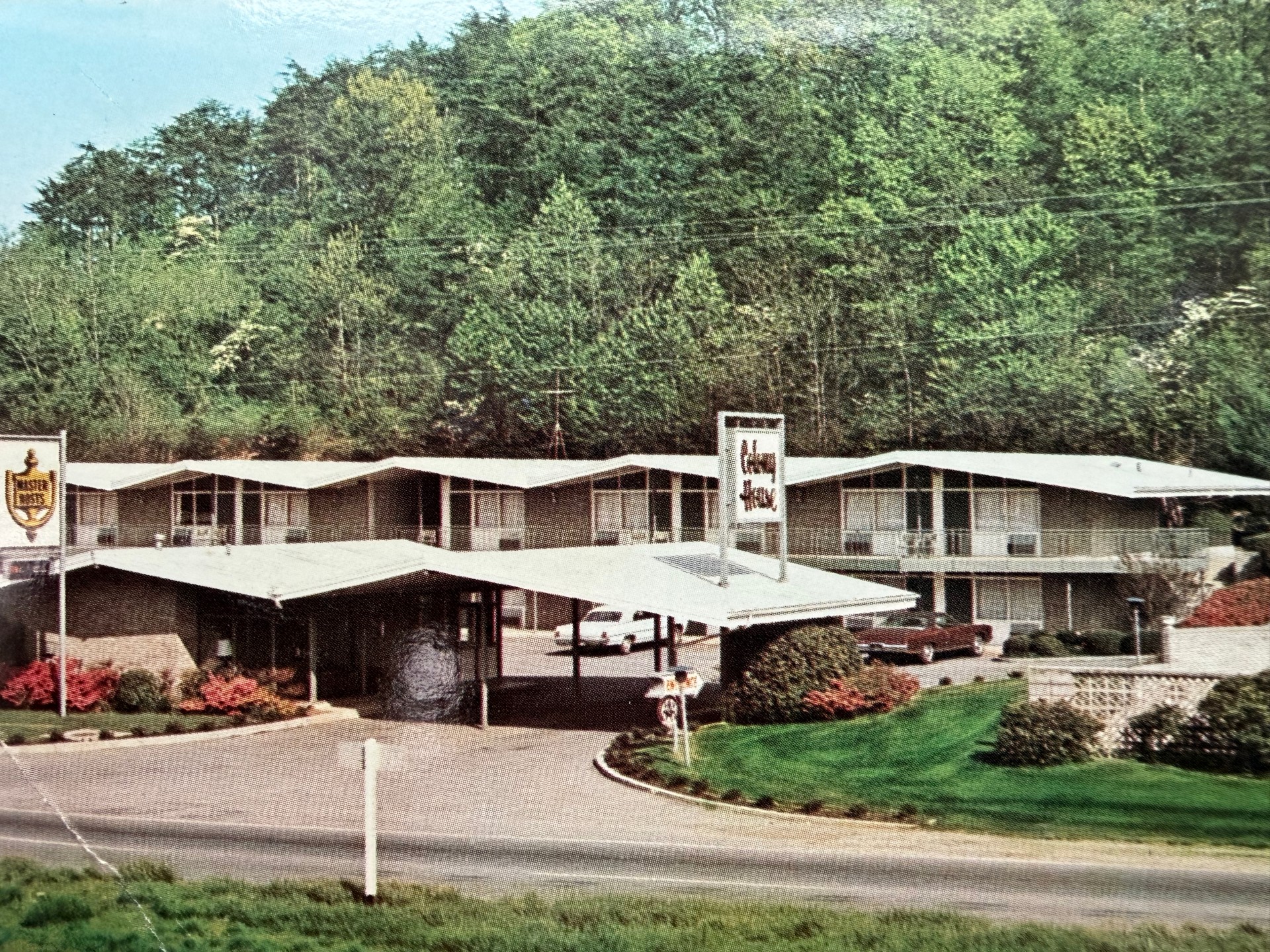
The Colony House Motor Lodge is a historic Midcentury Modern motor lodge that captures the character of America's roadside travel era.
The Colony House Motor Lodge in Roanoke, Virginia, is a notable example of mid-20th century roadside hospitality, embodying the economic ambitions associated with the rise of automobile travel in the United States. Constructed along U.S. Route 220 in 1959, a principal corridor linking Roanoke with communities to the south and west, the motor lodge occupied a strategic location that capitalized on the expanding culture of leisure and business travel in the post–World War II era. Prior to this period, cities such as Roanoke had oriented their commercial infrastructure around rail travel, with hotels clustered near station depots. But the subsequent decline of passenger rail service in the 1950s created a shift toward automobile-based tourism. The transition away from trains was particularly evident in Roanoke, where the decade witnessed both the waning dominance of the Norfolk and Western Railway and the proliferation of motels along major roadways. It was within this climate that Richard Trent and Horace Fralin decided to open their own motor lodge on the outskirts of the city. Entrepreneurs with deep ties to several of the area’s prosperous contracting firms, Trent and Fralin relied on their preexisting expertise to develop an innovative design for the destination. Richard Trent’s ownership of a construction company enabled the extensive use of concrete blocks and bricks in the lodge’s creation, integrating locally sourced materials with modern building techniques.
To further help their planning, Richard and Glover enlisted the services of an accomplished architectural firm based out of nearby Salem, Virginia, known as “Kinsey and Motley.” Kinsey and Motley proceeded to implement Mid-Century Modern motifs across the complex’s façade, using a design subset remembered today as “Googie.” The architects intended for the choice to convey a sense of futurism and motion to any prospective guest. A series of folded-plate roofs appeared atop the structure, which generated a rhythmic pattern of geometric gables. The architects’ use of concrete slabs, slender steel supports, and expansive plate-glass window walls reinforced Googie’s emphasis on dynamic forms of movement.
Named the “Colony House Motor Lodge” upon its debut, the establishment quickly hosted a diverse array of guests, including traveling salespeople, entertainers, and athletes performing at nearby venues (such as Victory Stadium). One of those was football legend Johnny Unitas as he was among the first people to visit the Colony House Motor Lodge, as was the soon-to-be-famous English pop band, Herman’s Hermits. Among the most alluring qualities those visitors encountered was the iconic swimming pool, situated centrally within the grounds. The Colony House Motor Lodge offered access to a stunning restaurant, Town and Ranch, which earned a celebrated regional reputation for its steak and seafood dishes. As a result, countless residents across the community soon began referring to Colony House Motor Lodge as the “guestroom of South Roanoke.”
Much of the destination’s success was due to the talented stewardship of the Trent family, who diligently managed the operations on-site for decades. Despite possessing a full-time job of his own, Richard Trent’s brother, Glover, served as the main front desk manager, while both of their children spent time as employees whenever school was out. The eventual closure of the motor lodge in 2018 marked the end of a more than a half-century of continuous operation, a lifespan that reflected the resilience of independently operated motels. The Colony House Motor Lodge soon experienced a comprehensive rehabilitation under the new ownership of the Farrell family not long thereafter. Interior spaces were redesigned to evoke the memory of mid-century travel trends, incorporating retro-inspired furnishings, bold color schemes, and period-authentic details. The Farrell family also masterfully integrated numerous contemporary amenities throughout the complex, including updated mechanical systems, fitness facilities, and expanded communal spaces. The climactic reopening of the historic motor lodge seven years later thus came to represent a true revitalization of the site, orienting the facility to function as a refined boutique hotel. Now listed in the U.S. National Register of Historic Places, the preservation of the Colony House Motor Lodge has been a remarkable achievement worth commemorating.
Hotel Timeline
The Location
The community now known as “Roanoke” lies at the intersection of the Great Wagon Road and the Carolina Road, both of which evolved from Native American trails in the Appalachian region. The name "Roanoke" is believed to have originated from a Native American word for shell beads used as currency, although this term was first used 300 miles away where the Roanoke River meets the Atlantic Ocean near Roanoke Island. Nevertheless, the Roanoke Valley was originally inhabited by the Tutelo tribe, a Siouan-speaking people who gradually migrated north to avoid the encroachment of European colonists. In their wake came the first Scotch-Irish settlers, who established numerous homesteads throughout the countryside during the 18th and early 19th centuries. They were soon followed by bands of German families arriving from Pennsylvania via the Great Wagon Road. By 1838, the population had grown enough to warrant the creation of Roanoke County from parts of neighboring Botetourt and Montgomery Counties. However, the fate of the area changed forever when the Virginia and Tennessee Railroad arrived in 1852, turning the site into a significant commercial hub for all goods traveling further in the mountains.
A small village soon emerged filled with several tobacco factories that specialized in shipping the product from costal Virginia. Referred to as “Big Lick Depot,” the town became an important Confederate supply center once the American Civil War erupted mid-century. Although the community managed to survive the war relatively unscathed, it still underwent a period of economic hardship due to reduced trade reaching the region amid the Reconstruction era. With the Virigina and Tennessee Railroad providing the only reliable source of transportation throughout the area, Big Lick Depot recovered much more quickly than most other settlements in the Commonwealth. In fact, the village was able to receive an official charter as the “Town of Big Lick” in 1874, reflecting the return of its prosperity. Then eight years later, Big Lick became the junction of the Shenandoah Valley Railroad and the Norfolk and Western Railway (N&W). Roanoke’s population subsequently exploded, ultimately enabling local civic leaders to grow Big Lick into the size of an actual city they renamed as “Roanoke.” However, this rapid growth eventually brought challenges to the local population, including inadequate infrastructure and public health issues.
Despite setbacks, Roanoke continued to grow throughout the 20th century, with several sprawling municipal projects, including the creation of the Roanoke Memorial Hospitality and the American Viscose Corporation’s rayon plant, serving as key achievements. But in 1982, the Norfolk & Western Railroad merged with the Southern Railway forming the Norfolk Southern Corporation. Roanoke lost its main employer, since the newly formed Norfolk Southern Corporation relocated its primary headquarters to Norfolk. This event, along with the closure of several manufacturing plants, left a gap in the city's economic base. Nevertheless, Roanoke has focused on revitalizing its economy and infrastructure in recent years, becoming celebrated as “The Star City of the South.” Partnerships with Virginia Tech and Radford University have led to the development of an "innovation corridor," and efforts to market the city as an outdoor tourism hotspot have helped reverse population decline. Furthermore, the city has evolved into a major tourism destination due to its proximity to natural attractions nestled in the greater Blue Ridge Mountains, such as Mill Mountain Park and Cavins Cove Natural Reserve. Other fascinating cultural landmarks are in Roanoke proper, including the Virginia Museum of Transportation, Taubman Museum of Art, and the Harrison Museum of African American Culture.
The Architecture
When architectural firm Kinsey and Motley originally built the Colony House Motor Lodge, it chose the aesthetics of Mid-Century Modern design as the source of his inspiration. More specifically, the company decided to rely upon the qualities of one of its subsets, a style remembered today as “Googie.” Googie architecture itself emerged in Southern California during the late 1940s and 1950s, reflecting a society captivated by speed, optimism, and the promise of the Space Age. Named after a Los Angeles coffee shop designed by John Lautner, the style quickly spread along highways and commercial strips, where eye-catching design was essential for attracting passing motorists. Architects such as Wayne McAllister and firms like Armet & Davis embraced exaggerated futuristic imagery to embody a distinctly American vision of progress and modernity. Buildings often featured sharp angles, sweeping rooflines, oversized signage, and bold geometric shapes that seemed to defy gravity. Glass walls, neon lights, and steel elements reinforced a sense of innovation, too, while motifs like boomerangs, starbursts, and atomic symbols echoed contemporary fascination with science. Googie architecture was as much about spectacle as function, designed to stand out within an increasingly competitive commercial landscape. Although the style fell out of favor for more subdued modernist forms in the 1960s, it has since been reappraised as a vivid expression of mid-century American culture.
Famous Historic Guests
- Johnny Unitas, legendary NFL quarterback known for setting passing records while playing for the Baltimore Colts in the mid-20th century.
- Lou Rawls, singer known for his baritone voice and three Grammy Awards for Best Male R&B Vocal Performance.
- Lulu Roman, comedian and singer remembered for being a longtime cast member of Hee Haw.
- Herman's Hermits, English pop band remembered for songs such as "I'm Into Something Good" and "Mrs. Brown, You've Got a Lovely Daughter."