
History
Discover Hanover Inn Dartmouth, which is Part of the Dartmouth College campus, and is located on the site of an inn dating back to 1780.
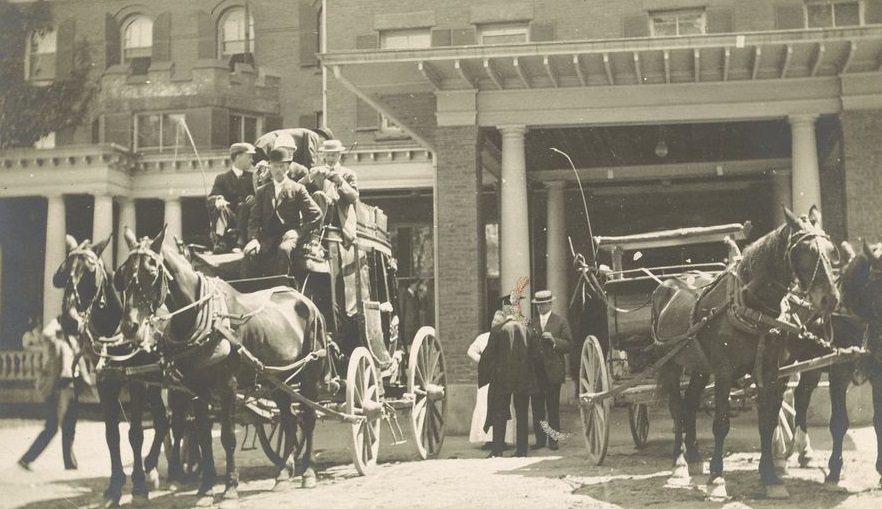
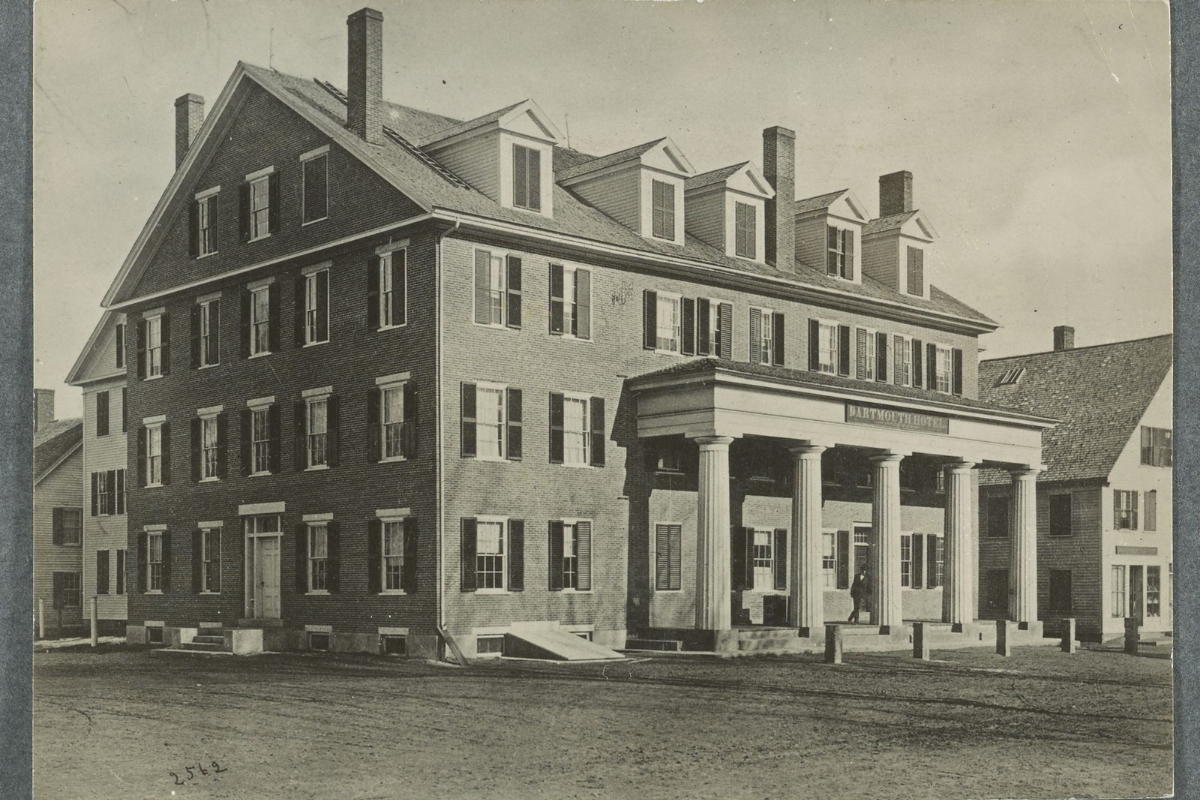
Part of the historic campus of Dartmouth College, the magnificent Hanover Inn Dartmouth has been a member of Historic Hotels of America since 2009. Blending rich history with 21st-century conveniences, this fantastic boutique hotel has truly earned its reputation for luxury and comfort. Like an intricately woven tapestry, the history of the Hanover Inn reflects the growth and change experienced by the school itself. Eleven years after Dartmouth College was founded via a charter granted by King George III in 1769, General Ebenezer Brewster arrived in Hanover to accept a position as the college’s steward. His home occupied the present site of the inn. An enterprising Connecticut Yankee, General Brewster redesigned the residence into a tavern in 1780. One historian has noted that his new business was, "not altogether, it would seem, to the gratification of the College authorities." The tavern flourished nonetheless, and in 1813, General Brewster's son, Amos, had the tavern moved to another site. Upon the new location, Amos Brewster proceeded to expand the structure significantly by adding on new extensions and wings. General Brewster may not have been incredibly keen on the project, too, as the younger Brewster only began the renovations after he had convinced his father to take a long leave of absence. Nevertheless, the refurbished tavern began to invite many guests from across the United States, some of whom were among the most influential in the country at the time. In fact, President James Madison visited not long thereafter, highlighting the grand prestige that the business had managed to create.
The larger structure then became known as the “Dartmouth Hotel,” which housed both permanent and transient residents alike. Following the debut of the Wheelock Hotel as a companion to the Dartmouth Hotel in 1889, the entire business went into an unfortunate period of decline that lasted for more than a decade. To revitalize its fortunes, Dartmouth College began an extensive renovation that sought to restore its luxurious character. Upon the project’s completion in 1903, the new building reopened as the “Hanover Inn Dartmouth” to great acclaim. Following the relaunch, the history of the Inn was one of continual growth and expansion. For instance, in 1924, the college installed an east wing that provided several dozen additional guestrooms. Then, a decade later, the inn underwent another significant renovation that saw an outdoor dining terrace constructed from the ground up. The work had its intended effect of resuscitating the building’s earlier prestige. In fact, it revitalized appeal even attracted F. Scott Fitzgerald, who had arrived to observe the school’s famed Winter Carnival in 1939. (Fitzgerald had actually come to create a screenplay of the whole event alongside writer Budd Schulberg and a few others.) Many other outstanding guests would stay over the following years, too, including Kirk Douglas, Ella Fitzgerald, and Theodor Seuss Geisel (remembered today as “Dr. Suess.”) A few more U.S. Presidents even graced the building with their presence, such as Franklin Delano Roosevelt, Dwight D. Eisenhower, and Ronald Reagan.
In 2011, the Hanover Inn Dartmouth closed for a $43 million transformational renovation. First, the inn thoroughly redesigned 94 of its 108 guestrooms and opened a casual restaurant located right next to the lobby. By the following August, the architects had added the Hayward Ballroom, as well as several spectacular executive meeting rooms. The work to create the venues were the first step taken toward addressing a longstanding need for modern, on-campus conference facilities that reflected Dartmouth College’s standing as a world-class educational institution. Then in the fall, the Hanover Inn saw the debut of yet another terrific meeting space called the “Minary Conference Center.” Measuring 11,000 sq. ft., it opened with a total of seven exclusive chambers and an extravagant Grand Ballroom meant to host all kinds of exciting soirees. The renovations even spawned the Hanover Inn Dartmouth’s wonderful PINE restaurant, which offered an imaginative menu of New England-made food and drink. Today, the Hanover Inn Dartmouth is a spectacular AAA Four Diamond hotel, with 108 guestrooms (including 14 suites) that are set within a classic, colonial-inspired facade. It is a favorite place to visit among the nation’s cultural heritage travelers, given its location in Dartmouth College’s historic campus. Many more attractions are nearby, too, such as the Saint Gaudens National Historic Park, the Hood Museum of Art, and Sugarbush Farm. (The Hanover Inn Dartmouth is owned by Dartmouth College and managed by Pyramid Hotel Group.)
Hotel Timeline
The Location
One of America’s Ivy League members, Dartmouth College has a history that harkens far back in time to the origins of the nation itself. The school first opened during the 1760s, the last of the nine colleges to debut in the Thirteen Colonies before the onset of the American Revolution. Reverend Eleazer Wheelock of Connecticut had created the college alongside his pupil and friend, Samson Occum. Dartmouth College had been specifically born from their efforts to prostyle Native Americans at the earlier Moor’s Indian Charity School. While Moor’s Indian Charity School had some initial results among its attendees, it had gradually run short on money. Seeking to keep the institution alive, Wheelock and Occum set about raising the funds in both New England and Great Britain. Donations were generous, especially after Occum had successfully petitioned several aristocrats in England like the Second Earl of Dartmouth, William Legge. But Wheelock’s vision for the school had changed, wishing for it to evolve into an actual college with a greater body of students. While Occum and a few of the supporters—including Legge—eventually left the project, Wheelock nonetheless managed to use the new finances to reopen the school in Hanover, New Hampshire. Constructed on a plot of land donated by Governor John Wentworth—whose nephew was an ardent ally to the endeavor—Wheelock’s school received its royal charter in 1769. Even though the reverend intended to name the facility “Wentworth,” the governor insisted that he choose the name “Dartmouth” in honor of the Earl’s initial backing. Dartmouth College subsequently became one of New Hampshire’s leading educational institutions, with its first class receiving their diplomas in 1771. It continued to build a reputation for its excellence, hosting a student body every year in spite of war and economic crisis.
Wheelock himself remained in charge of the school until his death in 1779, who left it in the hands of his son, John. Despite John Wheelock’s enthusiasm, his inexperience brought him at odds with the college’s trustees. The trustees subsequently ousted the younger Wheelock from his post and nominated Reverend Francis Brown has his successor. Incensed, Wheelock fled to the New Hampshire legislature, where he petitioned its delegates to help him win back control. Wheelock specifically cited charges against the college’s officials, whom he likened to aristocratic elites. The argument found ready support in the state government. Indeed, Governor William Plumer ultimately revoked the royal charter in favor of a new one that made Dartmouth College a public university. The controversy persisted for months thereafter, even when James Wheelock himself died in 1817. Seeking to file a lawsuit, the college trustees enlisted the help of Daniel Webster, a prominent lawyer and alum of Dartmouth College. (Webster would later become one of America’s preeminent politicians in the 19th century, serving as a respected U.S. Senator and Secretary of State.) Webster then represented the trustees’ suit before the Supreme Court in the historic Dartmouth College v. Woodward case. His oration was incredibly moving, supposedly reducing Chief Justice John Marshall to tears. His most emotionally evocative words were his closing remarks, specifically: “ It is, Sir, as I have said, a small college. And yet there are those who love it." But Webster had also masterfully presented his case, arguing that the seizure of the charter was in violation of the U.S. Constitution’s Contract Clause. As such, the school reverted back to private control as “Dartmouth College” in 1819.
While Dartmouth College continued to be respected throughout New Hampshire, it finally emerged as a nationally reputed educational institution during the early 20th century. The transformation specifically came about thanks to the efforts of a series of talented administrators. The first William Jewett Tucker, credited by many to have started the college’s modernization. He secularized the curriculum and grew the student body to over 1,000. He also enlarged the campus to number over 20 buildings, which he designed to accommodate the growing student population with innovative amenities and services. His work was further expanded upon by Ernest Martin Hopkins, who presided over the transformation of the school's admission process. But the greatest of them all was the celebrated John Sloan Dickey. Assuming the mantle of college president after World War II, Dickey instituted an ambitious plan that affected the whole institution for the next three decades. He specifically sought to revolutionize the curriculum so that it covered international topics in the hope that it would inspire the students to become more concerned with world affairs. When he finally stepped down during the 1970s, Dickey had completed the college’s transformation into a leading national educational and research facility. Today, Dartmouth College remains one of America’s finest schools. It also has a number of notable alumni, including leading businesspeople, intellectuals, and Olympic athletes. In fact, 170 of its former students have served in at least one chamber of Congress! Truly few schools in the United States can match the wonderful heritage of Dartmouth College.
The Architecture
The current iteration of the Hanover Inn Dartmouth stands today as a wonderful interpretation of Colonial Revival architecture. Colonial Revival architecture itself is perhaps the most widely used building form in the entire United States today. It reached its zenith at the height of the Gilded Age, where countless Americans turned to the aesthetic to celebrate what they feared was America’s disappearing past. The movement came about in the aftermath of the Centennial International Exhibition of 1876, in which people from across the country traveled to Philadelphia, Pennsylvania, to commemorate the American Revolution. Many of the exhibitors chose to display cultural representations of 18th-century America, encouraging millions of people across the country to preserve the nation’s history. Architects were among those inspired, who looked to revitalize the design principles of colonial English and Dutch homes. This gradually gave way to a larger embrace of Georgian and Federal-style architecture, which focused exclusively on the country’s formative years. As such, structures built in the style of Colonial Revival architecture featured such components as pilasters, brickwork, and modest, double-hung windows. Symmetrical designs defined Colonial Revival-style façades, anchored by a central, pedimented front door and simplistic portico. Gable roofs typically topped the buildings, although hipped and gambrel forms were used, as well. This form remained immensely popular for years until largely petering out in the late 20th century. Nevertheless, architects today still rely upon Colonial Revival architecture, using the form to construct all kinds of residential buildings and commercial complexes. Many buildings constructed with Colonial Revival-style architecture are even identified as historical landmarks at the state level, and the U.S. Department of the Interior has even listed a few of them in the U.S. National Register of Historic Places.
Famous Historic Guests
- Kirk Douglas, actor known for his roles in Spartacus, Paths of Glory, and The Bad and the Beautiful.
- Ella Fitzgerald, singer known for her songs “Dream a Little Dream,” “A-Tisket, A-Tasket,” and “It Don’t Mean a Thing (If It Ain’t Got That Swing).”
- Duke Ellington, legendary Jazz musician whose orchestra famously played at the Cotton Club.
- B.B. King, musician hailed throughout the world as “The King of the Blues.”
- Robert Frost, author best remembered for his four Pulitzer Prizes for Poetry.
- Sinclair Lewis, author best known for writing Babbitt, Main Street, and It Can’t Happen Here.
- Carl Sandburg, three-time Pulitzer Prize winner best remembered for his biography on President Abraham Lincoln.
- F. Scott Fitzgerald, author remembered today for writing The Great Gatsby.
- Theodor Seuss Geisel, author of more than 60 children’s books who remembered today by his pen name “Dr. Seuss.”
- J.D. Salinger, author best remembered for writing Catcher in the Rye.
- Booker T. Washington, educator and former slave who eventually founded Tuskegee University.
- James Monroe, 4th President of the United States (1809 – 1817)
- Woodrow Wilson, 28th President of the United States (1913 – 1921)
- Franklin Delano Roosevelt, 32nd President of the United States (1933 – 1945)
- Dwight D. Eisenhower, 34th President of the United States (1953 – 1961), and Supreme Allied Commander Europe during World War II.
- Richard Nixon, 37th President of the United States (1969 – 1974)
- Ronald Reagan, 40th President of the United States (1981 – 1989)
Guest Historian Series
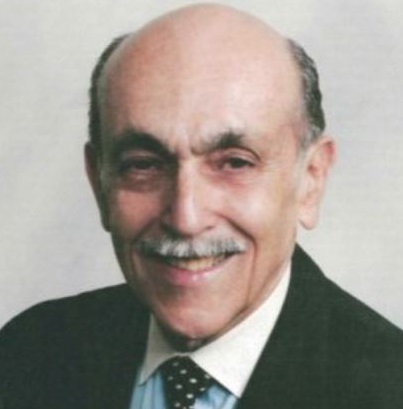
General Ebenezer Brewster whose home occupied the present site of the Hanover Inn, founded Brewster's Tavern in 1780. Around 1813, Brewster's son Amos replaced the tavern with a much larger building called the Dartmouth Hotel. That structure burned to the ground in 1887 and was replaced with a new building in 1889 which was called the Wheelock Hotel. From 1901 to 1903, Dartmouth College carried out extensive renovations to the facility which was named the Hanover Inn. An east wing was added in 1924 followed in 1939 by an exterior expansion. In 1968, a west wing was added to bring the total to 108 rooms. The neo-Georgian structure is owned by Dartmouth College and before it became co-ed, the fourth floor of the Hanover Inn was a women's dormitory with chaperones for single female guests.