History
Discover the Island House Hotel, which was originally constructed as a beachfront resort for Charles O’Malley.
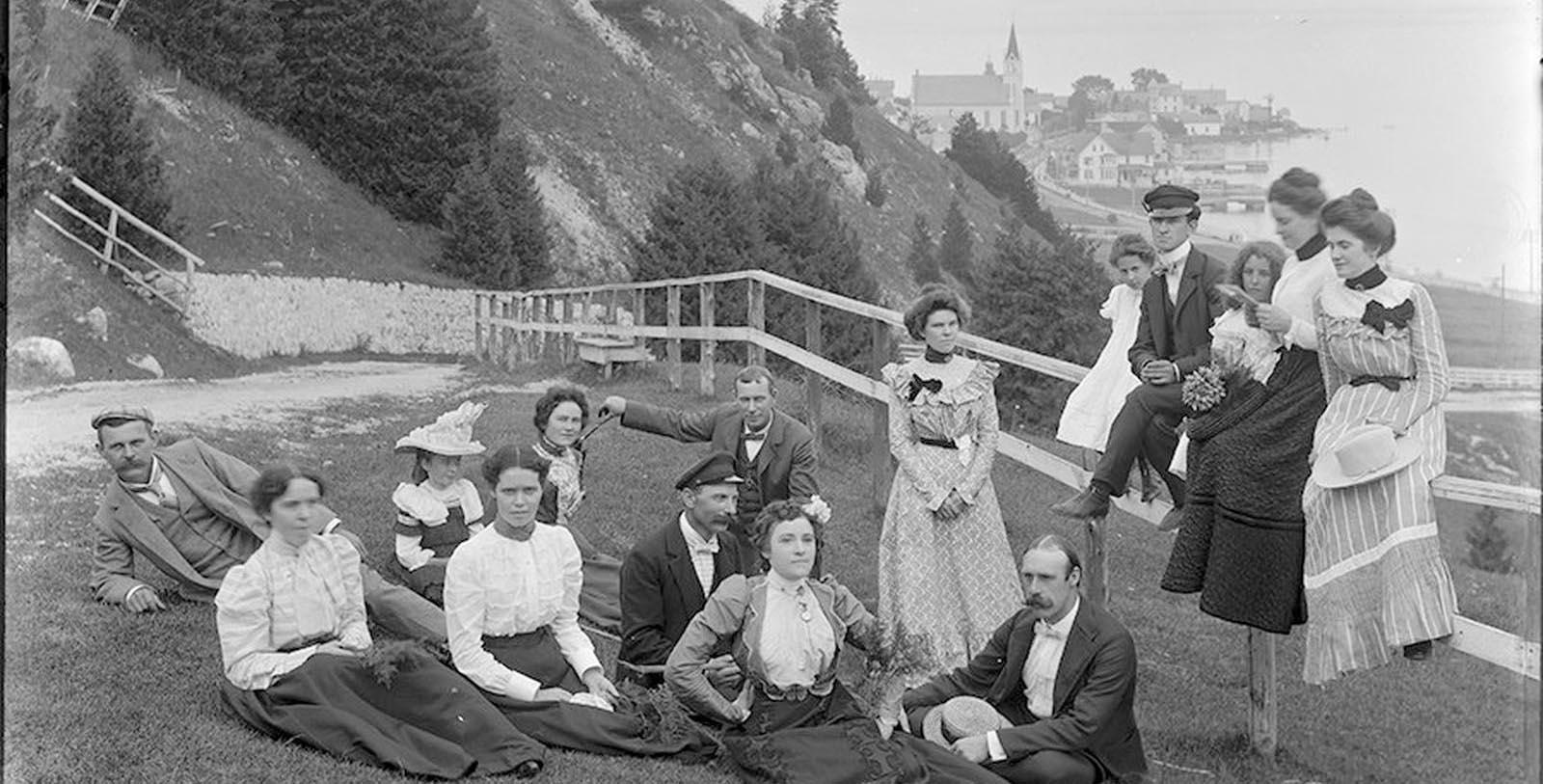
A member of Historic Hotels of America since 2005, the Island House Hotel has overlooked the water of Lake Huron since the mid-19th century. Charles O’Malley first constructed this brilliant historic destination, opening it as a beachfront retreat in 1852. O’Malley and his family had been enchanted with the island for years and recognized its potential as a pristine vacation retreat. But Captain Henry Van Allen subsequently purchased the building in the 1860s, relocating the building some 300 feet off the shoreline from its present location. Under Captain Van Allen’s direction, the hotel quickly emerged as one of Michigan’s most popular attractions. In fact, many visitors deemed the Island House Hotel as the “best family hotel” in the entire region. Upon his death in 1892, the captain left the business to his daughter, Rose Van Allen Webster. Alongside her devoted husband, they constructed two beautiful extensions on the Island House Hotel—the East and West wings—in 1895 and 1912, respectively. The guestrooms featured in those two new additions attracted socialites from across the country over the next quarter of a century, arriving from great metropolises like Chicago, Detroit, St. Louis, and New York City. The Websters sweetened the hotel’s appeal by offering many outstanding events, including afternoon high teas and a full ballroom orchestra. Rose Van Allen Webster continued to operate the Island House Hotel until her death in 1938, upon which the building remained vacant for the next several years as her descendants struggled to pay its taxes and maintenance.
But The Webster family finally found a financial solution to their problems when the Moral Re-Armament—an international peace organization—decided to lease the building around the start of World War II. The Moral Re-Armament then occupied the premises until the end of the 1940s. Yet, the Island House Hotel once again sat dormant after the group moved to Mission Point at the start of the following decade. The building underwent a prolonged period of decay as such, becoming incredibly dilapidated. The situation had grown so dire that the Chairman of Mackinac Island State Park, W.F. Doyle, feared that it had to be demolished. Fortunately, salvation arrived in 1969, when Harry Ryba and his son-in-law, Victor Callewaert, leased the ailing structure from the park. Dedicated to rescuing it, the two men decided to obtain the rights to reopen the structure again as the “Island House Hotel.” They then initiated a two-year-long renovation, which extensively restored every architectural detail inside the building. The men were so committed to saving the destination that they even managed to have the state government to recognize it as a Michigan State Landmark. The Island House Hotel subsequently reopened once again before thunderous applause in 1972. The Island House Hotel has since remained in the Callewaert family, who have continued to operate it with the utmost care. Historic Hotels of America has even recognized the brilliant work of the Callewaerts, awarding the Island House Hotel an Award of Excellence for “Legendary Family Historic Hoteliers of the Year” in 2020.
Hotel Timeline
The Location
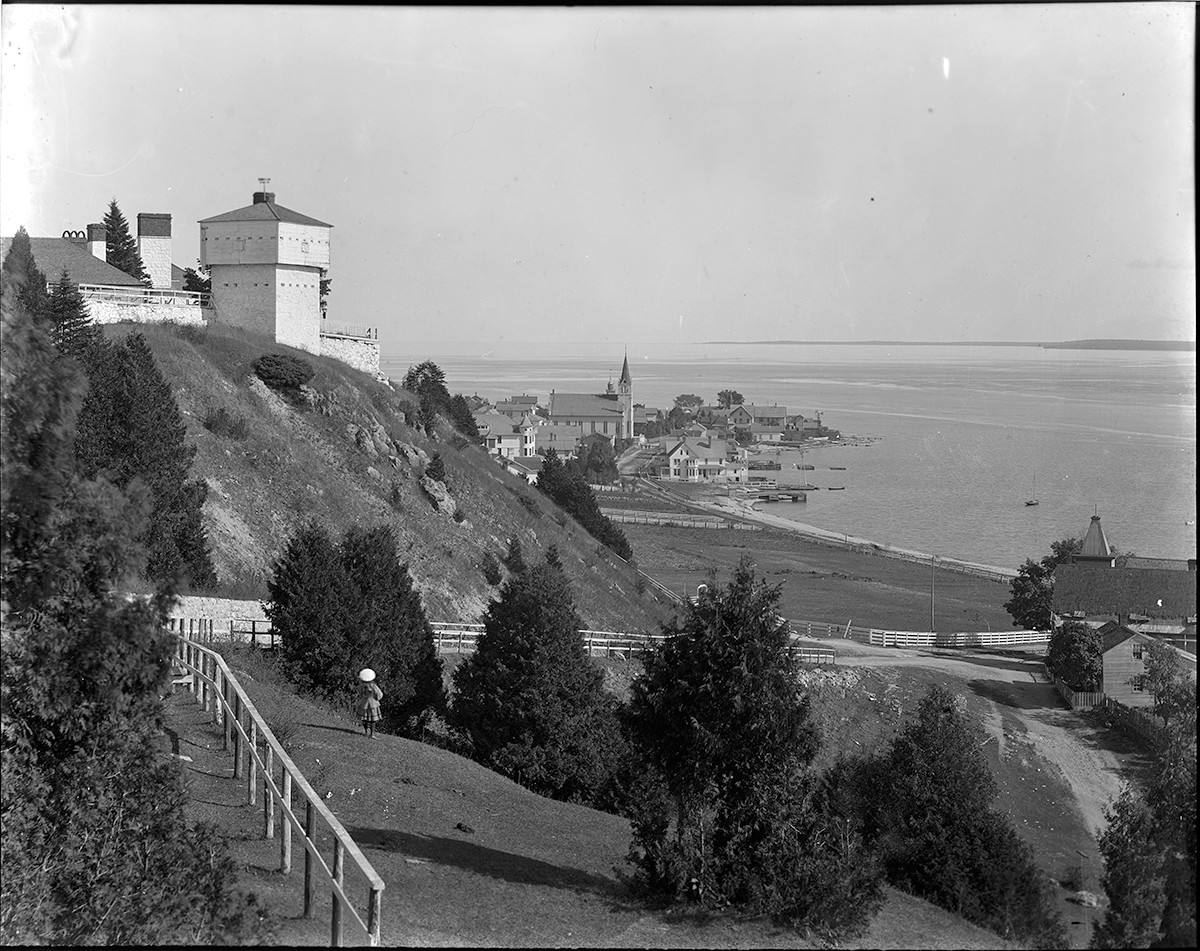
Located within the Straits of Mackinac at the confluences of Lake Michigan and Huron, Mackinac Island has been among the nation’s most celebrated holiday destinations since the late Victorian era. Yet, its history is quite extensive, harkening back millennia. Native Americans were the first people to visit Mackinac Island, traveling across the Straits of Mackinac to conduct religious ceremonies. Known as “Michilimackinac,” they regarded it as the home of the “Great Spirit” and buried their most influential tribal chiefs in the area. Then, in 1670, Claude Dablon—a Jesuit priest from French Canada—established a small mission on the island as a means of converting the local Indians. Another missionary named Jacques Marquette succeeded Dablon a year later, although he relocated the mission’s operations across the bay to a town he called “St. Ignace.” Many more French Canadians followed in Marquette’s wake, specifically creating numerous fur trading posts all over the region. Its prosperous trapping industry made the locale incredibly important to the economy of New France throughout the 17th and 18th centuries. Its economic significance was noticed by France’s greatest rival, Great Britain, whose military seized the entire area at the end of the French and Indian War. It subsequently raised a massive citadel which they named after the island itself. The island the fortress remained part of the British Empire for the next several decades, until the American colonists obtained the area via the Treaty of Paris after the American Revolutionary War in 1783. Despite the stipulations of the treaty, the British remained in the area for many more years thereafter. It took the signing of another agreement—the Jay Treaty—for Great Britain to finally relinquish control of Mackinac Island and the rest of the American Midwest to the young United States.
Mackinac Island continued to occupy great strategic significance for the American military, as Fort Mackinac functioned as a great deterrent for any possible British invasions into the region by way of Canada (now a colony of Great Britain). And as with the French and Indian War, the British attempted to capture the island again during the War of 1812. As soon as the fighting commenced, British Major General Isaac Brock dispatched a massive raiding party of a few hundred soldiers that attacked the island to be known as the “Siege of Mackinac.” The American commander, fearing for the lives of his men, surrendered the fort without a shot being fired. The British then reinforced their garrison and constructed a series of new military installations at the highest point on the island that they referred to as “Fort George.” Eager to recapture the area, the American sent a force of some 700 soldiers under the command of Colonel George Croghan. Arriving outside of the island in 1814, the Americans launched an assault of their own during the Battle of Mackinac Island. Unfortunately for the Americans, the new British defenses were too strong and easily battered away their attack. The island thus remained under British occupation, only reverting back to American control when the fighting stopped a year later. The Americans kept the island fortified in the decades that followed, although the gradual development of peaceful relations between the United States and Great Britain over the course of the 19th century reduced its military significance. By the late 1890s, the American government decided to officially decommission the fort—renamed as “Fort Mackinac”—to Michigan. Michigan, in turn, transformed the entire island into the “Mackinac Island State Park.”
A small village along the coastline of Mackinac Island had formed on the aftermath of the War of 1812, fueled by the lucrative fur trading that had long defined the region’s economy. The great American entrepreneur, John Jacob Astor, even centered his famous fur trading company from Mackinac Island. Over time, the trapping industry was supplemented by a number of additional trades. Commercial fishing eventually overtook fur trapping as the dominant economic force on Mackinac Island, with anglers capturing all kinds of whitefish and trout in the waters of the coast. Its reputation as a fisherman’s paradise quickly attracted amateur sportsmen from across Michigan, giving rise to an equally successful tourism industry. Soon enough, several boat and railroad companies constructed hotels all over Mackinac Island, transforming it into one of Michigan’s most renowned vacation hotspots. A few local islanders established their own businesses in support of the emerging hospitality trade, opening restaurants and small trinket shops. Some even debuted their own accommodations, including Charles O’Malley and his Island House Hotel. Mackinac Island has since become an internationally renowned holiday destination, noted for its scenic beauty and amazing cultural attractions. Fort Mackinac is perhaps the island’s greatest landmark, serving as the focal point for the renowned Mackinac Island State Park. The village that resides along the coastline has also retained its Victorian ambiance, with its residents diligently preserving the rich architectural character of every building. The community remains so committed to preserving the island’s heritage that automobiles are not even allowed on the island!
The Architecture
The Island House Hotel possesses a unique architectural style that can best be described as “eclectic.” Dating to the mid-19th and early 20th centuries, historians today consider “eclecticism” to be part of a much larger movement to fuse together a variety of historical designs. Earlier in the 1800s, architects—particularly those in Europe—decided to rely upon their own loose interpretations of historical architecture whenever they attempted to replicate it. Such a practice appeared within such styles as Gothic Revival, Italianate, and Second Empire architecture. But at the height of the Gilded Age, those architects decided to use historic architecture more literally when developing a building. A few architects went a step further by combining certain historical styles together to achieve something uniquely beautiful. And in some cases, those individuals felt inspired to add a new historical form onto a building that they were renovating—just like the Island House Hotel. Ultimately, the architects felt that joining such architectural forms together would give them a new avenue of expression that they otherwise did not have at the time. They also believed that they had stayed true to the earlier forms, having perfectly replicated whatever it was they wanted to mimic.
In Europe, this approach first appeared as a rehash of Gothic Revival-style known as “Collegiate Gothic.” The European architects then used such a mentality to influence the unfolding philosophies of both the Beaux-Arts school of design, as well as the emerging Renaissance Revival-style. Many architects in America followed suit, the most notable of which being Richard Morris Hunt and Charles Follen McKim. The American architects who embraced “eclecticism” were at first interested in the country’s colonial architecture. Much of the desire to return to the time period was born from the revived interest in American culture brought on by the Centennial Exposition of 1876. Pride in preserving the nation’s heritage inspired the architects to perfect the design principles of their colonial forefathers in new and intriguing ways. This interest gradually splintered into other revival styles, though, like Spanish Colonial and Tudor Revival. Some Americans even infused the approach with the popular Beaux-Arts aesthetics of France, such as Hunt and McKim. Yet, the birth of Modernism in the 1920s and 1930s eventually ended the worldwide love affair with “eclecticism,” for architects throughout the West became more enchanted with the ideas of modernity, technology, and progress.
Guest Historian Series

From its beginning over 150 years ago as a waterfront beach house to the family-restored hotel it is today, the Island House has opened its doors to over a million tourists from around the world. With its handsome Victorian structure and family-owned intimacy, Mackinac Island's oldest hotel is a tradition not be missed.
Originally constructed for Charles O'Malley in 1852 as beachfront resort, the Island House was one of the first summer hotels on Mackinac Island. In 1865, Captain Henry Van Allen, a Great Lakes skipper, purchased the resort, thus beginning a family tradition that would last nearly 75 years. During this time he moved the hotel about 300 feet off the shore to its present location to allow for future expansion. Under Captain Van Allen's direction, the Island House was deemed the Island's "best family hotel" as Mackinac Island was voted the most popular summer destination in America.
Continue Reading