
History
Discover the storied history of Mayflower Park Hotel, a Seattle landmark that has welcomed guests and evolved with the city since 1927.
Mayflower Park Hotel was constructed during the “Roaring Twenties,” when flappers, radio, and the Art Deco movement defined the age. Mayflower Park Hotel is the oldest continuously operating hotel in downtown Seattle. Its first incarnation was as the Bergonian, which opened with 240 rooms in 1927 following six months of construction and an investment of $750,000. Over the ensuing decades, the hotel underwent a number of ownership changes and transformations. The space that is now home to Oliver’s first operated as a Bartell Drugs location during Prohibition. Following the repeal of Prohibition, it became the Carousel Room, one of the first hotel bars in Washington State, known for its distinctive carousel horses suspended from the ceiling. In 1976, the space was transformed once again with the opening of Oliver’s, which became Washington State’s first Daylight Bar, a distinction reflecting its visible windows into the bar and restaurant.
Birney Dempcy and his wife, Marie, acquired the hotel in 1974 through a limited partnership and renamed it Mayflower Park Hotel. An extensive renovation followed, including the addition of the 4th Avenue entrance. In 1988, the opening of the neighboring Westlake Center brought renewed activity to the area and helped establish Mayflower Park Hotel as one of Seattle’s most distinguished hotels.
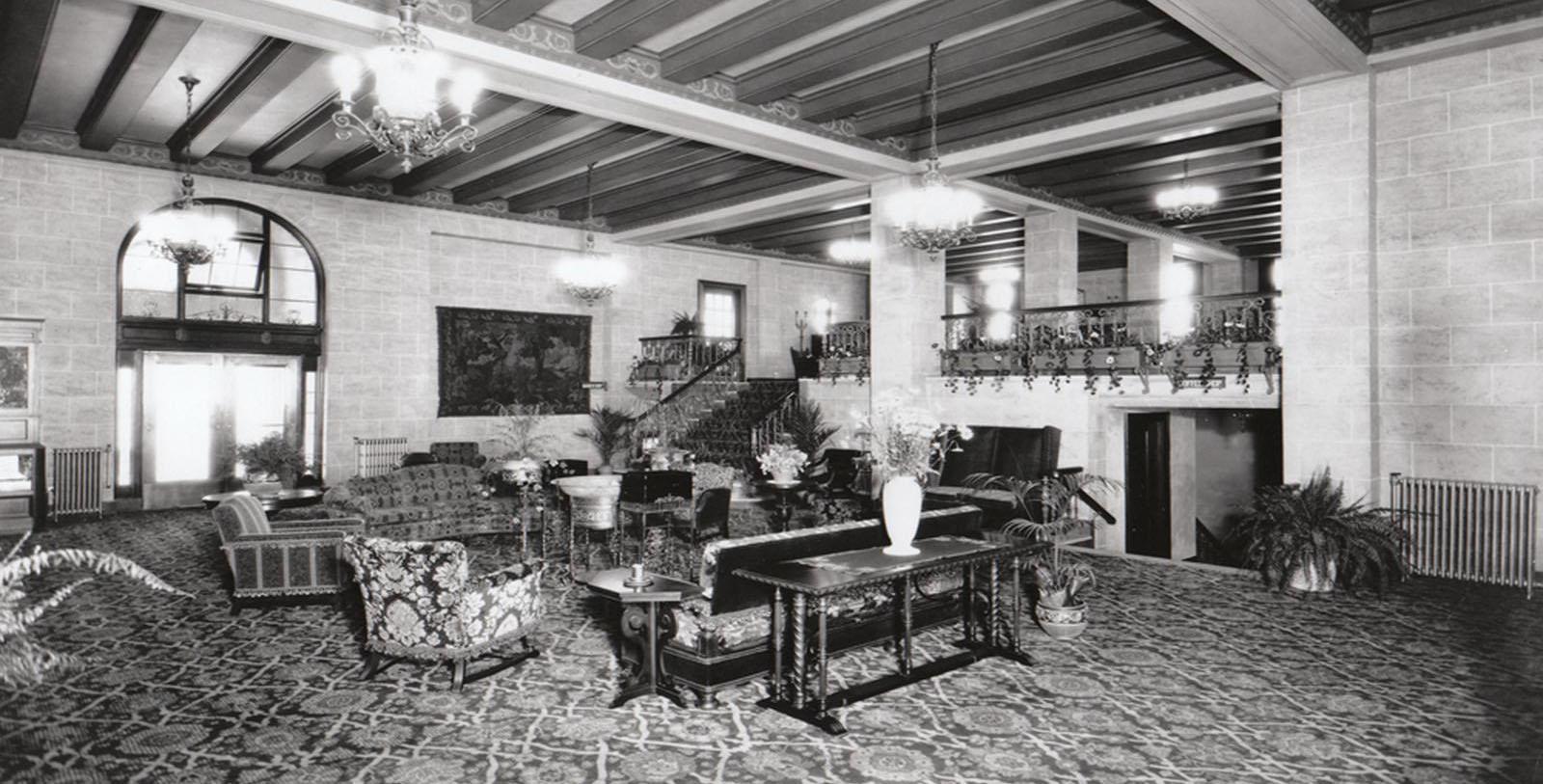
Today, details throughout Mayflower Park Hotel reflect its nearly century-long history, including the original terra cotta exterior, the lobby’s five-tier crystal chandelier, salvaged from the Grand Ballroom of the Olympic Hotel, and a 200-year-old grandfather clock. Together, these enduring features preserve the character and historical significance of one of Seattle’s longstanding landmarks.
Hotel Timeline
The Location
The founding of Seattle dates to 1851, when nearly two dozen Euro-American migrants arrived from Illinois to settle Alka Point. Led by Arthur A. Denny, those pioneers are known to history as the “Denny Party.” Their small community was the first non-Native American settlement in region, which primarily harvested timber from the surrounding forest. Yet, the water surrounding Alki Point proved to be too shallow to accommodate the commercial vessels that transported the lumber. As such, the pioneers relocated a few miles to the north along Puget Sound, specifically at the mouth of the Duwamish River near Elliot Bay. Shortly thereafter, those settlers were joined by another group under the direction of David Swinson Maynard, who many referred to as “Doc.” Maynard’s group set up just south of the Denny Party, and over time, those two communities melded together. Right next to the village was a vibrant community of local Duwamish Indians who were governed by a Chief Seattle. The two groups formed a close bond that proved to be beneficial over the next decade. In honor of the chief, the pioneers eventually called their settlement as “Seattle.” The name stuck, even after the Territorial Legislature formally incorporated the community in 1869.
Logging remained the dominant industry within the community, with a steam-powered sawmill serving as its main employer. The village grew slowly at first, with European immigrants from America’s East Coast constituting the majority of the new arrivals. Yet, the community’s population exploded when the Northern Pacific Railway arrived in nearby Tacoma. This development was further augmented when a second railroad, the Great Northern Railway, established an actual terminus within the city limits. As such, Seattle’s population rose from around 3,500 in 1880 to more than 80,000 some two decades later. The railroads also transformed the city into a major hub for trade in the western United States, rivaling the likes of San Francisco in its commercial importance. Some 50 miles of wharves emerged in the heart of Seattle, too, which turned the area into a bustling seaport. The development of its waterfront even caused countless miners to use it as their main supply depot for the Klondike Gold Rush of the 1890s. Its metamorphosis into an international trading center spawned rapid urbanization, as all sorts of businesses quickly appeared for the first time. Seattle, in particular, earned a reputation for being an “open city,” in which saloons, brothels, and casinos dominated the local landscape.
As the Seattle evolved more into a modern city, its politicians became increasingly concerned about its fate. Several activists within the early 20th-century Progressive Movement eventually drove out the officials who embraced the “open city” policies. In their wake, they instituted strict prohibitions against alcohol and other vices through the 1930s. But the progressives also made headways in such arenas like housing and women’s suffrage. The Progressive Movement in Seattle ebbed right when the Great Depression hit, which affected its economy significantly. The city was able to lift itself out of the financial slump, thanks in large part to the expansion of the Defense industry in the years leading up to World War II. Seattle was a key manufacturer for the American war effort, producing all kinds of matériel for the military. The city itself was home to several major defense contractors, too. The greatest among those company was Boeing, which created thousands of planes at its Seattle and Renton factories. Another business, the Seattle-Tacoma Shipbuilding Corporation, employed some 33,000 people, who churned out countless ships during the war. At the same time, the city’s demographics had changed considerably. Large numbers of African Americans arrived in Seattle, allured by the prospects of work in the new factories. Japanese Americans began immigrating to the city, as well, although the wartime policies the Roosevelt administration temporarily relocated them to internment camps hundreds of miles away in Idaho.
By the late 20th century, Seattle had become one of the most economically vibrant destinations in the world. Supplementing this growth was the emergence of several prominent technological firms. Many high profile names within the industry established a significant presence in the city, such as Amazon, Microsoft, and Nintendo of America. Those businesses attracted talent from around the world, which saw Seattle’s population grow to two million people by the 1990s. The infusion led to a cultural proliferation that saw Seattle become a center for art and knowledge. Among the most famous trends to appear within the city at this time was modern-day American alternative rock music. Seattle is now a celebrated destination among travelers the world over. It is one of America’s fastest growing cities in terms of its size and economy. But Seattle is also among the nation’s most diverse, as it has large demographics of people form across the globe. Few places in the United States can claim the cultural liveliness that reigns in Seattle today.
The Architecture
Stephen Berg built the original Mayflower Park Hotel alongside the design firm Stuart & Wheatley. The architects had worked with Berg across Seattle on commercial and residential projects, including the Biltmore apartments on Capitol Hill. Completed in 1927, Mayflower Park Hotel exhibits many styles of architecture in its individual elements, but is best defined by the famous Beaux-Arts movement. Four Parisian architects in particular were responsible for establishing the Beaux-Arts movement: Joseph-Louis Duc, Félix Duban, Henri Labrouste, and Léon Vaudoyer. The training that these instructors created involved fusing architectural elements from several earlier styles, including Imperial Roman, Italian Renaissance, ad Baroque. As such, a typical building created with Beaux-Arts-inspired designs would feature a rusticated first story, followed by several more simplistic ones. A flat roof would then top the structure. Symmetry became the defining character, with every building’s layout featuring such elements as balustrades, pilasters, and cartouches. Sculptures and other carvings were commonplace throughout the design, too. Beaux-Arts only found a receptive audience in France and the United States though, as most other Western architects at the time gravitated toward British design principles.