
History
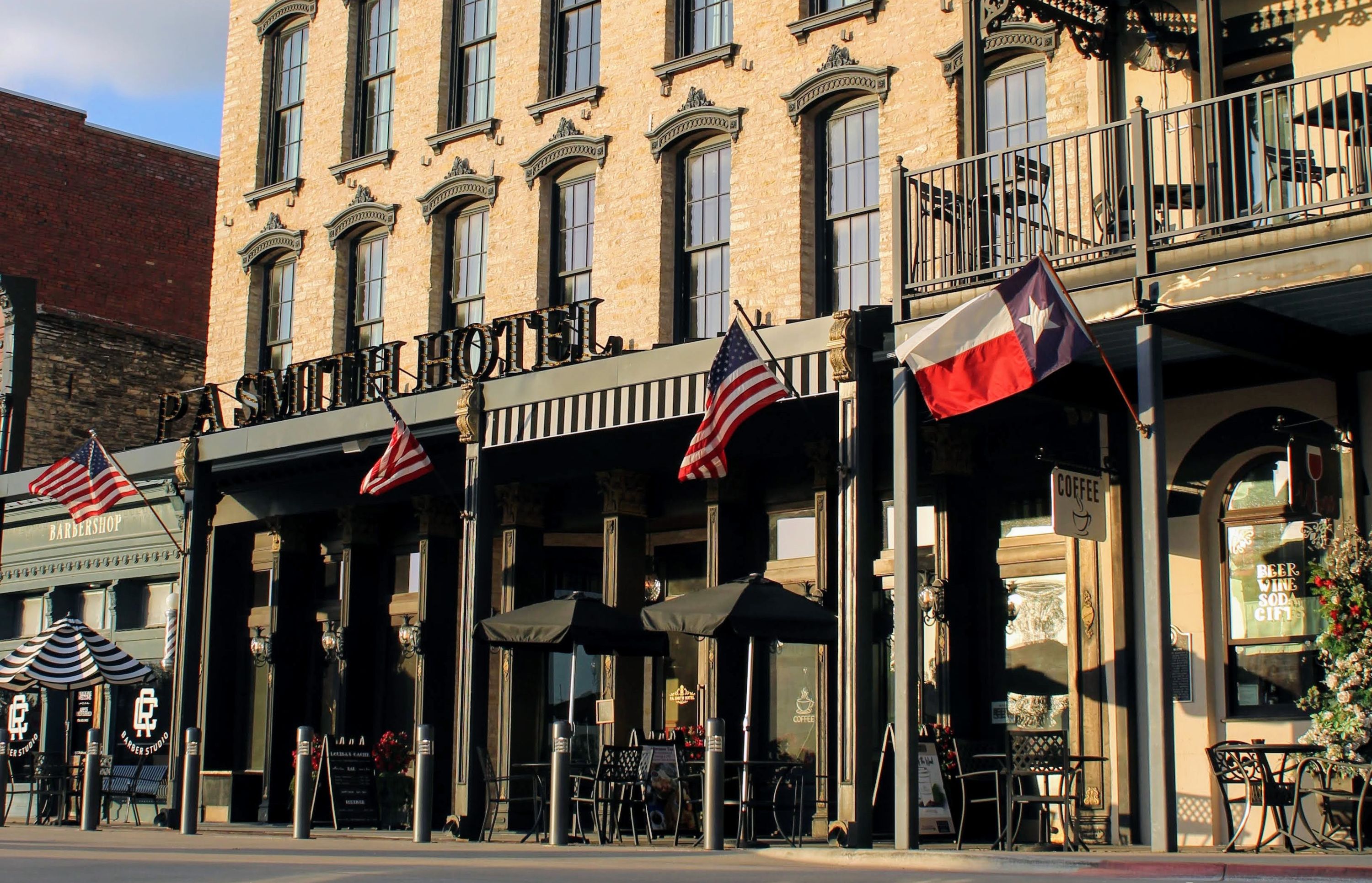
The story of the P.A. Smith Hotel is inseparable from the story of Navasota, a community that emerged as one of the most important commercial centers in Texas’ Brazos Valley during the latter half of the 19th century. Founded in 1854, Navasota quickly prospered after the arrival of the railroad, which transformed the town into a major shipping point for cotton, cattle, and agricultural goods. Indeed, this economic prosperity soon led civic leaders to envision a future that would place Navasota among the region’s most dynamic locations. Amid this atmosphere of optimism, local entrepreneur Louisa Loftin financed the construction of a substantial stone hotel near the railroad corridor, creating a landmark that could welcome travelers arriving in the bustling frontier community. Constructed masterfully of native limestone, the “P.A. Smith Hotel” immediately distinguished itself as one of the most impressive buildings in town. Rising three stories above Railroad Street, the structure embodied the prosperity that characterized Navasota at the time. Its proximity to the railroad made it an essential gathering place for businessmen, visitors, and residents alike, while its scale demonstrated the community’s growing importance within the commercial network of Texas.
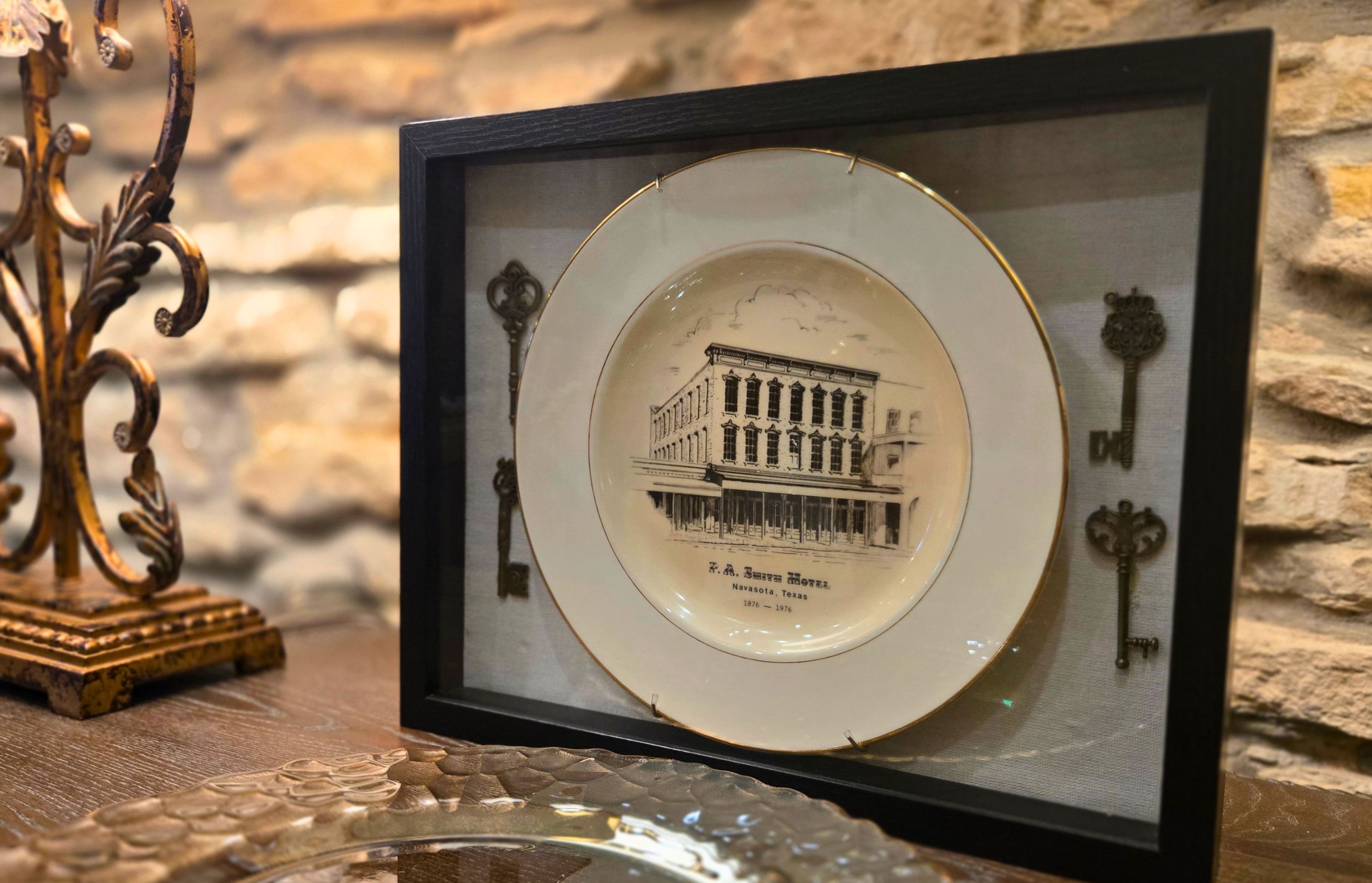
Loftin named the hotel after her husband Philip Aurene “P.A.” Smith, a prominent newspaperman, entrepreneur, and civic leader who had first arrived in Navasota right after the American Civil War. Smith’s life embodied the entrepreneurial spirit that helped shape many similar Texas communities throughout the Reconstruction era. Born in New York, he eventually relocated to Texas and became involved in a host of distinctive activities, including publishing, real estate, and community affairs. He operated several newspapers, maintained a furniture business, and even developed the celebrated Navasota Opera House. But his marriage to Louisa Loftin eventually united two influential figures whose combined vision contributed significantly to the city’s advancement. When the hotel finally opened in 1876, it stood as a visible symbol of their shared commitment to Navasota’s future. However, the building’s history soon took an unexpected turn. Although conceived as a hotel at the height of the railroad boom, it functioned in that capacity for only a relatively brief period. Following the death of Louisa Smith in 1890, the upper floors became the Smith family residence, and the structure gradually evolved to accommodate changing communal needs.
Indeed, the building served a variety of purposes over the following decades, reflecting the economic fluctuations that affected countless Texas towns as the 20th century began. Nevertheless, the historic building remained standing, enduring the hardships of the Great Depression, two World Wars, and generations of technological change. By the early 21st century though, years of deferred maintenance had taken a severe toll. When preservation-minded investors Stephen and Janice Scheve acquired the building in 2017, the future of one of Navasota’s most recognizable sites appeared uncertain. What followed was an extraordinary preservation effort that mirrored the growing interest in historic revitalization throughout Texas. Over the course of approximately five years, preservationists undertook the painstaking task of rescuing the structure while retaining its historic character. Thanks to those efforts, the P.A. Smith Hotel stands today as a reminder of the city’s rich heritage. Listed on the National Register of Historic Places for its architectural and commercial significance, the building bridges more than a century of regional history. Its restored interiors, historic stonework, and renewed role as a social destination have since truly come to echo the aspirations that first inspired its creation decades ago.
Hotel Timeline
The Location
Nestled along the historic corridor between Houston and the Brazos Valley, Navasota occupies a place in Texas history far larger than its modest size might suggest. Originally known as Hollandale after early settler Francis Holland, who established roots in the area in 1822, the community emerged at a strategic crossroads near the old La Bahía Road. The settlement adopted the name Navasota in 1854, taking its identity from the nearby river whose name has long been associated with the region. As Texas evolved from a frontier republic into a booming state, Navasota stood ready to capitalize on its advantageous location. The defining moment in the city’s development arrived in 1859, when the Houston and Texas Central Railway extended its tracks into town. While some neighboring communities resisted the coming of the railroad, Navasota embraced it. The decision transformed the settlement into one of the most important transportation and commercial centers in the region. Cotton from surrounding plantations, cattle from nearby ranches, and merchandise destined for distant markets all flowed through Navasota’s depots. By the close of the American Civil War, the town had grown into a thriving railhead with a population estimated at approximately 2,700 residents.
But prosperity was accompanied by hardship, enduring a series of devastating setbacks throughout the middle of the century. In 1865, an explosion involving stored cotton and gunpowder ignited a destructive fire that damaged much of the community. Soon afterward, cholera and yellow fever epidemics swept through the region, dramatically reducing the population and testing the resilience of those who remained. Despite these tragedies, the residents rebuilt with remarkable determination. By the late 19th century, new industries, cotton gins, oil mills, newspapers, churches, and civic institutions had emerged, while improved utilities such as electric lighting and water systems signaled the community’s transition into a modern era. As the 20th century subsequently dawned, Navasota continued to prosper as a commercial center serving the agricultural economy of Grimes County. The town’s historic downtown mirrored this success, with substantial brick commercial buildings—like hotels, churches, and storefronts—lining streets filled with countless merchants, travelers, and railroad workers. During this period, another chapter of Navasota’s legacy began to take shape, one that would ultimately earn the city statewide recognition.
Visitors interested in history and culture will find Navasota especially rewarding. The Historic Downtown Railroad District offers an evocative glimpse into the city’s railroad-era prosperity, with preserved commercial architecture and streetscapes that recall the late 19th and early 20th centuries. The Horlock History Center provides valuable insight into local heritage through exhibits, photographs, and artifacts that illuminate the community’s evolution. Travelers should explore the Foster House and the elegant historic residences along Washington Avenue, where mature oak trees and period architecture reflect generations of civic pride. Furthermore, those interested in music history will appreciate sites associated with Mance Lipscomb and the city’s enduring blues tradition. Lipscomb made a living playing music in rural communities surrounding Navasota before becoming one of the most respected blues musicians in America. In fact, Navasota is now widely celebrated as the "Blues Capital of Texas," a designation formally recognized by the Texas Legislature in 2005.
The Architecture
P.A. Smith Hotel possesses a unique architectural style that can best be described as “eclectic.” Dating to the mid-19th and early 20th centuries, historians today consider “eclecticism” to be part of a much larger movement to fuse together a variety of historical designs. Earlier in the 1800s, architects—particularly those in Europe—decided to rely upon their own loose interpretations of historical architecture whenever they attempted to replicate it. Such a practice appeared within styles like Gothic Revival, Italianate, and Second Empire architecture. But at the height of the Gilded Age, those architects decided to use historic architecture more literally when developing a building. A few architects went a step further by combining certain historical styles together to achieve something uniquely beautiful. And in some cases, those individuals felt inspired to add a new historical form onto a building that they were renovating—just like the Boar’s Head Resort. Nevertheless, the architects felt that joining such architectural forms together would give them a new avenue of expression that they otherwise did not have at the time. But they even believed that they had stayed true to the earlier forms, so long as their designs perfectly replicated whatever it was they wanted to mimic.
In Europe, this approach first appeared as a rehash of Gothic Revival-style known as “Collegiate Gothic.” The European architects then used such a mentality to influence the unfolding philosophies of both the Beaux-Arts school of design, as well as the emerging Renaissance Revival-style. Many architects in America followed suit, the most notable of which being Richard Morris Hunt and Charles Follen McKim. The American architects who embraced “eclecticism” were at first interested in the country’s colonial architecture. Much of the desire to return to the period was born from the revived interest in American culture brought on by the Centennial Exposition of 1876. More specifically, pride in preserving the nation’s heritage inspired the architects to perfect the design principles of their colonial forebearers in new and intriguing ways. This interest gradually splintered into other revival styles though, like Spanish Colonial and Tudor Revival. Some Americans even infused the approach with the popular Beaux-Arts aesthetics of France, such as Hunt and McKim. However, the birth of Modernism in the 1920s and 1930s eventually ended the worldwide love affair with “eclecticism,” for architects throughout the West became more enchanted with the ideas of modernity, technology, and progress.
Women in History
Fannie Giesel and Louisa Loftin: The story of P.A. Smith Hotel is a story of two women whose vision helped shape not only the current hotel but also the community of Navasota. P.A. Smith hotel is comprised of two historic buildings, though it takes the name of one. In 1860, German immigrants Fannie and R.H. Giesel completed a hotel and restaurant. Upon her husband’s death in 1871, Fannie continued to manage the hotel until 1881. The Giesel House remains the oldest commercial building standing in Grimes County. Sixteen years after the Giesel House was established, entrepreneur Louisa Loftin financed the construction of the neighboring three-story limestone hotel that would become P.A. Smith Hotel. Though Loftin's hotel would carry her husband's name, it was her foresight and investment that made it possible. At a time when few women directed major commercial building projects, both women left a lasting mark on downtown Navasota, and the two adjoining buildings have been given new life together.