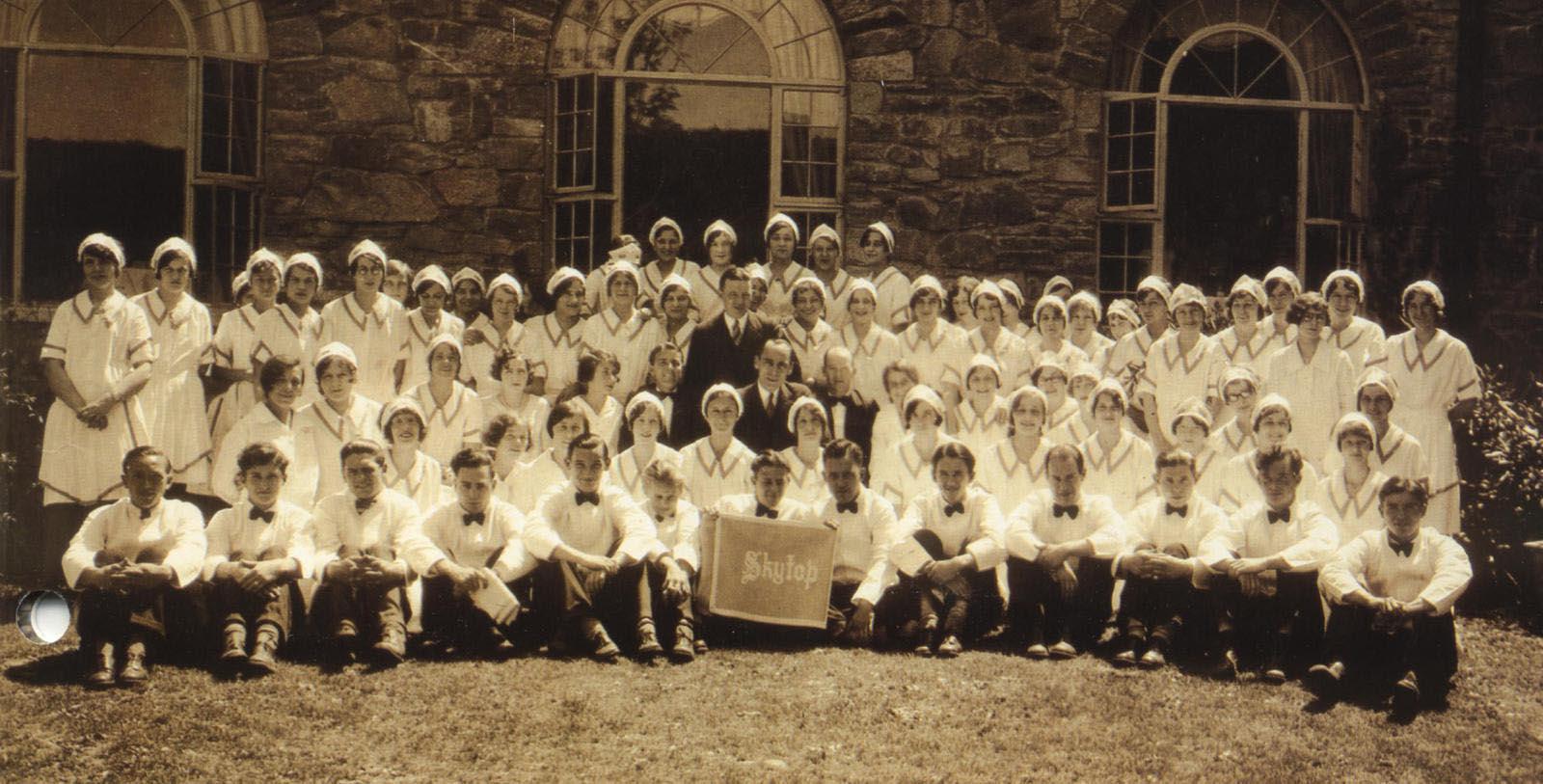

a group of people in white uniforms posing for a photo

History

Discover the Skytop Lodge with rustic charm and picturesque setting.

A member of Historic Hotels of America since 2000, the Skytop Lodge has offered world-class hospitality for nearly a century. Although its natural stonework seems to share its origins with the ancient mountains that surround it, Skytop Lodge began as the idea of a few farsighted individuals in 1925. In the Roaring Twenties, the nation's post-World War I prosperity was still at its height, and no one could have predicted the economic collapse that would occur in just a few years. There was optimism for the future, and big plans were common. As such, five men—John Stubbs, Charles Thompson, Frederic Smith, Earl Mayne and Samuel Packer—conceived of building a grand resort hotel in the Poconos on a high plateau three miles north of the village of Canadensis. They purchased eight contiguous tracts of land that initially totaled 2,500 acres just outside of Skytop, Pennsylvania, for their new wilderness retreat. Much of the location constituted an abandoned farm that was overrun with brush and stunted trees. Wasting no time at all, the men founded the Pocono Hotels Corporation to finance the project. They then created an operating arm called “Sky Top Lodges, Inc.,” to directly oversee the construction.

Stubbs specifically played a major role in getting the project underway, using his business connections to hire architect John Muller and his architectural firm to design the resort. Stubbs also commissioned the famous Olmsted brothers of Boston to landscape the surrounding grounds. He had even convinced Robert White—founder of the Professional Golf Association—to design an 18-hole golf course. For a sum of $642,547, Sky Top Lodges subsequently hired Barclay White & Company to oversee the construction of the main building of the nascent resort. Part of the money used to finance the project came from Daniel White—the uncle of Barclay White—and his business partner Jacob C. Myers also funded the construction by signing an indemnity bond worth $400,000 in loans from the Market Street Title and Trust Company. Both men had run a group of successful hotels in Atlantic City. (Other finances came from the issuing of “Gold Notes,” which were, in essence, debentures.) As such, both Daniel White and Jacob C. Myers became partners in the endeavor.

While the landscaping around the resort continued, construction on both the golf course and main building ended in 1928. As such, Thompson, Packer and Stubbs—as well as the other members of the board—opened the entire resort as the “Skytop Lodge” on June 16. Staying true to Stubbs’ plan, the board also elevated Samuel Packer to the status of General Manager. To enhance its value, the Pocono Hotels Corporation increased the capital stock to issue some 12,000 shares of preferred stock worth $100.00 par and 16,000 shares of common stock without par value. In 1930, the nearby lake was enlarged to its present size by the completion of a new dam. Additional Skytop projects soon followed, such as the construction of cottages and the acquisition of the 2,000-acre Goose Pond area. Hiking was also given great emphasis from the very onset of Skytop's development. Trails to all Skytop's scenic areas were laid out and maps were drawn to enable the lodge's guests to visit "places of quiet beauty and restful charm." Perhaps some of the best facilities that appeared at the resort involved the creation of the Poma Ski Lift, as well as its indoor skiing rink. As such, Skytop Lodge quickly emerged as one of the most exclusive vacation getaways in all the Poconos.

Skytop Lodge has undergone several dramatic transformations in recent years, too. In 1991, a new general manager named Ed Mayotte took over and immediately began renovating the entire facility. Among the changes he implemented involved the conversion of all the guestrooms on the “100 Level” into four massive meeting spaces. He also transformed the accommodations on the second floor into miniature suites and installed a spa on the fifth floor. Mayotte also oversaw the renovation of the boathouse into the Orvis shop and reintroduced several traditional activities like dog sledding. New versions of the 7th and 8th fairways debuted at the same time, as well as a community of condominiums called “Skytop Meadow” just beyond the 13th hole. More recently, the owners of Skytop Lodge constructed a wealth of new facilities, including the Adventure Center and the Executive Conference Center. They even initiated a massive $3.7 million-dollar renovation that beautifully refurbished all the guestrooms located on-site. Nevertheless, Skytop Lodge still possesses the same historic charm that first defined when it opened back during the 1920s. Truly, few places in the Poconos are better for a relaxing, bucolic vacation than Skytop Lodge.
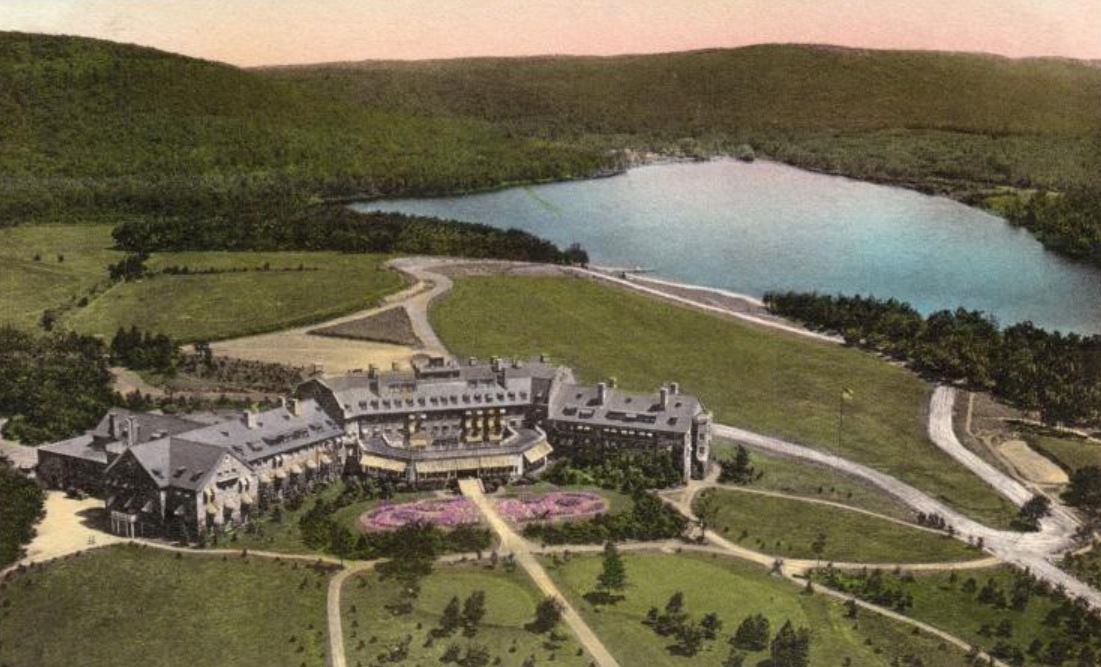
a large building surrounded by a lake

Hotel Timeline

The Inn at Buck Hill Falls underwent a significant period of alterations and enlargement. Operated by Charles Thompson and Samuel Packer, the destination was among the most popular in all the Poconos. Their colleague, John S. Stubbs—a dealer in securities in New York—proposed that the two men build another hotel nearby to capitalize upon Packer’s personality.

The men formed a holding company for their new hotel in Delaware called the “Pocono Hotels Corporation.” They then, in turn, created “Sky Top Lodges, Inc.,” which was an operating arm of the company headquartered in Monroe County, Pennsylvania. Approved by Governor Gifford Pinchot, Sky Top Lodges initially started running with just 12 board of directors.

Using his business connections in New York City, Stubbs connected with architect John Muller to design the new hotel, which the directors of the Sky Top Lodges envisioned as a magnificent wilderness resort hotel. Stubbs also commissioned the famous Olmsted brothers of Boston to landscape the surrounding grounds. He had even convinced Robert White—founder of the Professional Golf Association—to design an 18-hole golf course.

For a sum of $642,547, Sky Top Lodges subsequently hired Barclay White & Company to oversee the construction of the main building of the nascent resort. A part of the money used to finance the project came from the distribution of “Gold Notes.” Those documents were debentures issued to creditors, many of whom were members of the board.

VIEW MORE

While the landscaping around the resort continued, construction on both the golf course and main building ended. As such, Thompson, Packer and Stubbs—as well as the other members of the board—opened the entire resort as the “Skytop Lodge” on June 16. Staying true to Stubbs’ plan, the board also elevated Samuel Packer to the status of General Manager. The resort also debuted its “Maintain-Your-Health” program, which provided a full medical staff for guests to access.

Jacob C. Myers—one of the two who signed the indemnity bond some two years prior—convinced the directors of the Skytop Lodge to expand upon the resort, having convinced them of the inadequacies of the dining space. He subsequently hired Barclay White & Company to spearhead the project, which eventually constructed three cottages next to the fairway and several dozen more guestrooms. Meanwhile, a recent drought significantly reduced the size of Leavitts stream, leaving Skytop Lodge without a source of fresh water. Packer quickly began selling bottled water, while he commissioned the creation of a natural well.

Barclay White & Company was hired once more for another massive development project, constructing a 56-acre airstrip known as Barrett Airport. As such, Skytop Lodge began operating exclusive flights, as well as aerial tours of the greater Poconos. The company also built the Taproom and dining facilities, prompting some of the exclusive patrons to stop traveling to the site.

Dorothy Waldo Phillips—an educational psychologist—published a children’s book about the resort entitled, Dear Mrs. Bender. Phillips wrote the story from the perspective of the children who grew up in the mountains near the Skytop Lodge. Phillips had specifically used her experiences as the manager of the resort’s youth programming. Meanwhile, Samuel Packer vacated his role as the general manager to run the Lake Placid Club in New York. In his absence, the resort’s comptroller, Thornton Raney, assumed Packer’s responsibilities.

Ownership approved of new modifications for the resort’s outdoor destinations. Among the changes that they implemented was the creation of a 1,000-foot-long tow rope for those who disliked uphill hiking. And a few years later during World War II, the resort developed an observation post to help spot enemy aircraft. It was equipped with a telephone and instructional logbook.

Thornton Raney left the Skytop Lodge, leaving the resort without a general manager temporarily. William Malleson Jr., then arrived from New York City to become its third general manager. He had previously developed a national reputation within the hospitality industry, going as far as teaching hotel management classes at Cornell University.

Skytop Lodge acquired the 2,200-acre “Personeni Property,” which contained Goose Pond. Meanwhile, the Janey House located at the northern end of the resort was torn down. Additional renovations to the grounds commenced once Hurricane Diane ushered in record-breaking rainfall.

Peter Paul Muller—the nephew of the resort’s original architect, John Muller—designed the multipurpose Laurel Room. Measuring some 3,000 sq. ft., the venue featured a cocktail lounge, meeting space, and a banquet hall. Muller also designed the indoor pool located to the east of the main building’s lobby, which opened around Christmas. Other additions that appeared at the time included the direct automatic elevator and four “golf mobiles.”

An indoor skating rink and athletic pavilion debuted on the site of some former horse-riding grounds. This allowed for guests to engage in winter sports without having to worry about the state of the frozen lakes outside. Several new stales were built along the Dutch Hill Road, as well. At the same time, F.W. Smith published a short memoir about the founding of the resort entitled Skytop Lodge, Skytop: An Adventure.

In a bid to further enhance the resort’s winter activities, ownership commissioned the creation of the Poma Ski Lift. Donald Biles also assumed the role of general manager after having already been employed in various administrative roles at Skytop Lodge since 1952. Among his first tasks involved overseeing the creation of a new clubhouse that offered guests caddy services.

The resort discontinued horseback riding, but it created two new “Har-Tru” tennis courts. It also acquired snow-making equipment for the ski lift, and installed air conditioning throughout the facility. Sky Top Lodges, Inc. officially changed its name to “Skytop Lodges, Inc.,” as well.

William Malleson Jr’s son, Bill, assumed the role of general manager at the Skytop Lodge. He subsequently instituted dramatic changes throughout the resort, including installing televisions and computers for the first time. He also added a new outdoor pool, hot tubs, and a children’s swimming area. Under his watch, Skytop Lodge converted all its “running water rooms” (accommodations that share a connecting bathroom) into deluxe, twin bed guestrooms, as well.

VIEW MORE

Significant changes transpired at Skytop Lodge. A new general manager named Ed Mayotte took over and immediately began renovating the entire facility. Previously employed at Walt Disney World, Mayotte begins to recreate Skytop’s appeal as a family resort. Among the changes he implemented involved the conversion of all the guestrooms on the “100 Level” into four massive meeting spaces. He also transformed the accommodations on the second floor into miniature suites and installed a spa on the fifth floor. Mayotte also oversaw the renovation of the boathouse into the Orvis shop and reintroduced several traditional activities like dog sledding.

VIEW MORE

Skytop Lodge joined Historic Hotels of America, the official program of the National Trust for Historic Preservation for recognizing the nation’s finest historic destinations. Its brilliant connection to the Poconos and unrivaled hospitality have made it one of the best locations to visit in Pennsylvania.

The Ski Lodge warming hut was expanded, eventually becoming the Adventure Center. A new employee dormitory called the “Leavitt Lodge” made its debut, too, as did the Executive Conference Center. The new meeting venue featured two large ballrooms and 7,500 sq. ft. space devoted exclusively to hosting galas and soirees.

Douglas Hustad became the general manager of the Skytop Lodge, following Ed Mayotte’s retirement. Around the same time, the Adventure Center completed construction on its final venue, the Treetop Adventure Course. Horseback riding also returned as an amenity guests could enjoy.

Skytop Lodge underwent yet another major period of renovations that cost nearly $3.7 million to complete. All the guestrooms were remodeled, while a bar opened in the library located next to the lobby. The North Card Room also reemerged as a lounge connected directly to the Library Bar. Meanwhile, the South Card Room became two washrooms for both men and women, respectively. The resort also started offering an alternative to the “American Plan,” in which guests could no longer dine exclusively in the Windsor Dining Room.

Jeff Rudder became the new general manager of the Skytop Lodge. Among the changes he implemented were renovations to the Taproom, as well as the conversion of the lady's washroom into a coffee shop. The dress code also underwent revision, as the requirement of a jacket and tie was abandoned for the Windsor Dining Room.

1924
1925
1926
1927
1928
1929
1930
1934
1939
1945
1946
1957
1963
1964
1971
1982
1991
2000
2003
2011
2015
2017
The Location

Skytop Lodge is located on some 5,500 verdant acres of woodland in Skytop, Pennsylvania. High in the Poconos, the resort sits at an elevation of 1,500 feet. Among the outdoor attractions featured around the Skytop Lounge is a historic 18-hole golf course, a 75-acre lake, and nearly 30 miles of hiking trails. The Poconos themselves are a massive mountain chain that shades the Delaware River before ending near the Lehigh Valley. Its northern reaches drift into New York, where they link up with the Catskills. Some of the summits in the Poconos can reach several hundred feet in elevation, with the highest peak measuring some 1,800 feet. People have long inhabited the region, as many Native American societies—including the Lenape, Iroquois, and Shawnee—once called the Poconos home. In 1742, English and German settlers began arriving en masse, although the Dutch had created a few outposts on the fringes of the mountain chain a century prior. Small sustenance farms populated the areas where the land was flat and the soil arable. But the Poconos were soon celebrated regionally for their serene environment. The area, thus, gradually built a reputation as a secluded retreat, with the first hotel opening in 1829. Yet, its true metamorphosis into a major holiday destination did not truly come to fruition until the mid-20th century. World War II heavily spurred this development, as American soldiers returning from overseas took their loved ones up into the mountains for a much-needed vacation. Its popularity exploded tenfold once the war ended, with families travelling from all over the nation to enjoy its natural beauty. Since the 1990s, the Poconos have been among the most cherished vacation getaways in all of America, with tens of thousands visiting every year.

The Architecture

With some help from architect Mortimer Foster, John Muller of the architectural firm Rossiter & Muller designed the Skytop Lodge’s wonderful appearance. Muller and his associates specifically used the aesthetics of Dutch Colonial Revival style for their overall design. Popularized in the 1920s and 1930s, this form was loosely inspired by the original architecture of the Dutch colonists that settled the mid-Atlantic during the 17th century. The embrace of such a historical style was born from a greater desire among Americans to romanticize the country’s past. Ever since the Centennial Exposition of 1876, people across the nation have been returning to the structural principles that were popular in both the 17th and 18th centuries. In respect to Dutch Colonial Revival style, buildings were often constructed with stone or brick and featured a sweeping gambrel roof. Historically, the roof sloped dramatically toward the ground, with one side much longer than the other. The reason for this was that the Dutch colonists wanted to create a useful upper level without actually having to construct a second floor. Legend has it that the absence of a true second level enabled the residents to pay home taxes as if they owned a single-story house. The sides of the roof featured massive eaves, as well as many window dormers that added a wealth of light to the upper interiors of the building. Windows were also double hung, which helped to give the place a rather cozy atmosphere. A massive, covered porch is also wrapped around the exterior, complete with a railing and ornate column. To get inside the building, visitors had to enter through a double-hung door. Sometimes referred to as a “stable door,” it was cut horizontally at the middle so that only one part of the edifice would move when opened. Inside, the architects established a symmetrical floorplan that allowed for the building’s owners to easily add more wings if deemed necessary. While the Skytop Lodge certainly does not feature all of the aforementioned elements of Dutch Colonial Revival-style architecture, its brilliant roof, stonework, and double-hung windows are brilliant tributes to the form.