History
Discover The Gasparilla Inn, a grand resort on the isle of Boca Grande, that has been celebrating Florida's natural wonders since 1913.
By the 1870s, Florida was rapidly evolving into a luxurious holiday destination, particularly among northern Americans who wished to escape the harsh winters of their native states. Railroad tycoons played a central role in this transformation, building a myriad of new railways across Florida that ferried tourists in unprecedented numbers. But these businessmen also sponsored the creation of brilliant resort hotels along the tracks as a means of incentivizing travel on their specific rail lines. Henry B. Plant was perhaps the most prominent railroad magnate at the time to construct resort hotels, building such architectural masterpieces as the Royal Poinciana, the Tampa Bay Hotel, and the Hotel Belleview. Plant subsequently became incredibly successful, with his hotels attracting thousands of guests from all over the county. In fact, many other railroad executives aspired to follow in his footsteps. Thus, Peter Bradley—operator of the Charlotte Harbor and Northern Railroad on Gasparilla Island —decided to create his own luxurious resort hotel. Bradley himself was the President of the American Agricultural Chemical Company, which had originally created the railroad to transport the business’ local phosphate exports to market. Gasparilla Island itself had figured prominently in this operation, as its deep-water bay provided a wonderful haven for freighters to wait the delivery of cargo via the railroad. But over time, Bradley began to realize that the landmass possessed a tranquil environment that travelers would love to experience. He decided to make the luxurious hotel central to a new resort community called “Boca Grande,” with the railroad running passenger cars packed with guests from the mainland. In 1909, Bradley commissioned the Boca Grande Land Company to start developing plans for such a magnificent building. The business then charged Augustus D. Shephard to design the hotel, with the final blueprints completed by the end of the year.
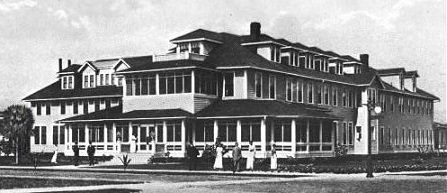
Construction commenced in 1910, only for it to stop temporarily when it became clear Shephard’s designs were too small. Fortunately, the project resumed a couple months later when architect Francis J. Kennard submitted new plans. Kennard’s vision of the hotel called of the creation of a brilliant multistoried structure built with a wooden frame (known as “Frame Vernacular”). A native New Englander, Bradley adored the single sidings of the seaside homes around Cape Cod and hoped that the architectural appearance of the hotel would mirror those aesthetics. As such, the new extensions showcased a brilliant combination of Queen Anne and Shingle-style architecture. Bradley also thoroughly enjoyed overseeing the construction of the building and got directly involved with its development on several occasions. He even hand-chose all of the furnishings that were to appear inside the new hotel. When the work finally concluded in 1913, it quickly became one of the most popular destinations in southern Florida. Wealthy Bostonians were among the first guests to step inside “The Gasparilla Inn,” although they later gave way to affluent travelers from all over the country. Some of the most influential people were guests at the hotel, including the likes of J. Pierpont Morgan, Henry Ford, Harvey Firestone, and Senator Henry A. du Pont. Henry B. Plant himself also sojourned out to The Gasparilla Inn upon hearing of its grand elegance. Bradley subsequently constructed an array of new facilities on-site in a move to capitalize on the hotel’s surging popularity, building a casino, tennis courts, and a nine-hole golf course. He even had to call on Kennard to nearly double the size of The Gasparilla Inn at a total cost of $85,000!
The Gasparilla Inn continued to entertain hundreds of guests, specifically in the winter and spring seasons when it was open. Over time though, the railroad traffic gave way to motor vehicles, which had started traveling directly to the island with the debut of the Boca Grande Causeway in the late 1950s. Nevertheless, The Gasparilla Inn remained a fixture in the region for years to come. The Collier Corporation had come to acquire the destination, after its founder, Barron Collier, had bought it outright from the American Agricultural Chemical Company at the start of the Great Depression. But a team of local investors led by Bayard Sharp acquired the rights to The Gasparilla Inn in 1961. A descendant of the du Pont family, he eventually outbid all of his partners to become the sole owner of The Gasparilla Inn. Sharp then immediately invested in its complete renovation, commissioning the creation of more cottages until a total of 18 occupied the grounds. He also expanded upon The Gasparilla Inn throughout the 1970s and 1980s, installing such brilliant additions like a brand new fireproof kitchen, an indoor dining pavilion, and a reborn Beach Club (which had existed on the grounds since 1928). Sharp also significantly expanded the amount of available guestrooms to 138, before adding a breadth of luxurious suites several years later. Looking ahead to the future, Sharp created a trust to help maintain The Gasparilla Inn in the years after his eventual death. And after operating the business for the better part of four decades, Bayard Sharp finally passed away at the age of 89 in 2002. The Farish family then assumed control over the business, pledging to preserve the legacy that Sharp had spent years cultivating. Now known as “The Gasparilla Inn,” this amazing historic hotel continues to be ranked as one of the nation’s most celebrated holiday retreats.
Hotel Timeline
The Location
Boca Grande is located on Gasparilla Island, a seven-mile-long geographical landmass off the coast of southwestern Florida. The first inhabitants to occupy the island were a seafaring people known as the “Calusa.” Politically powerful, they resided on Gasparilla Island as early as the 9th century. Massive in size, the civilization relied upon the temperate waters of nearby Charlotte Harbor for sustenance. Unfortunately, the Calusa had largely disappeared by the 18th century from a combination of war and pestilence. The region remained sparsely populated for some time thereafter, save for a few isolated bands of Seminole Indians who made the journey out from the mainland. Permanent settlement of the island resumed toward the end of the 1800s though, when Euro-American mariners began harvesting fish, too. They established their own small villages, the most notable of which was called “Gasparilla” at the northern end of the island. But in 1881, something momentous happened that changed the area’s fate forever. A few individuals discovered phosphate to the northeast of Gasparilla Island in the Peace River Valley. Important for the creation of commercial fertilizer, it spawned a wave of local economic development that lasted for decades. Among the lasting consequences of that discovery was the transformation of Gasparilla Island into a major hub for transportation. (Freighters often moored in the area while they obtained cargo from the coast.) Most of those changes occurred thanks to the influence of Peter Bradley, the President of the American Agricultural Chemical Company. Since the AAC dominated the phosphate industry in most of Florida, Bradley determined to make Gasparilla Island the center of its ability to distribute goods well beyond the state.
In 1905, Bradley decided to construct a new railroad that traversed the shoreline all the way to Gasparilla Island. They specifically assigned one of their subsidiaries, the Peace River Mining Company, to work alongside the U.S. Army Corps of Engineers to create the rail network. The new coalition surveyed the entirety of the island and selected a plot of land near the local lighthouse to host a terminus. The centerpiece of the compound was to be an ornate 1,000-foot-long pier that could handle pounds of phosphate at any given time. By 1907, the new railroad—called the “Charlotte Harbor and Northern Railroad”—was complete and immediately began servicing the freighters anchored nearby. But Bradley also wanted to increase the value of the surrounding real estate, and commissioned the creation of a town next to the new train depot. Bradley and his attorney, James M. Gifford, then began platting a community based on earlier plans made by an engineer named Albert W. Gilchrist. Their vision for the town differed from Gilchrist’s original idea, as the two wanted to fill it with vacation homes and resort hotels. Working with Gilchrist himself, the men created the “Boca Grande Land Company” and started selling plots of land to interested buyers. At first, only a handful of homes existed within the town of “Boca Grande”—a name selected by Gilchrist—before a deluge of land developers descended upon the community. Some of the most prominent families in the country soon purchased real estate within Boca Grande, such as the du Ponts, the Biddles, the Cabots, and the Drexels.
The railroad continued to deliver people to Boca Grande over the following decades, turning Gasparilla Island into one of the most exclusive vacation hideaways in all of Florida. Soon enough, grand resort hotels appeared across the island, too, with The Gasparilla Inn being among the first to debut. Both the commercial and residential development of the area continued unabated throughout the 1920s and 1930s, even as the Great Depression wrought havoc across the state. The community also managed to survive the great Florida-Cuba Hurricane of 1944, rebuilding back stronger than ever. Tourism gradually replaced the phosphate industry as the predominant business enterprise, especially once the railroad shut down during the 1970s. The train depot was subsequently restored and converted into a beautiful facility that housed shops, offices, and a restaurant. (Furthermore, the opening of the Boca Grande Causeway discouraged train travel, leading to a gradual decline in passenger traffic along the Charlotte Harbor and Northern Railroad after World War II.) Boca Grande still ranks as one of Florida’s most outstanding holiday retreats today. It is currently home to many tranquil beaches and temperate waters, while the town itself is home to a number of amazing cultural attractions. (Among the most prominent landmarks are the Boca Grande Lighthouse and the Boca Grande Historical Society and Museum.) A number of its buildings are even listed on the U.S. National Register of Historic Places, including both The Gasparilla Inn, as well as the Charlotte Harbor and Northern Railway Depot. Without a doubt, Boca Grande is one of the most fascinating places to visit in the country.
The Architecture
Architect Francis J. Kennard originally gave The Gasparilla Inn its original appearance, building a multistoried structure around a large, wooden frame. Known today as “Frame Vernacular,” the use of such a form was common throughout Florida at time. Kennard’s original designs also called for the combination of Queen Anne and Shingle-style architecture. Named in honor of the 18th-century British monarch, Queen Anne, the Queen Anne architecture started in England before migrating to the United States. Yet, its name was misleading, for it actually borrowed its design principles from buildings constructed during the Renaissance. Buildings developed with Queen Anne-style architecture are asymmetrical in nature, and are built with some combination of stone, brick, and wood. Those buildings also featured a large wrap-around porch, as well as a couple polygonal towers. Clapboard paneling and half-timbering are a few other forms of woodworking that are regularly found somewhere within a Queen Anne-style structure. Shingle-style architecture, on the other hand, was born out of an immense regional interest to preserve colonial American culture, specifically in New England. Those throughout New England felt that the style of Shingle architecture best represented the simplistic aesthetics of British American architecture that was perceived as a humble alternative to the popular Eastlake and Queen Anne architectural forms that predominated across the rest of the country at the time. In stark contrast to those aforementioned styles, Shingle architecture specifically eschewed ostentatious decorations for complex shapes constructed with modest materials. Cedar shingling became the most prominent kind, giving rise to the practice of referring to the form as “Shingle” architecture. The shingling was applied across the entire structure from the roof to the walls. Nevertheless, the innate aspects of the hotel’s brilliant Queen Anne architecture blend seamlessly with its Shingle-style aesthetics, giving it a rare, beautiful appearance.
But thanks to the renovations undertaken by Barron Collier in the 1930s, The Gasparilla Inn today displays Classic Revival-style architecture, too. Also known as “Neoclassical,” Classic Revival design aesthetics are among the most common architectural forms seen throughout the United States. This wonderful architectural style first became popularized at the World’s Columbian Exposition, which was held in Chicago in 1893. Many of the exhibits displayed architectural motifs from ancient societies like Rome and Greece. As with the equally popular Colonial Revival style of the same period, Classical Revival architect found an audience for its more formal nature. It specifically relied on stylistic design elements that incorporated such structural components like the symmetrical placement of doors and windows, as well as a front porch crowned with a classical pediment. Architects would also install a rounded front portico that possessed a balustraded flat roof. Pilasters and other sculptured ornamentations proliferated throughout the façade of the building, as well. Perhaps the most striking feature of buildings designed with Classical Revival-style architecture were massive columns that displayed some combination of Corinthian, Doric, or Ionic capitals. With its Greco-Roman temple-like form, Classical Revival-style architecture was considered most appropriate for municipal buildings like courthouses, libraries, and schools. Yet, the form found its way into more commercial uses over time, such as banks, department stores, and of course, hotels. The celebrated architectural firm McKim, Meade and White produced some of the most noteworthy buildings that utilized Classical Revival architecture, with most of their work appearing during the early 20th century. Examples of their portfolio can be found throughout many of America’s major cities, including Philadelphia and New York City.
Famous Historic Guests
- J. Pierpont Morgan, financier and founder of J.P. Morgan and Company.
- Henry A. du Pont, Civil War-era Medal of Honor recipient and Senator from Delaware (1906 – 1917).
- Henry B. Plant, railroad magnate responsible for developing the southeastern United States in the 19th century.
- Henry Ford, founder of the Ford Motor Company and inventor of the historic Model-T.
- Harvey Firestone, founder of the Firestone Tire and Rubber Company.
- John Singer Sargent, expatriate artist known at the time for being the “leading portrait painter of his generation.”
Film, TV and Media Connections
Hoot (2006)
Guest Historian Series
Hotel History: The Gasparilla Inn (1913), Boca Grande, Florida*
The Gasparilla Inn was named for the 19th century Spanish nobleman turned pirate, Jose Gaspar, whose plundered treasure was reputedly buried on Gasparilla Island.
Opened in 1913, the Inn is a grand resort built on the island's southern-most tip, named Boca Grande, or "big mouth" for the shape of the natural port. In 1885, the American Agricultural and Chemical Company (AAC) found phosphate rock just east of Gasparilla Island. This natural cleanser became a major ingredient in many detergents and the business base for development of the grand resort. Recently named to the National Register of Historic Places and a member of Historic Hotels of America, the resort occupies more than 180 acres of beautifully-landscaped grounds with breathtaking views of the Gulf of Mexico.
CONTINUE READING