History
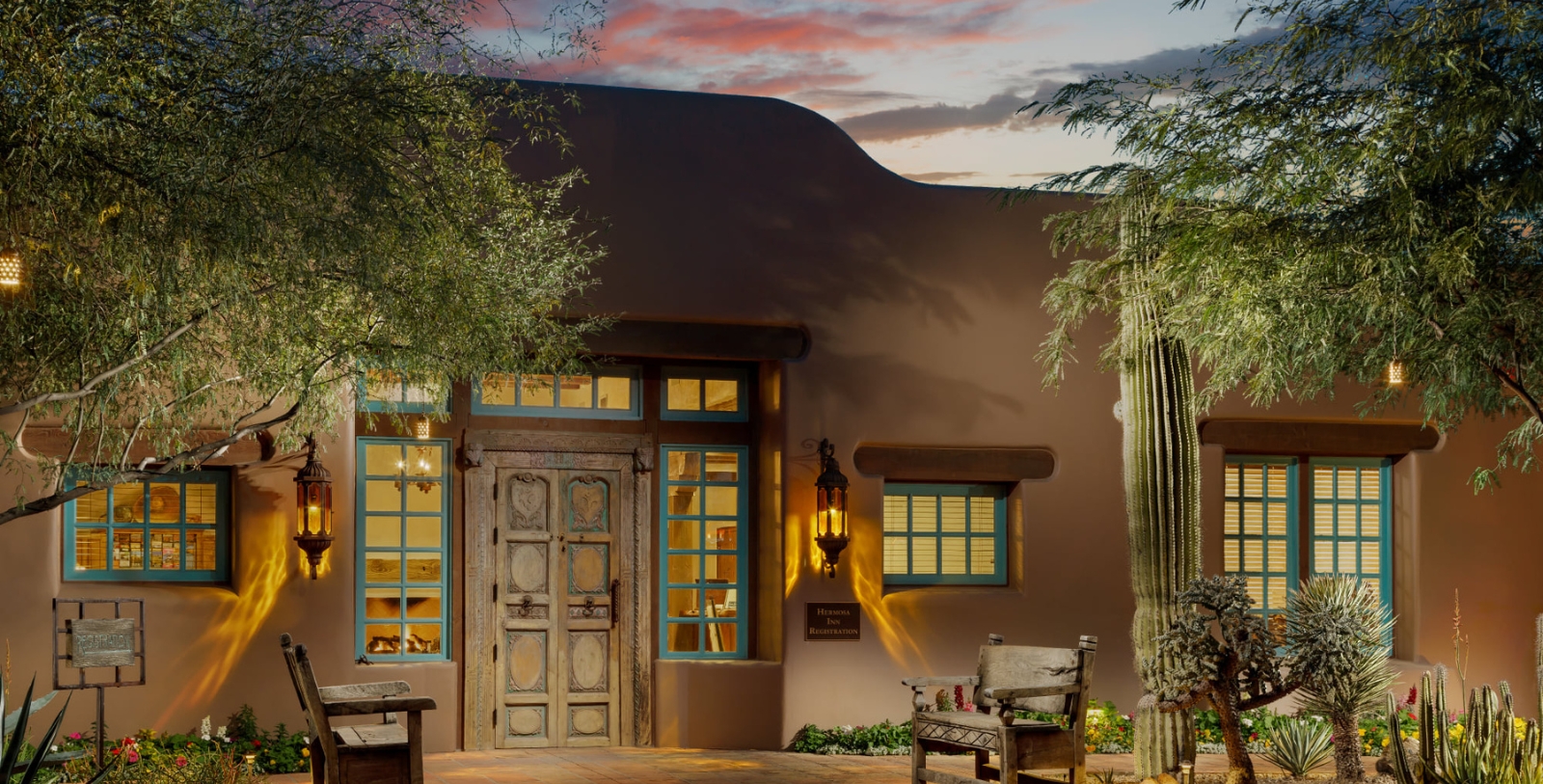
Discover The Hermosa Inn, which was once the private home of renowned American artist Lon Megargee.
Although The Hermosa Inn operates as a premier holiday destination today, it once existed as the personal home of renowned American artist Alonzo "Lon" Megargee. Originally born in Philadelphia at the height of the Gilded Age, the talented Megargee first moved to the American Southwest when he was just a teenager. Megargee initially found work as a ranch hand and gradually came to develop a deep appreciation for the industry. This profound interest eventually influenced his own unique artistic style once he decided to enroll full-time as a student at both the Pennsylvania Academy of the Fine Arts and the Los Angeles School of Art and Design during the early 20th century. (Interestingly, Megargee had taken a couple drawing courses at the Pennsylvania Academy several years prior but stopped his education abruptly after the death of his father in 1896.) Upon his graduation, the ambitious young artist then returned to Arizona, specifically taking up residence with the Hopi and Navajo for several weeks. He proceeded to paint numerous outdoor scenes depicting the landscape, which made their debut amid the Arizona territorial fair of 1911. The murals subsequently spawned a wave of national praise for Megargee seemingly overnight, leading to the establishment of a celebrated career that lasted for half a century. Indeed, people from across the country yearned to obtain copies of his distinctive illustrations, which usually highlighted authentic portrayals of ranch life, Native American rituals, and the expansive Arizona wilderness. His legacy remains an important part of the history of Paradise Valley Arizona, with The Hermosa Inn standing as a tribute to his artistic vision.
In fact, Megargee's popularity enticed many companies to pursue partnerships with him, such as the A-1 Brewing Company and a few travel magazines. His most significant collaboration involved Stetson, during which time Megargee painted an image of a cowboy giving his horse a drink of water from his upturned Stetson hat. Called The Last Drop from His Stetson, the picture became an enduring symbol for the Stetson brand for decades to come! Even the newly minted state government of Arizona hired Megargee to craft original pieces of artwork, who in turn created 15 large depictions of the Old West for display in the Arizona State Capitol. Megargee had thus emerged as one of the country's preeminent artists by the beginning of the 1930s, having captivated the collective imagination of an entire generation of Americans. In 1935, he capitalized on his success by acquiring six acres of vacant land just outside Phoenix in what is now Paradise Valley. He then set about constructing a rustic country estate known as "Casa Hermosa," using colonially inspired architectural motifs from neighboring Mexico to design its overall appearance. The manor proved to be an engineering masterpiece, featuring an ingenious mixture of oil and ash to produce an aged, weathered look. He incorporated historical building materials within the structure’s skeleton, such as wooden beams that had once resided within an abandoned local mine. When construction on Casa Hermosa finally concluded following months of diligent work, Megargee quickly started using the structure to serve as both his personal refuge and main art studio.
However, Megargee then began operating Casa Hermosa as a guest ranch to supplement his income, having realized the amount of joy his own guests had experienced while visiting. The decision proved to be a wise one, as the ranch rapidly became a popular retreat for artists, writers, and other likeminded intellectuals. Nevertheless, Megargee eventually encountered significant financial difficulties maintaining the facility, which he finally sold during World War II. The new owners continued to run the location as a guest ranch over the following years though, installing a variety of amenities on-site like additional guest accommodations, tennis courts, and a spacious pool. Then in 1992, the entrepreneurial Fred and Jennifer Unger purchased the location, instituting their own meticulous two-year-long renovation that saw much of the historical architecture masterfully restored. Now known as "The Hermosa Inn" today, this fantastic historic destination has prospered as a luxurious boutique hotel under the care of Ron and Mike Allred. The Allreds have paid particularly close attention to preserving the legacy left behind by the spirited Lon Megargee, taking great care to ensure the building faithfully reflects the architectural vision he laid out nearly a century ago. Thanks to their dedicated efforts, The Hermosa Inn has since remained a testament to Megargee's life and accomplishments. Combined with its outstanding amenities and unrivaled hospitality, this fantastic historic hotel offers a unique experience that truly celebrates the heritage of the American West.
Hotel Timeline
The Location
Nestled between the McDowell Mountains and Camelback Mountain, the rustic community of Paradise Valley is just a short drive away from the bustling downtown core of Phoenix, Arizona. Phoenix's history is quite extensive, having been founded three centuries ago by American pioneers. Frontiersman Jack Swilling specifically founded the city in 1868, who was interested in establishing a homestead that could feed the area's outlying mining towns and outposts. He subsequently developed a massive canal that could irrigate the land upon discovering the remnants of several trenches dug by the Pima Indians years earlier. Swilling quickly took to growing several different crops, establishing his quaint farm in what is now central Phoenix. Other settlers quickly noticed his success and migrated en masse to the area to create their own farms. A town rapidly evolved around Swilling’s quaint estate, which its first residents referred to as "Phoenix." Phoenix had grown so much during the first few years of its existence that President Ulysses S. Grant even issued an official land patent for the community. In fact, some 2,500 people called Phoenix home by the start of the 1880s. As such, Arizona's territorial legislature officially charted Phoenix as a city not long thereafter, eventually making it their capital in 1889. The population boom gave rise to a thriving local economy and an extensive railroad network. An influx of new capital into Phoenix subsequently spawned a massive wave of both residential and municipal construction at the start of the 20th century. Some of the city's most iconic municipal buildings debuted, too, such as the Arizona Capitol Building and the Carnegie Free Library. The greatest project developed at the time was the Salt River Dam, which the administration of Theodore Roosevelt built just outside of downtown Phoenix via the National Reclamation Act. (The dam today is known as the "Theodore Roosevelt Dam.")
Phoenix became Arizona's state capital when it was finally admitted into the Union as the 48th state in 1912. But Arizona was becoming more than just an important economic and political center—it was transforming into a prominent vacation hotspot for tourists all over the United States. The proliferation of both the passenger train and the automobile made it increasingly easier for vacationers to travel all over the country, including the once remote American Southwest. Many Americans soon discovered that Phoenix's perennially warm climate made it an attractive getaway, especially among those who wished to escape the harsh winters of the nation's northernmost states. Real estate developers and hospitality professionals began creating a series of magnificent hotels and resorts over the next few decades, including the likes of Dwight D. Heard and Charles Harris. Phoenix continued to grow in both populations, as well, giving birth to its modern skyline in the 1940s. (Many service members temporarily lived in Phoenix at the time, with many flying military aircraft at Luke Field, Falcon Field, and William Field nearby.) The city eventually attracted the manufacturing operations of powerful corporations, such as Motorola, Intel, and McDonnell Douglas. Dozens of skyscrapers opened in the 1960s and 1970s, as such—including the likes of the Rosenzweig Center, Phoenix Corporate Center, U.S. Bank Center, Valley Center, and the Phoenix Financial Center—with some based around the famous Phoenix City Square. Noted Phoenix city resident Sandra Day O’Connor even managed to break the gender barrier on the U.S. Supreme Court when President Ronald Reagan nominated her for the office in the 1980s. Today, Phoenix continues to occupy a special place in America's cultural landscape. It is home to many fascinating cultural attractions, such as the Desert Botanical Garden, the Heard Museum, and the Phoenix Museum of Art.
The Architecture
When Lon Megargee set about constructing the building that would become The Hermosa Inn, he chose Spanish Colonial architecture as his main source of inspiration. Also known as "Spanish Eclectic," Spanish Colonial Revival-style architecture is a representation of themes typically seen in early Spanish colonial settlements. Original Spanish colonial architecture borrowed its design principles from Moorish, Renaissance, and Byzantine forms, which made it incredibly decorative and ornate. The general layout of those structures called for a central courtyard, as well as thick stucco walls that could endure Latin America's diverse climate. Among the most recognizable features within those colonial buildings involved heavy carved doors, spiraled columns, and gabled red-tile roofs. Architect Bertram Goodhue was the first to widely popularize Spanish Colonial architecture in the United States, spawning a movement to incorporate the style more broadly in American culture at the beginning of the 20th century. Goodhue received a platform for his designs at the Panama-California Exposition of 1915, in which Spanish Colonial architecture was exposed to a national audience for the first time. His push to preserve the form led to a revivalist movement that saw widespread use of Spanish Colonial architecture throughout the country, specifically in California and Florida. Spanish Colonial Revival-style architecture reached its zenith during the early 1930s, although a few American businesspeople would continue to embrace the form well into the latter half of the 20th century.
Famous Historic Guests
Muhammad Ali, professional boxer and civil rights activist regarded as one of the best athletes of the 20th century.
Film, TV and Media Connections
Waiting to Exhale (1995)