History
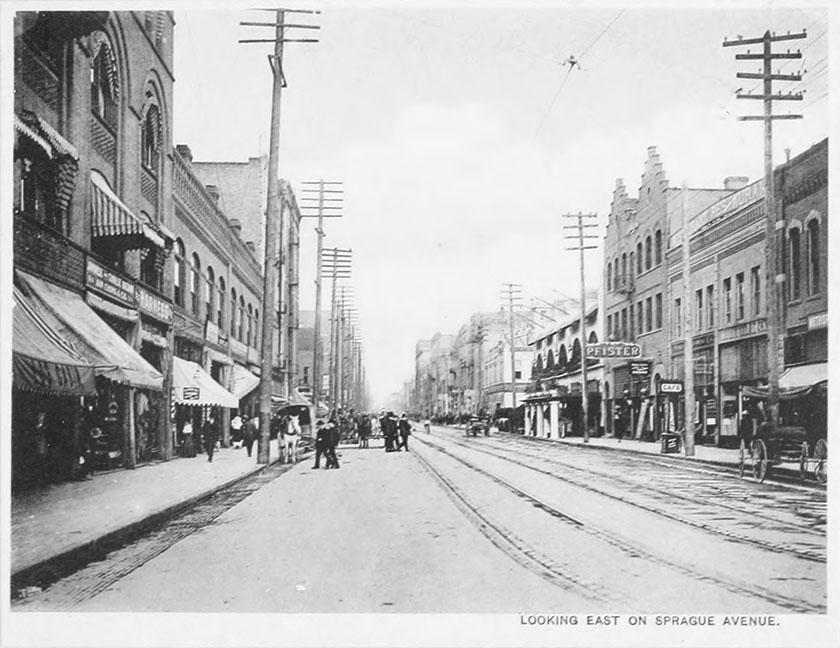
Commencing in 1890, and constructed for Spokane entrepreneur Stanley Miller by prominent architect William J. Carpenter, The Miller Block stands as an example of the artistic skill and creativity of the architect, and as an example of the commercial buildings erected immediately after the Great Spokane Fire of 1889. The Whitten Building, also constructed in 1890, displays the Romanesque Style architecture that was the preferred choice for the many commercial buildings that rose in Spokane's Central Business District.
The Louie, A Davenport Hotel, Autograph Collection, occupies the historic Miller Block, and comprises the historic Whitten Building, an emblem of Spokane’s rise as a regional commercial hub. These structures showcase refined craftsmanship through arched windows, decorative stonework, and richly detailed brick façade, features that reflected the community’s late 19th century growing ambitions. Originally designed as a mixed-use building with retail space below and lodging above, it quickly became part of the city’s vibrant downtown life. Notably, hotelier Louis Davenport once lived in the building while developing the nearby Davenport Hotel, further tying the site to his legacy.
Following economic shifts and changes in ownership after the Panic of 1893, one of the most severe economic crises in U.S. history, the building evolved alongside Spokane itself. In 1906, the Sherman Clay Music Company, a business specializing in pianos, moved into the ground-floor commercial space of the Miller Block. Sound-proof record and piano rooms, piano and Victrola display areas, and an auditorium designed to accommodate 200 people were built on the first, second, and third floors.
In 1924, the Miller Block’s commercial space was occupied by Western Union Telegraph, Spokane Northern Telegraph, and District Telegraph companies. With the star-studded Davenport Hotel across the street, the building teemed with activity, from businessmen and travelers to uniformed messengers and bicyclists. After decades of varied use, the structure was restored in the 1990s by a Portland hotel investor and his family and elevated into a luxury boutique hotel and named the Hotel Lusso.
Eventually purchased by the Worthy family, owners of the Davenport Hotel, in 2009, they renamed it the Davenport Lusso (as the little sister to the much larger Davenport Hotel). Subsequently, in 2025, the Davenport Lusso underwent a multi-million-dollar renovation and was renamed to pay homage to the city's iconic hospitality founder, Louis Davenport. Most recently, following the purchase of the Davenport Collection of hotels from the Worthy family by KSL, it became The Louie, A Davenport Hotel, Autograph Collection, and has carefully preserved its historic lineage, with thoughtfully redesigned interiors to honor both its architectural heritage and Louis Davenport’s influence, allowing the building to continue serving as a symbol of Spokane’s resilience, history, and civic pride.
Hotel Timeline
The Location
The Spokane Valley formed at the end of the last ice age, when glaciers formed a natural dam that blocked what is today the Clark Fork River. The resulting lake sustained life for generations of the Columbia River Indian tribes. By European contact, the Spokane Valley region was the home to many tribes and nations, most prominently the Coeur d’Alene tribe and the Spokane tribe. Early hunting trails, fur trading posts, and Catholic missions gave way to the expanding goals of the American nation. In 1873 James Nettle Glover founded a small settlement known as “Spokane Falls.” The name referred to the rushing river and waterfalls that bisect the city. Logging, agriculture, and mining businesses drew the Northern Pacific Railroad to Northwestern Washington in 1881. In 1883, Spokane was linked to the intercontinental railroad, drawing even more settlers and prominent business enterprises to the growing city west of the Rocky Mountains.
A natural disaster in 1889 allowed Spokane to rebuild using modern urban planning principles like elevated train tracks, a streetcar, and skyscrapers. The population by then had reached 20,000 and quickly ballooned to 104,000 by 1910. Federal projects like hydroelectric dams and aluminum manufacturing sustained Spokane’s residents through the Great Depression and World War II. Reflecting this long history, over half of Spokane’s buildings are designated as historic, and the city planning is still reflected in the beautiful Olmsted-designed parks, charming homes, and elaborate downtown establishments that comprise the city.
The Architecture
The Louie, A Davenport Hotel, Autograph Collection occupies two restored historic buildings dating to 1890: the Whitten Block and the Miller Building. The Whitten Block was designed by architect Lorenzo M. Boardman in the Romanesque Revival style, while the Miller Building was designed by architect William J. Carpenter in the Richardsonian Romanesque style, reflecting the architectural influences of Henry Hobson Richardson, Louis Sullivan, and the emerging Chicago School of Architecture. Constructed during Spokane's rebuilding following the Great Spokane Fire of 1889, the two buildings exemplify late nineteenth-century commercial architecture through their red brick façades, stone detailing, and arched window openings. In 1998, the buildings were combined and adapted into the boutique Hotel Lusso. Following its acquisition by the Worthy family, the historic hotel underwent a multimillion-dollar renovation and was reimagined as The Louie, honoring the legacy of Spokane hotelier Louis Davenport.
Famous Historic Guests
Louis Davenport - Spokane's pioneering hotelier whose vision created the iconic Davenport Hotel, and who lived in the buildings that now comprise The Louie, A Davenport Hotel, Autograph Collection.