
History
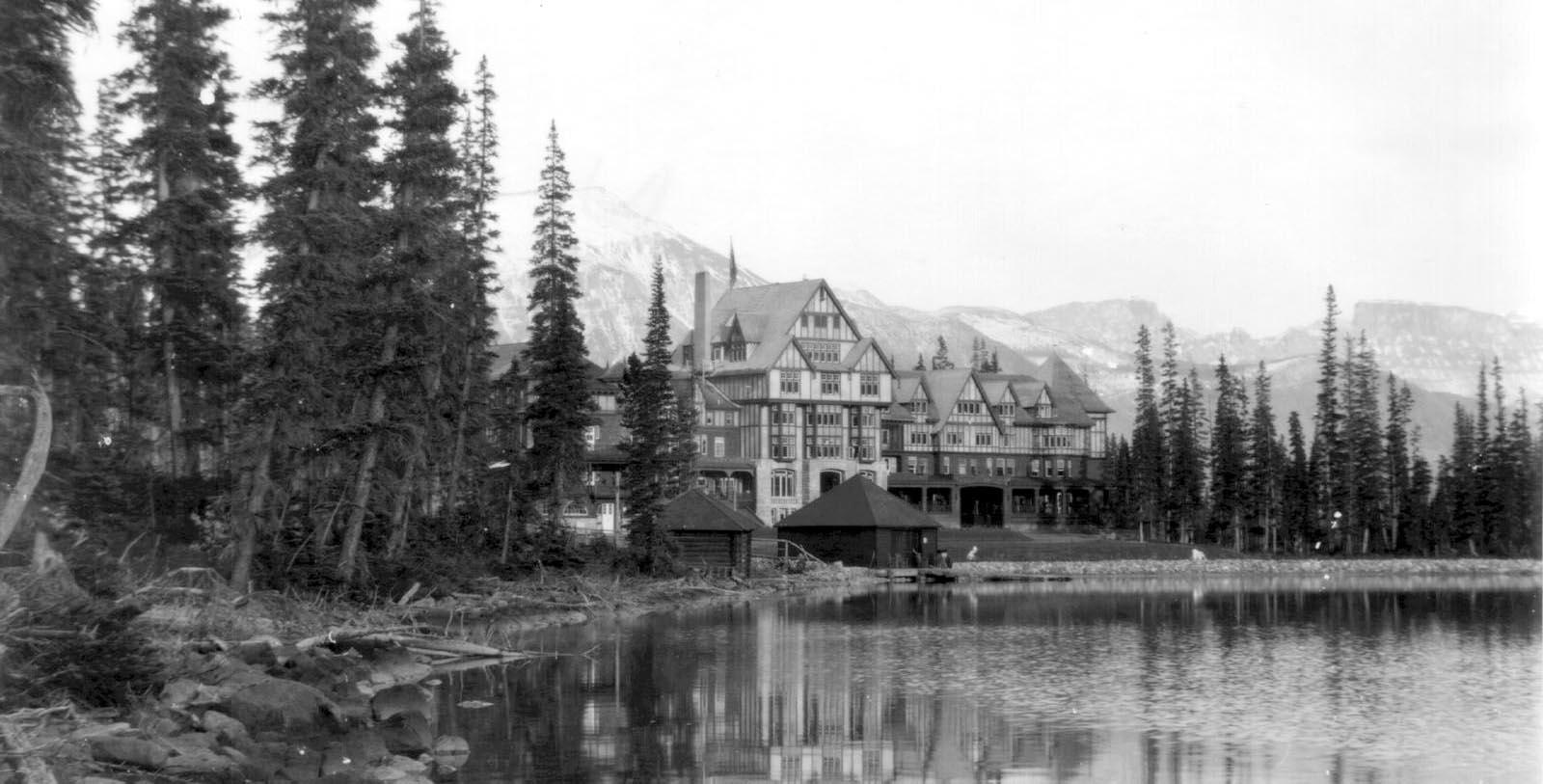
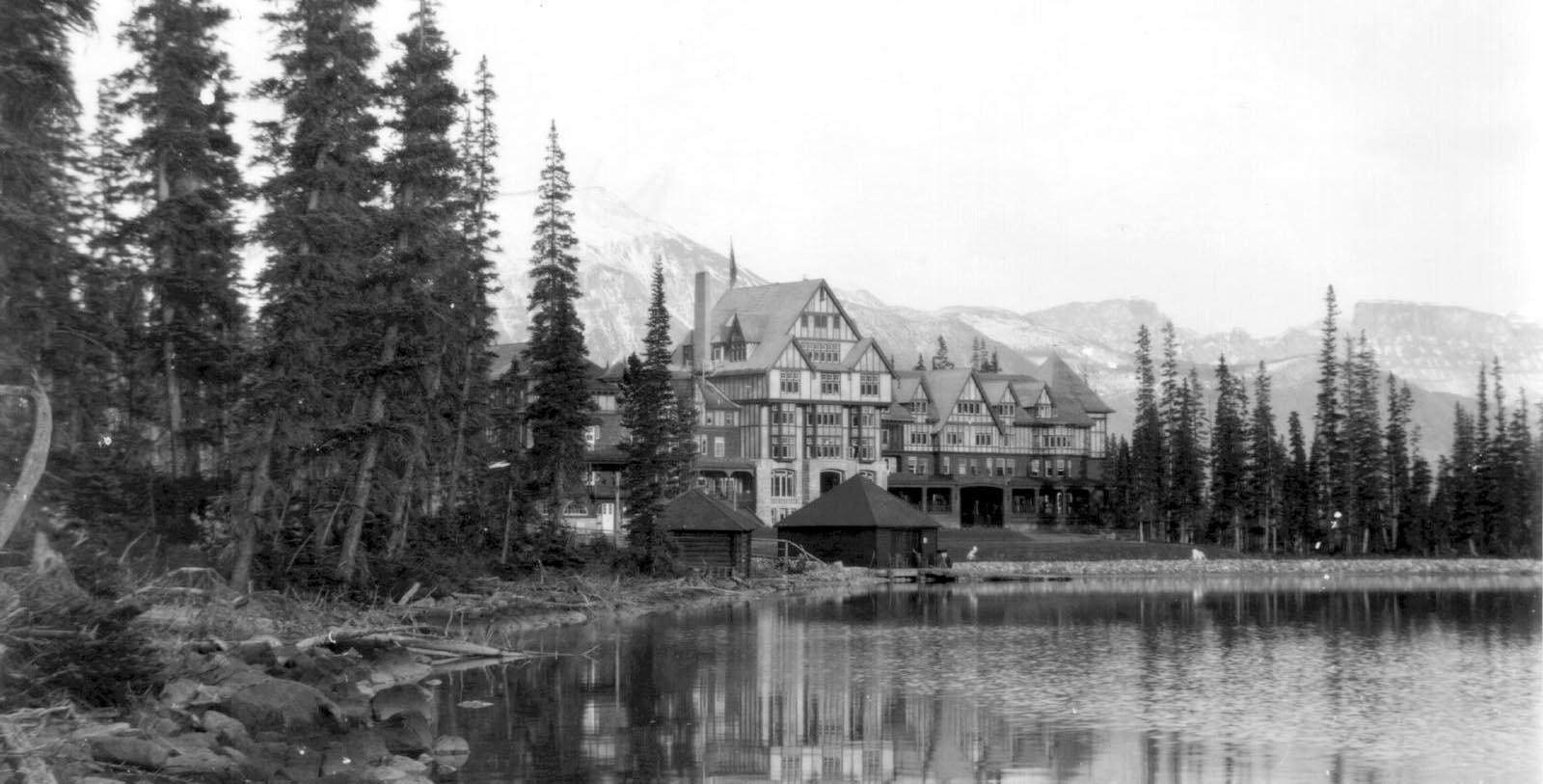
Discover the Fairmont Chateau Lake Louise, which was first opened by the Canadian Pacific Railway in 1882.
Located in Alberta, Canada, Fairmont Chateau Lake Louise is more than a grand luxury hotel; it is a major part of Canada’s colorful history. The hotel itself has beginnings with the naming and colonization of Lake Louise. While employed by the Canadian Pacific Railway in 1882, Thomas Wilson was procuring equipment for construction when he heard the sounds of a nearby avalanche. His native companions informed him the sounds were coming from the “snow mountains above the lake.” They took him there on horseback and what he saw, he named Emerald Lake because of its blue and green water.
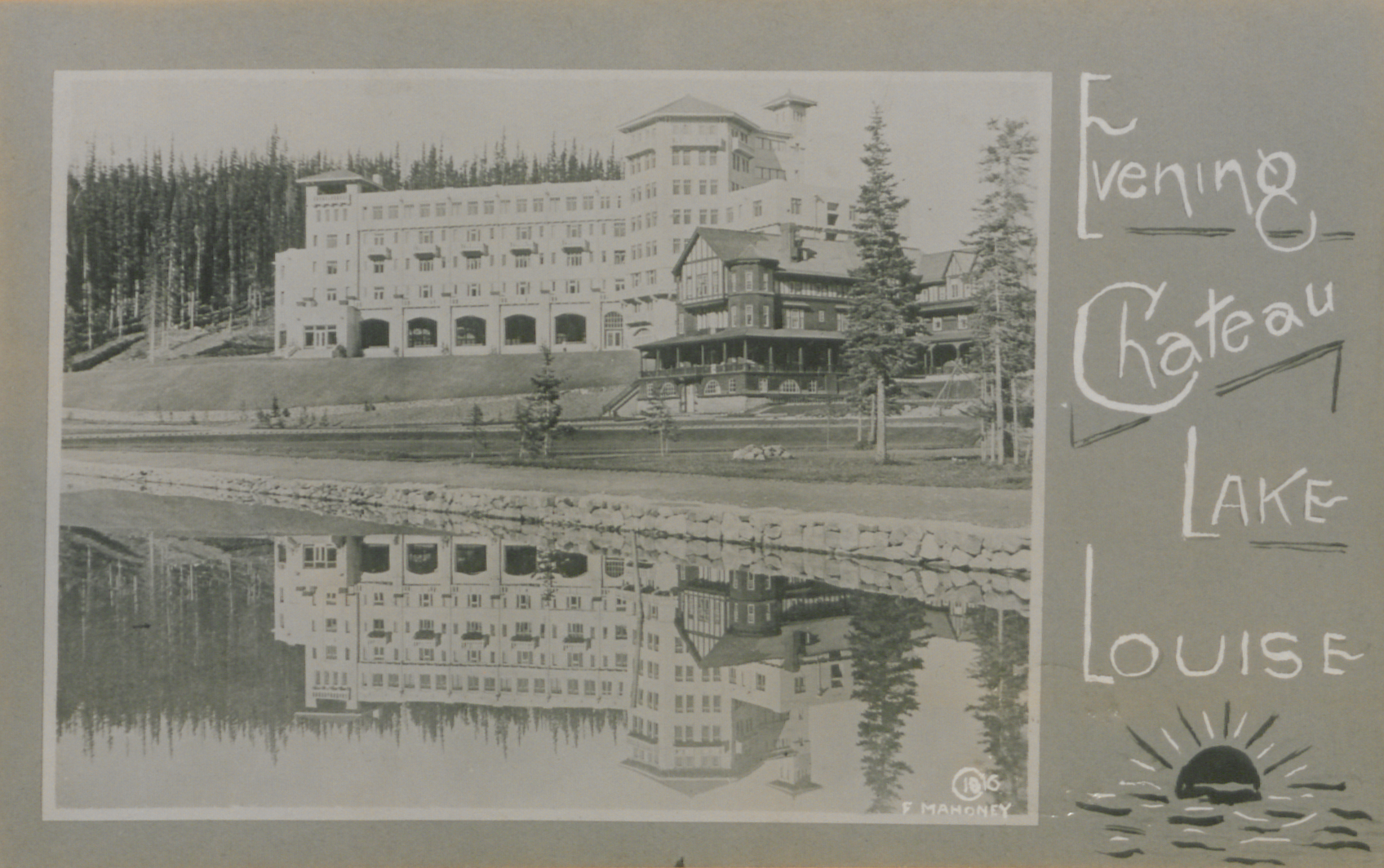
In 1890, Canadian Pacific Railway general manager Cornelius Van Horne had a one-story log cabin constructed on the shore of Lake Louise. This small log cabin had one central area that was used as a dining room, office, bar, and gathering room, as well as a kitchen, and two small bedrooms. He called it “Chalet Lake Louise,” which hosted visitors from various stations along the railway line. While just 50 guests stayed in 1890, by 1912, that number had risen to 50,000. Despite two fires, his tiny cabin would become today’s Fairmont Chateau Lake Louise. In August 1896, American lawyer Philip Abbot fell to his death while climbing Mount Lefroy. His was the first recorded death from mountaineering in North America. His unfortunate death influenced the Canadian Pacific Railway to hire two professional Swiss mountain guides for the safety of visitors wishing to reach the summit. These guides taught thousands of visitors and locals to mountain climb and ski over the next 55 years.
Due to the rise in popularity of mountain climbing, people began to holiday at Lake Louise for the purpose of this act, as well as horseback riding, stargazing, and more. Considered the “Hollywood North,” many early films were shot at Lake Louise with stars such as John Barrymore, Betty Grable, and Carmen Miranda. Stars also visited in droves including Mary Pickford, Douglas Fairbanks, Alfred Hitchcock, Marilyn Monroe, and Superman himself, Christopher Reeve. The 1940s brought WWII and Fairmont Chateau Lake Louise closed to the public. However, Lake Louise was still used by scientists from the Universities of Alberta, Saskatchewan, and Manitoba to develop the Pykrete. The Pykrete is a difficult to shatter and slow to melt mixture of wood pulp and ice, which was intended to be used a tool of war to create floating ice platforms for equipment transport. It was scrapped in favor of faster techniques.
Besides skiing, the area became popular for other adventures. Locals and guests began carving the logging trails and flying over jumps at Tunnel Mountain in the 1920s. Full scale ski areas were in operation by the 1930s. This caused Fairmont Chateau Lake Louise to open the resort year-round during the peak winter holiday seasons in the 1970s. This eventually led to the 1988 Calgary Winter Olympics being held in Banff National Park. Today, Fairmont Chateau Lake Louise hosts the Lake Louise World Cup every November for winter sport enthusiasts far and wide.
Hotel Timeline
The Location
For more than a century, the Fairmont Banff Springs has resided deep within the verdant, snow-capped mountains of Banff National Park. A UNESCO World Heritage Site, Banff National Park encompasses some 6,600 square miles in the famed Canadian Rockies. Some of the tallest mountains in North America are in the park, including Mount Sir Douglas (11,175 feet) and Mount Columbia (11,365 feet). Developed as a result of glaciation over several thousand years ago, most of these geographic formations are composed of such substances like limestone and shale. Banff National Park is known for more than just its pristine alpine summits, though, as it is filled with countless wetlands, meadows, and forests. The park is home to an active glacier field called the Columbia Icefield, which is located along its northern border. Fishing hotspots abound throughout the region at such magnificent bodies of water like the Bow and Red Deer Rivers, as well as the Lake Louise. The lake is among the park’s most celebrated destinations with its turquoise water and calm currents. It derives its name from Princess Louise Caroline Alberta, the fourth daughter of Queen Victoria of the United Kingdom Fairmont Chateau Lake Louise rests along Lake Louise’s shoreline, offering guests unrivaled access to this magnificent three-mile-long glacial lake.
Indigenous people have long lived in the lush forests of the Canadian Rockies, hunting its wildlife, and using its resources for centuries. Yet, the area did not become a Canadian National Park until the 1880s, when the Canadian Pacific Railway started laying track through the Continental Divide. Part of the company’s plan involved directing the nascent railway through the small mining settlements that proliferated throughout the Bow River Valley. In 1883, three workers under the employ of the Canadian Pacific Railway stumbled upon a series of hot mineral springs in an area on Sulphur Mountain that soon came to be known as “Siding 29.” William Cornelius van Horne quickly seized upon the economic opportunity, as he began to construct several grand hotels in the region in order to spur passenger travel along his railroad. But Horne did more than just commercial develop the land—he also petitioned the Canadian government to conserve the region as a national park. Horne succeeded, and the region became Canada’s first national park in 1885. This spectacular destination has since attracted millions of visitors from around the world due to its inherent national beauty and tranquil splendor.
The Architecture
Fairmont Chateau Lake Louise displays some of the finest Renaissance Revival-style architecture in all of Canada. Renaissance Revival architecture—sometimes referred to as "Neo-Renaissance”—is a group of architecture revival styles that date back to the 19th century. Neither Grecian nor Gothic in their appearance, Renaissance Revival-style architecture drew inspiration from a wide range of structural motifs found throughout Early Modern Western Europe. Architects in France and Italy were the first to embrace the artistic movement, who saw the architectural forms of the European Renaissance as an opportunity to reinvigorate a sense of civic pride throughout their communities. As such, those intellectuals incorporated the colonnades and low-pitched roofs of Renaissance-era buildings, with the characteristics of Mannerist and Baroque-themed architecture. Perhaps the greatest structural component to a Renaissance Revival-style building involved the installation of a grand staircase in a vein similar to those located at the Château de Blois and the Château de Chambord. This particular feature served as a central focal point for the design, often directing guests to a magnificent lobby or exterior courtyard. Yet, the nebulous nature of Renaissance Revival architecture meant that its appearance varied widely across Europe. As such, historians today often find it difficult to provide a specific definition for the architectural movement.
Famous Historic Guests
- John Barrymore, actor known for his roles in such films like Grand Hotel, Twentieth Century, and Midnight.
- Betty Grable, actress known for her roles in such films like Mother Wore Tights and How to Marry a Millionaire.
- Carmen Miranda, actress known for her roles in such films like Banana de Terra and The Gang’s All Here.
- Mary Pickford, actress known for her role in the silent film, Coquette.
- Douglas Fairbanks, actor known for his roles in such films like The Thief of Baghdad, Robin Hood, and The Mark of Zorro.
- Marilyn Monroe, actress known for her roles in such films like Bus Stop and Some Like It Hot.
- Alfred Hitchcock, filmmaker known for such classics like Vertigo, North by Northwest, and Psycho.
- Henry Ford, founder of the Ford Motor Company.
- Prince Rainier III of Monaco (1949 – 2005)
- King Hussein of Jordan (1952 – 1999)
- Queen Margrethe II of Denmark (1972 – present)
- King Edward VIII of the United Kingdom (1936)
- Queen Elizabeth II of the United Kingdom (1952 – 2022)
- Prince Phillip, Duke of Edinburgh (1952 – present)
- Theodore Roosevelt, 26th President of the United States (1901 – 1908)
Film, TV and Media Connections
- The Valley of Silent Men (1922)
- Winds of Chance (1925)
- Eternal Love (1929)
- Son of Lassie: Come Home (1944)
- Doctor Zhivago (1965)
- The Love Master (1999)