
History
Discover the Fairmont Hotel Macdonald, which has been an iconic landmark in Edmonton since 1915.
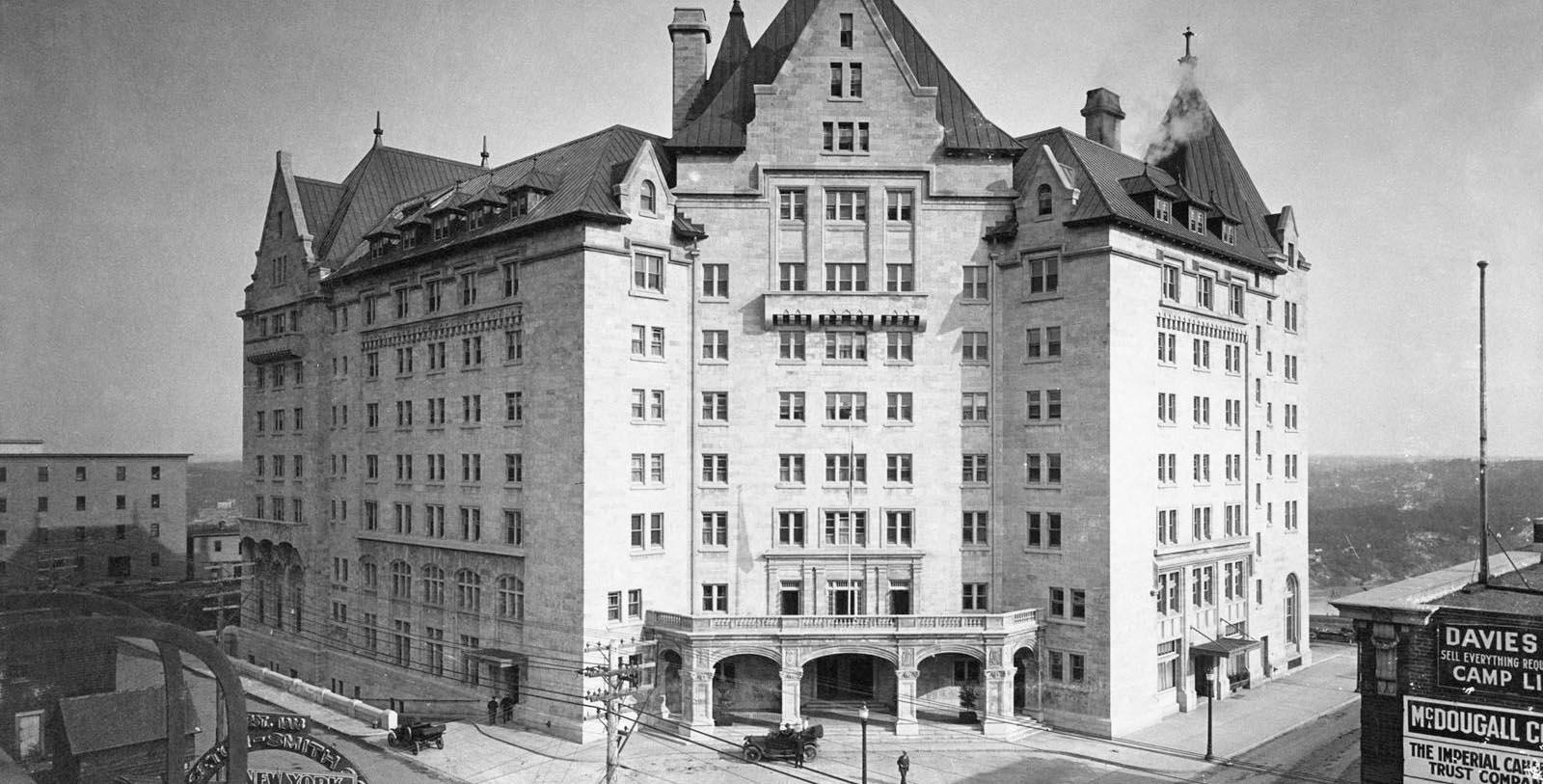
Known locally as “The Mac,” the Fairmont Hotel Macdonald has been an iconic figure against the Edmonton skyline since its grand debut on July 5, 1915. Setting the bar for hotelier excellence in Alberta, the Fairmont Hotel Macdonald has long been known for its elegance and draw as a luxury destination. The idea to create this spectacular holiday destination was that of the Grand Trunk Pacific Railway, which hoped to corner the market on tourist travel to Edmonton at the start of the 20th century. The company spared no expense in constructing its masterpiece, hiring the renowned architectural firm Ross and MacFarlane to oversee the entire project. Built in with Châteauesque-style architecture, the seven-story edifice includes such renowned building materials as Indiana limestone and copper. It took the Grand Trunk Pacific Railway some four years and C$2.25 million to complete—worth some $35 million today!
The Grand Pacific Railway christened its new hotel as the “Hotel Macdonald,” after Sir John A. Macdonald, Canada’s first prime minister. It quickly became Edmonton’s leading hotel, attracting all sorts of prevalent guests from across the world. In 1939, a visit from King George VI and Queen Elizabeth The Queen Mother caused Edmonton’s first traffic jam as well-wishers gathered to catch a glance of the royal couple. The grandest suite in the hotel was named in honor of The Queen Mother and features a large foyer, dining room, service pantry, two bedrooms, two and a half bathrooms, and a large, spacious living room. To accommodate the ceaseless popularity of the Hotel Macdonald, its owners added a 16-story, 292-room addition in 1953. The structure was noticeably different from the original style, though, and was referred to as “the Mac and the box it came in.” The difference was so problematic that the structure was demolished soon after it was built.
Unfortunately, the Hotel Macdonald was forced to close in 1983 due to disrepair. But in 1985, the City of Edmonton declared the hotel a Municipal Heritage Resource, saving it from being wrecked. It was the first building in the city to receive this distinction. It was then purchased by Canadian Pacific Hotels in 1988, which invested millions into restoring it back to its former glory. It re-opened in 1991, boasting a balance of modern convenience and historical elegance. This restoration also included the addition of specialty suites in what had once been the attic. Due to the unique construction of the building, these suites have turret spaces and magnificent views of valley below and the city of Edmonton. To pay homage to Fairmont Hotel Macdonald’s roots, the doorknobs in all the guestroom closets bear the Grand Trunk Rail monogram. Now known as the “Fairmont Hotel Macdonald,” this outstanding historic hotel has been a member of Historic Hotels Worldwide since 2017.
Hotel Timeline
The Location
Fairmont Hotel Macdonald resides along the North Saskatchewan River in downtown Edmonton. Also known as the city’s Financial District, the region is the cultural and economic heart of the entire city. Yet, the history of Edmonton harkens back to 1795 with the founding of a quaint frontier trading post called the “Edmonton House.” Operated by the Hudson Bay Company, the destination was located some 25 miles downstream from the present location of Edmonton. Its primary purpose was to exchange furs with the numerous local Native American tribes. The Edmonton House was later joined by another trading post named as Fort Augustus, which was operated by the rival North West Company. Eventually, these two outposts merged into a single business entity that worked out of a new location called Fort Edmonton in 1821. Fort Edmonton rapidly became the main center of commerce for the fur trade in western Canada for the next five decades!
Widespread Euro-American settlement did not commence until the Canadian government acquired most of the land surrounding Fort Edmonton during the 1870s. The fort itself resided within a plateau that was one of the most agriculturally fertile regions on the Canadian Prairies. Officials in Ottawa opened then started selling thousands of acres to interested farmers who established a patchwork system of homesteads that grew wheat, barley, and other grain products. A large portion of these homesteaders were of Ukrainian origin, who flocked to the region with its promise of arable land. Slowly but surely, a small community began for form around Fort Edmonton that served the farmers scattered throughout the surrounding countryside. The influx of railroads in the area further spurred its development, with the Canadian Pacific Railway arriving in 1891. It was then joined by the Canadian Northern Railway in 1905. The railroads also helped local agricultural producers transport their goods to wider markets, transforming Fort Edmonton into an important regional center of commerce seemingly overnight.
By the beginning of the 20th century, Fort Edmonton had simply become known as “Edmonton.” It absorbed many of the neighboring towns that popped up toward the end of the prior century, beginning with Strathcona (now South Edmonton) in 1912. More people continued to migrate west to Edmonton, especially as various entrepreneurs discovered the wealth of natural resources that surrounded the city. The discovery of oil at nearby Leduc in 1947 saw the creation of a local oil and natural gas industry that quickly made Edmonton a leading global leader in petrochemicals. Wealth from the oil and natural gas subsequently gave the city its modern appearance, as beautiful skyscrapers and office complexes began dotting its landscape. Edmonton today remains one of Canada’s most important economic hubs, serving as the provincial province to this very day. It also is home to a number of outstanding cultural attractions, such as the Muttart Conservatory, the Art Gallery of Alberta, and the Royal Alberta Museum.
The Architecture
The Grand Trunk Pacific Railway announced its plans to construct a magnificent hotel in downtown Edmonton in 1911. Saving no expense, the company enlisted the renowned architectural firm Ross and MacFarlane to oversee the entire project. It was originally created by architects George Allen Ross and David MacFarlane in 1907, before Robert Henry Macdonald replaced the latter some five years later. The duo designed many of Canada’s grand railway hotels throughout the early 20th century, including a fellow member of Historic Hotels Worldwide—Fairmont Château Laurier.
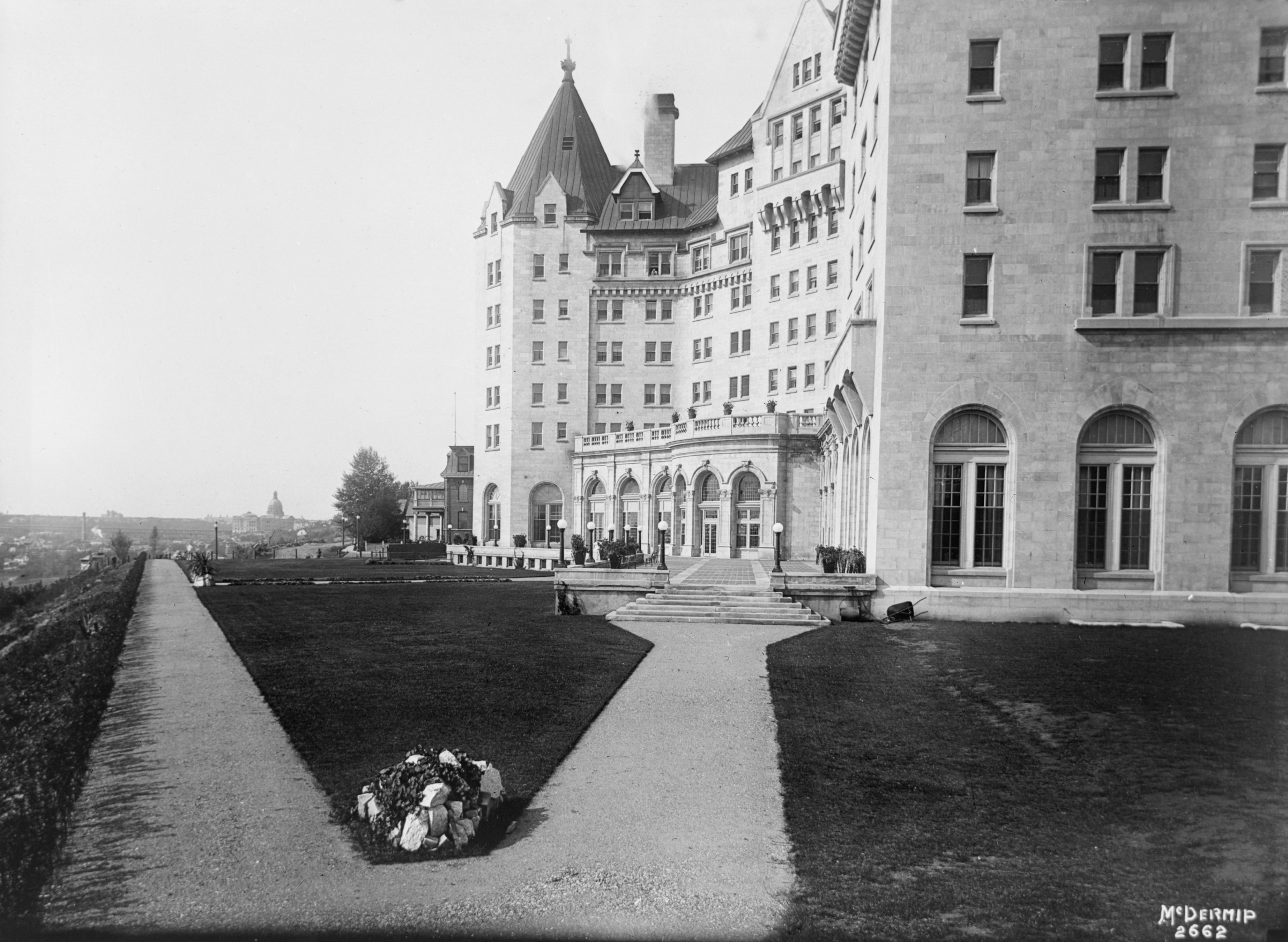
Similar to other grand railway hotels, Ross and MacFarlane relied upon the historic design aesthetics of the French Renaissance to create the Fairmont Hotel Macdonald. The firm specifically designed the structure to resemble a brilliant historical château from France’s famed Loire Valley. As such, the hotel displayed several characteristics unique to a French château, such as diagonally placed entrances, turreted towers, and majestic archways. Developed along an L-shaped foundation, the façade of the building is formed with a combination of Indiana limestone that is heavily detailed with balustrades, cornices, and hood moldings. Its main portico also features two pilasters that are detailed with gargoyles, as well as the provincial crest of the four provinces that comprise Western Canada. Yet, the most iconic feature of the Fairmont Hotel Macdonald is its spectacular pitched-copper roof.
The building’s interior also contained a wealth of outstanding architectural components, too. The Confederation Lounge, for instance, contained a brilliant replica of Robert Harris’ Confederation at Québec in 1864. The Empire Ballroom was adorned with amazing bas relief carvings, too, while the Wedgewood Room was named for its wonderful Wedgewood detailing. Those outstanding elements—as well as the hotel’s exterior appearance—inspired the government to protect the building by means of the Alberta Heritage Resource Act in 1984.
Famous Historic Events
Royal Tour of Canada (1939): King George VI of the United Kingdom and his wife, Queen Elizabeth The Queen Mother, went on a grand journey of Canada prior to World War II. Their trip was part of a great strategy to reinforce the cultural ties that bound Canada and the United Kingdom together, as well as to emphasize the former’s increasing independence from the latter. While many other royal tours had occurred in Canada previously, this one was unprecedented in its size and scale. Thousands lined the streets of every major city that the royal entourage visited, with entire roads shutdown just to manage the crowds. King George IV and Queen Elizabeth arrived in Québec City on May 17 and started traveling west along the Canadian Pacific Railway.
The Royal Family had managed to traverse the whole country, reaching British Columbia by the end of the month. Afterward, the King and Queen headed east to visit additional cities and towns in Atlantic Canada, as well as Newfoundland. On their way back to the eastern side of the country, the royal couple briefly passed through Edmonton. Intending to stop in the city for just ten minutes, the King and Queen were employed to stay for much longer when a crowd of some 200,000 well-wishers descended upon their caravan. The monarchs then decided to stay at the Hotel Macdonald for the night, before continuing their journey. The Fairmont Hotel Macdonald would go on to host countless other official visits by the British Royal Family, including Queen Elizabeth II’s tour of Edmonton in 2005.
Famous Historic Guests
- Queen Elizabeth of the United Kingdom, The Queen Mother
- King George VI of the United Kingdom (1936 – 1952)
- Queen Elizabeth II of the United Kingdom (1952 – 2022)
- Bill Clinton, 42nd President of the United States (1993 – 2001)