
History
Discover the history of Hotel de la Cité Carcassonne-MGallery, which was once part of a medieval fortress.
Many years ago, Hotel de la Cité Carcassonne-MGallery was once a medieval church that local stonemasons had built into the embattlements surrounding the ancient city of Carcassonne. Back then, the community was one of the most heavily defended settlements in all of Europe. The imposing stone fortifications that now encompass the city grew over the course of centuries, as different civilizations—like the Romans and the Visigoths—continuously fortified the settlement. Titanic battles waged before the citadel. Time and again, massive armies surged against Carcassonne’s mighty walls, its glorious defenders frequently fighting against such daunting foes as the Iberian Saracens and the Kingdom of the Franks. When the Treaty of the Pyrenees annexed the region to the French king in 1659, Carcassonne ceased functioning as a garrison town. For the next several hundred years, the city gradually developed a thriving domestic economy, becoming especially established within France’s textile industry. But by the dawn of the 20th century, tourism had also emerged as a major enterprise for the city. Throughout much of the century prior, the original walled portion of Carcassonne had been abandoned in favor of the “lower town” that hugged the base of the citadel. Having fallen into considerable disrepair, preservationists endeavored to save what remained of the hallowed city. They fortunately succeed in convincing France’s national government to restore the old fortress under the pretense that it would serve as a terrific holiday destination.
It was during this time that two ambitious entrepreneurs named Michel Jordy and Jean Cadenat decided to open a hotel in Carcassonne. Recognizing the immense potential that the city possessed as an international travel site, the two men selected an erstwhile chapel that bestrode the Cité de Carcassonne’s southwestern wall as the location for their new business. Debuting in 1909, the Hôtel de la Cité quickly developed a magnificent reputation for its quaint splendor. Its popularity became so significant that the building was expanded upon twice in order to cater to the burgeoning demand. By the 1920s, the hotel was among the favorite hotspots for travelers journeying throughout southern France. Soon, many illustrious luminaries from across the world started lodging at the Hôtel de la Cité, including Winston Churchill, Walt Disney, and Grace Kelly, the Princess of Monaco. Hotel de la Cité Carcassonne-MGallery remains as popular as ever. Consistently ranked as one of France’s most preeminent hotels, Hôtel de la Cité has maintained a bustling clientele base. Numerous celebrities still frequent the business, as Christian Lacroix, Johnny Depp, and Sting have all stayed on the grounds. The hotel’s continued success is in large part due to the Pujol family, who have managed the building since 2010. Their stewardship over the Hotel de la Cité Carcassonne-MGallery has been further reinforced through their partnership with Sofitel. The partnership has even overseen the hotel’s induction into Historic Hotels Worldwide, which transpired back in 2018. Together, the Pujol family and Sofitel are honored to share this spectacular hotel with Carcassonne’s enthusiastic visitors.
Hotel Timeline
The Location
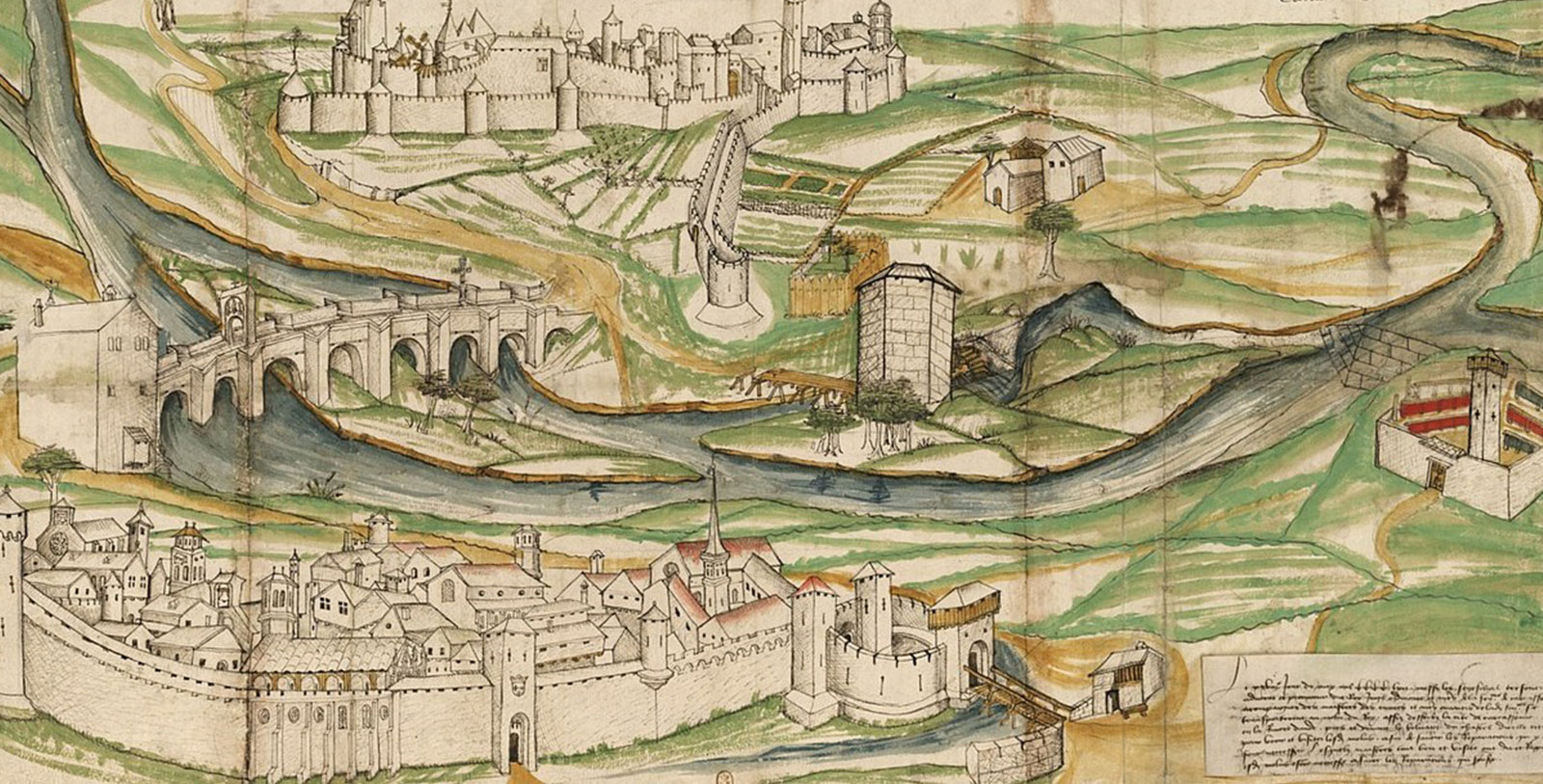
For centuries, the walled portion of Carcassonne has been one of the most strategically important communities in all of Europe. Its close proximity to both the Atlantic Ocean and Mediterranean Sea has been known throughout history, inspiring countless armies to fight for control over it. People have subsequently inhabited the space going back thousands of years, with the first signs of any permanent settlement dating to the Neolithic period five millennia ago. But the nucleus of what would evenutally become the legendary Cité de Carcassonne would not appear until the arrival of the Volques Tectosages in the 6th century BC. A tribal confederation of Celtic people, the Volques Tectosages specifically created a rudimentary fortified village atop a hill that dominated the local skyline for miles. They called it the “Carsac,” which became their central stronghold in the region. The Carsac community eventually caught the eye of the Roman Empire some five centuries later, who established the frontier outpost of “Colonia Julia Carcaso” in its place. The Romans immediately began to reinforce the town, encasing it within a series of imposing brick ramparts and a few dozen semicircular towers. (Today, most of the northern curtain walls that still surround the Cité de Carcassonne are from Roman times.) Yet, the Romans adorned the new fortress with all kinds of beautiful artwork, including a series of ornate mosaics within the lower levels of its foundation. The impressive embattlements that surrounded the Colonia Julia Carcaso quickly made it an important center for Roman influence, which ultimately elevated it to the capital of the local imperial province!
As Rome’s power diminished in the 5th century AD, it decided to grant the locale to an allied tribe of Visigothic barbarians led by the great Theodoric II. The Visigoths subsequently occupied the settlement for the next few hundred years and gradually expanded the surrounding fortifications. Among the project they initiated was the development of the current inner walls footprint. Numerous violent clashes with the newly created Kingdom of the Franks transpired at Carcassonne, culminating with King Clovis’ failed siege of the area in 508. But in the 8th century, a new military power succeed where the Franks had failed. An army of Arabs from Iberia—known among Europeans at the time as the “Saracens”—swept across southern France and expelled the Visigoths from the Carscac in 725. Their victory proved to be brief, however, as a coalition of Franks under King Pepin the Short forced them out of the region four decades later. But while the rest of the Saracens capitulated all along the Mediterranean coast, those garrisoned inside the walls of the Carsac managed to resist Pepin’s relief force for a while. As a testimony to the town’s mighty fortifications, the Saracens only surrendered once the rest of their allies had long since been chased back across the Pyrenees into Catalonia!
In the aftermath of Pepin’s victory, the community became the seat of power for the County of Carcassonne. Originally established by a Frankish noblemen named Bello, the County of Carcassonne arose as one of the most dominant states in the medieval Mediterranean basin. By the late 11th century, the county and its walled city—now known as “Carcassonne”—were under the authority of vassals to the King of Aragon, the Trencavel family. Like many of the previous rulers of Carcassonne, the Trencavels greatly renovated the defenses surrounding the town. Their most significant contribution was the development of the gorgeous Château Comtal and the Basilica of Saints Nazarius and Celsus. They maintained their power from within Carcassonne for decades, often aligning their interests with the royal families of Toulouse and Barcelona. But the Trencavel aristocrats evenutally saw their reign come to an abrupt end during the Albigensian Crusades of the 13th century. The ruling Trencavel at the time, Raymond-Roger, had been indifferent to a unique religious sect of Christians known as the “Cathars” that had taken up residence inside Carcassonne. Pope Innocent III quickly declared the Cathars heretics and organized a crusade that targeted Carcassonne and other settlements that tolerated their presence. After a brief siege in August of 1209, the crusaders captured Carcassonne and expelled most of the inhabitants. Raymond-Roger Trencavel himself had died, imprisoned in his own dungeon by the army of the Pope.
Carcassonne continued to operate as an important garrison in town in southern France, functioning as a military buffer between the kingdoms of Aragon and France. In 1247, King Louis XI of France finally captured the entire County of Carcassonne and integrated it into his own realm upon the signing of the Treaty of Corbeil a decade later. Louis and his successor, Philip III, completely redeveloped the entire outer ramparts of Carcassonne, reinforcing the perception that the town was an impregnable fortress. (They also laid the initial street grid for the lower city that surrounded the Carsac, which currently constitutes the site of present-day Carcassonne.) Edward the Black Prince decided to test its reputation a century later at the height of the Hundred Years War, leading a massive army to take the castle in 1355. Yet, the prince encountered defeat, just like many the other armies that had tried to seize Carcassonne in the past. The ancient Cité de Carcassonne finally stopped serving as a fortress in the mid-17th century, when both France and Spain—the descendent of the Kingdom of Aragon—demilitarized the area with the Treaty of the Pyrenees. The Cité de Carcassonne and its lower town gradually evolved into an important economic center in the south of France, becoming heavily immersed in the woolen textile industry. Yet, the lower town rapidly outgrew the settlement atop the Carsac, eventually eclipsing it in economic power. The historic part of the city entered a period of decay that culminated with its decommissioning by Napoleon Bonaparte in the early 19th century. And the Cité de Carcassonne would have even been demolished had it not been for the efforts of the locals to preserve the structure years later. Today, the Cité de Carcassonne is one of the most popular cultural heritage sites in the entire world, hosting thousands of visitors every. Historians also regard the settlement to be among the best representations of medieval fortifications still in existence. In fact, its grand historic architecture even earned it a rare listing as a UNESCO World Heritage Site in the late 1990s!
The Architecture
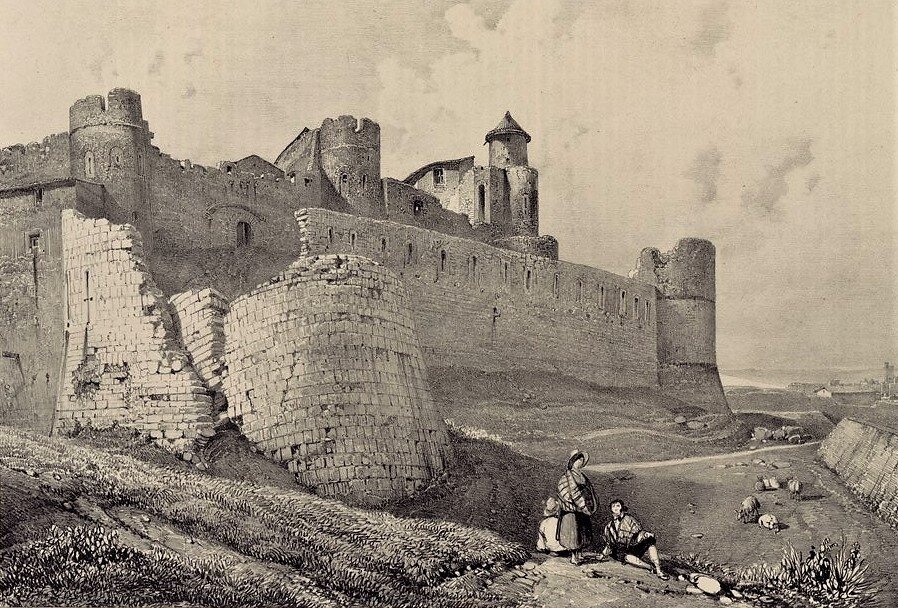
Gradually developed over centuries, the sprawling ancient citadel is part of a complex that is concentric in its design. Two imposing outer walls ringed the historic castle, with 53 different towers interspersed throughout its structure to help protect against siege engines. Interestingly, the various structures that lined the walls were built at various points in time, representing architectural styles that ranged from the Romans and all the way to the French. (Architectural historians have noted that the Roman section of the castle looks particularly unique, for its defined by red brick walls and pitched terracotta roofing.) The main portion of the fortress had its own central keep that the garrisoned soldiers could only access by way of a drawbridge. Carcassonne remained a powerful military stronghold for generations, until Napoleon Bonaparte decided to decommission it at the height of the Napoleonic Wars. The great citadel subsequently became incredibly dilapidated in the decades that followed, with some in the national government considering its complete demolition. When plans to destroy the fort finally went into effect in the late 1840s, a nationwide campaign to save the structure forced officials to reconsider. Perhaps the two greatest figures responsible for rescuing the legendary Cité de Carcassonne was the lower city’s mayor, Jean-Pierre Cros-Mayrevieille, and the prolific writer Prosper Mérimée. Together with the popular support of the local residents, the two men managed to convince the government to recognize the historic castle as national monument.
Construction to preserve the ailing facility’s architecture began in earnest in 1853, with architect Eugène Viollet-le-Duc spearheading the entire effort. (Viollet-le-Duc was well-qualified to oversee the project, as he had been restoring the castle’s Basilica of Saints Nazarius and Celsus.) His team first set about reconstructing the western portion of the walls, before shifting toward the towers at the primary front entrance. Viollet-le-Duc subsequently spent the rest of his life saving the the Cité de Carcassonne, although he never finished. It would take his student, Paul Boeswillwald, and another architect named “Nodet” to complete the daunting task. Still, what Viollet-le-Duc’s managed to accomplish was nothing short of spectacular. His work did attract some criticism, however, as he had erroneously used slate to rebuild certain aspects of the citadel. Nevertheless, the grand Cité de Carcassonne exists today thanks in large part to the work of Eugène Viollet-le-Duc, as well as the advocacy of Jean-Pierre Cros-Mayrevieille and Prosper Mérimée. Their work even made it possible for future preservationists to get the entire facility listed as a UNESCO World Heritage Site more than a century later in 1997.
Famous Historic Events
Albigensian Crusades: While the Cité de Carcassonne has withstood several significant military campaigns, the most prolific it endured was that of the Albigensian Crusade. The reigning Catholic pope, Innocent III, had grown weary of a Christian religious sect that had emerged called the “Cathars.” Sometimes referred to as “Albigensians,” the Cathars essentially believed that there were two primordial gods—one good, the other evil—that influenced time and space. Pope Innocent III subsequently regarded their beliefs as heretical, for Catholic doctrine specifically taught that only a single god existed. He came to see the loosely organized Cathars as a threat, especially as their movement spread across present-day northern Italy and southern France. Among the areas that the Cathars settled was the town of Carcassonne, whose ruler at the time, Count Raymond-Roger Trencavel, was relatively indifferent to their presence. Angered by what he perceived as a slight to his duties as a Catholic, Pope Innocent III excommunicated Trencavel and targeted his city upon his call for a crusade against the Cathars in 1209. (The pope had excommunicated a few other nobles, too, the most powerful of which was Count Raymond VI of Toulouse.)
By August, an army of some 10,000 crusaders led by Papal Legate Arnaud Amaury had arrived on the outskirts of Carcassonne. Alarmed that a siege might actually happen, Trencavel sought military relief from his liege lord, Peter II of Aragon. But Peter was powerless to confront the authority of the Pope, leaving the anxious Trencavel to fend for himself. He subsequently refortified Carcassonne, strengthening both its embattlements and available manpower. But Trencavel still held onto the hope that the forces of Pope Innocent III would listen to reason and rode out to accommodate the crusaders in their camp. Unfortunately for Trencavel, Arnaud Amaury gruffly turned him away, signaling to the count that a siege was inevitable. He subsequently raced back to Carcassonne in order to ready its defenses. By this point, the situation inside Carcassonne had grown considerably dire, as refuges from the countryside had flooded into the walled city and overpopulated it. Just as Trencavel began to deal with the problem, the siege equipment of Amaury’s army began its attack. Carcassonne’s water supply was immediately cutoff, spelling disaster for the defenders inside the citadel. Trencavel immediately accepted an offer to negotiate peace terms with the crusaders, although he was quickly imprisoned once the talks concluded.
Carcassonne surrendered unconditionally on August 15, with nearly its entire population expelled. Count Raymond-Roger Trencavel himself mysteriously died in his own dungeon from either illness of poison. The great knight Simon de Montfort—one of the leaders of the Albigensian Crusade—obtained the titles to Carcassonne as a reward for his service to the Vatican. (Montfort’s own heir, Simon V, rose to become a leading noblemen in England, who sparked the tumultuous Second Barons’ War of the 1260s.) But Trencavel’s own son, Raymond, attempted to recapture his family’s old dominion in 1240. Despite his dogged efforts, the young knight failed. Raymond eventually ceded his ancestral rights over Carcassonne to the French king, Louis XI, when the latter annexed the region after the Treaty of Corbeil in 1258. The Albigensian Crusade itself ended in 1229 with the ultimate defeat of the Cathars following the harrowing Siege of Toulouse. Catharism managed to exist as an underground movement for the next few decades, although various inquisitional forces tried to finally oppress it a century later. And while some scholars believe there is evidence to suggest the Cathars survived, most feel that the movement was largely abandoned by the end of the 1300s.
Famous Historic Guests
- Walt Disney, legendary cartoonist known for such films as Pinocchio, Bambi, and Cinderella.
- Princess Grace Kelly of Monaco, famous American film actress known for Mogambo and wife of Prince Rainier III.
- Prime Minister Winston Churchill of the United Kingdom (1940 – 1945; 1951 – 1955)