History
The architectural elegance and rich history of Hotel Chourakukan offer guests the opportunity to experience one of Kyoto's most treasured cultural landmarks.
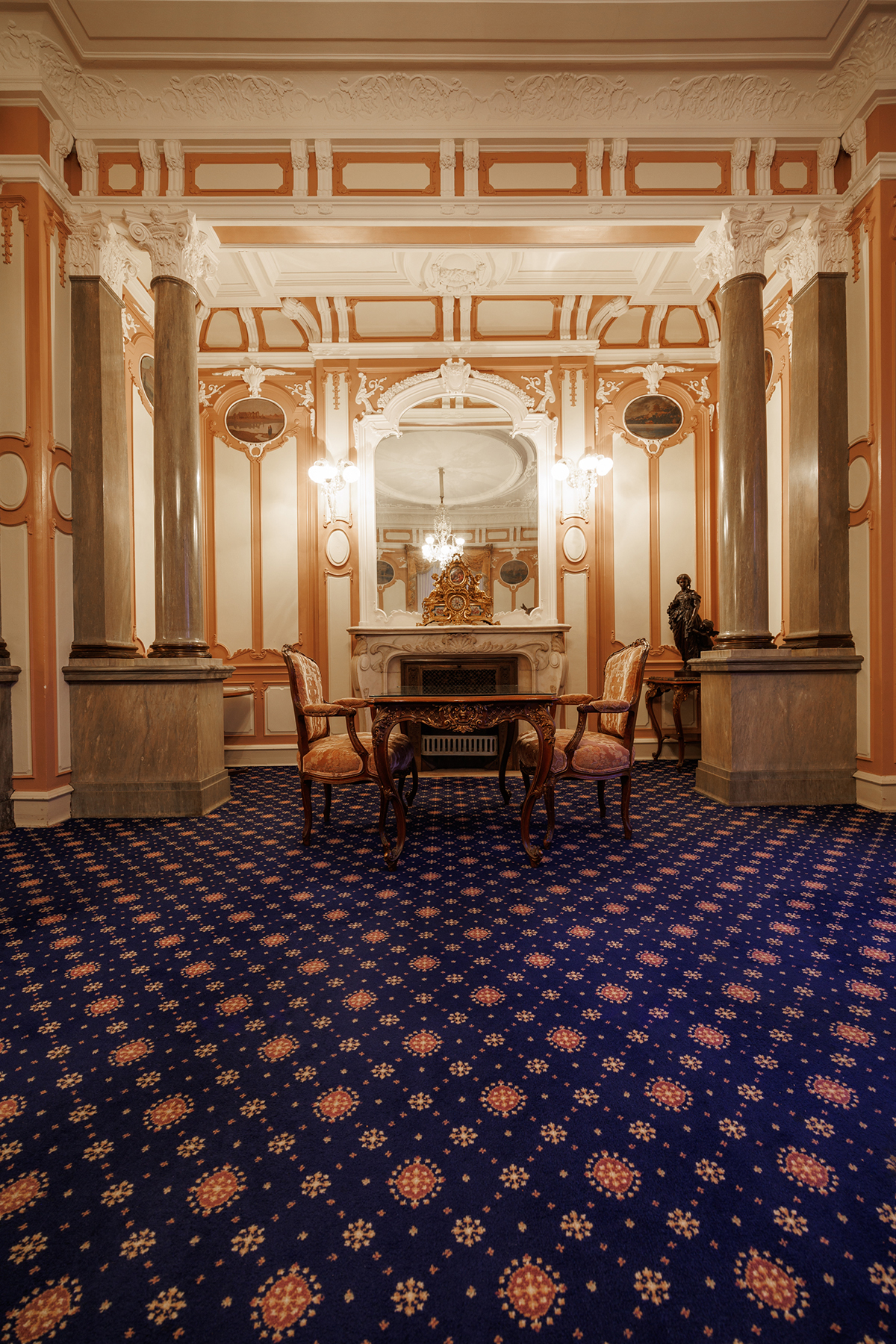
Originally constructed in 1909 as a grand guest house by pioneering tobacco industrialist Kichibei Murai, Hotel Chourakukan occupies one of Kyoto’s finest surviving examples of Meiji-era Western architecture. Conceived as an elegant guesthouse residence for entertaining members of the Imperial Family, foreign diplomats, distinguished statesmen, and prominent international visitors, Hotel Chourakukan reflected Japan’s emergence onto the world stage during the early twentieth century. Situated adjacent to Maruyama Park and Yasaka Shrine in Kyoto’s historic Higashiyama district, the mansion was designed by renowned architect James McDonald Gardiner, whose masterful design blends European Renaissance, Baroque, Rococo, and Art Nouveau influence with exceptional Japanese craftsmanship. Its richly appointed interiors feature Baccarat chandeliers, stained glass, marble fireplaces, carved woodwork, ornate plaster ceilings, and period furnishings that have remained remarkably intact for more than a century. Following decades of careful stewardship and preservation, the building was designated an Important Cultural Property of Japan in 2024, one of the nation’s highest heritage recognitions, affirming its extraordinary architectural, artistic, and cultural significance.
Following meticulous conservation and restoration efforts that carefully preserved the mansion’s historic fabric while sensitively introducing modern guest accommodations and amenities, Hotel Chourakukan was thoughtfully adapted into one of Japan’s most distinguished luxury boutique heritage hotels. Today, the hotel offers an intimate collection of elegantly appointed guestrooms and suites while preserving the grandeur and refinement of the original residence. Throughout the mansion, guests encounter beautifully restored reception rooms, salons, historic dining spaces, and remarkable architectural details that evoke Kyoto’s role as Japan’s cultural capital during the Meiji era. Hotel Chourakukan also serves as a steward of history through the preservation of its original decorative arts, furnishings, architectural features, archival photographs, and historic interiors, allowing guests to experience the same atmosphere of elegance enjoyed by distinguished visitors for more than a century. Few luxury hotels in Japan offer an authentic opportunity to stay within a nationally protected cultural landmark that continues to celebrate its original history and purpose.
Hotel Chourakukan is tied to acclaimed architect Frank Lloyd Wright through a reciprocal exchange of building materials. When Wright needed "yellow bricks" for the second Imperial Hotel design, the villa's original owner, Kichibei Murai, supplied the specific decorative bricks he had developed for Chourakukan for Frank Lloyd Wright to complete the construction of the Imperial Hotel in Tokyo from 1916 to 1923.
Hotel Timeline
The Location
Kyoto's story begins with an act of optimism and intention. In the late 8th century, Emperor Kanmu selected a broad valley surrounded by mountains as the site of a new capital. Founded as Heian-kyo in 794, the city was carefully planned along a grid inspired by continental models and adapted to the Japanese landscape. From the outset, Kyoto was envisioned as a center of political life, beauty, balance, and cultural aspiration.
During the Heian period, Kyoto blossomed into a refined world of courtly elegance that left an enduring imprint on Japanese culture. Aristocrats devoted themselves to poetry, calligraphy, fashion, and ceremony, while great literary works emerged from the imperial court. Kyoto became a cultural ideal whose influence extended far beyond the capital itself.
As Japan's political structure evolved and warrior families rose to prominence, Kyoto adapted with resilience. Though centers of military power shifted elsewhere, the city remained the symbolic heart of the nation and a center of learning and faith. Buddhist temples and Shinto shrines flourished, while Zen teachings influenced architecture, gardens, painting, and daily rituals. Though periods of conflict and fire reshaped the city, each rebuilding strengthened Kyoto's character and cultural life.
With the establishment of peace under the Tokugawa shogunate in the seventeenth century, Kyoto entered an era of prosperity and artistic refinement. While political authority resided in Edo, Kyoto thrived as a center of classical tradition and craftsmanship. Artisans perfected textiles, ceramics, metalwork, and woodblock printing, while festivals and seasonal celebrations preserved ancient customs.
The modern era brought new opportunities for transformation. After the imperial capital moved to Tokyo in 1868, Kyoto embraced modernization while preserving its historic treasures. This balance between progress and preservation helped redefine the city as a place where tradition and contemporary life coexist.
Largely preserved from wartime destruction, Kyoto retained an extraordinary concentration of historic buildings and landscapes. Today, history remains woven into everyday life, from ancient temples and family-run workshops to modern institutions and creative industries. Walking Kyoto's streets feels less like stepping back in time than joining a living conversation that continues to inspire visitors from around the world.
The Architecture
American architect James McDonald Gardiner designed Hotel Chourakukan with a Renaissance Revival-style exterior. The interior of the mansion features a series of distinct Japanese and Western design styles. Individual rooms incorporate Rococo, Neoclassical, Art Nouveau, Chinese, and Japanese shoin-zukuri influences, creating an eclectic design that was uncommon for the period.
Baccarat chandeliers, antique furnishings, plaster ceiling reliefs, and decorative domes remain throughout the historic reception rooms. Many furnishings are protected cultural assets and contribute to the mansion's designation as a National Important Cultural Property.
Lorem ipsum dolor sit amet, consectetur adipiscing elit, sed do eiusmod tempor incididunt ut labore et dolore magna aliqua. Ut enim ad minim veniam, quis nostrud exercitation ullamco laboris nisi ut aliquip ex ea commodo consequat.