History
Discover St. Helen’s Hotel, which preserves the legacy of a distinguished Georgian residence once owned by renowned military leaders, prominent statesmen, and influential figures in Irish history.
Rising above landscaped grounds in Booterstown on Dublin’s south side, St. Helen’s Hotel traces its story to the middle of the 18th century, when a distinguished Georgian residence known as “Seamount” debuted upon land facing Dublin Bay. Constructed during the 1750s for Thomas Cooley, a Dublin barrister and Member of Parliament, the mansion quickly became associated with refinement, stature, and the growing prosperity of Ireland’s capital. Its elevated setting provided sweeping coastal views, while its elegant proportions reflected the confidence and architectural fashions of the Georgian era. But as Dublin expanded beyond its historic core, Seamount passed through several influential hands. In 1795, for instance, the estate was acquired by Robert Alexander, who maintained the residence as one of the notable country houses that dotted the landscape outside the city. Then during the early decades of the 19th century, the mansion became associated with John Doherty, Chief Justice of the Common Pleas, whose tenure reflected the stature the house had already achieved among Ireland’s professional and political elite. Each successive owner contributed to the evolution of the residence, ensuring that it remained an address of consequence during a period when grand houses served as centers of social, cultural, and civic life.
Following a brief ownership by Colonel Henry White, the house came into the possession of Field Marshal Hugh Gough, 1st Viscount Gough, in 1851. One of the most celebrated military figures of the British Empire, Gough had earned distinction in campaigns ranging from the Peninsular War to India and China. It was during his ownership that the mansion assumed the name “St. Helen’s,” a designation that has endured ever since. Under Gough, the residence became associated with prestige on an international scale, linking the quiet Dublin estate to some of the most significant military and political events of the Victorian age. St. Helen’s was not merely a family home during these years; it was a setting connected to a figure whose career was recognized throughout the empire. The latter decades of the 19th century brought further transformation. Architectural enlargements and enhancements expanded the mansion’s scale, reinforcing its standing among Ireland’s great houses. In 1863, architect John McCurdy contributed to the development of the residence, while the surrounding grounds continued to complement the grandeur of the building itself. By the close of the century, ownership passed to Sir John Nutting, who invested heavily in both the house and its landscape. Nutting introduced extensive improvements, including distinctive Portland stone finishes and lavish interior details that elevated the residence to an even higher standard of elegance.
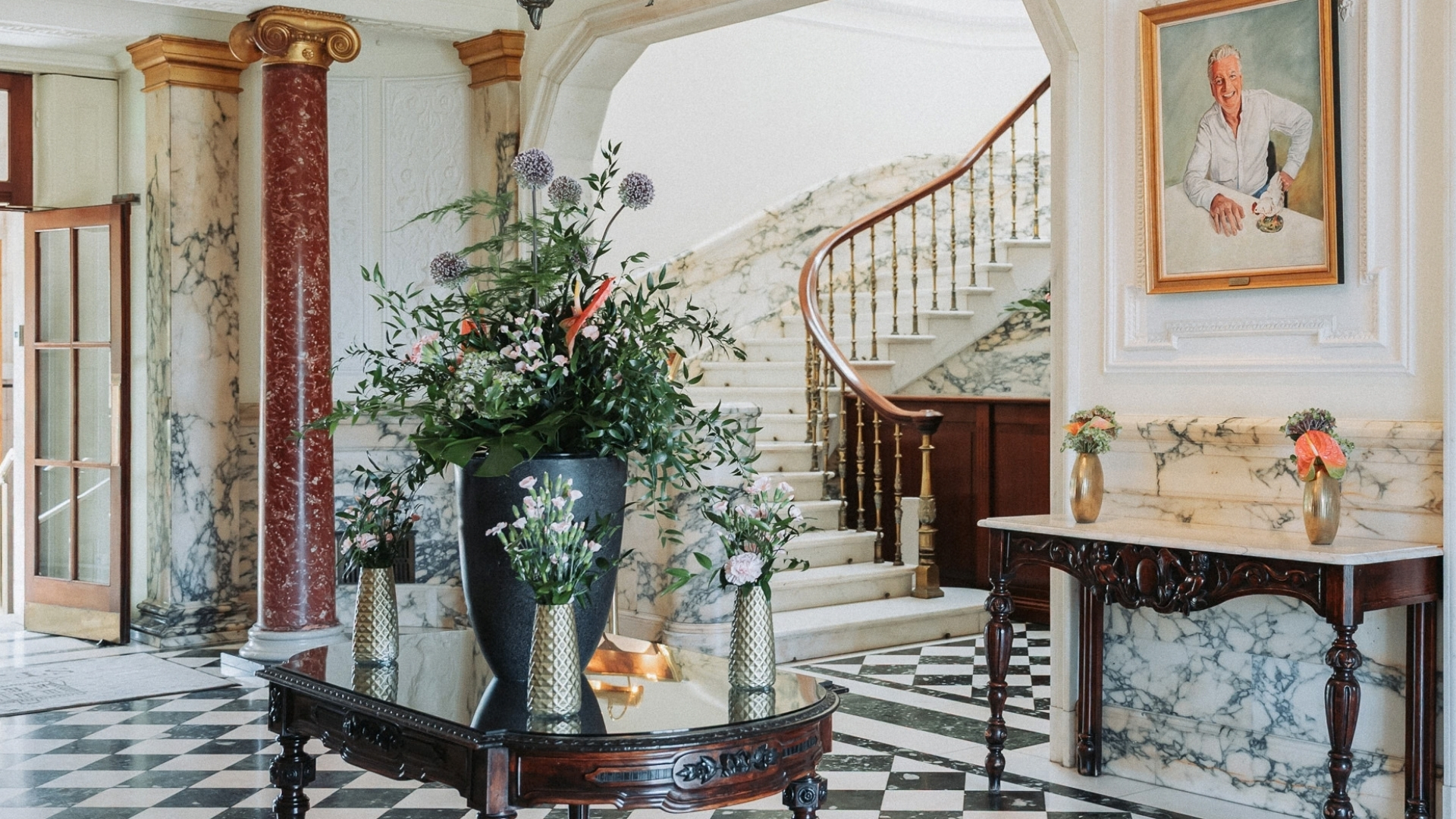
A new chapter unfolded after the Congregation of Christian Brothers purchased St. Helen’s and established its headquarters within the mansion in 1925. The Congregation of Christian Brothers is an administrative arm of the Catholic church that managed Catholic schools worldwide. For more than six decades, the estate served religious and administrative purposes, and certain rooms were adapted to meet the needs of the order. The ballroom, for example, became the chapel. At one point, demolition and redevelopment were even proposed, raising concerns about the potential loss of one of Dublin’s most important historic residences. Preservation advocates ultimately prevailed, and St. Helen’s gained recognition as a structure of national importance, safeguarding its future for generations to come. The rescue and restoration of St. Helen’s paved the way for its reinvention as a luxury hospitality destination. During the late 1990s, the mansion was carefully incorporated into a five-star hotel, allowing guests to experience a historic estate while enjoying contemporary comforts. Restoration efforts retained many of the residence’s defining features, including grand staircases, soaring ceilings, ornate detailing, and formal reception rooms. Now known as St. Helen’s Hotel, this terrific historic destination continues to stand as a testament to Dublin’s architectural and cultural heritage. Still majestically overlooking the sea, the site continues to embody the grace that first defined it over 250 years ago.
Hotel Timeline
The Location
Situated along the broad estuary of the River Liffey, Dublin emerged from a landscape that had attracted settlers for centuries before it became Ireland’s capital. The city’s Irish name, “Baile Átha Cliath,” refers to a “ford of hurdles,” while its English name derives from “Dubh Linn” (or “black pool”), a dark tidal basin formed where the River Poddle met the Liffey. Long before written history fixed these names in the record, the area served as a crossroads for trade and travel, with several of Ireland’s ancient roads converging near the future city. Nevertheless, Dublin’s transformation into a major urban center began in the 9th century, when Viking seafarers established a fortified settlement beside the River Liffey. What started as a seasonal encampment soon evolved into one of the most important Norse towns in the Irish Sea world. Merchants, craftsmen, sailors, and warriors crowded its winding lanes, while ships carried goods between Ireland, Britain, Scandinavia, and continental Europe. Although the Vikings frequently battled neighboring Irish kingdoms, their settlement endured, becoming a thriving center of commerce whose influence extended far beyond the island. Archaeological discoveries have revealed a bustling medieval community that stood among the most significant Norse settlements in western Europe.
The fortunes of Viking Dublin shifted dramatically with the Battle of Clontarf in 1014, fought just north of the settlement. The victory of Brian Boru weakened Norse political power, yet Dublin itself survived and continued to prosper. Over time, Gaelic and Norse traditions blended, creating a distinctive culture that shaped the city’s character for generations. By the 12th century, Dublin had become a coveted prize in the struggles for authority that defined medieval Ireland. The arrival of Anglo-Norman forces in 1170 marked another turning point, as the city entered a new era of English influence that would leave a profound imprint on its institutions, architecture, and governance. As English control expanded, Dublin developed into the administrative heart of the Lordship of Ireland. Dublin Castle rose as a symbol of royal authority, anchoring a walled city filled with churches, markets, and bustling quays. Christ Church Cathedral and later St. Patrick’s Cathedral dominated the skyline, reflecting both the spiritual and political importance of the capital. Through the late medieval period, Dublin remained relatively compact, concentrated within its defensive walls even as merchants enriched the city through trade with ports across the Irish Sea. The rhythm of life revolved around commerce, religion, and government, creating a community whose influence reached throughout Ireland.
Political conflicts, religious tensions, and shifting dynasties repeatedly altered the city’s fortunes over the following centuries, although Dublin continued to expand, nonetheless. By the 18th century, it had become one of the largest and most elegant cities in the British Isles. Magnificent Georgian streetscapes transformed the capital, introducing wide avenues, graceful squares, and rows of red-brick townhouses whose symmetry remains among Dublin’s defining visual features. Institutions such as Trinity College flourished, while writers, thinkers, and political leaders contributed to a vibrant intellectual culture. During this period, Dublin attained a reputation for refinement and sophistication, attracting visitors from across Europe. The Act of Union in 1801 altered the city’s trajectory by abolishing the Irish Parliament and transferring political power to Westminster. Although Dublin remained Ireland’s principal city, many aristocratic families spent less time there, and economic challenges became increasingly visible. However, the 19th century also witnessed remarkable cultural achievements. Daniel O’Connell’s campaign for Catholic emancipation energized public life, while literary figures such as Oscar Wilde, Bram Stoker, and later W.B. Yeats drew inspiration from the city’s streets and personalities. Expanding transportation networks connected Dublin more closely to the rest of the island, even as poverty and overcrowding became pressing realities for many residents.
The defining event of modern Dublin history unfolded during Easter Week in 1916. A group of Irish republicans seized key locations throughout the city and proclaimed an independent Irish Republic from the General Post Office on Sackville Street, now O’Connell Street. Fighting raged through central Dublin for nearly a week, leaving significant destruction in its wake. While the rebellion was ultimately suppressed, the execution of its leaders transformed public opinion and accelerated the movement for Irish independence. In the years that followed, Dublin became the focal point of the struggle that eventually led to the creation of the Irish Free State in 1922. Throughout the remainder of the century, Dublin evolved from the capital of a newly independent nation into a dynamic European city. Government buildings, cultural institutions, and universities expanded alongside growing residential districts. Preservation efforts ensured that landmarks such as Dublin Castle, the General Post Office, and the city’s Georgian squares remained central to the urban landscape. Meanwhile, generations of writers, musicians, and artists reinforced Dublin’s reputation as a place of creativity and storytelling, carrying forward traditions deeply rooted in its past. Today, Dublin presents a remarkable blend of historical layers accumulated over more than a millennium. Viking foundations lie beneath modern streets, medieval cathedrals stand near Georgian avenues, and monuments to independence share the cityscape with contemporary architecture. The Liffey still flows through the center of the capital, linking districts whose histories span from the 9th century to the present day. Few cities illustrate Ireland’s journey so completely. From its beginnings as a riverside settlement and Viking trading port to its role as the political, cultural, and economic heart of the nation, Dublin remains a place where the story of Ireland can be traced in stone, water, and memory.
The Architecture
The structure that now houses the St. Helen’s Hotel displays some of the finest preserved Georgian-style architecture in all Dublin. Georgian architecture itself is among the most predominant in the British Isles, defining the features for all kinds of buildings ranging from grand municipal structures to quaint country manors. Its name is a reference to its origins, having first appeared during the reign of King George I of the United Kingdom in the early 1700s. The form would remain popular in Great Britain for the next several decades, before dissipating around the death of his distant relative, King George IV. But while the architectural form’s moniker refers to Hanoverian monarchs, they had little to do with its spread. Instead, the work of great English architects Inigo Jones, James Gibbs, and Christopher Wren significantly established what would become known as the “Georgian” style. Inspired by the Roman architectural elements of antiquity, professionals like Jones, Gibbs, and Wren began to integrate it into their own blueprints.
Most of those early architects specifically embraced the great Andrea Palladio’s earlier interpretations of Classical architecture, which first manifested at the height of the Italian Renaissance. As such, the first iteration of Georgian-style architecture was known as “Palladianism,” which encouraged proportion and symmetry based on exact mathematical ratios. Palladianism also embraced Palladio’s strict use of Roman-era stylistic themes. But architects across the United Kingdom began to loosen their observance of Palladio’s philosophy as the 18th century progressed. Those artisans began to look more directly at the ancient buildings they sought to emulate, giving rise to the more ubiquitous Classic Revival (or “Neoclassical”) architectural style. Their new structures featured additional motifs from ancient Grecian societies and a few from medieval Europe. Nevertheless, the style remained immensely popular, even spreading across the Atlantic to greatly influence the British Empire’s American and Canadian colonies. In fact, the Americans formed their own unique spinoff of Georgian architecture in the wake of the American Revolutionary War, which they called “Federal” or “Adams” style.