History
Discover The Tokyo Station Hotel, which has welcomed travelers for more than a century from within Tokyo’s iconic red-brick station, blending timeless elegance, rich history, and modern luxury in the heart of Japan’s capital.
Set within the iconic red-brick Marunouchi building of Tokyo Station, the story of The Tokyo Station Hotel is inseparable from the development of modern Tokyo itself. However, the setting for the hotel was eponymously named after the Marunouchi district, an area whose roots stretch back to the Edo period. Once reclaimed from the sea, Marunouchi was located within the grounds of Edo Castle, but as Japan embraced industrialization and sought stronger connections with the wider world, the area became a showcase for modern business and architecture. At the center of this transformation stood Tokyo Station, designed by Kingo Tatsuno, who would later be hailed as the father of modern Japanese architecture. Drawing inspiration from European architectural traditions while adapting them to Japan’s unique environment and cultural identity, Tatsuno created a monumental structure. Tatsuno’s building quickly became one of the nation’s most recognizable landmarks. Civic planners had envisioned a hotel to be featured inside the greater station complex to accommodate the growing numbers of travelers, diplomats, and business visitors arriving in the capital. The Tokyo Station Hotel opened its doors in 1915, one year after the opening of Tokyo Station. Nevertheless, The Tokyo Station Hotel immediately earned an enviable reputation among the adjacent train station’s throngs of new travelers. In fact, the hotel’s position within the country’s principle rail gateway made it especially significant. Visitors arriving in Tokyo encountered the hotel as their first impression of the city, as departing guests viewed it as a final symbol of Japanese hospitality.
During the interwar years, the hotel remained an important social and commercial center, reflecting Tokyo’s growth into an increasingly modern metropolis. In 1933, it was renamed the Tokyo Railway Hotel after coming under the authority of the Ministry of Railways, further emphasizing its close connection to Japan’s transportation network. Despite undergoing hardship amid the onset of World War II, The Tokyo Station Hotel nonetheless remained a celebrated cultural icon throughout the country. Perhaps the greatest symbol of its enduring status was the rise of notable people who stayed at the hotel frequently. Japanese writers came to find the site to be incredibly inspiring, who spent long hours wandering its winding corridors and opulent venues. For instance, Nobel Prize winning author Yasunari Kawabata visited in 1956, using his time on-site to help write his famous novel, Onna de Aru Koto. Around the same time, Seichō Matsumoto used the view from his suite to author his own classic, Points and Lines (Ten to Sen). The pioneering Japanese mystery and detective fiction writer Edogawa Ranpo even cast the hotel as the setting for his book The Fiend with Twenty Faces (Kaijin Nijū Mensō), featuring scenes involving detective Kogoro Akechi and the master criminal Twenty Faces. By the end of the 20th century, growing appreciation for architectural heritage led to efforts to protect historic landmarks. In 2003, the Marunouchi station building was designated an Important Cultural Property of Japan, recognizing its significance as one of the nation’s architectural treasures.
The milestone set the stage for a massive preservation project, which began three years later. More than 500,000 individual bricks were preserved or replicated, the historic north and south domes were reconstructed to their original three-story appearance, and extensive seismic reinforcement was undertaken to protect the landmark for future generations. Building systems, plumbing, electrical infrastructure, life-safety systems, elevators, and guest accommodations were entirely modernized while preserving historic architectural features and materials. Today, the hotel is owned by East Japan Railway Company (JR East) and operates as one of Japan’s premier luxury hotels, offering exceptional accommodations, acclaimed dining, and a level of service that reflects both international standards and Japanese hospitality traditions. Beyond its architectural significance, The Tokyo Station Hotel serves as a steward of history through its extensive collections, interpretive displays, historic photographs, artwork, and guided tours that celebrate the heritage of Tokyo Station and the Marunouchi Building. Guests may explore the restored domes, learn about the history of the station and its architect, and experience exhibitions that document more than a century of transportation, architecture, and hospitality. Few luxury hotels in the world occupy an active national transportation landmark of such importance. The combination of a nationally protected cultural monument, a world-class luxury hotel, extensive preservation efforts, historical interpretation, and direct integration within one of the world’s busiest railway stations makes The Tokyo Station Hotel a truly unique destination on a global scale.
Hotel Timeline
The Location
Named for Chiyoda Castle,the historic alternative name for Edo Castle,Chiyoda stands today as the political, imperial, and financial heart of Japan. But long before it became a district of government ministries, corporate headquarters, and national institutions, the area existed as a strategic stronghold whose fortunes would become inseparable from the rise of Tokyo itself. At the center of Chiyoda’s story stands the site now occupied by the Imperial Palace, a landscape of moats, stone walls, wooded grounds, and historic gateways that has influenced the destiny of Japan for more than five centuries. More specifically, the origins of modern Chiyoda can be traced to 1457, when the military strategist Ōta Dōkan constructed Edo Castle on a commanding site overlooking the surrounding plain. Although modest by later standards, the fortress established the area as a center of power at a time when Japan was fragmented by regional rivalries. Over the following decades, control of the castle shifted among competing warlords, yet its strategic importance remained unquestioned. By the end of the 16th century, Tokugawa Ieyasu selected Edo Castle as his base of operations after receiving authority over the Kantō region, a decision that would alter the course of Japanese history. When Tokugawa Ieyasu became shōgun in 1603, Edo emerged as the seat of a new military government, and the lands that would eventually form Chiyoda became the administrative core of the Tokugawa shogunate. Successive generations of Tokugawa rulers transformed Edo Castle into one of the largest castle complexes in the world. Vast moats, imposing stone ramparts, fortified gates, and sprawling compounds spread outward across the landscape.
The castle grounds extended far beyond the limits of the present-day Imperial Palace, encompassing areas that now contain some of Tokyo’s most recognizable landmarks. Around the fortress, the city of Edo flourished, evolving into one of the largest urban centers on earth during the 17th and 18th centuries. Throughout the Edo period, the district functioned as the nerve center of national government. Powerful feudal lords-maintained residences nearby, senior officials conducted state affairs within the castle precincts, and an intricate network of roads connected the capital to the rest of Japan. The area’s influence extended far beyond politics, though. Indeed, merchants, artisans, scholars, and travelers converged on Edo, contributing to a vibrant urban culture that helped define Japanese society for more than 250 years. Although much of the district was reserved for administrative and military purposes, its fortunes rose alongside the immense growth of the city surrounding it. Nevertheless, a profound transformation occurred during the 19th century. Following the Meiji Restoration of 1868, the Tokugawa shogunate surrendered power, and the Emperor relocated from Kyoto to the former shogunal capital. Edo was renamed Tokyo, meaning “Eastern Capital,” and the old castle became the Imperial Palace. The shift symbolized Japan’s emergence into a new era of modernization and centralized government. While portions of the former castle complex were lost to fire and redevelopment, significant sections of the moats, walls, gates, and gardens survived. The district retained its position at the center of national affairs, but its identity evolved from military headquarters to imperial and governmental capital.
As modern Tokyo expanded during the late 19th and early 20th centuries, Chiyoda became the preferred location for many of the institutions that defined the nation’s future. Government ministries clustered around Kasumigaseki, while the National Diet Building and other state facilities reinforced the district’s political significance. East of the palace grounds, neighborhoods such as Marunouchi and Ōtemachi developed into major business centers. Railways accelerated this transformation, and Tokyo Station emerged as one of the city’s most important transportation hubs, linking the capital to every corner of the country. What had once been castle lands gradually became one of the most influential economic districts in Asia. The modern ward was further established through the merger of Kanda Ward and Kōjimachi Ward in 1947. The new municipality adopted the name “Chiyoda,” honoring the historic castle that had shaped the district’s identity for centuries. Despite its comparatively small residential population, Chiyoda quickly assumed an outsized role in Japanese life. The Imperial Palace remained at its center, while major government offices, corporate headquarters, cultural institutions, and diplomatic facilities gathered around it. Today, Chiyoda continues to occupy a unique place in Japan. Visitors encounter reminders of every stage of its evolution, from the surviving remains of Edo Castle and the tranquil gardens of the Imperial Palace to the bustling streets of Marunouchi, Kanda, and Akihabara. The district serves simultaneously as the symbolic home of the Japanese monarchy, the seat of national government, and a center of commerce that helps drive the country’s economy. Few places in Japan illustrate the nation’s remarkable journey from the feudal world to the global metropolis more vividly than Chiyoda.
The Architecture
The architectural story of The Tokyo Station Hotel begins with the creation of Tokyo Station , one of the most ambitious building projects undertaken in Japan during the early 20th century. Conceived as the capital’s grand central railway terminal, the station emerged from decades of planning intended to connect the nation’s growing rail network through the heart of Tokyo. After earlier proposals were rejected, renowned architect Kingo Tatsuno was entrusted with designing a station worthy of a rapidly modernizing nation. Having studied under British architect Josiah Conder and traveled extensively throughout England and continental Europe, Tatsuno drew upon the traditions of European Renaissance and Baroque architecture to create a monumental structure that would rival the great civic buildings of the west while serving as a powerful symbol of modern Japan. Tatsuno refined his plans over several years, revising the design as the project’s budget expanded following Japan’s victory in the Russo-Japanese War. His final scheme called for a symmetrical, 3-story station building stretching approximately 335 meters across the Marunouchi district and facing the Imperial Palace. Construction commenced soon after the war concluded and continued for six years before the station opened in 1914.
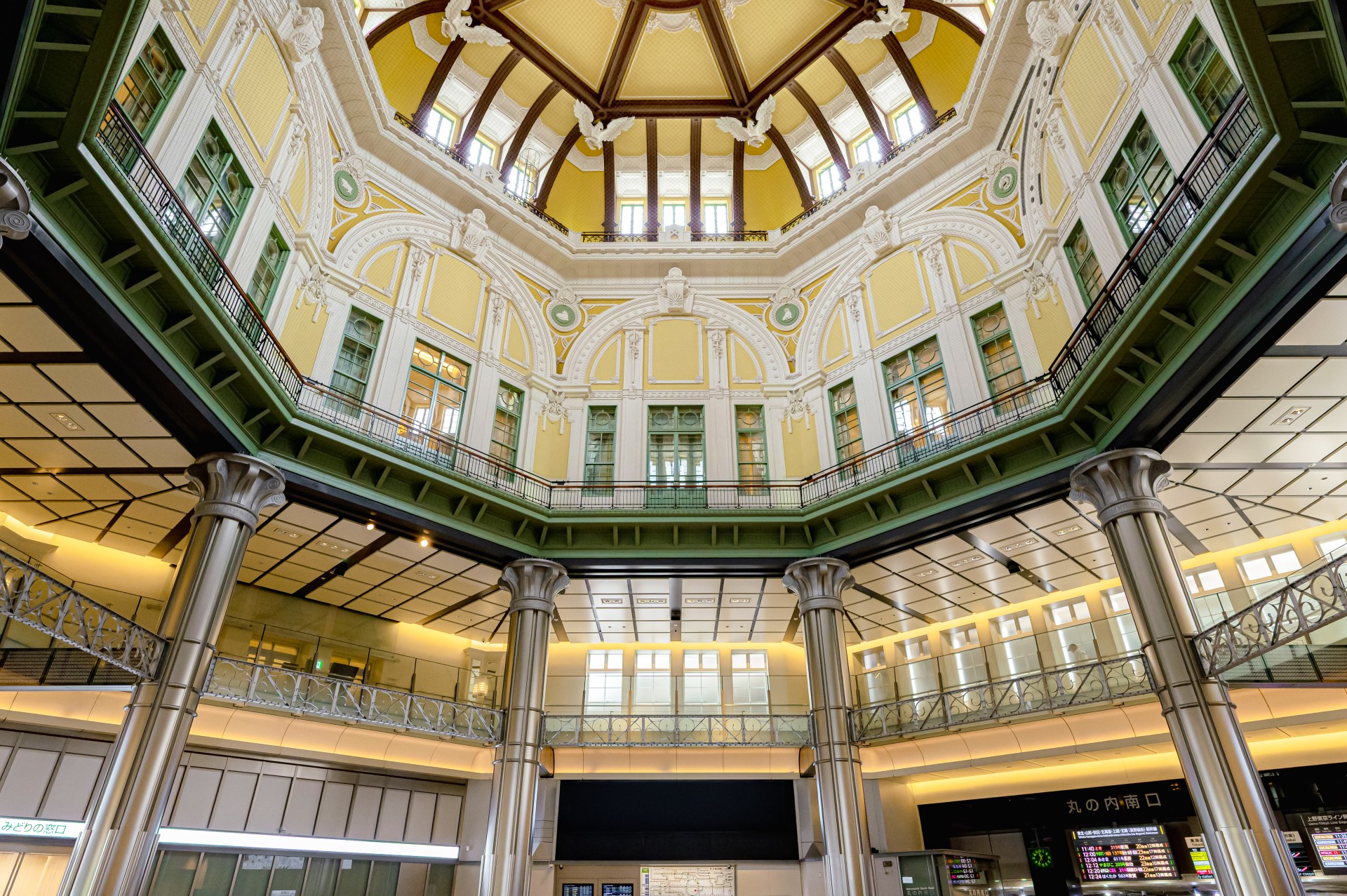
Employing advanced engineering methods for its era, the building combined a steel-framed structural system with load-bearing brickwork, creating one of the largest and most technically sophisticated examples of European-style architecture then constructed in Japan. The celebrated red-brick exterior, accented by white stone trim and crowned by domes at either end, demonstrated Tatsuno’s belief that monumental public buildings should project permanence, dignity, and national prestige. When The Tokyo Station Hotel opened within the Marunouchi Station Building in 1915, guests found themselves immersed in an architectural environment shaped by the same design philosophy. Throughout the hotel, long corridors, lofty ceilings, arched openings, decorative plasterwork, and carefully proportioned windows reflected the Neo-Baroque and Renaissance Revival influences that characterized Tatsuno’s work. The building’s domes became especially significant architectural features, introducing grand interior volumes enriched by ornamental detailing and abundant natural light. Together, these elements created a sophisticated atmosphere reminiscent of the great railway hotels and civic landmarks that Tatsuno had observed during his studies abroad.
Remarkably sturdy construction helped the station withstand the Great Kantō Earthquake of 1923 with relatively minor damage, reinforcing Tatsuno’s reputation for designing exceptionally durable buildings. During postwar reconstruction though, the building was simplified into a two-story structure with modified roof forms, remaining in that altered state for more than six decades. However, a transformative preservation campaign began after the Marunouchi Station Building was designated an Important Cultural Property. Between 2007 and 2012, architects, engineers, and craftsmen undertook a meticulous restoration that sought to recreate the building’s original appearance while discreetly incorporating 21st-century technology. The lost third floor (and domes) were reconstructed using historic photographs, surviving documents, and careful material analysis. Original bricks, stonework, interior walls, and decorative elements were preserved whenever possible, while sophisticated seismic-isolation systems were installed beneath the structure to improve earthquake resistance. Simultaneously, The Tokyo Station Hotel underwent a comprehensive renovation that restored historic architectural character while introducing modern guest accommodations. Reopened in 2012, the hotel is a masterful example of architectural conservation, where heritage craftsmanship and contemporary engineering coexist within one of Japan’s most significant early-20th-century landmarks.
Famous Historic Guests
- Yasunari Kawabata, Nobel Prize-winning author and Japan's first Nobel Laureate in Literature.
- Seichō Matsumoto, one of Japan's most famous mystery writers, known for writing such novels like Points and Lines (Ten to Sen), Inspector Imanishi Investigates (Suna no Utsuwa), and Pro Bono (Kiri no Hata).
- Hyakken Uchida, renowned essayist, novelist, and famous railway enthusiast, known for writing novels like Ahō Ressha, Realm of the Dead (Meido), and Nora Ya.
- Edogawa Ranpo, pioneering Japanese mystery and detective fiction writer, known for writing novels like The Human Chair (Ningen Isu), The Beast in the Shadows (Injū), and The Strange Tale of Panorama Island (Panorama-tō Kitan.)