History
Discover Claremont Resort & Club, a castle that Bill Thornburg built for his family, who wanted to live in an English castle.
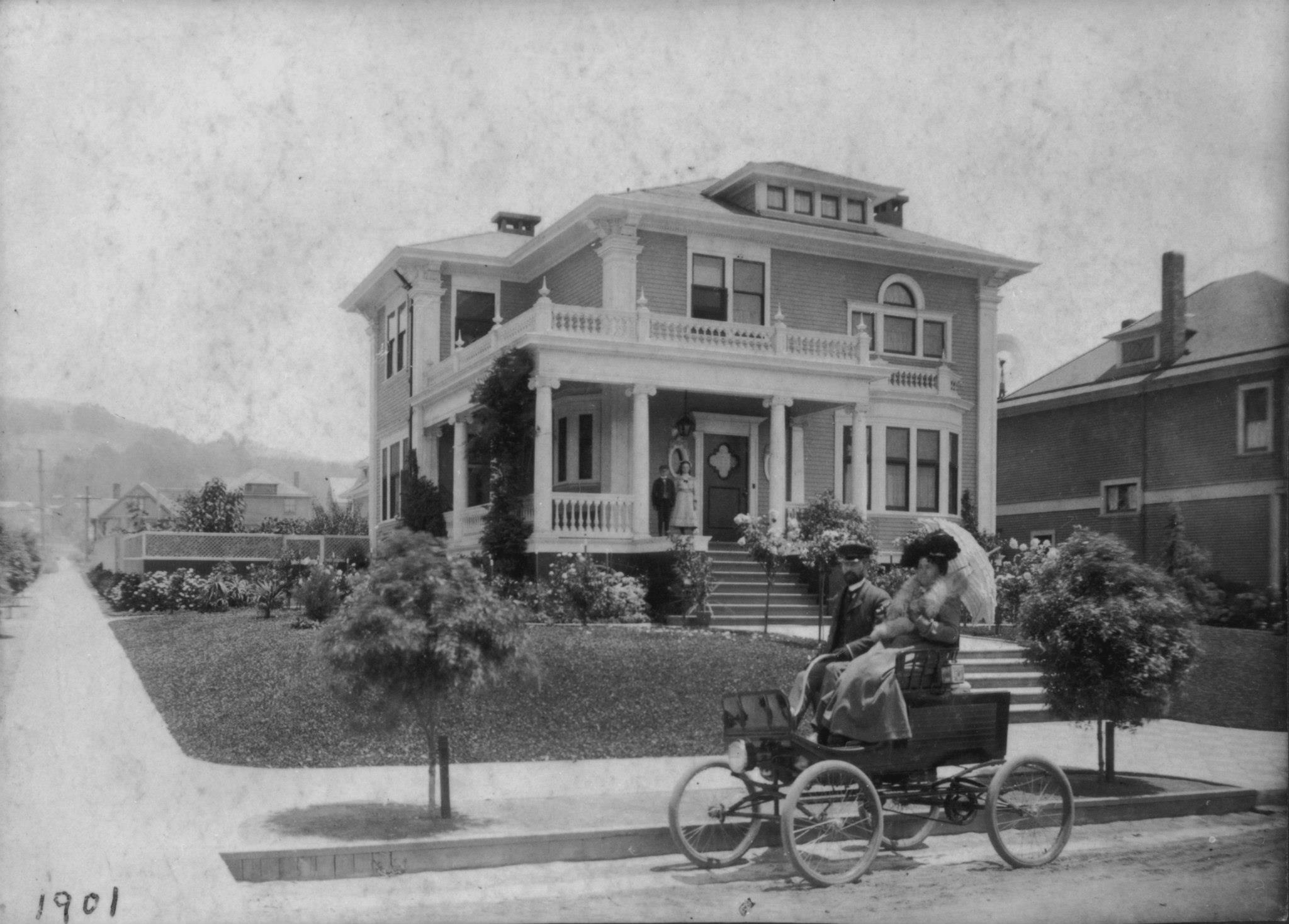
The site upon which the Claremont Resort & Club, currently resides was once home to a beautiful estate known locally as the “castle.” It had been owned by William B. Thornburg, who constructed the facility during the mid-19th century. A native of Kansas, Thornburg had struck it rich at the height of the California Gold Rush. He and his family then traveled to Alameda County, and purchased some 13,000 square acres of land high atop the Berkeley Hills. Their English-inspired manor dominated the local skyline, as did several impressive horse stables. When his daughter married and relocated to Europe several years later, Thornburg decided to sell the entire location to John Ballard. Ballard’s descendants subsequently lived at the estate for generations, until a wildfire swept across the area in 1901. The fire grew so great that it consumed both the “castle,” as well as the surrounding community. Only the stables were spared from the inferno’s wrath. Dejected, the Ballard family sold what remained to a group of investors led by John Hopkins Springs, Francis “Borax” Smith, and Frank C. Havens. One night, the men decided to reconstruct the historic estate as a glorious resort unlike any other active at the time. As such, the formed the “Claremont Hotel Co.” in 1905.
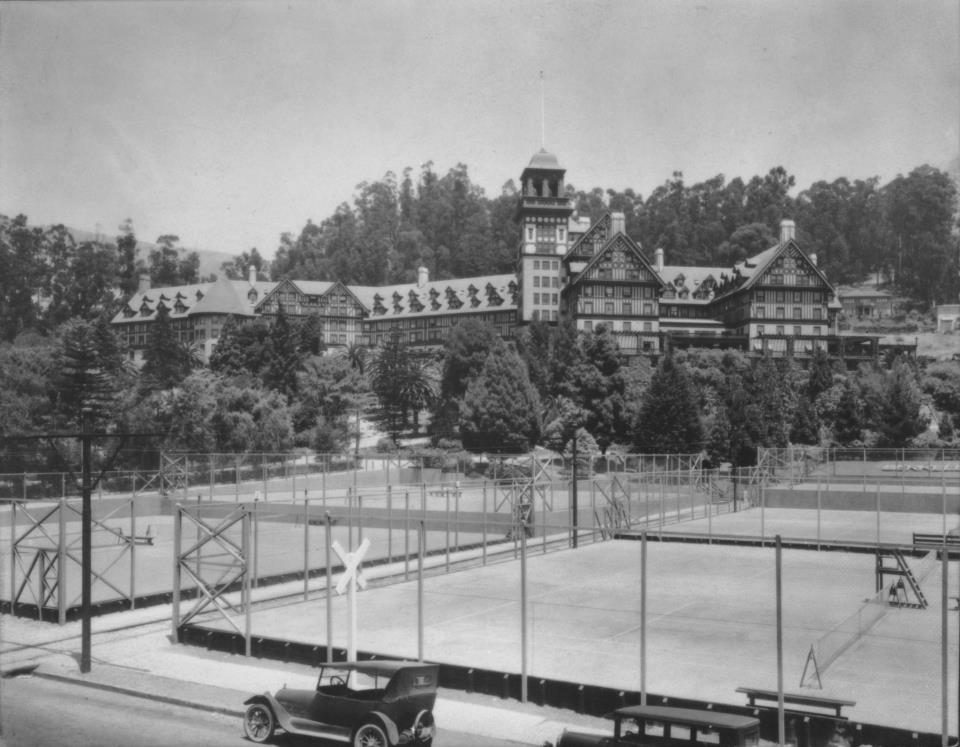
Construction on the destination began shortly thereafter, spearheaded by architects Charles William Dickey and Walter D. Reed. The original blueprints for the destination were incredibly ambitious. They called for a spectacular Tudor Revival-style destination developed almost completely out of wood. It would extend for nearly several thousand square feet and provide the most cutting-edge amenities. Smith and Havens in particular even commissioned the creation of an independent transbay railway line that sat led directly to the resort’s front entrance. Eventually designated the “E” line, the two conceived of the idea from the system of commuter rails they ran in neighboring Oakland through their company, the “Key System.” Yet, their plans were put on hold briefly when a massive earthquake struck the region in 1906. And just as the construction crews began to resume work, the national economy collapsed a year later. The project was also frequently beset by shortages in labor and building materials. Nevertheless, the investors were undeterred by the projects many delays. They even purchased several hundred acres of land in 1908 just for the sake of adding more facilities. By 1915, work on the entire resort had finally concluded. When the dust settled, the group formally debuted its magnificent destination as the “Claremont Hotel.” The Claremont Hotel quickly became one of the most exclusive retreats in Northern California, offering unrivaled views of the surrounding Berkeley Hills and nearby San Francisco Bay.
Interestingly, the destination had to operate under strict prohibition laws during its early history. While national prohibition did not take effect until 1920, the Claremont Hotel was subject to a local statue that denied the sale of alcohol to any business within two miles of the University of California, Berkeley. Hopkins, Smith, and Havens, even tried to amend the law when the business first opened, but to no avail. The Claremont Hotel continued to operate under those conditions until 1937, when a cohort of students at the university determined that the resort resided a few feet outside of the statue’s zone of authority. Meanwhile, Claude Gillum, who had been with the destination since the Roaring Twenties, purchased the Claremont Hotel. He subsequently enacted a thorough renovation throughout the entire facility, practically reconstructing it from the ground up. But Gillum’s tenure as the resort’s managing partner saw the location become one of the most celebrated attractions in California, too. Its marvelous Mediterranean-inspired porch hosted countless upscale weddings from all over the nation, doubling as an open air venue called “The Wedding Chapel.” The legendary Garden Room was the even site of several legendary performances from the likes of Louis Armstrong, Count Basie, and Tommy Dorsey.
In 1954, Claude Gillum sold the Claremont Hotel to Harold J. Schnitzer of the Harsh Investment Corporation. Schnitzer continued to oversee the Claremont Hotel’s maturation into a luxurious holiday retreat, making it one of the busiest convention centers in California during the mid-20th century. During the 1980s, the Claremont underwent another series of renovations that cost a grand total of $40 million. The refurbishment saw the installation of air-conditioning throughout the resort, while every single guestroom received an extensive overhaul. New exotic fauna populated the grounds, alongside several new tennis courts and an outdoor pool. But perhaps the greatest addition to the resort was the development of a $6 million European-style spa facility. This outstanding space later experienced a massive expansion in 2001, following the conclusion of another significant renovation project called the “Millennium Grand Makeover.” Today, the Claremont Hotel operates as a Resort as the “Claremont Resort & Club.” The destination continues to be among America’s most prominent vacation getaways, with its spa ranked as one of the nation’s best year after year.
Hotel Timeline
The Location
Claremont Resort & Club, resides high atop the Berkeley Hills overlooking the cities of Oakland and Berkeley. The resort is specifically located in the East Bay neighborhood of Claremont, which is one of the area’s most prestigious. Use of the name “Claremont” to define the region first occurred following a meeting between several real estate developers and a local named Grant Taggert in 1879. Within a year of the gathering, the main thoroughfare that bisected the area, Telegraph Road, became “Claremont Avenue.” The entire area had previously been referred to as “Telegraph Canyon,” as it once hosted the first telegraph line into Oakland. Shortly thereafter, civic officials condoned the development of a stage coach line that ascended the canyon and over toward Contra Costa County. The stage coach line functioned as one of the first route automobiles could take through the Berkeley Hills, which thousands of motorists traveled ever year. It remained immensely popular for many decades, even after the Caldecott Tunnel opened nearby in 1903. Further local developments occurred at the beginning of the 20th century, the most notable of which was when Duncan McDuffie constructed Claremont Park. While a portion of the park was annexed by the City of Oakland in 1909, much of it still lies in an unincorporated area of Alameda County today. Other such massive real estate developments included the creation of the Key System railway line that passed by the Claremont Resort & Club. Starting at the mouth of the Claremont Canyon, the Key System eventually connected with the San Francisco, Oakland Bay Bridge. Service along this historic line first began in 1909 and ended nearly four decades later in 1958.
The Architecture
When architects Charles William Dickey and Walter D. Reed first began designing the Claremont Hotel more than a century ago, they used Tudor Revival-style architecture as the source of their inspiration. Tudor Revival architecture is best defined as an eclectic mixture of late medieval building traditions that influenced the appearance of English villages during the Middle Ages. The form specifically attempted to emulate the historical character of the feudal cottage that once dominated England’s landscape. The name “Tudor” is somewhat of a misnomer, though, for the design aesthetic does not borrow any of its principles from buildings constructed during the reign of the 16th century Tudor monarchs. Tudor Revival style first became prevalent in the United Kingdom at the beginning of the 20th century, when architects were exploring alternative ways to connect better with the past. Tudor Revival was specifically applied to residential homes, although some commercial structures, like hotels, also bore the unique appearance. It then spread across the Atlantic to the United States, where it was second only in popularity to Colonial Revival architecture. Architects at the time had been motivated by the various revivalist movements spawned from the World’s Fair of 1893, known as the “Columbian Exposition,” which encouraged artists and intellectuals to embrace romanticized versions of history.
Buildings constructed with Tudor Revival-style architecture were typically identified by their half-timbering. In essence, half-timbering is the practice of constructing a series of interlocking load-bearing timber frames that were then filled with some kind of plaster mold. As such, the architects left the frame exposed, creating a visibly distinctive appearance. Another common characteristic of Tudor Revival-themed buildings was the presence of a steeply pitched roof that usually featured heavy shingles. This area of the structure was often lined with overhanging gables, as well as eaves and diamond-shaped casement windows. In many cases, the architects endeavored to make the roof appear as if it had been thatched. Stone chimneys also protruded from the roof, conveying rich details. A wonderful, round arched doorway guided guests into the interior, too, which featured an irregular floor plan. The use of such a layout was normal inside late medieval English homes, as it usually took several generations to build. Modern architects hence attempted to capture that ambiance whenever they set about creating the blueprints for Tudor Revival-style buildings. Today, Tudor Revival-style architecture is cherished for its ability to ensconce its tenants with a charmingly tranquil atmosphere.
Famous Historic Guests
Francis “Borax” Smith, founder of the famed Pacific Coast Borax Company.
Count Basie, big band leader known for leading the Count Basie Orchestra to national prominence from Chicago.
Louis Armstrong, Jazz musician regarded as one of the most influential figures in the genre.
Frank Lloyd Wright, architect responsible for creating over 500 legendary building.
Film, TV and Media Connections
Mrs. Doubtfire (1999)