
History
Discover Colorado Chautauqua, a mountain resort on the edge of Boulder opened in 1898 as part of the Chautauqua adult education and nature movement.
At the close of the 19th century, a quiet yet transformative movement took root along the eastern slope of the Rocky Mountains. The Colorado Chautauqua, established outside Boulder in 1898, grew from a broader national impulse toward education, self-improvement, and communal gathering that had first emerged in Chautauqua, New York. Its founders envisioned a space where intellectual life and natural beauty could coexist, fostering a community grounded in learning and recreation. Nestled beneath the dramatic sandstone formations of the Flatirons, the Colorado Chautauqua became both an extension of a national movement and a distinctly Western expression of it. Originally designed to provide educational opportunities outside formal academic institutions, especially during the summer months when families could travel, the program blended lectures, religious discussions, and theatrical performances into a cohesive cultural experience. Under the leadership of Texas-based educator Charles C. Ellis, the Colorado Chautauqua emerged as an accessible center for enrichment. It welcomed a diverse audience seeking intellectual growth and spiritual renewal, ensuring that education could be better shaped by curiosity, openness, and shared experience.
As the 20th century dawned, the campus quickly came to embody ideals of simplicity, community, and balance between mind and body. Visitors arrived by train and horse-drawn carriage, entering a thoughtfully planned environment that included an auditorium, dining hall, and guest cottages. The Colorado Chautauqua Auditorium became the heart of the campus, hosting a wide array of speakers, including prominent political figures such as Champ Clark, Robert M. La Follette, and William Jennings Bryan. Meanwhile, the surrounding natural landscape played an equally vital role in shaping daily life. Unlike many Eastern counterparts, the Colorado Chautauqua emphasized outdoor activity, encouraging guests to hike in the foothills, explore scenic trails, and embrace the perceived restorative benefits of nature. This combination of structured intellectual programming and unstructured time outside created a unique equilibrium that defined the visitor itinerary. Although the wider Chautauqua movement declined after World War I due to technological sophistication and economic hardship, the Colorado Chautauqua endured. Today, it remains a vibrant cultural destination, continuing to host concerts, lectures, and community events, while its historic cottages invite visitors to immerse themselves in both the landscape and the enduring spirit of shared learning and connection.
Since its founding, the Colorado Chautauqua has been closely intertwined with the City of Boulder, reflecting both communities’ evolving identities. Civic leaders were instrumental in bringing the Chautauqua to life during the 1890s, recognizing its potential to elevate Boulder as a center for culture and tourism in the American West. In its early years, the site functioned as a hub that not only drew visitors to the region, but specifically Boulder. Their presence in turn helped spur Boulder’s economic growth from a remote outpost to a modern city. From the early days, The City of Boulder relied on the nonprofit Colorado Chautauqua Association (CCA) which leased the 26 acre Chautauqua campus to “preserve the site and spirit of the historic Chautauqua”. By the mid-century, concerns over the site's deterioration due to the waning of the Chautauqua movement again prompted stronger municipal involvement, and Boulder played a key role in efforts to preserve and revitalize the location alongside CCA leadership and longtime Chautauqua resident and advocate Mary H. Galey. Those efforts gained traction throughout the 1960s and 1970s, ultimately leading to the Colorado Chautauqua’s designation as a U.S. National Historic Landmark in 2006. Today, the Colorado Chautauqua Association continues to operate, preserve and fund the Colorado Chautauqua, working closely with the City Of Boulder on sustainable preservation policies that safeguard and revitalize its grounds, multiple historic structures, and surrounding open space.
Colorado Chautauqua Lodging was inducted into Historic Hotels of America, the official program of the National Trust for Historic Preservation for recognizing the nation’s finest historic destinations. This distinction recognizes the property’s commitment to preserving its historic character while continuing to welcome guests to one of Boulder’s most treasured landmarks.
Hotel Timeline
The Location
The landscape surrounding present-day Boulder was shaped thousands of years ago as glaciers retreated from Colorado’s Front Range, leaving the sandstone formations now known as the Flatirons. During the early nineteenth century, Zebulon Pike, Stephen Harriman Long, and John C. Frémont passed through the region, bringing national attention to the Colorado frontier. The discovery of gold in the nearby foothills during the late 1850s then transformed the area into one of the focal points of the Colorado Gold Rush. Prospectors established mining camps in the surrounding mountains, while entrepreneurs, merchants, ranchers, and farmers settled along Boulder Creek.
In 1859, members of the Boulder City Town Company formally laid out a new community at the mouth of Boulder Canyon, helping establish what would become the City of Boulder. Over the following decades, the arrival of railroads, electricity, higher education, and new industries allowed Boulder to evolve from a frontier settlement into one of Colorado’s leading cultural and economic centers. At the southern edge of the growing city stood Bachelder Ranch, a working ranch and apple orchard situated beneath the Flatirons. The property’s open meadows, mature trees, irrigation systems, and panoramic mountain views made it one of the most desirable landscapes in the region. In 1898, Boulder civic leaders partnered with the Texas-Colorado Chautauqua Association to transform the former ranch into the Colorado Chautauqua, a summer community dedicated to education, culture, recreation, and personal enrichment. The site was selected not only for its natural beauty but also for its proximity to downtown Boulder and the University of Colorado. Unlike many Chautauqua established resorts in the eastern United States, Colorado Chautauqua was defined by its mountain setting. The campus soon became one of Boulder’s most popular destinations and played an important role in establishing the city’s reputation as a center for culture and outdoor recreation. Today, Colorado Chautauqua is designated as a National Historic Landmark.
The Architecture
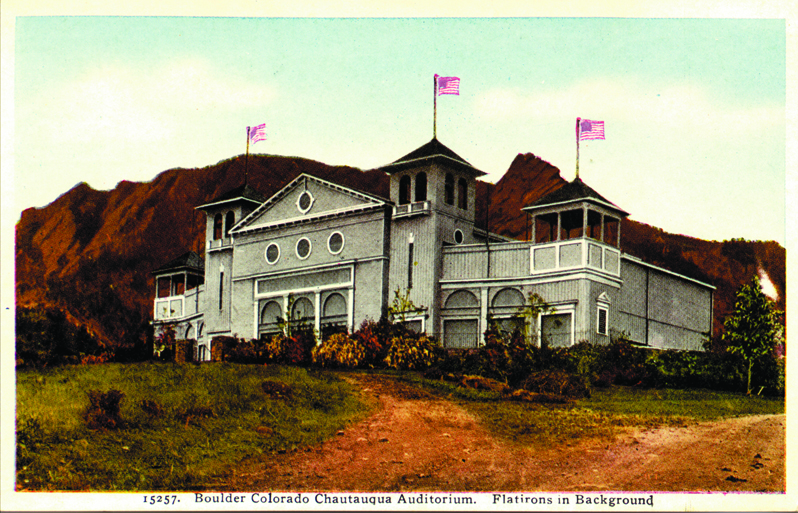
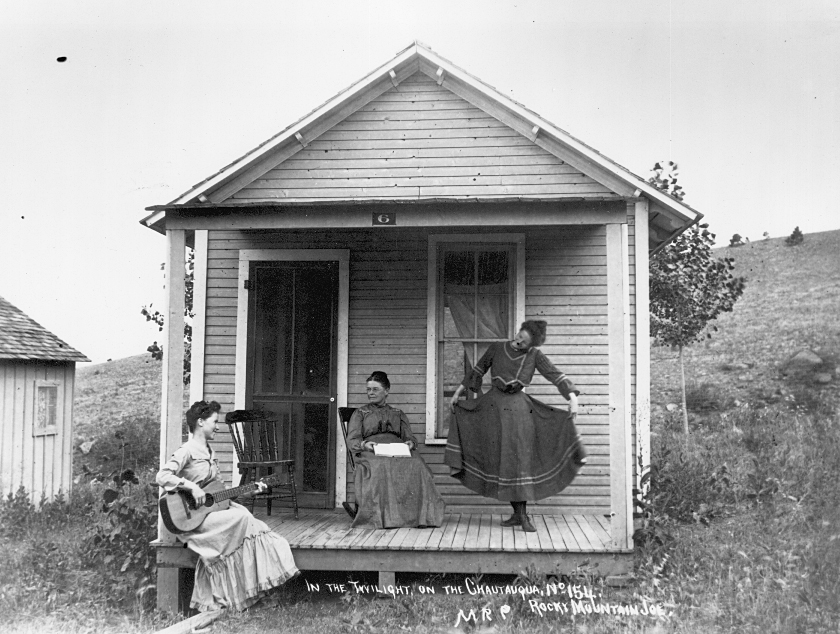
When the Colorado Chautauqua opened in July 1898, most visitors stayed in approximately 150 canvas tents erected on wooden platforms throughout the grounds. Permanent cottages would gradually replace these temporary accommodations over the following decades as the community expanded. The campus’s defining landmark, Chautauqua Auditorium, was constructed in just 53 days during the spring of 1898. Because of its long occupancy and community-focused building projects, Colorado Chautauqua is not defined by a single building or architect, but by a planned collection of more than 100 structures constructed between 1898 and 1950.
The campus occupies a 26-acre section of the former Bachelder Ranch and was laid out according to a modified grid that followed the natural slope of the land beneath Boulder’s Flatirons. Public buildings were concentrated on the flatter northern portion of the site, while cottages were arranged along narrow roads and pedestrian-oriented lanes to create a camp-like setting. The architecture reflects a range of late nineteenth- and early twentieth-century influences, including Victorian Folk, Craftsman, Mission, and Arts and Crafts styles. Character-defining features throughout the district include wood-frame construction, horizontal and vertical siding, screened porches, open eaves, simple gabled roofs, stone retaining walls, and the use of locally sourced Lyons sandstone. The arrangement and scale of the cottages were intentionally designed to preserve the feeling of the original tent community that occupied the grounds during the first Chautauqua season.
The Chautauqua Auditorium, completed in 1898 by architects F. E. Kidder and E. R. Rice, is a 1,300-seat wood-frame auditorium designed as an open-air assembly hall. Its monumental façade is the visual centerpiece of the campus and features towers, arched openings, decorative woodwork, shingled elements, and a broad gabled roof. Other significant campus buildings include the Academic Hall (1900), which served as Colorado’s first university-level summer school; the Craftsman-style Community House (1918), designed by Arthur A. Saunders; the Arts and Crafts-style Missions House (1911); and the Columbine Lodge (1919), which functioned as lodging for short-term guests. Together with the preserved cottages, gardens, and landscape features, these buildings form one of the nation’s most intact Chautauqua campuses and a rare example of architecture created specifically to support the educational, recreational, and cultural goals of the American Chautauqua movement.
Famous Historic Events
Preview of Thomas Edison’s Kinetoscope (1898): When the Colorado Chautauqua opened in the summer of 1898, moving pictures were still a novelty for most Americans. The new Chautauqua Auditorium had been completed just in time for the inaugural season, and organizers sought to bring the latest educational and entertainment attractions to Boulder audiences. On July 21, 1898, visitors gathered inside the auditorium for a presentation featuring Thomas Edison’s motion picture technology, called the kinetoscope. The program included scenes related to the Spanish-American War.
William Jennings Bryan Draws a Record Crowd (1899): On July 12, 1899, the Colorado Chautauqua hosted one of the most significant public events in its history when William Jennings Bryan spoke on site. Already one of the nation’s most famous political figures, Bryan had gained national prominence as the Democratic Party’s presidential nominee in 1896 and was widely regarded as one of the greatest orators of his era. His appearance at Chautauqua Auditorium attracted a record-breaking crowd of more than 13,000 people, far exceeding the capacity of many similar venues throughout the West. Visitors traveled from across Colorado to hear Bryan speak. The success of the event reinforced the auditorium’s reputation as a destination for nationally prominent speakers and civic discussion.
A Trip to the Moon Screened at Chautauqua Auditorium (1900): Two years after hosting one of its earliest film presentations, Chautauqua Auditorium again demonstrated its interest in emerging technology by screening Georges Méliès’ A Trip to the Moon (Man in the Moon). Released in 1900, Méliès’ production was among the world's first cinematic fantasy films and introduced innovative special effects that defined the possibilities of motion picture storytelling. Motion pictures soon became a regular feature of programming at the auditorium, leading to the installation of a dedicated projection booth in 1905. The early embrace of film at Colorado Chautauqua helped secure its place in the history of American cinema exhibition and contributed to the auditorium’s continuing role as a venue for film, lectures, and live performance.
Famous Historic Guests
William Jennings Bryan, three-time Democratic presidential nominee and 41st U.S. Secretary of State.
Samuel Porter, evangelist and religious speaker.
Oliver Toussaint Jackson, entrepreneur, restaurateur, and founder of Dearfield, Colorado.
Theodosia Grace Ammons, suffragist, educator, and first female dean at Colorado State University.
Charles C. Ellis, educator and founding leader of the Colorado Chautauqua.
Women in History
Theodosia Grace Ammons: Theodosia Grace Ammons was a pioneering educator, suffragist, and advocate for women’s advancement whose contributions helped shape both higher education and the women’s rights movement in Colorado. As president of the Colorado Equal Suffrage Association, she championed women’s civic participation at a time when opportunities for women in public life remained limited. Ammons represented Colorado women at national suffrage conventions and advocated for expanding opportunities for women through both education and public service. She was a nationally recognized leader in the emerging field of domestic science, promoting education that combined practical skills with scientific principles.
In 1895, Ammons co-founded the Department of Domestic Economy at Colorado Agricultural College, now Colorado State University. She became the department’s first faculty member and later the institution’s first female dean, helping establish academic opportunities for women while elevating domestic science as a respected field of study. Her work emphasized household efficiency, hygiene, nutrition, and the use of innovative technologies that could reduce the burdens of domestic labor. Ammons also played an important role in the Colorado Chautauqua. As Director of the School of Domestic Science, she taught continuing education courses and promoted practical applications of scientific knowledge in everyday life. She designed Gwenthean Cottage, one of the earliest permanent cottages on the Chautauqua grounds, where she later lived with her sisters during her final years. The cottage served as a model home demonstrating modern approaches to health, comfort, and household efficiency. Ammons passed away in 1907. Her papers have been preserved by Colorado State University and digitized through the Mountain Scholar repository. In recognition of her lasting impact on Colorado history, Theodosia Grace Ammons was inducted into the Colorado Women’s Hall of Fame in 2022.
Film, Media, and Television Connections
In 1898, Chautauqua Auditorium presented one of the earliest moving pictures shown in America on an Edison kinetoscope.
In 1900, Georges Méliès’ groundbreaking film A Trip to the Moon (Man in the Moon) was screened at Chautauqua Auditorium.
The starting credits for the popular sit-com “Mork and Mindy” (1978-1982) starring Robin Williams prominently featured Chautauqua and Boulder.
The film Elevation (2024) was filmed on site.
In 2026, Chautauqua Auditorium was announced as an official venue for Sundance Film Festival.