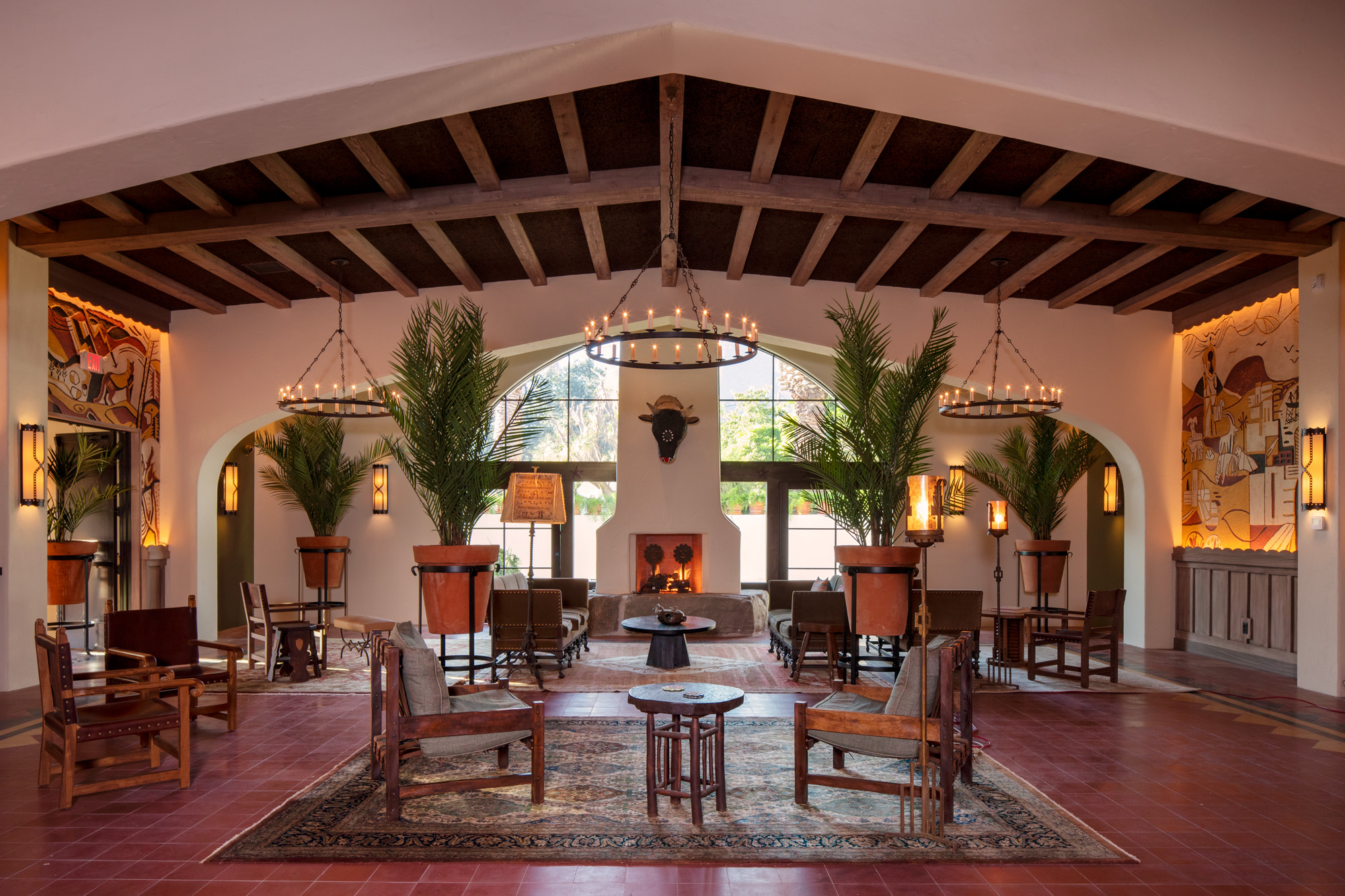
History
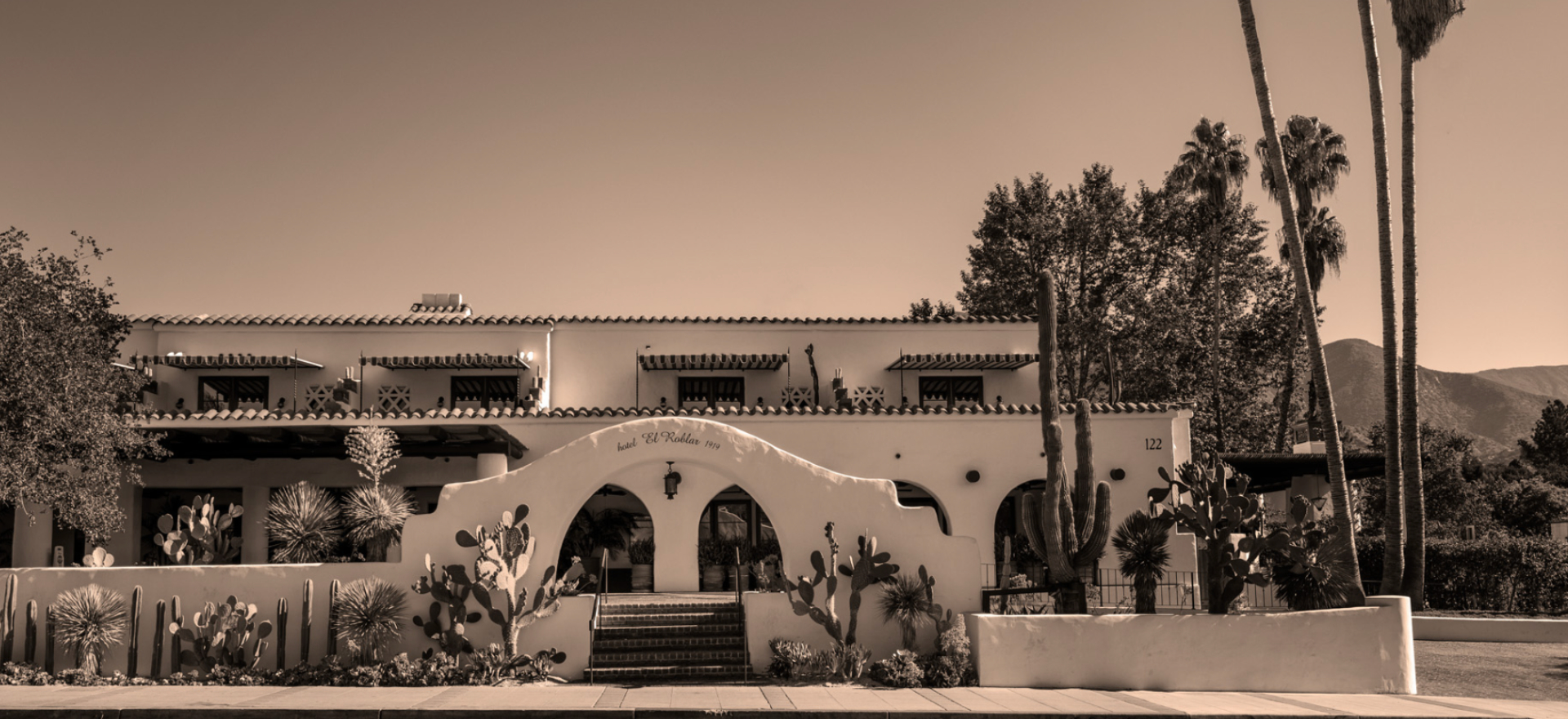
Located in the heart of Ojai, California, Hotel El Roblar has been an enduring witness to more than a century of change in the community it calls home. Its story begins in 1919, when Ojai,then just a small agricultural village,was carefully shaped into a planned town rooted in a romantic portrayal of early California. The hotel emerged as part of that vision, influenced by ambitious civic leader Edward Drummond Libbey. An Ohio industrialist who first visited Ojai in 1908, Libbey had fallen in love with the site and became instrumental in promoting its development. Working alongside architects such as Richard Requa, Libbey dreamed of enhancing one of the local towns to reflect the broader heritage of the region. Within this broader civic plan, the future Hotel El Roblar was conceived as part of a cohesive cultural vision for Ojai. Libbey called for the use of distinctive Spanish Revival architecture to be implemented throughout the building’s façade to create a cohesive aesthetic identity that meshed well with the reimagined Ojai. From the outset, the building that would become Hotel El Roblar was intended to function as a social anchor for the whole town. Originally known under earlier incarnations such as the “Ojai Tavern,” it quickly evolved into a central gathering place that welcomed countless travelers and locals alike. Its opening signaled not only the arrival of a hotel, but the debut of Ojai as a holiday destinationone tied to agriculture, improved health, and unrivaled relaxation.
Guests arriving over the following years encountered a landscape populated with verdant citrus groves and oak trees, the latter inspiring the hotel’s eventual name “El Roblar” meaning “oak grove” in Spanish. As California grew and automobile travel expanded throughout the mid-20th century, the hotel continued to entertain numerous guests drawn by Ojai’s mild climate, mountain vistas, and increasingly well-regarded artistic communities. The neighboring countryside’s unique orientation—which produced a famed “pink moment” at sunset—became a particularly alluring trait of the hotel’s character, tying the guest experience to the contours of the landscape. Given its enduring popularity, the building itself started to undergo new, innovative transformations as the century progressed. Perhaps the most exciting modification to affect the site was its reformation into a luxurious wellness resort called “The Oaks at Ojai” in 1977. Then, during the 21st century, a renewed appreciation for historic preservation and experiential travel created conditions for a comprehensive revitalization of the compound. Designers and developers intentionally drew upon archival imagery and regional history to reintroduce historic elements, such as Mission-style detailing, period-inspired interiors, and references to the nearby geography, ensuring that the restored Hotel El Roblar would feel both authentic and relevant. As a result, Hotel El Roblar stands as one of the region’s longest-serving hotels, a distinction that underscores both its resilience and its adaptability across more than a century.
Hotel Timeline
The Location
The history of Ojai harkens back centuries, with the native Chumash residing in the area thousands of years ago. In fact, the word “Ojai” is derived from the Chumash word “awha’y,” which means “moon.” The area itself was an outpost of their sprawling society that populated the California coastline from Morro Bay to Malibu Creek. The Chumash established thriving villages on the charming Channel Islands. Eventually, in the late 18th century, Spanish Franciscan priests began creating missions throughout the region. Those isolated locations were all that existed of European society for decades, until Mexico achieved its independence from Spain in 1821. The new Mexican government then ordered all the mission complexes secularized, with the land divided among political allies. Those new estates were owned by a class of people soon known as “rancheros,” who wielded significant influence over the Mexican frontier. In 1837, a businessman from Santa Barbara named Fernando Tico received one such land grant, which constituted the lower and upper sections of the Ojai Valley. Called the “Rancho Ojai” Grant, it covered a land mass of nearly 18,000 acres! Tico subsequently operated a cattle ranch in the upper valley, while his family lived in an adobe down in the lower portion. But their time at the estate proved to be short-lived, as they wound up selling the site to new owners in 1853.
The Rancho Ojai then exchanged hands several times until Thomas A. Scott acquired it nearly ten years later. Scott was a Pennsylvania oil and railroad baron, who was attracted to the Ojai Valley due to rumors about its vast subterranean oil reserves. In 1866, Scott and his nephew, Thomas Bard, raised a steam-powered drilling rig on the northern face of Sulphur Mountain. Known as “Ojai No. 6,” Scott and Bard spent the next several months attempting to extract crude oil from the area. Their lives changed drastically when on May 29, 1867, the rig struck an oil pocket at a depth of 550 feet. The reservoir that Ojai No. 6 hit was immensely large, eventually producing 10 to 20 barrels a day. Around the same time, Scott’s neighbor, Josiah Stanford—the older brother of Leland Stanford, founder of Stanford University—created his own oil rig on the south side of Sulphur Mountain. It, too, found oil, and became just as productive as Scott’s Ojai No. 6. But this prosperity did not last long, for the country experienced a decline in oil prices toward the end of the decade. Making matters worse was the rise of other oil fields across the United States in places like Texas and New Mexico. As such, Scott closed Ojai No. 6, while Bard began selling surface rights all over the Rancho Ojai. (When the local oil economy finally recovered in the 1890s, Bard would return to Sulphur Mountain to construct many more new rigs.)
While the rapid oil boom temporarily cooled, the core of the City of Ojai started to come into existence. In 1874, a businessman from San Buenaventura named R.G. Surdam laid out a small street grid in the lower valley near the Rancho Ojai. He named the little community “Nordhoff” after the author Charles Nordhoff. Surdam had chosen Nordhoff as the town’s namesake, as the latter had written a popular book entitled, California for Health, Pleasure and Residence. As such, Surdam hoped to affiliate his new town with Nordhoff’s work, crafting its identity as a preeminent vacation and health retreat. (Even though Nordhoff never mentioned Ojai Valley in the first edition of his book, he included it in later versions upon learning of the town.) The marketing strategy worked brilliantly. At first, Surdam only talked about the climate and Nordhoff’s book—but in the 1880s, he also began to address the area’s mineral springs. Hundreds of individuals began flocking to the area, arriving predominately along the Ventura and Ojai Valley Railroad. By the end of the century, both the town of Nordhoff and the surrounding Ojai Valley had developed strong reputations as places of healing. People affected by respiratory diseases found the region particularly attractive, settling along the mountains that lined the valley’s borders.
In the early 1900s, Nordhoff was a vibrant resort community that was especially popular among wealthy families from the East Coast and Midwest. The upscale Foothills Hotel catered to many of those affluent people. Some of those visitors even made their stay permanent, constructing grand manors in the undeveloped land surrounding the town. Among the individuals who decided to live in Nordhoff year-round were Edward Drummond Libbey and his wife, Florence. First arriving in 1907 from Ohio, the Libbeys quickly fell in love with the valley. Edward Drummond Libbey proceeded to buy land near the Foothills Hotel two years later, creating a Craftsman-style home designed by Myron Hunt and Elmer Grey. A follower of the City Beautiful movement, Libbey started considering new ways to improve Nordhoff’s landscape. He specifically hired Frank Mead and Richard Requa to create a Spanish Colonial-themed town center. Among the most notable features involved a Mission-style arcade and a bell tower that mimicked the famous Havana Cathedral in Cuba. Once the final phase of the project concluded in 1917, the town’s name was officially changed to “Ojai.” To thank Libbey for all that he had done, the townspeople proposed holding a celebration in Civic Center Park, now known as Libbey Park, called “Libbey Day.” Always modest, Libbey instead implored them to name it “Ojai Day.” The Town of Ojai continued to celebrate “Libbey Day” every year until 1928. Nevertheless, the holiday was revived by a local schoolteacher named Craig Walker during the 1990s. The event has been a cherished local festival ever since.
The Architecture
Hotel El Roblar displays some of the finest Spanish Colonial Revival-style architecture around Ojai. Also known as “Spanish Eclectic,” this architectural form is a representation of themes typically seen in early Spanish colonial settlements. Original Spanish colonial architecture borrowed its design principles from Moorish, Renaissance, and Byzantine forms, which made it incredibly decorative and ornate. The general layout of those structures called for a central courtyard, as well as thick stucco walls that could endure Latin America’s diverse climate. Among the most recognizable features within those colonial buildings involved heavy carved doors, spiraled columns, and gabled red-tile roofs. Architect Bertram Goodhue was the first to widely popularize Spanish Colonial architecture in the United States, spawning a movement to incorporate the style more broadly in American culture at the beginning of the 20th century. Goodhue received a platform for his designs at the Panama-California Exposition of 1915, in which Spanish Colonial architecture was exposed to a national audience for the first time. His push to preserve the form led to a revivalist movement that saw widespread use of Spanish Colonial architecture throughout the country, specifically in California and Florida. Spanish Colonial Revival-style architecture reached its zenith during its height during the early 1930s, although a few American businesspeople continued to embrace the form well into the late 20th century.