
History
Discover the Inn at the Presidio with its Classic Revival design.
A U.S. National Landmark, the Inn at the Presidio is part of a much larger historical complex known as the “Presidio of San Francisco.” By the late 19th century, the Presidio of San Francisco had emerged as a very strategic military base in the western United States. Due to the federal government’s increased national interest with the Pacific, the Presidio became a critically important defense installation guarding the maritime approaches into San Francisco Bay. It also evolved into an important staging ground for troops destined to head overseas, starting with the Filipino theater in the Spanish American War. To address the rising importance of the Presidio, the War Department instructed its commanding officer at the time—Brigadier General Nelson A. Miles—to expand its facilities exponentially. Miles started the process by developing an intricate road system throughout the complex, followed by new ring of enclosed concreate fortifications facing the bay. A new series of brick barracks then appeared that were meant to house the rising number of soldiers stationed at the base. Known as the “Montgomery Street Barracks,” those buildings would form the basis for the Presidio’s “Main Post.” The Letterman Army Hospital opened around the same time, too, which quickly became the biggest medical facility that the U.S. Army would operate in the 20th century. There was even a special railroad line that ferried servicemen and women straight to downtown San Francisco. Thus, the Presidio of San Francisco was one of the five largest military bases in the whole country at the end of the 1890s.
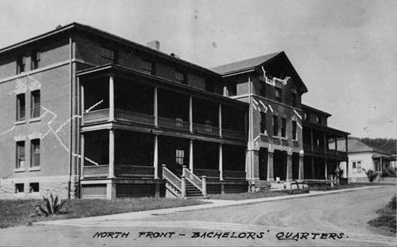
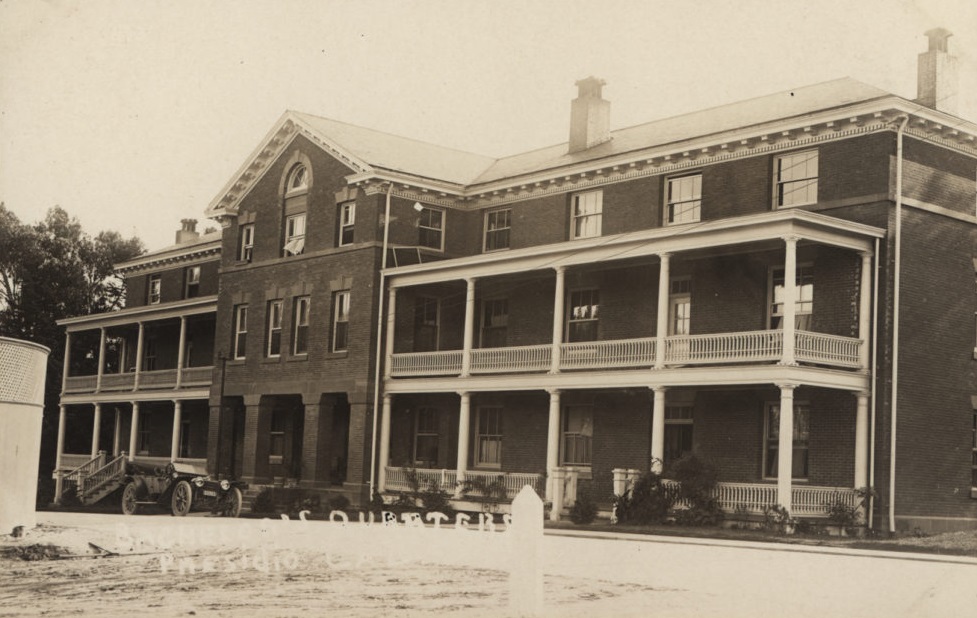
Construction work continued well into the first two decades of the following century. Among the most prominent structures developed at the time included the massive artillery post known as “Fort Winfield Scott,” which debuted in 1912. Like many other buildings raised at the Presidio in the early 1900s, Fort Winfield Scott displayed the design principles of Colonial Revival-style architecture. This was a markedly different approach from previous construction projects that sought to replicate the base’s Spanish heritage. Yet, one much smaller building appeared nearly ten years earlier that acted as the prototype of the base’s use of Colonial Revival architecture. In 1903, military engineers led by architect James Campbell started building a new dormitory-like living space for unmarried army officers within the Main Post. Taking several months and some $45,000 dollars to complete, the building embraced the neoclassical elements that defined Colonial Revival aesthetics. The new building was meant to replace another wood-frame structure called “The Corral,” which had burnt down four years prior. As such, the Colonial Revival-style architecture used to create the barracks served as the example that many more buildings would follow at the Presidio. This new structure went unnamed for some time, though, until General John J. Pershing assumed command over the installation in 1913. Pershing would rise to become one the nation’s greatest heroes, defeating the Mexican bandit Pancho Villa and leading the American Expeditionary Force in World War I. The building was subsequently named “Pershing Hall” in his honor.
The Presidio of San Francisco continued to act as the central base for the U.S. Army on the West Coast for the rest of the 20th century. The Army specifically continued to rely on the Presidio to funnel countless soldiers to many areas scattered across the Pacific in World War II, the Korean War, and Vietnam. It even briefly served as the headquarters for both the Fourth and Sixth U.S. Armies, which presided over the entire national defense apparatus of the western United States at various points in time. But with the end of the Cold War in the late 1980s, Congress decided to close the Presidio along with many other military installations. The Presidio of San Francisco formally ceased operating in 1994 and was turned over the National Park Service (NPS). To help the organization run the massive facility as a park, Congress created a non-profit called the “Presidio Trust.” The entity assumed control of nearly 80% of the Presidio, with just the coastline under the direct purview of the NPS. It subsequently began renovating most of the structures inside the Presidio and even leased a few of the spaces to private groups. The hope was that the new tenants would provide a much-needed source of income that would help preserve the Presidio. Over time, tourists from around the world fell in love with the site and traveled to it in the thousands. To accommodate the influx, the Presidio Trust decided to open a luxurious vacation retreat on the grounds. In 2011, it began transforming Pershing Hall into a wonderful boutique hotel named the “Inn at the Presidio.” The business then debuted to great acclaim roughly a year later. Now a member of Historic Hotels of America, this fantastic destination is among the most exciting places to visit in San Francisco today.
Hotel Timeline
The Location
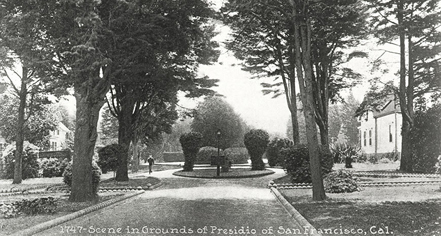
A part of the much larger Golden Gate Recreational Area, the Presidio was once a sprawling military base located toward the western end of the San Francisco Peninsula. The region covers a landmass of some 2.3 square miles and has been recognized as a national park since 1996. The Presidio of San Francisco has received several historical designations throughout its history, too, becoming a California Historical Landmark in 1993 and a National Historical Landmark in 1962. It connects directly to the historic Golden Gate Bridge, which specifically passes by its northernmost installation—Fort Point National Historic Site. Most of the surviving historic structures reside within a section of the Presidio known as the “Main Post.” The Main Parade Ground resides just to the east of the Main Post, while Fort Winfield Scott resides to the west. Other locations that define the eastern side of the Presidio include the former grounds of Letterman Army Hospital and the San Francisco National Cemetery. The historic structures affiliated with the once active Crissy Field lie next to Fort Winfield Scott. A ring of enclosed concreate field guns line the Presidio’s coastline, including Battery Chamberlin, Battery East, and Battery Marcus Miller. Yet, the Presidio of San Francisco doubles today as a massive nature preserve, filled with dozens of hiking trails and scenic overlooks. Perhaps its most famous outdoor attraction is the majestic Marshall’s Beach. Thousands of recently planted trees also call the Presidio home, with such species as eucalyptus, pine, and cypress filling the southern end of the park in large numbers. But other privately owned cultural attractions have populated the Presidio of San Francisco in recent years, like The Walt Disney Family Museum.
The history of the Presidio is immense, far too great to cover in detail here. Nonetheless, it was formally founded in 1776, when Lieutenant Colonel Juan Bautista de Anza ordered a cross erected on the Punta del Cantil Blanco just above the mouth of San Francisco Bay. By raising the cross, de Anza had followed conventional Spanish protocols to set aside land for official military development. He had hoped that the heights would be sufficient to guard against any encroachments by rival European powers that wanted to inhabit the region. Juan Bautista de Anza soon dispatched his second-in-command, Jose Moraga, to lead an expedition from present-day Arizona to the site for its settlement. The installation that Moraga’s men created was nothing more than a small adobe surrounded by a few quaint agricultural structures that they called the “El Presidio Real de San Francisco.” Constructed alongside the Mission San Francisco de Asis, the military installation functioned more as an outpost for the distant Viceroyalty of New Spain (now modern-day Mexico). Life was often difficult for the soldiers of the garrison, as they received little government support. As a result, they engaged in activities like farming and hunting just as much as their normal military duties. Their situation became a bit better in the 1790s though, when the garrison developed an imposing coastal battery named the “Castillo de San Joaquin.” Manned by half-a-dozen cannons, it greatly enhanced the soldiers’ ability to deter the British and the Russians from invading the bay.
For the next two decades, the citadel protected the entrance into San Francisco Bay on behalf of the Spanish Empire, until Mexico achieved its independence in 1821. Despite news of the event taking a full year to reach the outpost, the soldiers declared its loyalty to the new Mexican government. But the Presidio became even more remote, and its garrison gradually left for bases further to the south. The largest exodus occurred under Mariano Vallejo, who led all but a squad of soldiers to nearby Sonoma in 1835. The decision to relocate the garrison several hundred miles away proved costly, as American forces easily captured the structure at the onset of the Mexican-American War. Originally inhabited by a unit of cavalry, a few companies of the 1st New York Volunteer Regiment moved into the Presidio in 1847. From the base, they served as an occupational unit that coordinated the defense of the entire bay region, thus beginning the Presidio’s role in protecting the western United States. This responsibility was further augmented when thousands of Americans flooded the region at the start of the California Gold Rush in 1849. The U.S. Army—which had formally assumed control over the base around the same time—began an arduous reconstruction project that saw the Presidio slowly transform into a sprawling military installation. The old Castillo de San Joaquin was replaced with Fort Point, while the heavily forested region immediately to the south was cleared to make way for new administrative buildings. The Presidio quickly became the nerve center for the defenses ringing San Francisco, directing orders to such faraway places like the Marin Headlands and Fort Funston.
After the American Civil War, the Presidio of San Francisco underwent a series of several massive expansions that saw its size increase tenfold. The War Department approved plans to erect a new series of coastal batteries with Fort Point at its center. It also commissioned the creation of the many buildings that constituted the Presidio’s Main Post, including around a dozen barracks built along its iconic Main Parade Ground. Further developments occurred around the start of the 20th century, including the creation of the Letterman Army Hospital (1898) and Fort Winfield Scott (1912). Among the last greatest additions to the Presidio was Crissy Field in 1921, which was a pioneering military aviation center operated by the legendary Henry “Hap” Arnold. At this point, the Presidio had become one of the five largest military bases in the entire country. Letterman Army Hospital alone was the U.S. Army’s biggest facility, capable of several thousand patients at once. It also served as the most important Army base along the West Coast, functioning as the primary training, supply, and embarkation post for soldiers destined to serve overseas in the Pacific. Indeed, the Army relied on the Presidio to funnel units to Asia in World War II, the Korean War, and the Vietnam War. It even briefly served as the headquarters for both the Fourth and Sixth U.S. Armies, which presided over the entire national defense apparatus of the western United States at various points in time.
When the Cold War finally ended during the 1980s, Congress started drafting plans to demobilize much of America’s standing military. Those plans included the deactivation of the country’s military bases except for the most critical. Congress outlined the particular aspects of its strategy within its Base Realignment and Closure program, which ultimately decommissioned some 350 military installations throughout the United States. The Presidio of San Francisco was among the first to be shuttered, considered to be non-essential in 1989. Congress formally voted to close the facility five years later, concluding the Presidio’s three-century-long career as a military base. It then turned over to the Presidio to the National Park Service to operate as one of its parks. But in 1996, Congress decided to create the Presidio Trust to help oversee much of the Presidio’s management. As such, the Presidio Trust was left in charge of most of the site, while the National Park Service retained direct control over the shoreline. Congress also mandated that the Presidio Trust become fully self-sufficient, which it achieved completely in 2005. Now one of San Francisco’s most iconic destinations, the Presidio of San Francisco has a history that few other places in the United States can claim to possess.
The Architecture
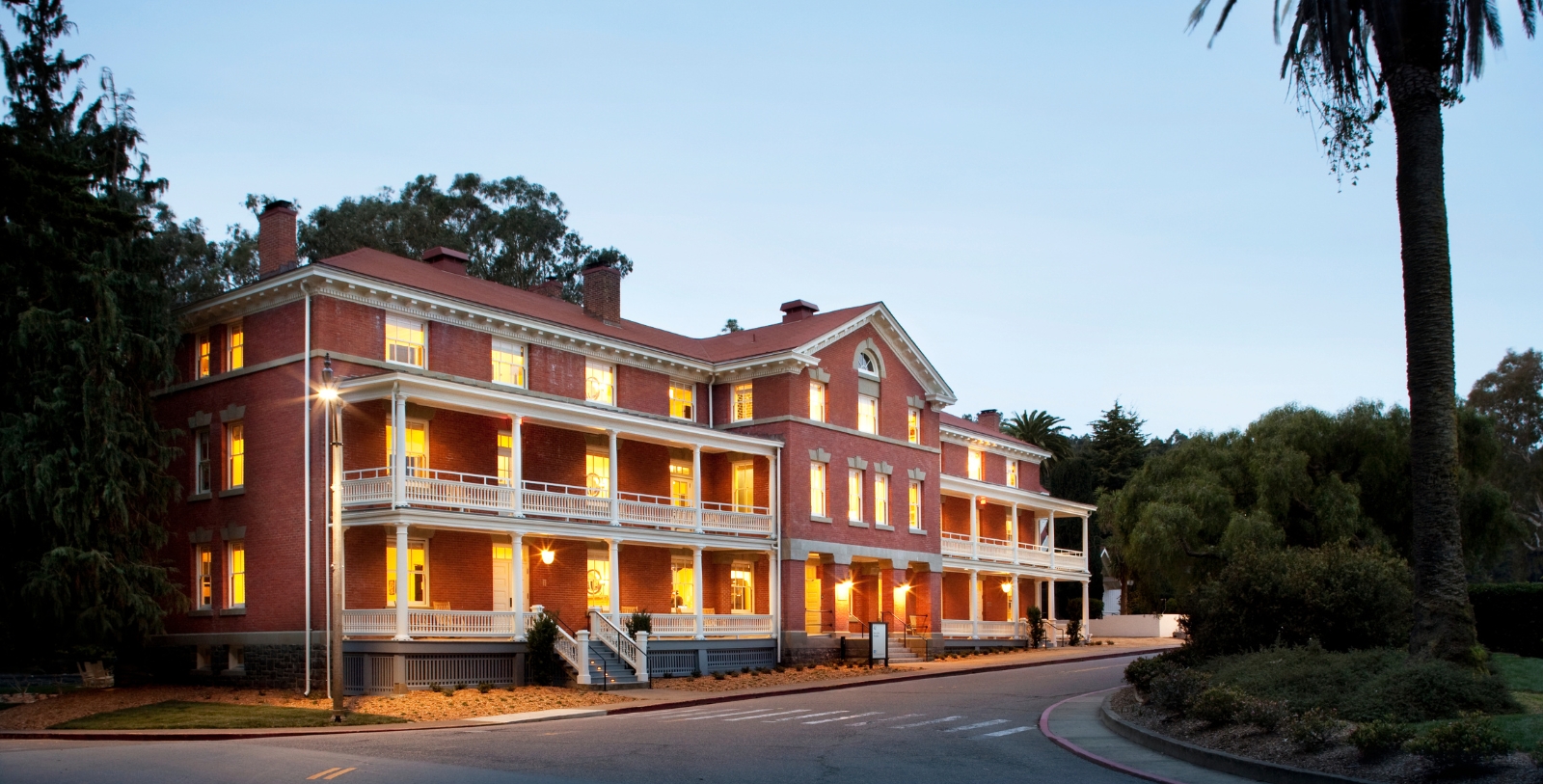
In 1903, architect James Campbell constructed Pershing Hall as a dormitory-like living space for unmarried army officers. It cost the military some $45,000 to complete and mainly followed the conventional blueprints endorsed by the Office of the Quartermaster General. Those plans embraced a cruciform layout that featured a cross-axial rectangle bisected by a pavilion. It also called for the building to stand three stories tall and roughly measure 34 feet by 142 feet. The building’s main rectangular structure contained decorative elements that included a classical cornice detailed with several prominent modillions and dentils. Thick, red brick walls constituted the primary building material, but a combination of brick and ashlar created as the foundation. Campbell and his team also installed a sandstone belt course between the second and third stories, which made the final floor appear as if it resembled a separate attic. A hipped roof also topped Pershing Hall, while a transverse gable roof sat above the pavilion. Mounted with asphalt shingles, the main hipped roof was home to seven chimneys. Furthermore, according to the U.S. Department of the Interior:
- “The front elevation has a projecting entrance pavilion and two-level verandas to either side with wooden Tuscan columns and molded handrails with turned balusters. The bottom story of the central pavilion is open, forming an entrance porch of brick piers topped by flat stone capitals with curved silhouettes suggesting a simplified section of classical molding.”
The pavilion itself acted as the front entrance to Pershing Hall and anchored the entire design. Its most iconic structural element was the large third-story window that sat in the center, surmounted by a semi-circular fanlight. This beautiful fanlight specifically resided in the middle of the pavilion’s pedimented gable end. Campbell used carved rock to construct both the keystone voussoirs and that defined the pavilion. Three additional entrances scattered throughout the façade possessed doors with wood paneling and transoms. The architectural team also included stone-jacked arches to surround the first and second story windows, while those located on the third story rested just below the cornice. Each and every window had stone lug sills and double-hung sash.
Like most of the buildings erected at the Presidio in the early 20th century, Pershing Hall featured a brilliant blend of Colonial Revival architecture. In fact, the structure’s appearance served as the prototype for many future facilities built throughout the base. Also known as “Georgian Revival,” Colonial Revival architecture today is perhaps the most widely used building form in the entire United States. It reached its zenith at the height of the Gilded Age, where countless Americans turned to the aesthetic to celebrate what they feared was America’s disappearing past. The movement came about in the aftermath of the Centennial International Exhibition of 1876, in which people from across the country traveled to Philadelphia, Pennsylvania, to commemorate the American Revolution. Many of the exhibitors chose to display cultural representations of 18th-century America, encouraging millions of people across the country to preserve the nation’s history. Architects were among those inspired, who looked to revitalize the design principles of colonial English and Dutch homes. This gradually gave way to a larger embrace of Georgian and Federal-style architecture, which focused exclusively on the country’s formative years. As such, structures built in the style of Colonial Revival architecture featured such components as pilasters, brickwork, and modest, double-hung windows. Symmetrical designs defined Colonial Revival-style façades, anchored by a central, pedimented front door and simplistic portico. Gable roofs typically topped the buildings, although hipped and gambrel forms were used, as well. This building form remained immensely popular for years until largely petering out in late-20th century. Nevertheless, architects today still rely upon Colonial Revival architecture, using the form to construct all kinds of residential buildings and commercial complexes.
Famous Historic Events
Spanish-American War (1898): One war in particular called upon the services of the Presidio more than most the others—the Spanish-American War of 1898. Since a significant portion of the conflict occurred in the Philippines, the base became a major staging ground for troops headed across the ocean. Dozens of temporary camps emerged throughout the Presidio, as such, in order to accommodate the swell of new soldiers into the base. Some of the camps were little more than just a massive city of tents, with Camp Merriam the largest! Named after Major General Henry Clay Merriam, the camp resided along the axis of Lombard Street. Among the units that called Camp Merriam its home were the 1st and 7th California Volunteer Infantry Regiments, as well as the 51st Iowa Volunteer Infantry Regiment, the 20th Kansas Volunteer Infantry Regiment, the 1st New York Volunteer Infantry Regiment, and the 1st South Dakota Volunteer Infantry Regiment. Over time, additional overflow encampments appeared near the Main Parade Ground and the south end of Funston Avenue.
World War I (1917 – 1918): Even though World War I formally began in Europe in August of 1914, America did not join until a full three years later. Congress specifically declared war on the Central Powers following Germany’s resumption of unrestricted warfare throughout the Atlantic. Most of the fighting remained in Europe and the Mediterranean, which placed the Presidio of San Francisco on the opposite side of the world. Nevertheless, the Presidio’s Letterman Army Hospital became a major triage center for casualties returning from the front. It also pioneered the use of women as Army nurses and played a significant role in refining the practice of physical therapy to treat wounds. As such, the size of the Presidio increased greatly, as a number of medical buildings appeared to assist the hospital. Additional enhancements were made to the ring of coastal batteries that surrounded the main complex, as well. Several of the Presidio’s garrison units, such as the 30th Infantry Regiment, were shipped to the war’s Western Front and experienced great success in fighting the Germans. The regiment had specifically gained famed serving in the 3rd Infantry Division, which earned the moniker as the “Rock of the Marne” for its dogged defense of Paris in the spring of 1918.
Crissy Field (1921): In July 1918, the U.S. Congress passed Public Law 189, which sought to establish eight “air coast defense stations” across the United States. It specifically set aside $1.5 million to develop one exclusively for San Francisco. As the Army still controlled the Air Force at this time, it assigned Colonel Henry H. Arnold as its commanding officer and directed him to develop the site. He led a team of four fellow officers during the survey, ultimately selecting the former grounds of the Panama-Pacific International Exposition that resided just beyond the current boundaries of the Presidio. Construction began in 1919, as engineers raised several hangars, as well as an airstrip upon the grounds of an abandoned racetrack. When the facility was ready to open as part of the Presidio in 1921, Arnold christened it as “Crissy Field.” The name was inspired by Major Dana H. Crissy, who had died while attempting to complete a transcontinental flight from California to New York.
Under Arnold’s watch, aviators at Crissy Field pioneered countless aeronautical feats, including artillery fire coordination, aerial photography, and search and rescue missions. The airstrip also saw the first aerial forest fire patrol launched to great success. Perhaps the most enduring legacy of Crissy Field was that it sponsored the first successful flight to Hawaii. The attempt was originally led by Commander John Rogers, although his crew were forced to ditch in the Pacific before they reached the archipelago. But Lester Maitland and Albert Hegenberger managed to complete the trek two days later, flying non-stop on the Bird of Paradise. Eventually, Crissy Field was shut down and its personnel transferred to other bases shortly before America’s entry into World War II. One of its hangars was even used to house the U.S. Army’s Military Intelligence Service Language School. Crissy Field is now a central attraction of the Presidio of San Francisco National Park. Most of its facilities have been brilliantly restored, preserving its close connection to America’s innovative history with the art of aviation.
World War II (1941 – 1945): As soon as America entered World War II, the Presidio of San Francisco once again became a major deployment zone for the U.S. Army. Like the Spanish-American War, it specifically oversaw the training and embarkation of soldiers destined to serve in battle across the Pacific. The base subsequently underwent its greatest period of development, in which dozens of new buildings emerged with the sole purpose of serving the influx of new recruits. The Presidio also oversaw the entire defense of the western United States and the far coast of Alaska. Lieutenant General John L. DeWitt commanded the Western Desert Command from the Presidio, as well as the United States Fourth Army and the rings of costal defenses that guarded San Francisco Bay. Letterman Army Hospital resumed its status as one of the Army’s most important medical facilities, too, hosting thousands of wounded soldiers from units stationed throughout the Pacific Theater. At the height of the conflict, the hospital hosted some 72,000 patients.
But the Presidio was involved in some of the more insidious parts of the American war effort, as General DeWitt used the base’s troops to round up Japanese Americans for internment. As directed by President Franklin Delano Roosevelt’s Executive Order 9066, he forced them to live inside makeshift camps scattered across the Presidio. Despite the treatment, many second-generation Japanese Americans volunteered for military service. Some were even among the first to be trained at the Presidio at the outbreak of the war. They were specifically assigned to a special military program called the Military Service Language School, in the hopes that their knowledge of Japanese culture would play a significant role in beating Japan. Launched in an abandoned hangar at Crissy Field, the school itself was the forerunner to the modern Defense Language Institute.
Australia, New Zealand, United States Security Treaty (1951): Also known as “ANZUS,” the Australia, New Zealand, United States Security Treaty was a non-binding joint defense agreement that governs military operations between the three nations. It specifically coordinates the efforts between Australian and New Zealand, as well as Australia and the United States. The Treaty stipulated that if any foreign entity were to launch an attack against one of the three nations, the rest should mobilize their forces to meet the common threat. ANZUS itself was born out of the many global agreements that America formed with its allies in the aftermath of World War II, as a better way to confront the Soviet Union. In September of 1951, the delegates met inside an officer’s club at the Presidio to discuss the matter in private. Coming to an agreement, they later convened at the same spot to sign the treaty. The law is still in operation today, although New Zealand was expelled for a time due to its imposition of a nuclear weapons ban within its territorial waters in the late 1980s.
Treaty of Mutual Cooperation and Security between the United States and Japan (1951): Following the ratification of the Treaty of San Francisco, the United States and Japan sent delegates to discuss ways to further bolster their newfound friendship. Convening in September 1951 at the Presidio, the politicians devised strategies in which the two nations would respond to a variety of potential foreign threats in East Asia. In essence, their agreements called for the United States military to mobilize against any hostile country that attacked Japan within its territories and vice versa. Yet, the American delegates managed to force Japan to accept the role as a junior partnership, with the United States holding sway over Japanese interpretations of belligerency. Yet, the status between the two parties was later addressed in 1960, when Japan and the United States met in San Francisco once more to review the agreement. Japan managed to make the deal more equal, in which the United States was bound to inform Japan of any future mobilizations near its Home Islands. The revised treaty included additional language that encouraged further economic cooperation between the two, as well. The of Mutual Cooperation and Security between the United States and Japan is still in effect today, making it one of the most lasting international agreements in world history.
Presidio Mutiny (1968): By the time the Vietnam War had reached its climax in 1968, the Presidio of San Francisco had already been shipping hundreds of American G.I.s to active combat zones in Southeast Asia. The Letterman Army Hospital was back to treating numerous soldiers that had been wounded while on their respective tours of duty. The war’s controversial nature was now fully reverberating throughout the nation, too, as people across America protested furiously either for or against it. This cultural tumult was even felt at the Presidio, where 27 inmates imprisoned inside the base’s stockade protested their living conditions on October 14. The men specifically locked arms while they say on the ground and sang “We Shall Overcome.” The leaders of the protest also presented a list of demands that requested the better treatment of prisoners, especially those who were black. The impetus for the soldiers’ demonstration evolved from an incident in which a guard had killed a prisoner only a few days prior. Massive protests swirled outside of the Presidio’s gates, inspiring the 27 prisoners to stage their own demonstration. The U.S. Army subsequently charged the prisoners with mutiny—one of the most serious criminal offenses in the military.
Known to society as the “Presidio 27,” the inmates received lengthy prison sentences that ranged anywhere from six months to 16 years. Yet, the Presidio 27 were not violent criminals. Many, in fact, were working-class teenagers, who were drafted against their will into the service. All had become disillusioned with the Vietnam War and had deserted. Fleeing deep into San Francisco, the Presidio 27 were gradually arrested by the base’s military police and incarcerated in the stockade. As the population in the stockade swelled, the living conditions became practically unbearable. When those details surfaced following their sentencing, it caused mass outrage throughout the general public. Their tribulations made national headlines and further fueled the growing Anti-War Movement in the Bay Area. Nevertheless, the Presidio 27 suffered great personal hardship over the next several years, with a few even spending time in federal prison. Eventually, the Army overturned all of their convictions based on the revelation that the Presidio 27 had not actually attempted to overthrow the military hierarchy at the Presidio. Historians today consider the actions of the Presidio Mutiny to constitute the greatest example of G.I. civil disobedience to the Vietnam War in the nation’s history.
Famous Historic Guests
Erasmus D. Keyes, general best remembered for commanding the Union IV Corps during the American Civil War.
Henry W. Halleck, general best remembered for serving as the “General-in-Chief” for all Union armies during the American Civil War, before getting replaced by Ulysses S. Grant.
Irwin McDowell, general best remembered for leading Union forces at the First Battle of Bull Run during the American Civil War.
George H. Thomas, general best remembered today as the “Rock of Chickamauga” for his exploits in the American Civil War.
Emory Upton, Medal of Honor recipient best remembered for charging the Confederate breastworks at the Battle of Spotsylvania Courthouse during the American Civil War.
John J. Pershing, commanding general of the American Expeditionary Force during World War I.
Henry H. Arnold, General of the Army and General of the Air Force in the first half of the 20th century.
Joseph Stilwell, general remembered for famously leading Allied forces in the "China Burma India" Theater during World War II.
Theodore Roosevelt, 26th President of the United States (1901 – 1908)
Film, TV and Media Connections
The Man Who Cheated Himself (1950)
Vertigo (1957)
Point Blank (1967)
Petulia (1968)
Mission: Impossible: Ultimatum (1972)
The Streets of San Francisco: In the Midst of Strangers (1972)
Mannix: Cry Danger (1973)
High Anxiety (1977)
Foul Play (1978)
Emergency!: What’s a Nice Girl Like You Doing…? (1979)
Murder She Wrote: Birds of a Feather (1984)
Torment (1986)
Falcon Crest: Flash Point (1986)
Star Trek IV: The Voyage Home (1986)
The Presidio (1988)
The Royal Road (2015)