





Receive for Free - Discover & Explore eNewsletter monthly with advance notice of special offers, packages, and insider savings from 10% - 30% off Best Available Rates at selected hotels. 
history
Discover La Posada, which is the only hotel still in operation outside of Grand Canyon National Park to be designed by renowned architect Mary E.J. Colter.
Rising from the high desert along the main line of the Atchison, Topeka and Santa Fe Railway, La Posada was built to be a place where travelers arriving by rail could be immersed instantly in a carefully imagined vision of the Southwest. When it opened its doors at the height of the Great Depression, the hotel marked the culmination of more than half a century of railroad expansion, tourism development, and architectural experimentation in northern Arizona. Built at the edge of Winslow’s rail yards, La Posada stood not merely as a hotel though, but as a very deliberate statement that the journey itself possessed incredible cultural significance. Winslow’s emergence as a rail town began in 1881, when tracks of the Atlantic and Pacific Railroad reached the Little Colorado River crossing near the settlement of Brigham City. As construction pushed westward, Winslow quickly became a division point, complete with roundhouses, servicing facilities, and yards essential to the operation of a transcontinental line that followed earlier wagon roads that traced along the 35th parallel. Once the Santa Fe Railroad consolidated full control of the route in the 1890s, Winslow was firmly established as a logistical and social hub, although amenities for passengers remained limited and uneven.
The transformation of rail travel into an organized tourist experience arrived through the partnership between the Santa Fe and the Fred Harvey Company, whose restaurants and hotels introduced standardized hospitality to a system that lacked true guest accommodations. Harvey “houses” thus became essential waypoints on the line, catering to travelers drawn west by curiosity as much as necessity. By the beginning of the 20th century, Fred Harvey and the railroad had begun marketing the American Southwest promoting pueblos, mesas, canyons, and deserts as cultural destinations, accessible through carefully planned rail itineraries and guided excursions. La Posada was envisioned as the final and most ambitious hotel in the network, designed to serve as the regional hub for excursions to renowned natural landmarks like the Painted Desert, Meteor Crater, and White Mountains. Planning started during the 1920s, but construction costs soon ballooned beyond initial estimates to eventually exceed $1 million—a reflection of both the hotel’s scale and the extraordinary level of craftsmanship invested in every aspect of its appearance. Overseeing the development of La Posada fell to Mary E.J. Colter, the renowned architect whose work for the Fred Harvey Company had already redefined the architectural ambiance of the region.
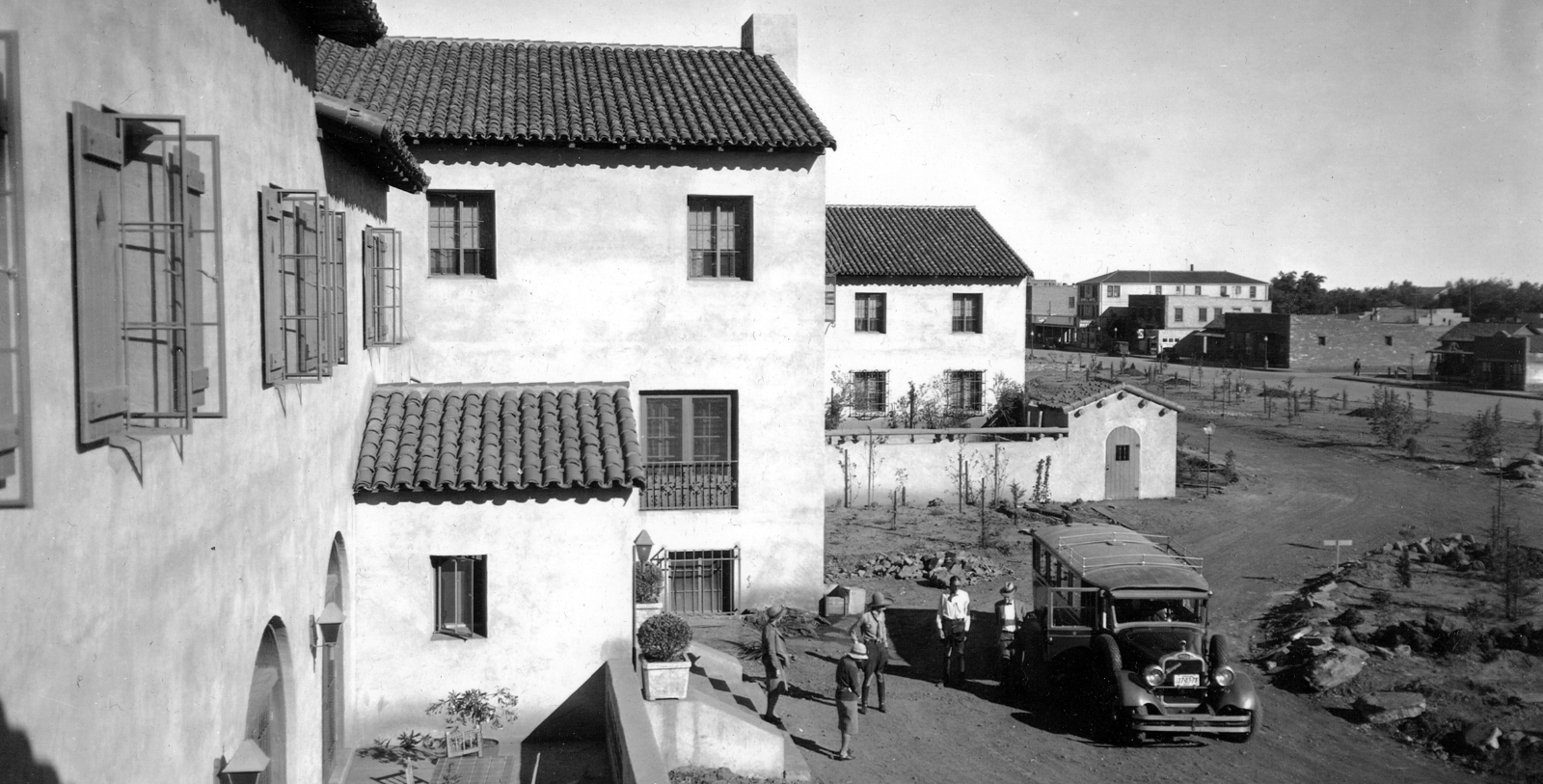
Colter rejected generic revivalism in favor of deeply site-specific narratives, inventing layered histories for her buildings that guided everything from materials to furnishings. For La Posada, she imagined a sprawling Spanish ranch estate that had evolved over generations, owned by a wealthy don and later adapted, imperfectly and organically, into a hotel. This fictional past justified the use of asymmetrical patterns, irregular forms, and a sense of accumulated age, allowing the building to appear timeless rather than newly constructed. The resulting complex, encompassing both a hotel and railroad station within an 11-acre site, was among the finest expressions of Spanish Colonial Revival architecture in Arizona. Stucco walls, terra‑cotta tile roofs, and intimate courtyards were arranged in an informal yet controlled composition and framed by gardens intended to shelter guests. The grounds included petrified wood fountains, orchards, and even romanticized ruins echoing nearby historic sites, reinforcing Colter’s belief that architecture should feel inseparable from its setting. The hotel became the town’s gathering place upon its debut in 1930, hosting civic events, celebrations, and daily rituals that blurred the boundary between local life and transient travel.
Enduring the financial hardships of the Great Depression, La Posada went on to act as a vital link in the wider regional tourism industry. Rising numbers of travelers sought a reservation at La Posada, especially once automobile traffic increased exponentially due to the modernization of Route 66 around World War II. The enhanced accessibility attracted national attention in turn, including notable figures from around the country. In fact, the hotel’s guest list came to feature amazing names like Albert Einstein, Gary Cooper, Carole Lombard, Douglas Fairbanks, Mary Pickford, John Wayne, Clark Gable and even two U.S. Presidents—Franklin D. Roosevelt and Harry S. Truman. Nevertheless, changing travel behaviors unfortunately forced La Posada to close for good during the late 1950s. Despite years of neglect and alteration, La Posada retained its essential character by the time Allan Affeldt acquired it in 1997. Initiating a comprehensive renovation project, Affeldt proceeded to revitalize the ailing historic structure back to its former glory. Thanks to his efforts, La Posada has resumed its place as one of the most charming destinations to visit in the Southwestern United States. This fascinating historic site is also the only surviving hotel designed entirely by Mary Colter to operate outside of Grand Canyon National Park, embodying a rare link to the region’s past.
The transformation of rail travel into an organized tourist experience arrived through the partnership between the Santa Fe and the Fred Harvey Company, whose restaurants and hotels introduced standardized hospitality to a system that lacked true guest accommodations. Harvey “houses” thus became essential waypoints on the line, catering to travelers drawn west by curiosity as much as necessity. By the beginning of the 20th century, Fred Harvey and the railroad had begun marketing the American Southwest promoting pueblos, mesas, canyons, and deserts as cultural destinations, accessible through carefully planned rail itineraries and guided excursions. La Posada was envisioned as the final and most ambitious hotel in the network, designed to serve as the regional hub for excursions to renowned natural landmarks like the Painted Desert, Meteor Crater, and White Mountains. Planning started during the 1920s, but construction costs soon ballooned beyond initial estimates to eventually exceed $1 million—a reflection of both the hotel’s scale and the extraordinary level of craftsmanship invested in every aspect of its appearance. Overseeing the development of La Posada fell to Mary E.J. Colter, the renowned architect whose work for the Fred Harvey Company had already redefined the architectural ambiance of the region.
Colter rejected generic revivalism in favor of deeply site-specific narratives, inventing layered histories for her buildings that guided everything from materials to furnishings. For La Posada, she imagined a sprawling Spanish ranch estate that had evolved over generations, owned by a wealthy don and later adapted, imperfectly and organically, into a hotel. This fictional past justified the use of asymmetrical patterns, irregular forms, and a sense of accumulated age, allowing the building to appear timeless rather than newly constructed. The resulting complex, encompassing both a hotel and railroad station within an 11-acre site, was among the finest expressions of Spanish Colonial Revival architecture in Arizona. Stucco walls, terra‑cotta tile roofs, and intimate courtyards were arranged in an informal yet controlled composition and framed by gardens intended to shelter guests. The grounds included petrified wood fountains, orchards, and even romanticized ruins echoing nearby historic sites, reinforcing Colter’s belief that architecture should feel inseparable from its setting. The hotel became the town’s gathering place upon its debut in 1930, hosting civic events, celebrations, and daily rituals that blurred the boundary between local life and transient travel.
Enduring the financial hardships of the Great Depression, La Posada went on to act as a vital link in the wider regional tourism industry. Rising numbers of travelers sought a reservation at La Posada, especially once automobile traffic increased exponentially due to the modernization of Route 66 around World War II. The enhanced accessibility attracted national attention in turn, including notable figures from around the country. In fact, the hotel’s guest list came to feature amazing names like Albert Einstein, Gary Cooper, Carole Lombard, Douglas Fairbanks, Mary Pickford, John Wayne, Clark Gable and even two U.S. Presidents—Franklin D. Roosevelt and Harry S. Truman. Nevertheless, changing travel behaviors unfortunately forced La Posada to close for good during the late 1950s. Despite years of neglect and alteration, La Posada retained its essential character by the time Allan Affeldt acquired it in 1997. Initiating a comprehensive renovation project, Affeldt proceeded to revitalize the ailing historic structure back to its former glory. Thanks to his efforts, La Posada has resumed its place as one of the most charming destinations to visit in the Southwestern United States. This fascinating historic site is also the only surviving hotel designed entirely by Mary Colter to operate outside of Grand Canyon National Park, embodying a rare link to the region’s past.
-
About the Location +
Long before Winslow, Arizona, was ever settled, the area was home to Indigenous peoples, including the Hopi and Navajo, whose seasonal presence reflected a deep understanding of the rugged landscape. However, the modern town began to take shape with the arrival of the Atlantic and Pacific Railroad in 1881, which transformed a windswept expanse into a strategic rail stop. Named after Edward F. Winslow, a railroad executive, the town quickly filled with railroad workers, merchants, and families. Winslow in turn became a vital junction between Gallup and Flagstaff, as well as an important lifeline for both freight and passengers moving across the Southwest. The railroad defined Winslow’s early character and prosperity. Harvey Houses, hotels operated by the Fred Harvey Company, brought reliable hospitality and cuisine to travelers and railroad crews, with La Posada coming to be regarded as one of the most elegant railway hotels in the region. Artists, architects, and craftspeople left their mark, embedding culture into a town otherwise known for industry and transit. Winslow was never just a place to stop—it was a place where diverse people passed through, drawn by opportunity and the promise of the American West. That promise expanded dramatically with the advent of automobiles and the establishment of U.S. Route 66 in 1926.
When the Mother Road traced its path through northern Arizona, Winslow found itself reborn as a roadside town, serving motorists as it once served rail passengers. Gas stations, motels, diners, and trading posts sprang up along the highway, and the rhythm of the town began to embody the lure of the open road. Route 66 linked Chicago to Los Angeles, but for many travelers Winslow became a vivid memory, a place where the scale of the western landscape felt especially profound. The Great Depression and World War II brought hardship and change though, and the later debut of nearby Interstate 40 threatened Winslow’s survival. By the late 20th century, the town faced population loss and economic struggle. But history, once again, became a source of renewal. A growing nostalgia for Route 66 and mid-century Americana brought visitors back, eager to trace the historic Route 66 in its distinctive communities. Winslow embraced this revival, restoring landmarks, celebrating its railroad heritage, and leaning into its cultural moment in popular music and memory. Today, Winslow stands as a memory of the ways transportation shapes place and identity. From Indigenous pathways to steel rails, its story mirrors the broader history of the wider region. Route 66 threads through Winslow’s heritage, reminding visitors that even small towns can hold expansive histories at the crossroads of a nation on the move.
-
About the Architecture +
When renowned architect Mary E.J. Colter first began designing La Posada during the 1930s, she chose Spanish Colonial revivalism as the main source of her inspiration. Also known as “Spanish Eclectic,” Spanish Colonial Revival-style architectural form is a representation of themes typically seen in early Spanish colonial settlements. Original Spanish colonial architecture borrowed its design principles from Moorish, Renaissance, and Byzantine forms, which made it incredibly decorative and ornate. The general layout of those structures called for a central courtyard, as well as thick stucco walls that could endure Latin America’s diverse climate. Among the most recognizable features within those colonial buildings involved heavy carved doors, spiraled columns, and gabled red-tile roofs. Architect Bertram Goodhue was the first to widely popularize Spanish Colonial architecture in the United States, spawning a movement to incorporate the style more broadly in American culture at the beginning of the 20th century. Goodhue received a platform for his designs at the Panama-California Exposition of 1915, in which Spanish Colonial architecture was exposed to a national audience for the first time. His push to preserve the form led to a revivalist movement that saw widespread use of Spanish Colonial architecture throughout the country, specifically in California and Florida. Spanish Colonial Revival-style architecture would reach the height of its popularity during the early 1930s, although many people would continue to embrace the form well into the latter half of the 20th century.
Colter also incorporated elements of Mission Revival architecture throughout La Posada’s appearance. This historic hotel stands today as a brilliant example of California Mission Revival. An offshoot of the larger Spanish Colonial Revival-style, Mission Revival architecture first emerged in the United States during Gilded Age, specifically in California. The movement specifically enjoyed its greatest popularity from 1890 to 1915, although it continued to be used by architects well into the late 20th century. The Mission Revival style of architecture has a historical and cultural predominance in the southwestern United States, as it is a common sight throughout that region of the country. Franciscan monasteries constructed throughout California during the 1700s served as the primary source of inspiration for Mission Revival-style architecture.
-
Famous Historical Events +
Route 66: Few roads in the United States have captured the imagination and spirit of the nation quite like Route 66. Stretching approximately 2,450 miles in length, Route 66 is more than just a highway. It acts as a symbol of freedom, migration, and the American dream. The very idea for Route 66 emerged at a time of rapid automobile expansion during the early 20th century. As cars became more accessible, Americans demanded better roads. In response, Congress passed the Federal Aid Highway Act in 1921, which laid out the groundwork for a sprawling highway system that could meet those expectations. Rather than being built from scratch, Route 66 instead functioned as a patchwork of existing local, state, and national roads. It followed paths that had been used for centuries, like Native American trails, Spanish colonial paths, and railroad lines. And the route managed to reach major urban centers, including Chicago, St. Louis, Oklahoma City, and Los Angeles. Work on the development of the highway did not fully begin until 1925, with engineers connecting the various stretches together via dirt thoroughfares. (For reference, Springfield, Missouri, saw Route 66 arrive a few years later.) But thanks to New Deal-era federal funding, the entire expanse of Route 66 was finally paved near the end of the 1930s. It was not long before Route 66 had thus become an important institution for thousands of people throughout the country.
During the Dust Bowl, Route 66 was a lifeline for displaced families who migrated westward in hopes of finding work. (This harrowing experience was immortalized in John Steinbeck’s classic novel The Grapes of Wrath, where he famously dubbed Route 66 the "Mother Road.”) Then as the nation mobilized for World War II, Route 66 played a strategic role in transporting troops to the West Coast. After the conflict though, Route 66 truly entered its golden age. With automobile ownership skyrocketing, families took the road for thrilling vacations. The number of mom-and-pop businesses on the highway soon multiplied as a result, including hotels akin to La Posada in Winslow, Arizona. These establishments not only provided essential services but contributed to the unique roadside culture that eventually defined Route 66. Indeed, Route 66 became synonymous with the American road trip with many distinctive kinds of pop cultural productions reinforcing the perception. Musician Bobby Troup wrote the incredibly popular song “(Get Your Kicks on) Route 66” that artists like Nat King Cole, Chuck Berry, and The Rolling Stones later recorded. Renowned Hollywood icons Peter Fonda and Dennis Hopper captured the road’s relationship to the mid-century countercultural movement in their classic film Easy Rider. CBS even aired a television series called Route 66, which portrayed the highway as an incredible place of adventure and self-discovery.
Route 66 was not built to handle the increasing volume of post-war traffic. To address the problem, President Dwight D. Eisenhower signed the Federal-Aid Highway Act, which initiated the construction of the modern Interstate Highway System. Although the effects of these new roads were not felt immediately, they would come to displace Route 66 given their faster and safer characteristics. Observing the decline of the once great thoroughfare, the American Association of State Highway and Transportation Officials voted to ultimately decommission Route 66 in 1985. The decision subsequently devastated many communities that had relied on the highway for commerce, with some turning into ghost towns. However, Congress eventually recognized the cultural significance of Route 66 and created the Route 66 Corridor Preservation Program to help revitalize the legendary road. Historic preservationists have since worked tirelessly to protect the highway’s legacy, with many distinctive historic sites having been renovated to reflect their former glory. More recently, the National Trust for Historic Preservation provided grants to aid in the ongoing restoration of Route 66, while highlighting hidden gems to explore along the route. Route 66 remains a powerful symbol of America’s journey through the 20th century. From its humble beginnings as a patchwork of rural streets to its rise as a national cultural icon, the site continues to inspire travelers, historians, and dreamers alike to this very day.
-
Famous Historic Guests +
Albert Einstein, Nobel Prize winning physicist known for his role in developing quantum theory.
Alice Faye, singer and actress known for her roles in films like Alexander’s Ragtime Band, Lillian Russell, and Hell, Frisco, Hello.
Amelia Earhart, pioneering aviator who was the first woman to fly solo across the Atlantic Ocean
Betty Grable, actress known for her roles in such films like Mother Wore Tights and How to Marry a Millionaire.
Bob Hope, comedian and patron of the United Service Organization (USO).
Carole Lombard, actress known for her roles in My Man Godfrey, Nothing Sacred, and To Be or Not to Be.
Charles Lindbergh, historic aviator and military officer.
Clark Gable, actor known for his roles in It Happened One Night, Mutiny on the Bounty, and Gone with the Wind.
Diane Keaton, actress remembered for her roles in films like Annie Hall, The Godfather, and Reds.
Dorothy Lamour, singer and actress best remembered for appearing in the Road to… film series.
Douglas Fairbanks, actor known for his roles in The Thief of Baghdad, Robin Hood, and The Mark of Zorro.
Ed Ruscha, highly influential American artist associated with the Pop Art movement.
Gary Cooper, actor known for such roles in High Noon, Sergeant York, and For Whom the Bell Tolls.
Gene Autry, singer and actor known for such roles in The Phantom Empire, In Old Santa Fe, and The Old Corral.
Grant Withers, actor known for his roles in films like My Darling Clementine, Fort Apache, and Rio Grande.
Howard Hughes, business magnate and pilot best known for creating the Hughes Aircraft Company in 1932.
Hugh Downs, news anchor best known for his work on Today, 20/20, and Tonight Starring Jack Paar.
James Cagney, actor known for his roles in movies like The Public Enemy, Angels with Dirty Faces, and Yankee Doodle Dandy.
Jane Russell, actress known for her roles in films like Gentlemen Prefer Blondes, The Outlaw, and The Paleface.
Jimmy Doolittle, aviation pioneer, remembered for leading the daring “Doolittle Raid” during World War II.
Jimmy Stewart, actor known for his roles in such films like Mr. Smith Goes to Washington, The Man Who Shot Liberty Vance, and It’s a Wonderful Life.
John Huston, director remembered for filming movies like The Maltese Falcon, The Treasure of the Sierra Madre, and The African Queen.
John Wayne, actor known for his roles in The Man Who Shot Liberty Vance, True Grit, and The Longest Day.
Lionel Barrymore, actor known for his roles in films like It’s a Wonderful Life, Grand Hotel, and Captains Courageous.
Mary Pickford, actress known for her role in the silent film Coquette.
Pola Negri, actress known for her roles in films like Madame DuBarry, Sumurun, and Hotel Imperial.
Robert Young, actor best remembered for his roles on Father Knows Best and Marcus Welby, M.D.
Roddy McDowall, actor known for his roles in films like Planet of the Apes, How Green Was My Valley, and The Poseidon Adventure.
Sam Maloof, renowned woodworker whose furniture now appears in museums like the Metropolitan Museum of Art.
Shirley Temple, child actress known for her roles in Bright Eyes and The Little Princess.
Victor Mature, actor known for his roles in films like My Darling Clementine, Kiss of Death, and Samson and Delilah.
Wallace Beery, actor known for his roles in films like The Champ, Grand Hotel, and Dinner at Eight.
Wiley Post, aviator remembered for completing the first solo flight around the world.
William Boyd, actor best remembered for playing the character “Hopalong Cassidy” in numerous Hollywood films.
Will Rogers, actor known for his roles in such films like Judge Priest, In Old Kentucky, and Steamboat Round the Bend.
Jane Hull, Governor of Arizona (1997 – 2003).
Janet Napolitano, 21st Governor of Arizona (2003 – 2009); U.S. Secretary of Homeland Security (2009 – 2013).
Isabella Greenway, U.S. Representative from Arizona (1933 – 1937).
J.D. Hayworth, U.S. Representative from Arizona (1995 – 2007).
Barry Goldwater, U.S. Senator from Arizona (1969 – 1987).
John Kerry, U.S. Senator from Massachusetts (1985 – 2013).
Franklin Roosevelt, 32nd President of the United States (1933 – 1945).
Harry Truman, 33rd President of the United States (1945 – 1953).
-
Women in History +
Mary E.J. Colter: The architect responsible for giving the La Posada its iconic appearance, Mary E.J. Colter is remembered today as one of the most prolific architects in American history. Not only is Colter responsible for helping establish National Park Service Rustic architecture as a style, but she also managed to promote her work at a time when architectural design was a male-dominated industry. Born in Pittsburgh right after the American Civil War, Colter moved around the country with her family before finally settling down in St. Paul, Minnesota. From there, Cotler began studying architecture and eventually enrolled into the California School of Design at the height of the Gilded Age. After relocating back to St. Paul to teach architecture for a few years, Colter secured a position as an interior decorator with the esteemed hotel business, the Fred Harvey Company, in 1902. While only seasonal in nature, she nonetheless made a memorable first impression. For instance, her work with the Alvarado Hotel’s special Indian Building in Albuquerque, New Mexico, was regarded as an absolute masterpiece. (The Alvarado Hotel is no longer standing, as the building’s owner, the Atchison, Topeka and Santa Fe Railway, demolished it during the 1970s.)
By 1910, Colter had become a permanent, full-time employee of the Fred Harvey Company, designing numerous interior designs. In fact, Colter had established herself as the led architect for many of the corporation’s numerous buildings projects throughout the Southwestern United States. She specifically affected the designs of many outstanding hotels, including La Fonda, which the Fred Harvey Company had managed for a time in the early 20th century. Perhaps Colter’s finest work transpired in Grand Canyon National Park during the 1930s, where she created and renovated several beautiful recreational structures, like the hotels of Phantom Ranch and the Bright Angel Lodge & Cabins. Colter specifically synthesized numerous historic architectural examples throughout the project, such as Spanish Colonial, Mission Revival, and the Arts and Crafts Movement. Her architectural approach subsequently inspired many other contemporary architects, including those employed on behalf of the National Park Service. Indeed, the National Park Service would even incorporate aspects of Colter’s designs into its greater “National Park Service Rustic” aesthetic. Today, Mary E.J. Colter is hailed as one of the most influential architects of 20th-century America, as well as a pioneer for women who have since followed her into the field of professional architecture.
Harvey Girls:
Fred Harvey restaurants set the standard of dining, with linens imported from Ireland, silver from England, and chinaware from France. The diners, however, also took note of the company's trailblazing workforce: The Harvey Girls. “Harvey Girls” was the nickname for unmarried women who took hospitality jobs nationwide for the Fred Harvey Company, most often as waitresses, beginning in the late 1800s. A Harvey Girl had to be between the ages of 18 and 20, sign a contract to stay in the job for about a year, and reside in company dormitories under the watchful eye of a “housemother.” Called by the promise of adventure and decent wages, young women from the East and Midwest made their way westward to restaurants and hotels like La Posada, and many made permanent homes in these areas.