Guest Historian Series
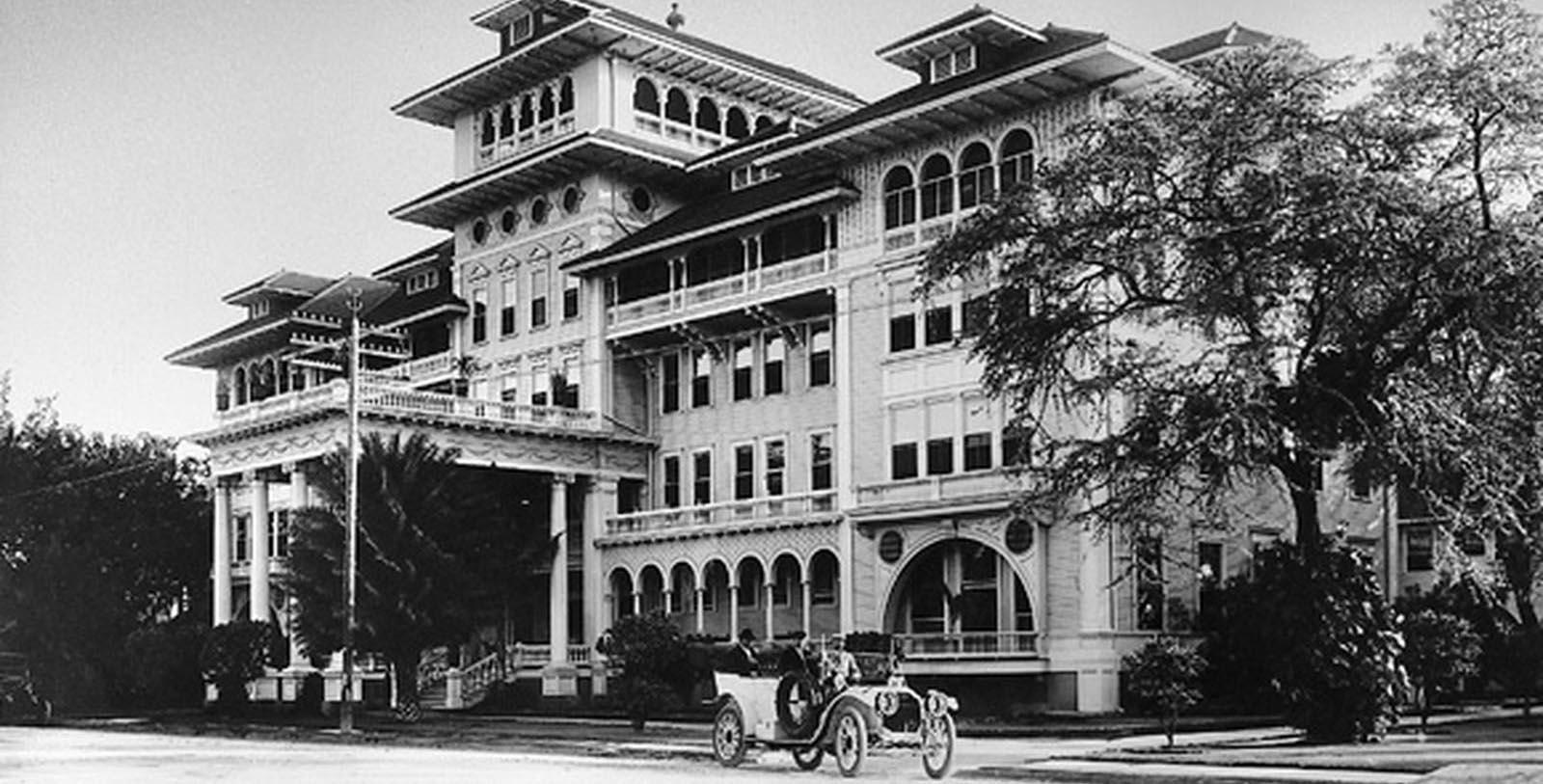
The original Moana Hotel was a four-story wood structure which featured an elaborately designed lobby which extended to outdoor lanais, the Banyan Court and the ocean. The Moana’s architecture was influenced by popular European styles with Ionic columns, intricate woodwork and plaster detailing throughout the building. It was designed with a grand porte-cochere on the street side and wide lanais on the ocean side. Some of the original 75 guestrooms had telephones and bathrooms. The hotel featured a billiard room, saloon, main parlor, reception area and a library. The Moana had the first electric-powered elevator in Hawaii which is still in use today. Other design elements of the original structure that survive include extra-wide hallways to accommodate steamer trunks, high ceilings and cross-ventilation windows to cool the rooms (prior to air conditioning).
The hotel’s first guests were a group of 114 Shriners, hosted by the Aloha Temple Shriners. In 1905, Peacock sold the Moana Hotel to Alexander Young, a prominent Honolulu businessman who had other hotel interests. After Young’s death in 1910, his Territorial Hotel Company continued to operate the Moana until the Matson Navigation Company purchased it in 1932 for $1.6 million.
In 1905, the Moana Hotel was at the center of one of America’s legendary mysteries. Jane Stanford, co-founder of Stanford University and former wife of California Governor Leland Stanford, died in a Moana Hotel room of poisoning. An account of the events says that on the evening of February 28 at the hotel, Stanford had asked for bicarbonate of soda to settle her stomach. Her personal secretary, Bertha Berner, prepared the solution, which Stanford drank. At 11:15 PM, Stanford cried out for her servants and Moana Hotel staff to fetch a physician, declaring that she had lost control of her body. Robert W. P. Cutler, who wrote the book The Mysterious Death of Jane Stanford recounted what took place upon the arrival of the Moana Hotel physician, Dr. Francis Howard Humphris:
As Humphris tried to administer a solution of bromine and chloral hydrate, Mrs. Stanford, now in anguish, exclaimed, “My jaws are stiff. This is a horrible death to die.” Whereupon she was seized by a tetanic spasm that progressed relentlessly to a state of severe rigidity: her jaws clamped shut, her thighs opened widely, her feet twisted inwards, her fingers and thumbs clenched into tight fists, and her head drew back. Finally, her respiration ceased.
Stanford was dead from strychnine poisoning and the identity of whoever killed her remains a mystery. Today, the room in which Stanford died no longer exists, having been removed to make room for an expansion of the lobby.
Duke Kahanamoku, the legendary Olympic swimmer and popularizer of the sport of surfing, frequented the Moana Hotel restaurants and private beachfront. The Moana Hotel became a favorite stomping ground for Kahanamoku’s famed group, dubbed the Waikiki Beach Boys.
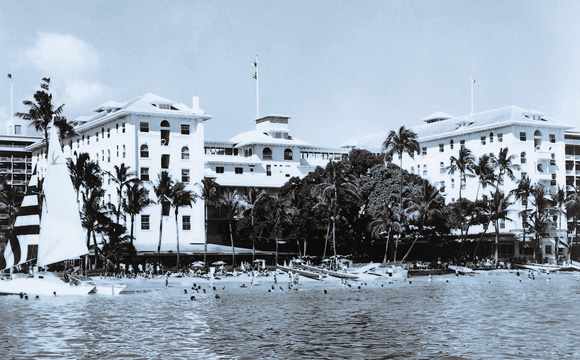
The Moana grew along with the popularity of Hawaiian tourism. Two floors were added in 1918, along with Italian Renaissance-styled concrete wings on each side of the hotel, creating the H-shape seen today. In the 1930s the hotel was known for a few years as the Moana-Seaside Hotel & Bungalows. The bungalows were additional buildings constructed on the large plot of land directly across Kalakaua Avenue. The hotel’s outward appearance was altered slightly over the years, including “updates” to such designs as Art Deco in the 1930s and Bauhaus in the 1950s. From 1935 to 1975, the Moana’s courtyard hosted the Hawaii Calls live radio broadcast. Legend has it that listeners mistook the hiss of the radio transmission as the waves breaking on the beach. When learning of this, the host instructed the sound man to run down to the waterfront to actually record the sound, which became a staple of the show.
In 1952, Matson built a new hotel adjacent to the Moana on the southeast side, called the SurfRider Hotel. In 1953, Matson demolished the Moana’s bungalows across the street and, two years later, opened the new Princess Kaiulani Hotel on the site. Matson sold all of their Waikiki hotel properties to the Sheraton Company in 1959. Sheraton sold the Moana and the SurfRider to Japanese industrialist Kenji Osano and his Kyo-Ya Company in 1963, though Sheraton continued to manage them. In 1969, Kyo-Ya built a towering new hotel on the Moana’s northwest side. They named it the Surfrider Hotel. The older SurfRider Hotel on the other side was turned into part of the Moana, named the Diamond Head Wing.
In 1989, a $50 million restoration (designed by Hawaii architect Virginia D. Murison) restored the Moana to its 1901 appearance and incorporated the 1969 Sheraton Surfrider Hotel and the 1952 SurfRider Hotel buildings with the Moana Hotel building into one beachfront resort with a common lobby, renaming the entire destination the Sheraton Moana Surfrider. The restoration has cemented the Moana as one of Waikiki’s premier hotels. It includes 793 rooms (including 46 suites), a freshwater swimming pool, three restaurants, a beach bar and a poolside snack bar.
The destination has been recognized with the President’s Historic Preservation Award, the National Preservation Honor Award, the Hawaii Renaissance Award, and the Hotel Sales and Marketing Association International Golden Bell Award. The main historic section of the hotel, The Banyan Wing, has been listed on the National Register of Historic Places.
In 2007, Starwood Hotels & Resorts, the management company of the Moana, rebranded the hotel from a Sheraton Hotel to a Westin Hotel. The name of the hotel became Moana Surfrider, A Westin Resort & Spa. The 1901 wing is now known as the Historic Banyan Wing. The low-rise 1952 SurfRider Hotel building is today the Diamond Wing. The 1969 Surfrider Hotel building is now called the Tower Wing.
In the center of the Moana Surfrider’s courtyard stands a large Indian banyan tree which was planted in 1904 by Jared Smith, Director of the Department of Agriculture Experiment Station. When planted, the tree was nearly seven feet tall and about seven years old. It now stands 75 feet high and spans 150 feet across the courtyard.
In 1979, the historic tree was one of the first to be listed on Hawaii’s Rare and Exceptional Tree List. It has also been selected by the Board of Trustees of the America the Beautiful Fund as the site for a Hawaii Millennium Landmark Tree designation, which selects one historic tree in each state for protection in the new millennium.
The hotel was the base of operations for about 24 White House staffers who accompanied Barack Obama to his Winter White House at Plantation Estate during Christmas visits.
The Moana Surfrider, a Westin Resort & Spa is a member of Historic Hotels of America, the official program of the National Trust for Historic Preservation.
*excerpted from his book Built To Last: 100+ Year-Old Hotels East of the Mississippi
*****
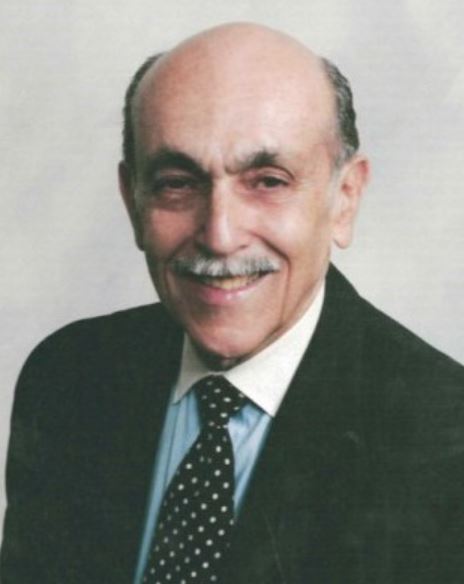
About Stanley Turkel, CMHS
Stanley Turkel is a recognized consultant in the hotel industry. He operates his hotel consulting practice serving as an expert witness in hotel-related cases and providing asset management an and hotel franchising consultation. Prior to forming his hotel consulting firm, Turkel was the Product Line Manager for worldwide Hotel/Motel Operations at the International Telephone & Telegraph Co. overseeing the Sheraton Corporation of America. Before joining IT&T, he was the Resident Manager of the Americana Hotel (1842 Rooms), General Manager of the Drake Hotel (680 Rooms) and General Manager of the Summit Hotel (762 Rooms), all in New York City. He serves as a Friend of the Tisch Center and lectures at the NYU Tisch Center for Hospitality and Tourism. He is certified as a Master Hotel Supplier Emeritus by the Educational Institute of the American Hotel and Lodging Association. He served for eleven years as Chairman of the Board of the Trustees of the City Club of New York and is now the Honorary Chairman.
Stanley Turkel is one of the most widely-published authors in the hospitality field. More than 275 articles on various hotel subjects have been posted in hotel magazines and on the Hotel-Online, Blue MauMau, Hotel News Resource and eTurboNews websites. Two of his hotel books have been promoted, distributed and sold by the American Hotel & Lodging Educational Institute (Great American Hoteliers: Pioneers of the Hotel Industry and Built To Last: 100+ Year-Old Hotels East of the Mississippi). A third hotel book (Built To Last: 100+ Year-Old Hotels in New York) was called "passionate and informative" by the New York Times. Executive Vice President of Historic Hotels of America, Lawrence Horwitz, has even praised one book, Great American Hoteliers Volume 2: Pioneers of the Hotel Industry:
-
“If you have ever been in a hotel, as a guest, attended a conference, enjoyed a romantic dinner, celebrated a special occasion, or worked as a hotelier in the front or back of the house, Great American Hoteliers, Volume 2: Pioneers of the Hotel Industry is a must read book. This book is recommended for any business person, entrepreneur, student, or aspiring hotelier. This book is an excellent history book with insights into seventeen of the great innovators and visionaries of the hotel industry and their inspirational stories.”
Turkel was designated as the “2014 Historian of the Year by Historic Hotels of America,” the official program of the National Trust for Historic Preservation. This award is presented to an individual for making a unique contribution in the research and presentation of history and whose work has encouraged a wide discussion, greater understanding and enthusiasm for American History.
Works published by Stanley Turkel include:
Most of these books can be ordered from AuthorHouse—(except Heroes of the American Reconstruction, which can be ordered from McFarland)—by visiting www.stanleyturkel.com, or by clicking on the book’s title.