






Receive for Free - Discover & Explore eNewsletter monthly with advance notice of special offers, packages, and insider savings from 10% - 30% off Best Available Rates at selected hotels. 
history
History of Omni Royal Orleans — A Living Legacy

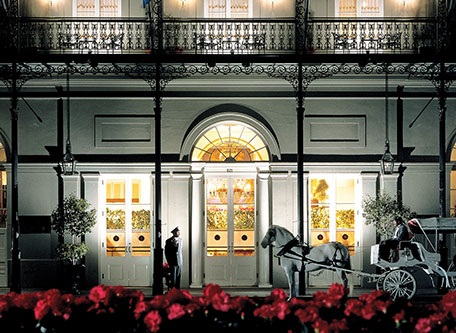
Omni Royal Orleans, a member of Historic Hotels of America since 2010, dates back to 1843.
VIEW TIMELINELike New Orleans itself, the Omni Royal Orleans is defined by reinvention, resilience, and a flair for the unforgettable. Its story begins in the early 19th century, when the city’s riverfront thrummed with steamboats, merchants, and international ambition. At the corner of St. Louis and Royal once stood the City Exchange, later reimagined by visionary hotelier James Hewlett, a Creole of Black and French descent, who set out to create a grand gathering place worthy of New Orleans’s stature.
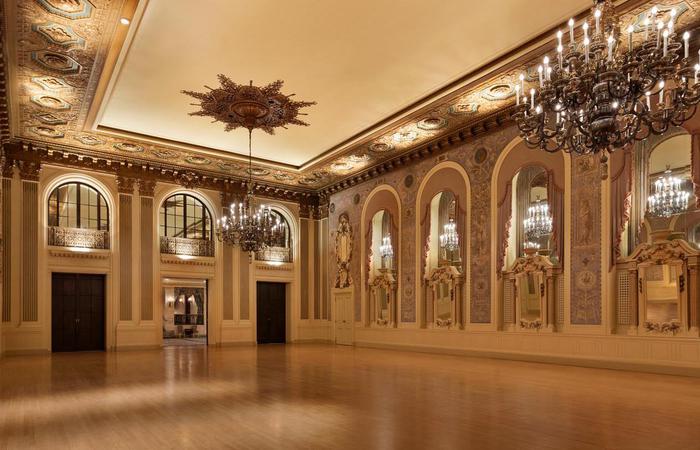
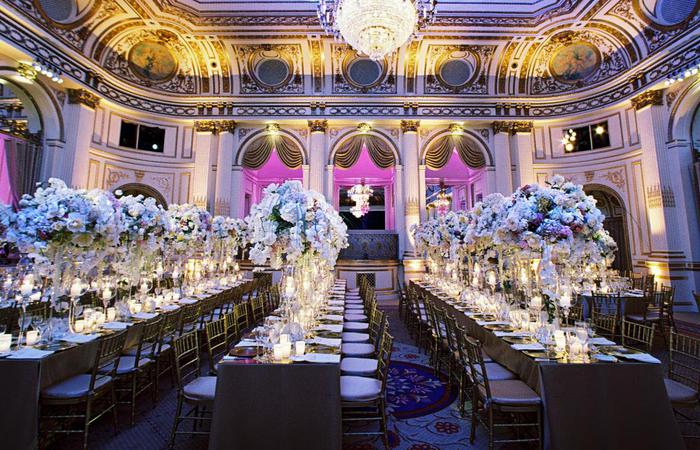
In 1838, Hewlett enlisted architect Jacques Nicolas Bussière de Pouilly to infuse European elegance into a new hotel inspired by Paris’s Rue de Rivoli. Despite a devastating fire during construction, the St. Louis Hotel opened triumphantly in 1843, unveiling glittering ballrooms and soaring interiors across three luxurious floors. The hotel quickly became the stage for lavish banquets, society balls, and famed Mardi Gras festivities, an address synonymous with celebration.
War and politics reshaped the property’s path. Requisitioned by Union forces in 1862, the building served as a military hospital and later as a temporary state capitol during Reconstruction. Though the hotel reopened, a long decline followed; it closed in 1912, then suffered further damage in the storm of 1915. A single surviving wall, its faded “CHANGE” inscription now a haunting echo of “CITY EXCHANGE,” remains protected as a tangible link to the past.
Revival arrived mid-century. Led by philanthropists Edith and Edgar Stern, a sweeping restoration returned the property to grandeur in 1960 as the Royal Orleans, guided by architects Arthur Davis and Samuel Wilson Jr. The hotel resumed its role as one of the city’s great “Grand Dames,” welcoming cultural icons, statesmen, and film legends. When Omni Hotels & Resorts assumed stewardship in 1986, a new era began, one that honored historic architecture while embracing contemporary hospitality.
As a proud member of Historic Hotels of America, the Omni Royal Orleans remains a place to see and be seen, where an enduring heritage meets a living soundtrack. From the stately ballrooms of the St. Louis Hotel to the intimate glow of Three Maries, the property continues to write its history in real time, one celebration, one performance, and one unforgettable night at a time.
-
About the Location +
The Omni Royal Orleans is located in the heart of the Vieux Carré, otherwise known more popularly as the French Quarter. A National Historic Landmark, the French Quarter was first established in 1718 by French colonials under the direction of the Mississippi Company. These aspiring settlers were specifically led to the region by Jean-Baptiste Le Moyne de Bienville, who would go on to serve as the local colonial governor throughout much of the early 18th century. The French Crown intended for the nascent settlement to operate as an important regional port that controlled trade throughout the Mississippi Delta. After navigating the local coastline for several weeks, Bienville and his compatriots found a section of high ground above the Mississippi River that offered natural protection from flooding waters, as well as incursions against English and Spanish privateers. They named their new community “La Nouvelle-Orléans” in honor of the Duke of Orleans, a nephew of King Louis XIV.
La Nouvelle-Orléans eventually evolved into New Orleans, the capital of the French colony of Louisiana. France lost control over the city for a time during the late 18th century, when the French were forced to cede the colony to the Spanish following the Seven Years War. Yet, the Spanish gave New Orleans back to the French in 1800 at the height of the Napoleonic Wars. The town and the surrounding parishes were then part of the Louisiana Purchase, in which Emperor Napoléon Bonaparte sold 828,000 square miles of French-controlled territory in central North America to U.S. President Thomas Jefferson. The city subsequently became the capital for the new state of Louisiana in 1812, rapidly evolving into the most important port in the southern United States. This growth was offset temporarily with the outbreak of the War of 1812, with New Orleans itself becoming a battleground. It was the site of the famous Battle of New Orleans, where future president Andrew Jackson defeated the British in an incredibly lopsided victory.
New Orleans’ significance as a commercial port made it a highly valuable strategic point of interest for both the Union and Confederacy during the American Civil War. Both armies fought over the city early in the war, with the United States Navy forcing local Confederate units from the area in early 1862. It subsequently became the base for future operations by the Union in the Mississippi Delta for the duration of the conflict. Following the cessation of hostilities between the two sections in 1865, New Orleans resumed its national status as a premier port city. It even served as an integral part to the national war effort in World War II, where it became the site for the development of the crucial Higgins Boat. New Orleans has since emerged as one of the nation’s most popular tourist destinations, with millions visiting every year. The most popular attraction is the original French Quarter and its celebrated landmarks, such as Jackson Square, St. Louis Cathedral, and Bourbon Street. All of these fantastic sites wonderfully represent the original French heritage of the Vieux Carré.
-
About the Architecture +
The current iteration of the Omni Royal Orleans displays some of the finest Renaissance Revival-style architecture in all of New Orleans. Renaissance Revival architecture—sometimes referred to as "Neo-Renaissance”—is a group of architecture revival styles that date back to the 19th century. Neither Grecian nor Gothic in their appearance, Renaissance Revival-style architecture drew inspiration from a wide range of structural motifs found throughout Early Modern Western Europe. Architects in France and Italy were the first to embrace the artistic movement, who saw the architectural forms of the European Renaissance as an opportunity to reinvigorate a sense of civic pride throughout their communities. As such, those intellectuals incorporated the colonnades and low-pitched roofs of Renaissance-era buildings, with the characteristics of Mannerist and Baroque-themed architecture. Perhaps the greatest structural component to a Renaissance Revival-style building involved the installation of a grand staircase in a vein similar to those located at the Château de Blois and the Château de Chambord. This particular feature served as a central focal point for the design, often directing guests to a magnificent lobby or exterior courtyard. Yet, the nebulous nature of Renaissance Revival architecture meant that its appearance varied widely across Europe. As such, historians today often find it difficult to provide a specific definition for the architectural movement.
-
Famous Historic Guests +
Louis Armstrong, renowned Jazz musician regarded as one of the most influential figures in the genre.
Patti LaBelle, singer and songwriter often referred to today as the “Godmother of Soul.”
Luciano Pavarotti, one of the most famous Italian opera singers of the 20th century.
Bette Davis, actress known for her roles in All About Eve, Jezebel, and What Ever Happened to Baby Jane?
Charlton Heston, actor known for his roles in such movies like Ben-Hur, El Cid, and Planet of the Apes.
Paul Newman, actor known for his roles in such films like Cool Hand Luke, The Sting, and Butch Cassidy and the Sundance Kid.
Robert Redford, actor known for such roles in Out of Africa, All the President’s Men, and Butch Cassidy and the Sundance Kid.
Muhammad Ali, professional boxer and political activist regarded as one of the greatest athletes of the 20th century.
David Brinkley, longtime news anchor for NBC and ABC, whose career lasted from 1943 to 1997.
Richard Nixon, 37th President of the United States (1969 – 1974)
Lassie, a Rough Collie dog who served as the main character in the television series, Lassie.
-
Film, TV and Media Connections +
Live and Let Die (1973)