
History
Discover the Omni William Penn with its grand style.
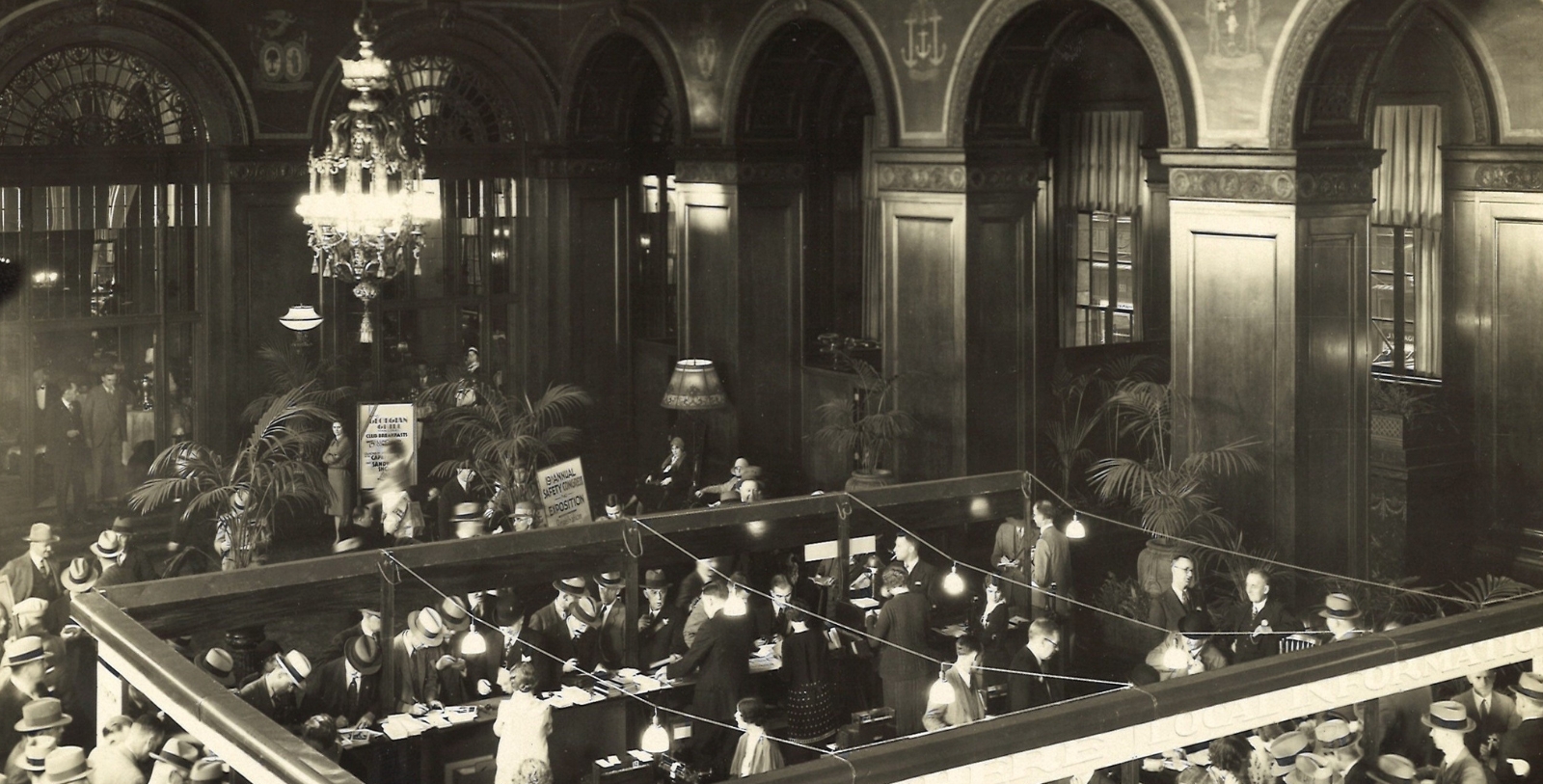
Omni William Penn was constructed during World War I, when the Central Powers battled the Entente for global dominance. But despite the worldwide turmoil, local Pittsburgh industrialist Henry Clay Frick decided to proceed with his plans to construct this beautiful historic hotel. Founder of a coke manufacturing company called the “H.C. Frick & Company,” he had played a significant role in making the American steel industry a dominant global force by the end of the 19th century. As such, Frick was instrumental in making Pittsburgh one of the nation’s greatest commercial centers. Frick had hoped that the William Penn would rival those of Europe, effectively becoming Pittsburgh's greatest Grand Dame. He hired the renowned architectural team at Janssen and Abbot to oversee the hotel’s creation, which designed the hotel’s beautiful façade based on the principles of Beaux-Arts architecture. After $6 million and a year of construction, the William Penn opened to great acclaim in March of 1916. The opening ceremony proved to be a lively affair, with U.S. Secretary of State Philander Knox serving as its master of ceremonies.
Frick and the company though which he managed the business—the Pittsburgh Hotel Company—sold it to Eugene Eppley of the Eppley Hotel Company in 1928. A native of Omaha, Nebraska, Eppley was a legendary hotelier who would go on to command one of the largest American hotel chains by the 1950s. Under Eppley’s stewardship, the William Penn experienced a massive renovation that saw the room count explode to 1,600. The renovations also saw the inclusion of an outstanding ballroom atop the hotel called the “Urban Room.” Named after its primary architect, Joseph Urban, the Urban Room features a wealth of Art Deco-inspired design aesthetics. Perhaps the greatest element to the Urban Room was a series of 14 beautiful murals that still reside the space to this very day. By the time Eppley had finished the construction project, the William Penn stood as the second tallest structure of its kind throughout the entire world.
The Great Depression greatly interrupted Eppley’s ability to finance the William Penn, forcing him to put it up for sale. He eventually reached an agreement with Statler Hotels in 1940, which subsequently managed the location throughout the following decade. Eppley would soon return to the hotel, however, reacquiring his controlling interests in the business during the early 1950s. But the change in management proved to be brief, as Eppley decided to sell the building yet again in 1956. This time, Eppley reached an agreement with the Sheraton Hotels and Resorts, in what turned out to be the second-largest hotel sale in U.S. history. Sheraton’s ownership of the William Penn was short, too, as it transferred the business over to a local investment firm called Nomarl. Nomarl, in turn, then sold its interests to the Aluminum Company of America (ALOCA) in 1971. Partnering with Westin Hotels, ALCOA operated the William Penn as the “Westin William Penn.” ALCOA and Westin Hotels also greatly reduced the number of available guestrooms down to 650 as part of their joint restoration of the building. The hotel was sold for a final time in 2001 when Omni Hotels and Resorts acquired it from ALCOA.
Throughout its storied past, The Omni William Penn has hosted some of 20th-century America’s most noteworthy celebrities. A young bandleader named Lawrence Welk—who would later gain fame for his eponymous television show—performed in the hotel’s various ballrooms. The Omni William Penn’s engineers even helped produce Welk’s iconic bubble machine. The Omni William Penn has also received every seated president since Theodore Roosevelt. Several U.S. presidents have even campaigned inside the building at one point or another, including Harry S. Truman, Lyndon B. Johnson, and Ronald Reagan. On one such occasion in 1956, Dwight D. Eisenhower gave an impassioned speech, in which he made a point of reminding his constituents of his dogged determination to protect American interests abroad as the Cold War worsened. Today, Omni William Penn is among Pittsburgh’s greatest holiday destinations. A member of Historic Hotels of America since 2010, this fantastic historic hotel has received numerous accolades for its timeless elegance and unrivaled splendor.
Hotel Timeline
The Location
The Omni William Penn resides at Mellon Square in downtown Pittsburgh, Pennsylvania. Originally created in 1953, Mellon Square first came into existence as part of a desperate bid to stop the Aluminum Company of America (ALCOA) from relocating to New York City after World War II. Richard King Mellon of Pittsburgh’s renowned Mellon family could not stomach the thought of ALCOA leaving for it has been an iconic fixture in the city since the late 19th century. Its departure would cost thousands of people their jobs and would seriously blunt Pittsburgh’s economic growth. To deter ALCOA of such a move, Mellon proposed the creation of a brand-new headquarters in a beautiful skyscraper known today as “Regional Enterprise Tower.” Mellon sweetened the deal by pledging to construct the building an exclusive underground garage topped by a beautiful public park. He hired only the finest architectural firms to work on the entire project, with Simonds & Simonds doing a majority of the landscaping for the park. Costing the Mellon family some $8 million to complete, this beautiful outdoor destination became known as Mellon Square in honor of their dogged efforts to keep ALCOA in the city. The Pittsburgh City Council specifically named the park after Richard King Mellon’s father and uncle, Richard Beatty Mellon and Andrew Mellon, respectively. The whole area—including the Omni William Penn—is preserved today by the U.S. Department of the Interior as part of the Pittsburgh Central Downtown Historic District. Both the hotel and Mellon Square are close to numerous local landmarks, including Point State Park, Market Square, and the Three Rivers Heritage Trail.
The Architecture
With a blend of classic elegance and modern sophistication, the renowned Omni William Penn has served as Pittsburgh’s premier hotel since 1916. Its original owner, Henry Clay Frick, had long hoped that the hotel would rival the great Grand Dames of Europe in its luxury and elegance. To actualize his dream, he hired the renowned architectural firm Janssen and Abbot for the project. Led by Benno Janssen and Franklin Abbot, the firm designed the building based on the principles of Beaux-Arts architecture. Janssen in particular was a popular architect among Pittsburgh’s most prominent citizens, having trained at the École des Beaux-Arts in Paris during his youth. As such, the city’s elite hired him to design a number of other well-known buildings in Pittsburgh, including the Long Vue Country Club, the Mellon Institute, and the Pittsburgh Athletic Association. The initial phase of the hotel included 1,000 guestrooms, and an elegant two-tier Grand Ballroom located on the 17th floor. Completed in a year and at the cost of $6 million, the William Penn was the last major construction project that Henry Clay Frick would undertake in his lifetime.
Beaux-Arts architecture itself originally began at the École des Beaux-Arts during the 1830s. There was much resistance to the Neoclassism of the day among French artists, who yearned for the intellectual freedom to pursue less rigid design aesthetics. Four instructors in particular were responsible for establishing the movement: Joseph-Louis Duc, Félix Duban, Henri Labrouste, and Léon Vaudoyer. The training that these instructors created involved fusing architectural elements from several earlier styles, including Imperial Roman, Italian Renaissance, ad Baroque. As such, a typical building created with Beaux-Arts-inspired designs would feature a rusticated first story, followed by several more simplistic ones. A flat roof would then top the structure. Symmetry became the defining character, with every building’s layout featuring such elements as balustrades, pilasters, and cartouches. Sculptures and other carvings were commonplace throughout the design, too. Beaux-Arts only found a receptive audience in France and the United States though, as most other Western architects at the time gravitated toward British design principles.
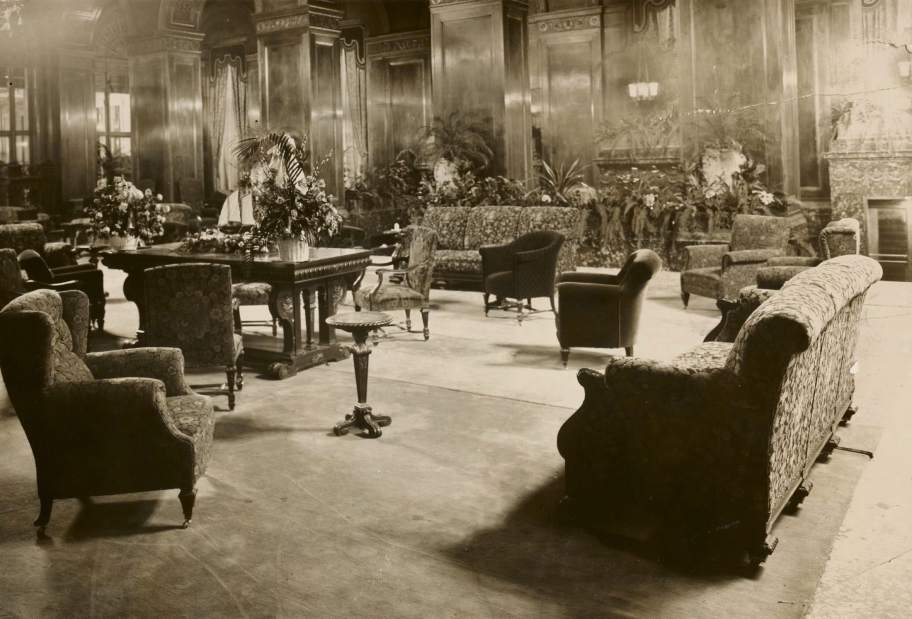
Omni William Penn subsequently experienced another series of extensive renovations when Frick sold the structure to Eugene Eppley in 1928. The construction work was immense, as Eppley added 600 new accommodations and a slew of cutting-edge facilities. In just a matter of months, the hotel became the second largest of its kind throughout the entire world. Yet, the greatest part of Eppley’s renovations involved the creation of a new meeting space opposite of the Grand Ballroom called the “Urban Room.” Designed by Joseph Urban, this spectacular venue functioned as a secondary ballroom for the hotel. Urban himself had built a national reputation for his brilliant use of Art Deco design aesthetics. As such, the space featured many outstanding Art Deco architectural elements that made the Urban Room radiate a sense of tranquil elegance. The room’s most defining feature was a series of 14 brilliantly painted murals adorned symmetrically between its tall reflective panels of black Carrara glass.
The hotel has since undergone a series of additional—yet smaller—renovations during the 1960s, 1980s, and 2000s. Much of the work involved reducing the number of available guestrooms from its astronomically high-count of 1,600 to a more manageable 650. The hope in every case was to enhance the quality of the rooms without sacrificing their great historical character. An investment company called Nomarl truly began the process when it lowered the amount to 900 in 1968. The Aluminum Company of America (ALCOA) then continued the trend two decades later, spending some $20 million to bring that number further down to 650. Renovations initiated by Omni Hotels and Resorts in 2001 focused more on enhancing the luxury of the Omni William Penn. The total cost of the project went as high as $22 million.
Famous Historic Events
First Annual Dapper Dan Sports Award Banquet (1939): The Dapper Dan Award Banquet is a historic fundraising event that has continuously sought to raise money for community sporting clubs. Much of the proceeds finance the Boys and Girls Club of Western Pennsylvania, which help purchase different kinds of youth athletic equipment for thousands every year. First held at the Omni William Penn in 1939, the banquet is a program offered by the Dapper Dan Charities. The organization itself was originally founded by Pittsburgh Post-Gazette Editor Al Abrams at the height of the Great Depression. The highlight of the event featured an exciting award ceremony in which the organization named the renowned boxer Bill Conn as its “Sportsman of the Year.” (The ceremony has since been joined by another award, the “Sportswoman of the Year.) Many of the subsequent banquets paid tribute to some of the region’s greatest athletic figures, including Art Rooney, Jock Sutherland, and John Harris. Omni William Penn went on to host the next 20 Dapper Dan Sports Award Banquets, with the last dinner being held in honor of the Pittsburgh Pirates’ Danny Murtaugh.
Famous Historic Guests
- Lawrence Welk, musician and bandleader best remembered for hosting The Lawrence Welk Show.
- Ferdinand Foch, Supreme Allied Commander during World War I.
- George C. Marshall, General of the Army and Army Chief of Staff under presidents Franklin Delano Roosevelt and Harry S. Truman.
- Pat Nixon, First Lady to former U.S. President Richard Nixon
- Theodore Roosevelt, 26th President of the United States (1901 – 1909)
- William Howard Taft, 27th President of the United States (1909 – 1913) and 10th Chief Justice of the United States (1921 – 1930)
- Woodrow Wilson, 28th President of the United States (1913 – 1921)
- Warren G. Harding, 29th President of the United States (1921 – 1923)
- Calvin Coolidge, 30th President of the United States (1923 – 1929)
- Herbert Hoover, 31st President of the United States (1929 – 1933)
- Franklin Delano Roosevelt, 32nd President of the United States (1933 – 1945)
- Harry S. Truman, 33rd President of the United States (1945 – 1953)
- Dwight D. Eisenhower, 34th President of the United States (1953 – 1961), and Supreme Allied Commander Europe during World War II
- John F. Kennedy, 35th President of the United States (1961 – 1963)
- Lyndon B. Johnson, 36th President of the United States (1963 – 1969)
- Richard Nixon, 37th President of the United States (1969 – 1974)
- Gerald Ford, 38th President of the United States (1974 – 1977)
- Jimmy Carter, 39th President of the United States (1977 – 1981)
- Ronald Reagan, 40th President of the United States (1981 – 1989)
- George H.W. Bush, 41st President of the United States (1989 – 1993)
- Bill Clinton, 42nd President of the United States (1993 – 2001)
- George W. Bush, 43rd President of the United States (2001 – 2009)
- Barack Obama, 44th President of the United States (2009 – 2017)
Film, TV and Media Connections
- Silence of the Lambs (1989)
- Foxcatcher (2014)
- Southpaw (2015)
- Concussion (2015)