History
Discover The Brown Palace Hotel and Spa, Autograph Collection, which has been Denver’s most historic hotel since the height of the Gilded Age.
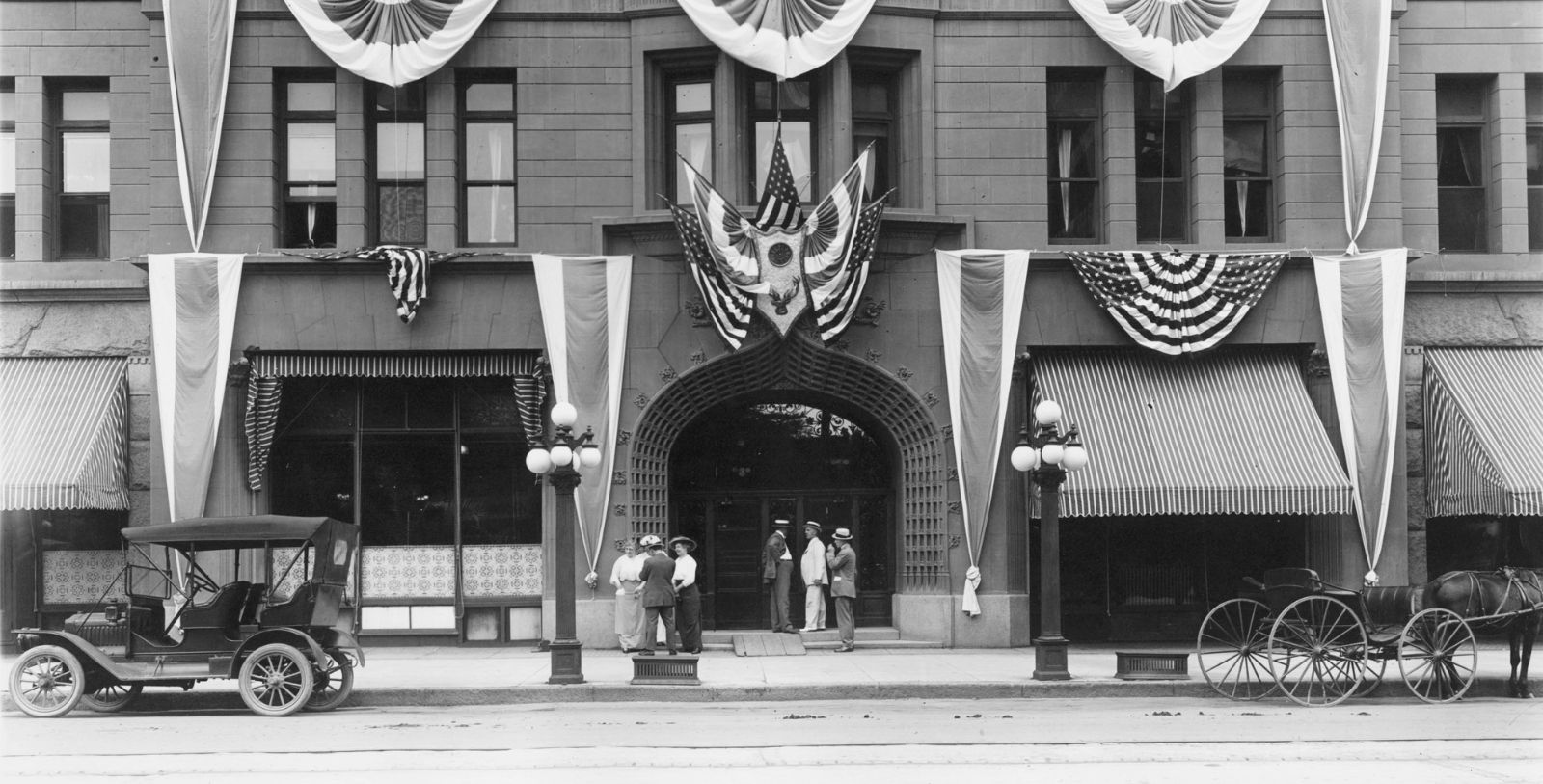
A charter member of Historic Hotels of America, The Brown Palace Hotel and Spa, Autograph Collection, is the most historic hotel to still be active in Denver, Colorado. While many changes have occurred within the building over the years, this fantastic historic hotel has nonetheless exuded the same elegance that first defined it generations ago. Its origins harken back to the height of the Gilded Age when thousands of people were flocking to Denver to pursue countless fortunes. One such individual was a carpenter-turned-real-estate speculator from Ohio named Henry Cordes Brown, who had undertaken the arduous journey across the Great Plains right before the outbreak of the American Civil War. Brown’s entrepreneurial spirit flourished in the city, where he became very wealthy reselling large tracts of land for commercial and civic development (interestingly, he made a considerable profit auctioning off his holdings on Capitol Hill to the Colorado state government, which then erected a brand-new State Capitol Building). Among his most noteworthy plots was a triangular section located at the corners of Broadway, Tremont, and 17th streets. Originally used for cattle grazing, Brown eventually decided to raise a magnificent hotel upon the site that could act as the main social gathering spot in downtown Denver.
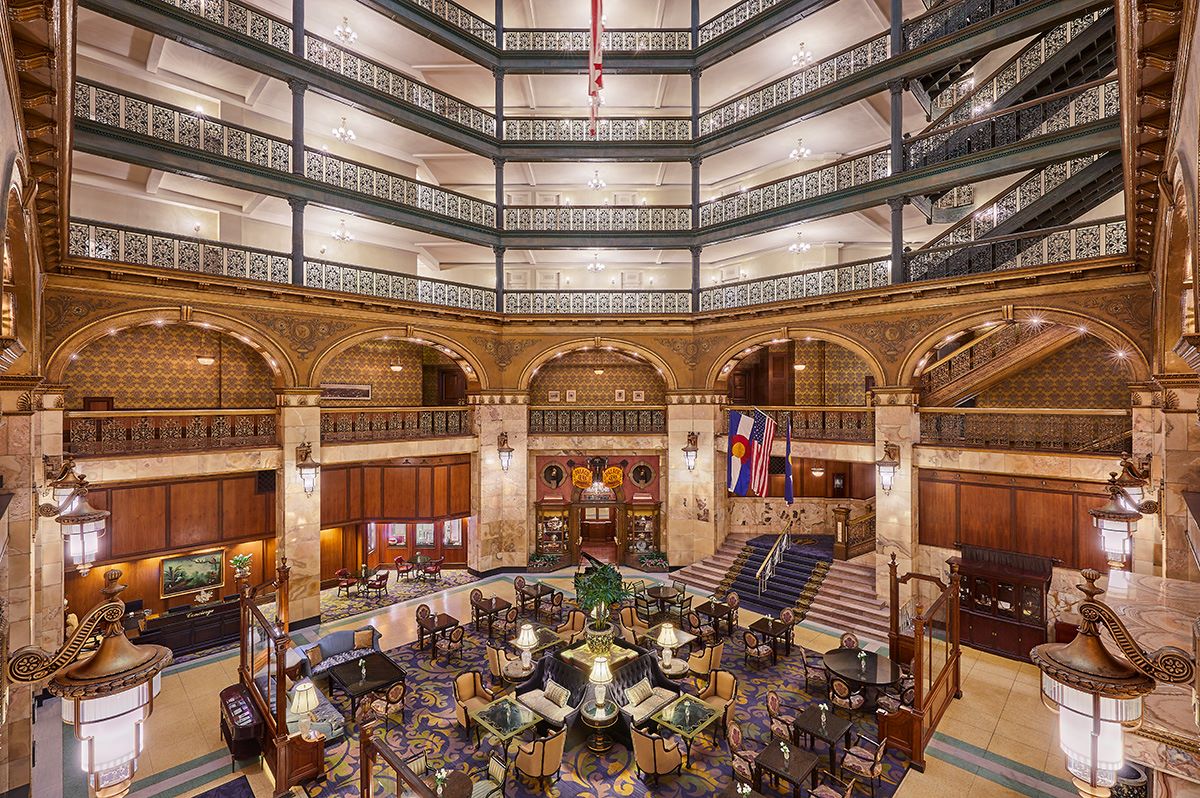
To turn his dream into a reality, Brown hired the renowned architect Frank E. Edbrooke to oversee the design. Like Brown, Edbrooke had already played a significant role in Denver’s history for his work creating several local landmarks, including Central Presbyterian Church and the Masonic Temple Building. Edbrooke subsequently crafted Brown’s hotel with a combination of beautiful Italian Renaissance and Romanesque-inspired architecture. He also only used the best resources available, incorporating Colorado red granite and Arizona sandstone throughout the exterior façade. For a finishing touch, artist James Whitehouse was commissioned to carve 26 medallions that each depicted an animal native to the nearby Rocky Mountains. Inside, Edbrooke produced a breathtaking atrium lobby complete with balconies that extended for eight stories, extravagant onyx stonework, and a gorgeous stained-glass ceiling. After an expenditure of $1.6 million—a remarkable sum for the era—and another $400,000 for furniture, “The Brown Palace Hotel” opened on August 12, 1892. It had 400 guestrooms that were priced between three and five dollars a night. There were two banquet halls, a ladies’ lounge, and a “Grand Salon,” as well. The marvelous lobby itself housed a smoking room, a men’s bar, a ladies’ waiting room, and at least 18 unique storefronts.
True to Brown’s vision, “The Brown Palace Hotel” quickly emerged as one of Denver’s most popular destinations. Indeed, the hotel was soon hosting influential figures from all over Colorado, including Jefferson “Soapy” Smith, Louise Sneed Hill, and Margaret “Molly” Brown. But as word spread of The Brown Palace Hotel’s luxury, national luminaries began arriving to reserve a guestroom, too, like Andrew Carnegie, Thomas Edison, and Charles Lindbergh. Even U.S. Presidents were common guests, starting with Theodore Roosevelt in 1905 (the hotel has hosted every U.S. President since Roosevelt’s visit, save for three). Unlike other historic hotels, The Brown Palace Hotel has never closed for renovation either, being remodeled, refurbished, and redecorated on an ongoing basis. In fact, the hotel did not even shut down during the recent $6.5-million restoration of the top two floors, as well as the $3-million construction project that created the Spa at The Brown Palace. Now known as “The Brown Palace Hotel and Spa, Autograph Collection,” this marvelous historic hotel has since remained a celebrated cultural icon. Many cultural heritage travelers continue to enjoy the hotel’s amazing amenities and fascinating heritage.
Hotel Timeline
The Location
In the late 1850s, prospector William Greeneberry Russell lead a group of fellow miners into the Rocky Mountains to locate rumored deposits of gold. Russell’s team proceeded to travel north along the Santa Fe Trail until they reached the confluence of the Cherry Creek and South Platte rivers in what was then the Territory of Kansas. They subsequently founded a small outpost and began panning for gold within the South Platte during the summer of 1858. Russell and his contemporaries eventually collected a few ounces much to their delight, giving credence to their decision to undertake the arduous journey. They then decided to create a more permanent settlement on the western edge of Cherry Creek known as “Auraria.” Word about the discovery spread rapidly, instigating a surge of migration to the region remembered as the “Colorado Gold Rush.” (It was initially called the “Pike’s Peak Gold Rush” in the 19th century.) Among the first people to arrive was William H. Larimer, Jr., a former general of the Pennsylvania state militia who sensed great opportunities out west. Reaching the site in November, Larimer quickly established his own rival community across the river that he named “Denver City” after James W. Denver, the Kansas territorial governor. Denver City and Auraria expanded at a rapid pace, with the two merging together to form the city of Denver right before the outbreak of the American Civil War.
Recognizing its mounting cultural importance, politicians of the newly independent Colorado Territory designated the community as the home for the territorial government in 1867. In fact, Denver would even stay the capital when Colorado finally entered the union as an official state a decade later. Driving this exceptional growth was the continued prosperity of the nearby mining industry, which extracted significant amounts of gold in great quantities. Life in Denver was not always easy, though. Indeed, natural disasters impacted the community periodically, including a flash flood that swept away many buildings. Unrest among local groups of Cheyenne and Arapaho Native Americans also existed, culminating in a protracted war that lasted for years. Even the city’s relative remoteness in the Rocky Mountains made governing hard. But during the 1870s, the citizens of Denver organized a campaign to connect a local railway to a spur of the Union Pacific Railroad. Work on a second line for the Kansas Pacific Railroad started not long thereafter, as well. Their completion helped to further accelerate Denver’s economic development, giving countless miners the ability to ship their ore more easily to markets beyond Colorado. New mines soon opened, as did sprawling smelting plants that employed hundreds. Many more people settled in Denver as such, including immigrants from Europe and Asia.
A nationwide financial depression known as the “Panic of 1893” ultimately brought the era to an abrupt end. The event destroyed the value of the ore collected by the mines, namely silver, which had overtaken gold as the primary export. Denver’s economy subsequently collapsed in a matter of weeks. However, the residents rebuilt the city by nurturing a variety of different industries that gradually diversified its economic landscape. Agriculture emerged as a dominant trade, as well as tourism and transportation. Food processing also became a popular business in Denver, with many grain elevators, flour mills, and breweries debuting throughout the area. Conventional manufacturing gradually supplemented this economic activity in the 20th century, especially once defense contractors started operating inside the city during World War II and the early Cold War. Denver has since remained one of the most prosperous communities in the western United States. This fantastic metropolis is also among the most culturally vibrant, as it is home to many outstanding attractions like the Denver Arts Museum, the Denver Botanical Gardens, Denver Union Station, Larimer Square, and the Red Rocks Park and Amphitheatre. The renowned Rocky Mountain National Park is just an hour outside of Denver, too, providing a terrific place to go hiking and sightseeing.
The Architecture
Architect Frank E. Edbrooke used Italian Renaissance Revival architecture to build the hotel at the height of the Gilded Age. Italian Renaissance Revival architecture itself is a subset of a much larger group of styles known simply as “Renaissance Revival,” which is among the most ubiquitous in America. Sometimes referred to as “Neo-Renaissance,” Renaissance Revival architecture is a group of architectural forms that originally date back to the 19th century. Neither Grecian nor Gothic in appearance, Renaissance Revival-style architecture drew inspiration from a wide range of structural motifs found throughout Early Modern Western Europe. Architects in France and Italy were the first to embrace the artistic movement, who saw the architectural forms of the European Renaissance as an opportunity to reinvigorate a sense of civic pride throughout their communities.
Those intellectuals incorporated the colonnades and low-pitched roofs of Renaissance-era buildings along with the distinctive sub-characteristics of Mannerist and Baroque architecture. Perhaps the greatest structural component of a Renaissance Revival-style building involved the installation of a grand staircase in a vein like those located at the Château de Blois and the Château de Chambord in France. This particular feature served as a central focal point for the design, often directing guests to a magnificent lobby or exterior courtyard. But the nebulous nature of Renaissance Revival architecture meant that its appearance varied widely across Europe and North America. Many architects left their own mark upon any structure designed with Renaissance Revival-style design aesthetics, including Frank E. Edbrooke. Historians thus often find it difficult to provide a specific definition for the architectural movement, yet acknowledge its inherent beauty nonetheless.
However, Edbrooke had also incorporated elements of Romanesque Revival-style architecture into his greater designs for the hotel. This wonderful architectural style first appeared in North America in the middle of the 19th century, as design principles from both Rome and medieval Europe found a popular audience on the continent. Architects who were interested specializing in Romanesque Revival-themed architecture specifically studied the works of Norman and Lombard engineers active in the High Middle Ages. Structures created with the form were commonly defined by their pronounced round arches and circular towers. But those grand archways and towers were far less ostentatious in places like America than their historic counterparts located on the other side of the Atlantic. Romanesque Revival-style architecture also implemented squat columns, decorative wall carvings, and the extensive use of masonry. Those same architects would sometimes favor wood over bricks or stones due to financial concerns, though.
The first wave of Romanesque Revival-style architecture impacted North America in the 1840s and 1850s. Nevertheless, professionals in the United States did not fully embrace the aesthetic at the time, preferring the tastes of Italianate and Gothic Revival architecture instead. It was not until an American architect named Henry Hobson Richardson started using the form in the late 1800s that Romanesque Revival style finally became popular in the country. A graduate from the renowned École des Beaux-Arts in Paris, Richardson developed numerous designs in places like New York City, Boston, and Detroit. His approach to Romanesque Revival style was somewhat different, for it also infused elements of medieval Mediterranean design principles. His vision of Romanesque Revival-style architecture was soon embraced by other architects, including those in neighboring Canada. Contemporary scholars today largely refer to Richardson’s design philosophy as its own group, using the name “Richardson Romanesque” to identify it.
Famous Historic Guests
- Louise Sneed Hill, popular socialite in Denver who created the well-known Blue Book list of the city’s influential people.
- Jefferson “Soapy” Smith, gangster who famously sold bars of soap embedded with prize money to increase sales.
- Margaret “Molly” Brown, well-known socialite and famous survivor of the RMS Titanic.
- John Wayne, actor known for his roles in The Man Who Shot Liberty Valance, True Grit, and The Longest Day.
- Zsa Zsa Gabor, socialite and actress known for her roles in We’re Not Married!, Moulin Rouge, and Lovely to Look At.
- The Beatles, legendary rock band consisting of George Harrison, John Lennon, Paul McCartney, and Ringo Starr.
- Thomas Edison, inventor known for such inventions as the motion picture camera and the light bulb.
- Andrew Carnegie, founder of the U.S. Steel Corporation.
- Charles Lindbergh, aviator who completed the first solo transatlantic flight in world history.
- Sun Yat-sen, First President of the Republic of China (1912)
- Mamie Eisenhower, First Lady of the United States (1953 – 1961)
- Queen Marie of Romania (1914 – 1922)
- Theodore Roosevelt, 26th President of the United States (1901 – 1909)
- William Howard Taft, 27th President of the United States (1909 – 1913) and 10th Chief Justice of the United States (1921 – 1930)
- Woodrow Wilson, 28th President of the United States (1913 – 1921)
- Warren G. Harding, 29th President of the United States (1921 – 1923)
- Herbert Hoover, 31st President of the United States (1929 – 1933)
- Franklin Delano Roosevelt, 32nd President of the United States (1933 – 1945)
- Harry S. Truman, 33rd President of the United States (1945 – 1953)
- Dwight D. Eisenhower, 34th President of the United States (1953 – 1961), and Supreme Allied Commander Europe during World War II.
- John F. Kennedy, 35th President of the United States (1961 – 1963)
- Lyndon B. Johnson, 36th President of the United States (1963 – 1969)
- Richard Nixon, 37th President of the United States (1969 – 1974)
- Gerald Ford, 38th President of the United States (1974 – 1977)
- Jimmy Carter, 39th President of the United States (1977 – 1981)
- Ronald Reagan, 40th President of the United States (1981 – 1989)
- George H.W. Bush, 41st President of the United States (1989 – 1993)
- Bill Clinton, 42nd President of the United States (1993 – 2001)
- George W. Bush, 43rd President of the United States (2001 – 2009)
Film, TV and Media Connections
Our Souls at Night (2017)
Women in History
Margaret “Molly” Brown: One of the most significant historical guests to stay at The Brown Palace Hotel and Spa, Autograph Collection, was Margaret “Molly” Brown. Born shortly after the American Civil War to Irish immigrants, Molly Brown was a well-known socialite during America’s Gilded Age. While she rose to national prominence following her harrowing escape from the RMS Titanic, she had also built a considerable career as a civil rights activist and philanthropist. She spent her childhood in Hannibal, Missouri, where she attended her aunt's grammar school before working at a local tobacco factory. In 1886, Brown eventually left Missouri for Leadville, Colorado, alongside her brother, Daniel Tobin, and half-sister, Mary Ann Collins Landrigan. Upon taking a job at a mercantile store, she met James Joseph Brown and the two quickly wed. They relocated to the small mining community of Stumpftown, where James established a decent career as a mining engineer.
As James advanced up the corporate hierarchy to become a superintendent, Molly began running soup kitchens for the families of the miners. Her work at the soup kitchens eventually connected her to the budding western branch of the state’s emerging suffragette movement. Meanwhile, the Browns gained considerable affluence when James discovered an innovative way to access gold at the bottom of Little Jonny Mine. Moving to Denver with their newly acquired wealth in 1894, the Browns soon became significant players in Colorado’s elite social circles. Molly herself used her newfound social standing to help found the Denver Woman’s Club, as well as to create one of the first juvenile courts in the entire country. Her political activities also increased over the next three decades, emerging as a lively member of the Political Equality League. Brown even ran for a national congressional seat on several occasions!
In 1909, Molly and James separated, although they continued to be close friends for the remainder of their lives. Molly Brown then took the time to travel the world alone, including a trip to Egypt in 1912. She did not stay in the country for long though, as she soon received word that her grandson had fallen ill. Boarding the RMS Titanic when it briefly docked in Cherbourg, France, she became a leading figure when the ship struck an iceberg just four days into its maiden voyage. Tales abounded of how Brown assisted countless passengers into various lifeboats before the crew finally persuaded her to evacuate. At one point, Brown had even taken an oar to help her own lifeboat escape the vortex of the sinking ship. When the RMS Carpathia finally arrived to save the Titanic’s surviving passengers, Brown used her multilingual fluency to assist those who came from non-English speaking countries find their loved ones.
Molly Brown’s actions became known throughout the nation, with newspapers quickly giving her the moniker of the “Unsinkable Molly Brown.” But Brown never let fame overcome her sense of humility, as she continued to work for a variety of philanthropic causes throughout the rest of her life. Perhaps the greatest of those efforts emerged during World War I, when she campaigned for the American Committee for Devastated France. For her lifetime of charitable work, Brown received the French Légion d'Honneur in 1932. She earned many other accolades posthumously, too, including an induction into the Colorado Hall of Fame. Several theatrical productions have immortalized Brown as well, such as the popular musical, The Unsinkable Molly Brown, and its subsequent film adaptation starring Debbie Reynolds. In more recent years, actress Kathy Bates assumed her persona in James Cameron’s 1997 classic movie, Titanic.