
History
Discover Fairmont Hotel San Francisco, the exquisite Nob Hill palace known for its grandeur and illustrious history.
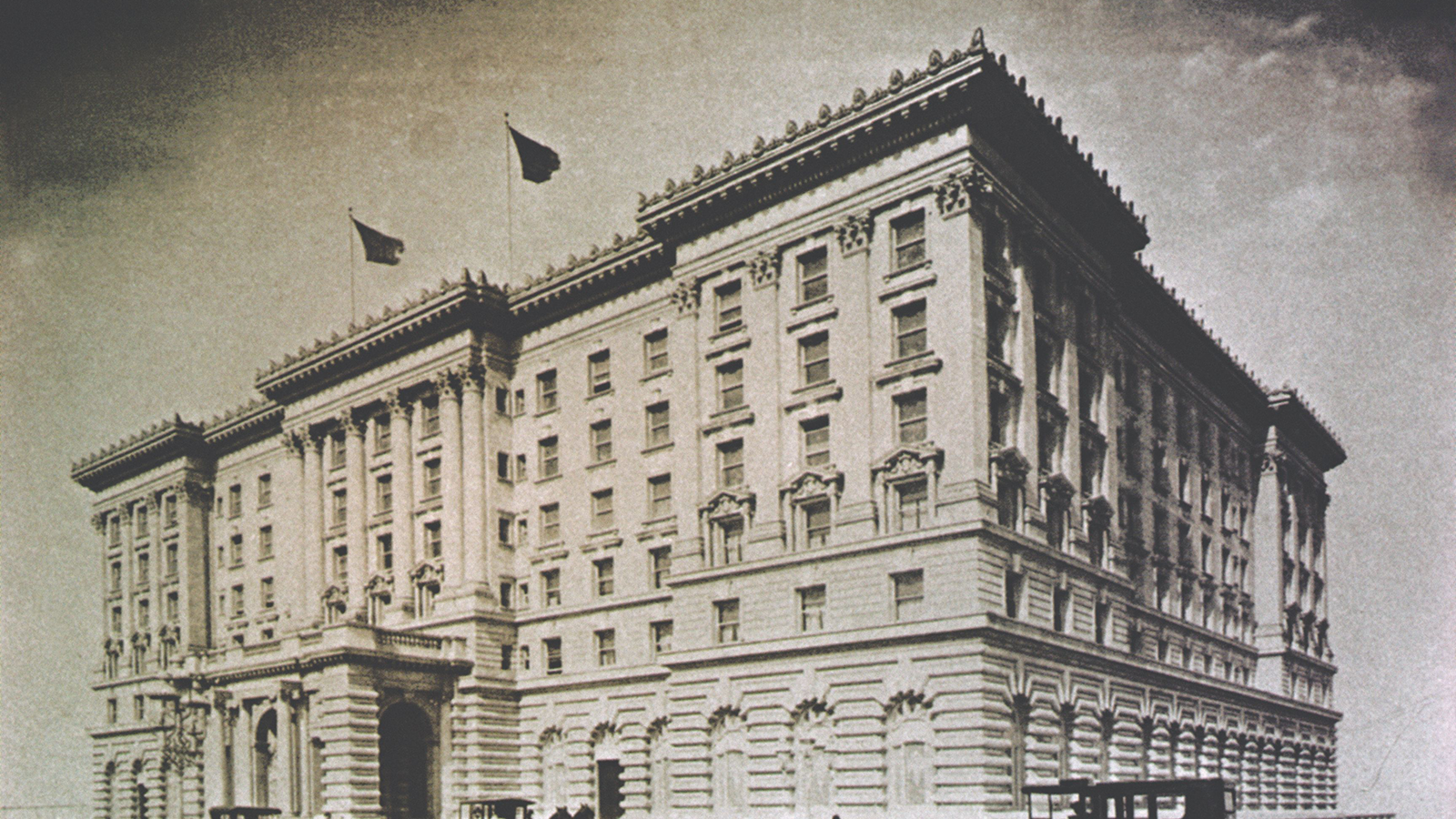
Fairmont San Francisco dates to 1903, when two sisters—Theresa Fair Oelrichs and Virginia Fair Vanderbilt—decided to build a spectacular boutique hotel in the heart of San Francisco’s Nob Hill. Dedicated in honor of their father, Senator James Graham Fair, the two hoped that the business would become a renowned local icon. Yet, mere weeks after the building debuted, the San Francisco Earthquake of 1906 struck the region. Like many other buildings in Nob Hill, Fairmont San Francisco was utterly destroyed. Undeterred, the sisters hired architect Julia Morgan—who would later come the nation’s preeminent female architect—to rebuild the entire structure. Exactly one year after the quake, the Fairmont Hotel re-opened and soon the destination became the social hub of the city. During the next several decades the hotel shifted ownership several times until the early 1930s, when the economic stagnation caused by the Great Depression eventually dragged the hotel into a state of benign neglect. But once again, Fairmont San Francisco rose from the ashes. At the end of World War II two events served to transform the business: the International Conference—which led to the birth of the United Nations—and the purchase of the hotel by Benjamin Swig. Swig an East Coast businessman that, "had a knack for seeing a good thing and turning it around." In turn, Swig hired interior decorator Dorothy Draper, who completely redesigned the space to reflect the ambiance of a Venetian palace.
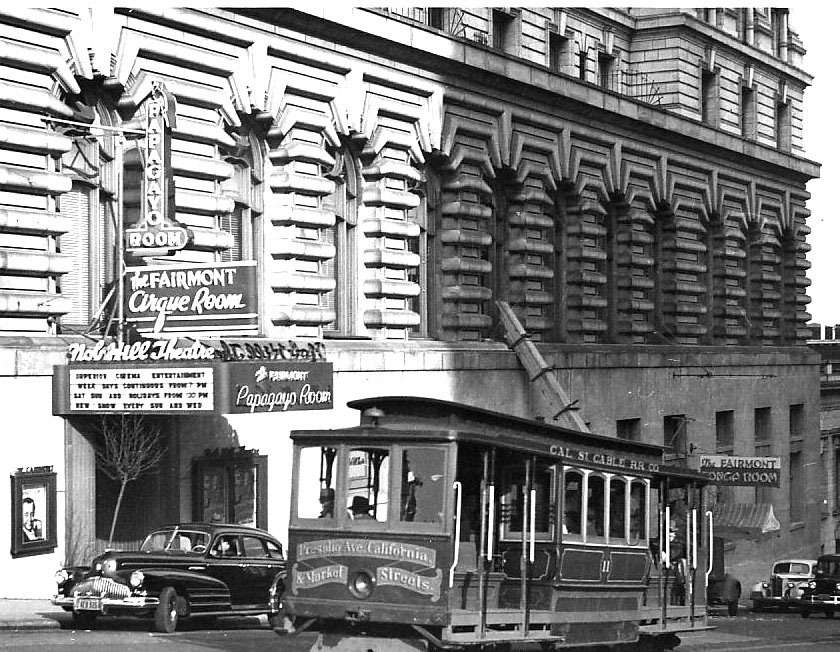
Under Swig’s watch, Fairmont San Francisco underwent a cultural renaissance. It quickly became the desired spot for visiting celebrities, athletes, and even U.S. presidents. The refurbished Venetian Room's grand opening as San Francisco's premier Supper Club took place in 1947 and for decades the room would attract big-name entertainers like Ella Fitzgerald, Nat King Cole, Marlene Dietrich, Joel Grey, Bobby Short, Vic Damone and James Brown. But the Venetian Room is perhaps most famous as the place where Tony Bennett first sang, "I Left My Heart in San Francisco” in 1961. The Cirque Room—the first bar to open in San Francisco following prohibition—is also inside the Fairmont. It was decorated by architect Tim Pflueger in a beautiful Art-Deco style with an incredible bar and murals by the celebrated Bruton sisters. Before the Venetian Room opened, the Cirque was the place to go for entertainment in the city. In November of 1961 another section opened: the 29-story tower, designed by Mario Gaidano. A recent $85 million restoration elevated the entire location to its present-day status, transforming the historic building into one of San Francisco’s most fabulous destinations. Now listed on the U.S. National Register of Historic Places, this wonderful historic hotel continues to entertain patrons in the same manner it has since its founding more than a century ago.
Hotel Timeline
The Location
Fairmont San Francisco resides high in Nob Hill, one of San Francisco’s original neighborhoods. Filled with all sorts of high-end storefronts, restaurants, and historic sites, the area has acted as a symbol for San Francisco’s economic prosperity in the 21st century. Prior to the 1850s, San Franciscans had known of Nob Hill as “California Hill” for the street that climbed up its eastern slope. The name was later changed to “Nob Hill,” when the Central Pacific Railroad’s main executives—The Big Four—started building their mansions atop the crest. Otherwise called the “Nobs,” the Big Four consisted of Mark Hopkins, Leland Stanford, Collis Porter Huntington, and Charles Crocker. Its proximity to downtown San Francisco combined with its views overlooking the bay made Nob Hill an exclusive enclave for the city’s affluent and well-connected. Soon enough, prominent Americans like James Flood—owner of the famous Comstock Lode—were among those who had a palatial home in Nob Hill. Ordinary residents took to calling those new migrants as “nabobs,” a term that was typically applied to wealthy men at the height of the Gilded Age. Over time, the term was eventually shortened to “nob,” which some speculate may have preserved the word’s affiliation to the neighborhood throughout the 20th century.
Rapid urbanization quickly followed the arrival of the Nobs to the area, too, as dozens of marvelous skyscrapers started to emerge en masse. Yet, this commercial proliferation was nearly destroyed when the San Francisco Earthquake of 1906 struck the city with tremendous force. What buildings that managed to survive the massive tremor were later damaged by the fire that followed. The only structures that escaped relatively unaffected from the calamity were the mansions of the Central Pacific Railroad’s Nobs. But like the rest of San Francisco, Nob Hill quickly rebuilt itself back to resemble its former glory. Leading the economic revitalization was The Fairmont Hotel, which had tragically opened just before the earthquake first struck. New skyscrapers soon replaced the older ones, giving the area its current modern appearance. Most of the private residences that had not survived the disaster were replaced with luxurious boutique hotels, including the InterContinental Mark Hopkins—which is another member of Historic Hotels of America. Those businesses served as the foundation for the neighborhood’s vibrant tourist industry that took off in the latter half of the 20th century. Lavishly upscale apartment buildings also appeared, too, further reinforcing the area’s identity as a popular haunt for the city’s most affluent citizens. Nob Hill now proudly retains its status as one of San Francisco’s most outstanding locations.
The Architecture
Fairmont San Francisco is one of the most iconic structures to define the skyline of San Francisco’s celebrated Nob Hill neighborhood. The building itself is divided into two parts: the original main structure and its modern tower wing. The historical portion of The Fairmont Hotel was built upon a steel frame that extended for seven stories, topped with a magnificent penthouse along the roof. Workers filled the frame with a beautiful combination of granite and white terra cotta cladding. As such, the hotel bears a striking resemblance to the Beaux-Arts architectural style that was first popularized in the United States during the 1890s. According to the U.S. Department of the Interior, additional characteristics that qualified The Fairmont Hotel as having a Beaux-Arts-inspired design were: “A five part composition, prominent central mass, paired columns at the prominent central mass, and arched openings at the base of the building.” The building also displayed single, prominent symmetrical elevations that contained both arched and linteled openings between its columns. Those elevated platforms cascaded along the hotel’s interior, too, as they were divided into advancing and receding planes. Yet, the northeastern corner of the building contains the more recent Fairmont Tower—a 29-story edifice that was developed in 1960. The U.S. Department of the Interior considers this segment of the building to be non-historical.
While Julia Morgan is often credited with designing the final version of Fairmont San Francisco, James and Merritt Reid actually constructed the original hotel. Brothers from New Jersey, James Reid operated as the principal designer in their mutual firm, known as the “Reid Brothers.” James had studied at the Massachusetts of Technology, before studying at the École des Beaux-Arts in Paris. Merritt, on the other hand, was already active in San Francisco, and implored his brother to join him in the city. Together, they formed one of the most influential architectural firms active in the early 20th century. Much of their work occurred following the calamitous San Francisco Earthquake of 1906, in which most of the city was entirely reconstructed. The Reids subsequently designed numerous structures throughout San Francisco, from gigantic office buildings to single-family residences. Among the most important structures that they created were the Call Office Building, the First Congregation Church, and the Cliff House. The inspiration or their work came from the City Beautiful movement, which sought to make America’s urban communities more harmonious. Like many other likeminded members of the movement, they hoped that by constructing ornate municipal buildings, the residents of every major American city would develop a stronger sense of moral and civic virtue.
Yet, the Reids work on Fairmont San Francisco was one of their earliest, as they started working on the structure some three years prior to the earthquake. Tragically, the hotel opened a few months before the calamity hit, which damaged it significantly. As such, Theresa Fair Oelrichs and Virginia Fair Vanderbilt hired a new architect, Stanford White, to oversee the building’s reconstruction. But White never got to work on the project, as he was shot and killed in New York City just weeks before heading out to San Francisco. The two sisters then tasked Julia Morgan with guiding the building’s restoration, particularly for her apt use of employing reinforced concrete. (That building material was especially attractive to Theresa Fair Oelrichs and Virginia Fair Vanderbilt, as it was very resilient to all sorts of natural disasters.)
The first female graduate from the École des Beaux-Arts, Morgan used the original blueprints—as well as her own personal preferences—to reconstruct the hotel. Ultimately, she did not deviate too far from the building’s first design, making minor modifications throughout the interior whenever appropriate. In the end, Morgan managed to brilliantly redevelop The Fairmont Hotel in a matter of months. People across San Francisco hailed her as such, citing both the quality of her work and the speed in which it was finished.
Famous Historic Events
United Nations Conference on International Organization (1945): Beginning on April 25, 1945, the City of San Francisco hosted a nine-week-long event known as the United Nations Conference on International Organization. Attended by delegates from 46 different nations, the conference specifically hoped to create an international organization—the United Nations—that would maintain global peace and cooperation while the world recovered from World War II. Fairmont San Francisco was just one of seven hotels in the city to entertain the dignitaries from those many disparate countries. Yet, the business distinguished itself as it was one of the major meeting places for the “Big Five” nations in attendance: France, China, Russia, the United Kingdom, and the United States. Representatives from those five nations made most of the critical decisions during the event that led to the singing of the United Nations Charter. They also constituted the five main countries that would act as the permanent members governing over the nascent United Nations. The Big Five specifically meet inside the building’s penthouse suite, where then-Secretary of State, Edward Stettinius, was residing. Stettinius then sent detailed reports that addressed the discussions that had occurred within the suite to President Harry S. Truman. Among the topics that Stettinius introduced to President Truman concerned voting procedures, nomination protocols, and the responsibilities of the Secretary General at the United Nations.
Historians today recognize that those daily meetings were critical, for they functioned as the medium to address all the primary grievances that affected the prospect of forming the United Nations. Those decisions and agreements later acted as the basis for the future United Nations Charter. As such, the United Nations Conference on International Organization proved to be the final major step in creating the actual United Nations. The United Nations Charter itself was unanimously adopted on June 25, 1945, at the San Francisco Opera House. The following day, fifty nations signed the document in the nearby Herbst Theater subset of the Veterans War Memorial Building. Poland would then join the signatories shortly thereafter, having not been in attendance at the conference. The United Nations finally came into existence that October, when the charter was formally ratified by the Big Five, which were now designated as the first members of the organization’s Security Council. It was then formally ratified by some 46 other nations. Flags of the original signatories of the United Nations Charter fly above the main entrance of Fairmont San Francisco in honor of such a momentous event. Today, nearly every nation in the world has signed the United Nations Charter, making it one of the most influential legal documents in world history.
Famous Historic Guests
- Marlene Dietrich, actress known for her roles in Morocco, Shanghai Express, and The Blue Angel.
- Ella Fitzgerald, singer known for her songs “Dream a Little Dream,” “A-Tisket, A-Tasket,” and “It Don’t Mean a Thing (If It Ain’t Got That Swing)
- Nat King Cole, musician known for his outstanding jazz recordings, as well as for being the first African American to host a television show.
- Bobby Short, cabaret singer and pianist known for his interpretations of songs by the likes of Noël Coward, Jerome Kern, and George and Ira Gershwin.
- Buddy Rich, musician who is regarded as one of the best jazz drummers of all time.
- James Brown, musician known as the “Godfather of Soul,” who is regarded as a founder of funk music.
- William Howard Taft, 27th President of the United States (1909 – 1913) and 10th Chief Justice of the United States (1921 – 1930)
- Woodrow Wilson, 28th President of the United States (1913 – 1921)
- Warren G. Harding, 29th President of the United States (1921 – 1923)
- Calvin Coolidge, 30th President of the United States (1923 – 1929)
- Herbert Hoover, 31st President of the United States (1929 – 1933)
- Franklin Delano Roosevelt, 32nd President of the United States (1933 – 1945)
- Harry S. Truman, 33rd President of the United States (1945 – 1953)
- Dwight D. Eisenhower, 34th President of the United States (1953 – 1961), and Supreme Allied Commander Europe during World War II.
- John F. Kennedy, 35th President of the United States (1961 – 1963)
- Lyndon B. Johnson, 36th President of the United States (1963 – 1969)
- Richard Nixon, 37th President of the United States (1969 – 1974)
- Gerald Ford, 38th President of the United States (1974 – 1977)
- Jimmy Carter, 39th President of the United States (1977 – 1981)
- Ronald Reagan, 40th President of the United States (1981 – 1989)
- George H.W. Bush, 41st President of the United States (1989 – 1993)
- Bill Clinton, 42nd President of the United States (1993 – 2001)
- George W. Bush, 43rd President of the United States (2001 – 2009)
Film, TV and Media Connections
- Vertigo (1957)
- Kiss Them for Me (1957)
- Petulia (1968)
- Magnum Force (1973)
- The Streets of San Francisco: Shattered Image (1973)
- Freebie and the Bean (1974)
- The Towering Inferno (1974)
- Family Plot (1976)
- A Night Full of Rain (1978)
- Shoot the Moon (1982)
- Sudden Impact (1983)
- Hotel (1983 – 1988)
- Murder She Wrote: The Great Train Robbery (1990)
- Jade (1994)
- Junior (1995)
- Mother (1996)
- The Rock (1996)
- Nash Bridges: High Impact (1996)
- The Rock (1996)
- Mythbusters (2013)
- The Intern (2015)
- Chance: The House of Space and Time (2016)
- Shang-Chi and the Legend of the Ten Rings (2021)
Women in History
Julia Morgan: Born in San Francisco in 1872, Julia Morgan was one of the most prolific female architects to work in the United States. Regarded as an architectural genius, she was an incredibly imaginative architect who enjoyed the use of several distinctive architectural styles. Yet, she was most notable for her meticulous craftsmanship and attention to detail, all while remaining fixed to a tight budget. Morgan began her career by studying at the University of California, Berkeley, before apprenticing privately under Bernard Maybeck. With Maybeck’s encouragement, she traveled to Paris in 1890s to join the prestigious École des Beaux-Arts. Morgan sought the esteemed guidance from the French school like so many other American architects during the Gilded Age, for its was considered to be the world’s most elite architectural institution at the time. Enrolling in 1898, she became the first woman to gain admittance into the École des Beaux-Arts. When Morgan retuned to California following her graduation fours years later, she also became the first woman in the state to receive an architect’s license.
Her career spanned some four decades and resulted in the construction of some 800 magnificent buildings. While Morgan worked all over the country, she specifically designed buildings in her native San Francisco. Opening her own office in 1904, she played a significant role in reconstructing the city when it was beset by a destructive earthquake two years later. The massive redevelopment of the entire San Francisco Bay region granted Morgan a rare opportunity to show off her talents in a variety of ways. She proceeded to design numerous homes, offices, schools, and churches throughout the area, giving her great fame. Her newfound celebrity status attracted new clients to her firm, including publishing magnate William Randolph Hearst. Hearst specifically commissioned Morgan to create Hearst Castle, a magnificent country house on his family ranch in faraway Simeon, California. Lasting for some 28 years, the Hearst Castle quickly became one of the most lavish private residences in the whole world. Like many of Morgan’s other creations, Hearst Castle is currently listed on the U.S. National Register of Historic Places.
Guest Historian Series
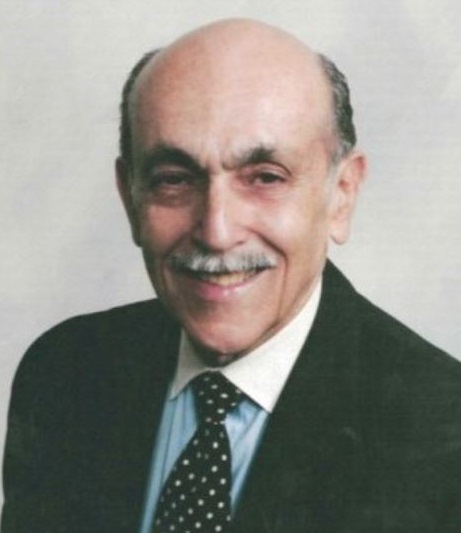
The luxurious Grande Dame atop Nob Hill in San Francisco was named after U.S. Senator James Graham Fair (1834-1894) by his daughters, Theresa Fair Oelrichs and Virginia Fair Vanderbilt. When the silver king James Fair purchased the site back in the late 1800s, his interest was to build the largest mansion in the neighborhood. However, when he died in 1894, the lot was still undeveloped until 1907 when his daughters commissioned the architectural and engineering firm of Reid & Reid to design a large hotel in Italian Renaissance style. The Reid brothers: James (1851-1943), Merrit (1855-1932) and Watson (1858-1944) designed a 600-room, seven story building made of gray granite, cream marble and terracotta stone. Before the new hotel could open, the 1906 San Francisco earthquake and subsequent fire gutted the structure.
CONTINUE READING