History
Discover The Jefferson Hotel, which has remained a luxury cornerstone of historic Richmond since the 19th century.
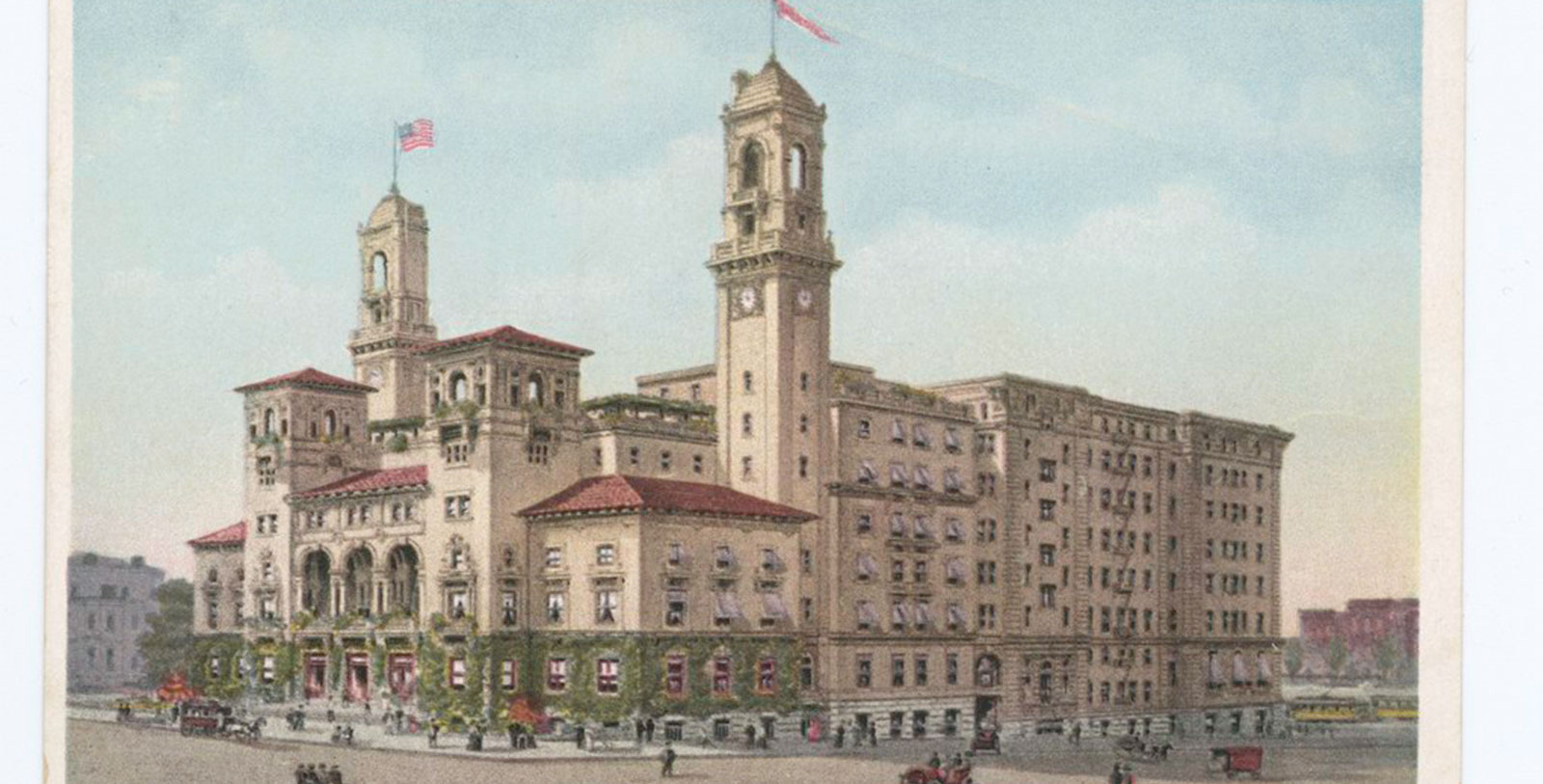
Listed in the U.S. National Register of Historic Places by the U.S. Department of the Interior, The Jefferson Hotel is among the most historic travel destinations in the country. In 1892, Lewis Ginter—one of the area's most eccentric characters—decided to construct a magnificent hotel for his beloved city. An estimated $5 to $10 million went into planning, building and furnishing the hotel, with nearly $2 million going toward its three-year construction. But Ginter’s plan to construct an extravagant holiday destination paid off. Thousands of visitors from across the United States flocked to The Jefferson Hotel when it first opened its doors on Halloween Day of 1895. By the end of the decade, The Jefferson Hotel affectionately bore the moniker of “The Belle of the ‘90s.”
Three-fifths of the building’s structure became compromised from a tragic accident in 1901. Even though 100 guestrooms remained intact, the hotel had trouble recovering. A concerned group of local citizens led by Lieutenant Governor Joseph Willard then decided to fully renovate The Jefferson Hotel. They hoped to achieve that vision in time for the tercentennial anniversary of the Jamestown Expedition. Through the Jefferson Realty Company, the group initiated an extensive restoration of the building in 1905. Together, they added marbleized columns and applied a combination of rococo aesthetics to the hotel’s interior. The Grand Staircase and the Mezzanine—both formerly enclosed behind arched walls—were opened up and the hotel expanded to include 330 new accommodations. The Jefferson Hotel then held its grand reopening in 1907.
During World War II, the hotel lodged transient recruits on their way to one of the war’s many theaters across the globe. The stained-glass skylights and windows were taken down not only to conform to blackout requirements, but also to prevent breakage from empty bottles tossed by the rowdy crowds. In March 1944, another structural mishap befell the hotel, which marked the beginning of a gradual decline in business for The Jefferson Hotel. This period of prolonged decay continued throughout the 1960s and 1970s, despite diligent efforts to attract scores of new patrons. The hotel closed to everyone by 1980, except for when Director Louis Malle used the Grand Ballroom in his film, My Dinner With Andre.
New life entered The Jefferson Hotel when another round of renovations began in 1983. Three years and more than $34 million later, the hotel reopened once more on May 6, 1986. Developers removed layers of paint to reveal the building’s beautiful mahogany paneling and marble columns that others had covered up a few decades prior. The original hardwood and marbling flooring were cleaned and properly polished for the first time in years. Craftsmen resurrected many items, such as hand-carved fireplace mantels, ornate ceiling fixtures, wall sconces, and writing tables. Then in 1991, The Jefferson Hotel became owned by Historic Hotels, Inc., a Richmond-based group of investors unaffiliated with Historic Hotels of America. In the ensuing decades, the hotel has thrived as a cornerstone of Richmond's social and business scenes. The luxury hotel in Virginia recently completed a full reconstruction of its guestrooms and suites, as well as a renovation of all public spaces. The future of this legendary hotel has never looked brighter.
Hotel Timeline
The Location
Toward the beginning of the 18th century, the site of present-day Richmond was known among the Virginia colonists for its strategic location along the James River. Settlement had remained sparse though, consisting of only a few dozen Euro-American families. But the fate of the area changed dramatically after the passage of the Warehouse Act by the Virginia House of Burgess in the early 1730s. The legislation specifically called for the inspection of tobacco cultivation, then Virginia’s most lucrative industry. As such, planter William Byrd II began to construct one of the depots close to his estate, ultimately leasing a sizeable tract of land for the creation of an accompanying town. Work on Byrd’s new community began in earnest in 1737, with civil engineer William Mayo laying out the original street grid. Byrd subsequently called his new town “Richmond” in honor of Richmond, England, as they both enjoyed similar landscapes. Richmond remained small despite its important role in Virginia’s colonial economy, hovering around a couple hundred residents on the eve of the American Revolution. The community nonetheless saw itself at the forefront of the movement once it started to erupt across the Thirteen Colonies in the 1770s.
Among the most prominent events to occur within the town was Patrick Henry’s famous “Give me liberty, or give me death” speech at St. John’s Church, which historians often cite as one of the American Revolution’s most prominent moments. Virginia politicians sympathetic to the Patriot cause gradually met in Richmond afterward, leading to its designation as the new state capital in 1780. But its rich affiliation with the revolutionaries made it a target for the British military. In fact, notorious American turncoat Benedict Arnold led a raid on Richmond, forcing the state government—including then-governor Thomas Jefferson—to temporarily flee further into the Virginian interior. Richmond recovered from the attack, emerging as one of Virginia’s leading municipalities in the wake of the American Revolution. In fact, Richmond started to industrialize in the early 19th century, thanks to the debut of the celebrated James River and Kanawa Canal. Now evolving into a full-fledged city, Richmond attracted many industrialists due to its enhanced transportation and hydropower capabilities. Perhaps the largest business to appear at the time was the sprawling Tredegar Iron Works, which produced a multitude of metallic goods for decades.
This economic activity only increased when the railroads arrived during the 1850s, namely the Richmond and Petersburg Railroad. However, this prolonged period of prosperity featured a darker side, as it was supplemented by African American slavery. The institution became such a bedrock component to the city’s socioeconomic identity that it eventually drove the populace to support the Southern Confederacy once the American Civil War erupted in 1861. Richmond itself emerged as the national capital for the Confederacy, with the historic Virginia State Capitol functioning as its main legislative building. The city’s importance within the Confederacy ultimately made its capture a central component to the Union’s war strategy as well, causing many battles to be fought all around its borders in 1862 and 1864. But the worst devastation occurred near the end of the war when retreating Confederate soldiers set the metropolis ablaze in order to prevent anything of significance from falling under Union control. U.S. President Abraham Lincoln then visited the desolated city just a few days later, iconically entering the vacated Confederate capital alongside a troop of Black cavalry soldiers.
Unlike the American Revolution, it took Richmond several years to fully rebuild. Nevertheless, Richmond did finally reemerge once more as one of the most prosperous communities in the American South at the height of the Gilded Age. This new era of economic success continued well into the 20th century, too, which saw the city expand exponentially via a variety of infrastructural and commercial projects. Richmond still struggled with the legacies left behind by the American Civil War though, specifically the fate of its African American residents who continued to live in racial segregation. Richmond thus became a major battleground in the fight for modern civil rights, with protests taking place all over the city. Among the greatest to occur were the actions taken by the Richmond 34, who famously staged the sit-in of a segregated lunch counter inside the Thalhimers department store. Richmond has since grown to be one of the most culturally diverse communities throughout the entire country, serving as home to fascinating museums, art galleries, universities, and even Fortune 500 companies. The city is particularly noted for its wealth of historic sites that relate intimately to the American Revolution, American Civil War, and Civil Rights Movement. Cultural heritage travelers are certain to find Richmond’s past to be worth learning more about.
The Architecture
Hailed by the U.S. Department of the Interior as “one of the nation’s most outstanding examples of late-19th century eclectic architecture,” The Jefferson Hotel is a structural masterpiece. Many different architectural flavors permeate throughout the building, most notably Beaux-Arts and Spanish Baroque-style design aesthetics. The first architects to oversee the development of The Jefferson Hotel’s rare appearance was the New York-based firm Carrère and Hastings, which later designed the New York Public Library (now a National Historic Landmark). When the building underwent its second round of renovations in 1905, a new architect named J. Kevan Peebles oversaw the project. Peebles had by that point attracted nationwide praise for his prior work on the Virginia State Capitol. The Jefferson Hotel has since undergone three additional renovations with the most recent starting in 2013.
Ginter spent an estimated $5 to $10 million to finance The Jefferson Hotel’s initial construction. He used his money to lavishly outfit the building with the finest artwork and amenities of its day. Ginter imported exotic vegetation from throughout Latin America and place rare antiques in all the public spaces. An exquisite library appeared inside the structure, as did a ladies’ salon, a grill room, and several billiard halls. Ginter even installed a series of luxurious Turkish and Russian baths throughout the building. The Jefferson Hotel was also among the first structures in downtown Richmond to feature electricity, working telephones, and indoor plumbing.
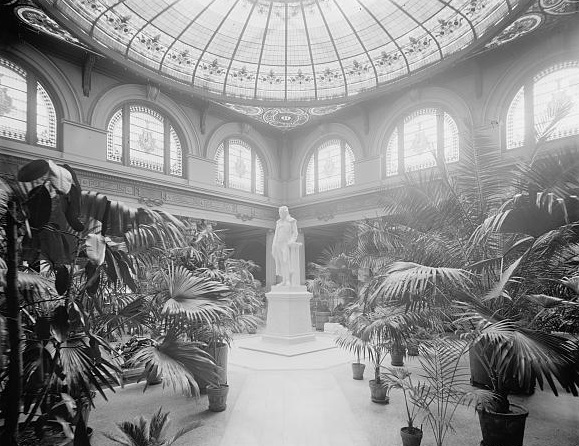
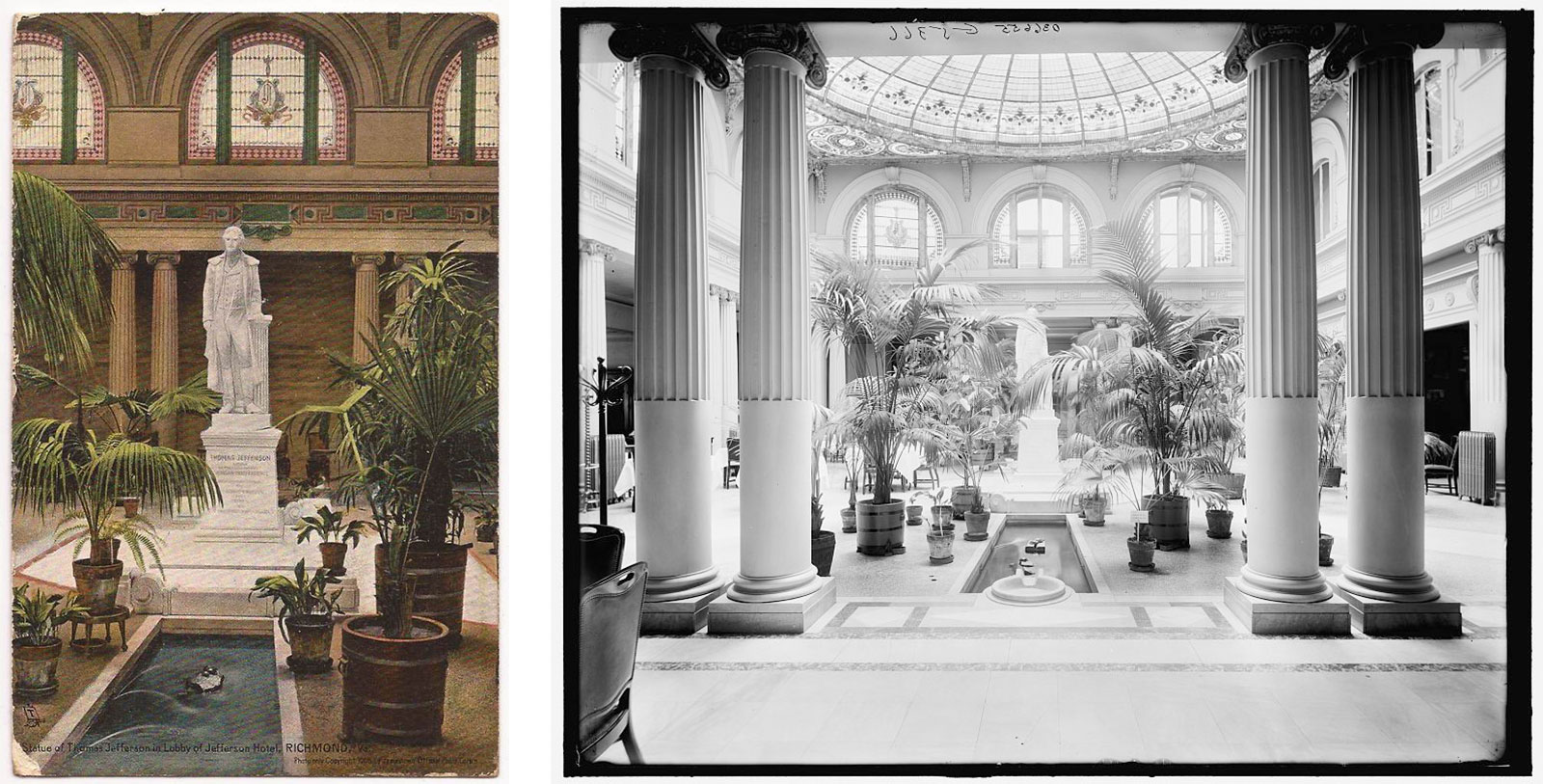
Perhaps the most ostentatious aspect of The Jefferson Hotel when it first opened was the life-size replica of its namesake, Thomas Jefferson. The centerpiece of the hotel’s main lobby, the statue of the nation’s third president cost Ginter nearly $12,000 to make. He commissioned a local sculpture named Edward V. Valentine for the project, who subsequently used Carrara marble as his material. Valentine was so fully invested in producing an accurate portrayal of Jefferson that he incorporated the design of some of president’s actual clothing into the statue.
Many of The Jefferson Hotel’s interior spaces are an everlasting tribute to the meticulous work done by the original architects. No room reflects this sentiment better than the marvelous Palm Court. The focal point of the Palm Court at The Jefferson Hotel is the circular stained-glass that completes a majority of the room's 35-foot ceiling. Surrounding the room are 12 stained-glass windows, each vibrant design featuring The Jefferson's original logo, similar to the crest that is used today. These side-panel windows are believed to been crafted by the famous artisan Louis Tiffany. The stained-glass elements were added to the lobby following the 1901 fire which destroyed two-thirds of the original 1895 structure. The 40-foot ceiling of The Jefferson's Rotunda lobby features both a massive stained-glass skylight as well as intricately carved plaster featuring an elegant palm frond motif.
Famous Historic Events
Southern Governors’ Conference (1993): This was one of many conferences organized by the Southern Governors’ Association to address and coordinate common interests held by the region’s leading state executives. Founded in 1934, the organization met for many years throughout the United States before disbanding in 2016.
Famous Historic Guests
- Henry James, famed author known for such works as The Portrait of a Lady and The Wings of a Dove.
- Sarah Bernhardt, renowned French stage actress.
- Gertrude Stein, renowned author known for such works like Three Lives and The Making of Americans.
- F. Scott Fitzgerald, renowned author best known for writing The Great Gatsby.
- Charles Lindbergh, historic aviator and military officer
- Dolly Parton, renowned country music musician known for songs like, “Jolene,” “Coat of Many Colors,” and “9 to 5.”
- Elvis Presley, rock star celebrated as the “King of Rock and Roll.”
- Ray Charles, legendary musician who pioneered American soul music and created countless chart-topping singles.
- Frank Sinatra, celebrated actor and singer who sold over 150 million records worldwide.
- Sarah Bernhardt, renowned French stage actress.
- Charlie Chaplin, renowned actor known for his silent roles in The Kid and A Woman of Paris.
- Robert Mitchum, famous actor known for his roles in such films like El Dorado, The Night of the Hunter, and Cape Fear.
- Grover Cleveland, 22nd and 24th President of the United States (1885 – 1889; 1893 – 1897)
- Benjamin Harrison, 23rdPresident of the United States (1889 – 1893)
- William McKinley, 25th President of the United States (1897 – 1901)
- Theodore Roosevelt, 26th President of the United States (1901 – 1909)
- William Howard Taft, 27th President of the United States (1909 – 1913) and 10th Chief Justice of the United States (1921 – 1930)
- Woodrow Wilson, 28th President of the United States (1913 – 1921)
- Calvin Coolidge, 30th President of the United States (1923 – 1929)
- Franklin Delano Roosevelt, 32nd President of the United States (1933 – 1945)
- Harry S. Truman, 33rd President of the United States (1945 – 1953)
- Ronald Reagan, 40th President of the United States (1981 – 1989)
- George H.W. Bush, 41st President of the United States (1989 – 1993)
- Bill Clinton, 42nd President of the United States (1993 – 2001)
- George W. Bush, 43rd President of the United States (2001 – 2009)
- Barack Obama, 44th President of the United States (2009 – 2017)
Film, TV and Media Connections
- My Dinner with Andre (1981)
- Sunday Morning (1987, 1994)
- Good Morning America (1992, 1994)
Guest Historian Series
Tobacco baron Lewis Ginter began building the hotel in 1892 and opened it in 1895. Designed by Carrère and Hastings, the same architecture firm that designed the New York Public Library on Fifth Avenue, the Ponce de Leon Hotel (St. Augustine), Flagler's Whitehall Mansion (Palm Beach), the House and Senate Office Buildings (Washington, D.C.) and many more.
As a centerpiece for the upper lobby, Ginter commissioned Richmond sculptor Edward V. Valentine to create a life-size image of Thomas Jefferson from Carrara marble. Ginter imported exotic palm trees from Central and South America and purchased hundreds of valuable antiques. The hotel had electric lights, electric elevators, hot and cold water in the guestrooms and a Teleseme (predecessor of the telephone) for room service. Other unusual amenities were a grill room, ladies’ salon, a library, Turkish and Russian baths. The hotel opened on Halloween 1895 for the engagement party for Charles Dana Gibson, the famous illustrator and Irene Langhorne, better known as the Gibson Girl.
Continue Reading