
History
Discover The Lafayette Hotel, which is among the most important structures within the nationally recognized Marietta Historic District.
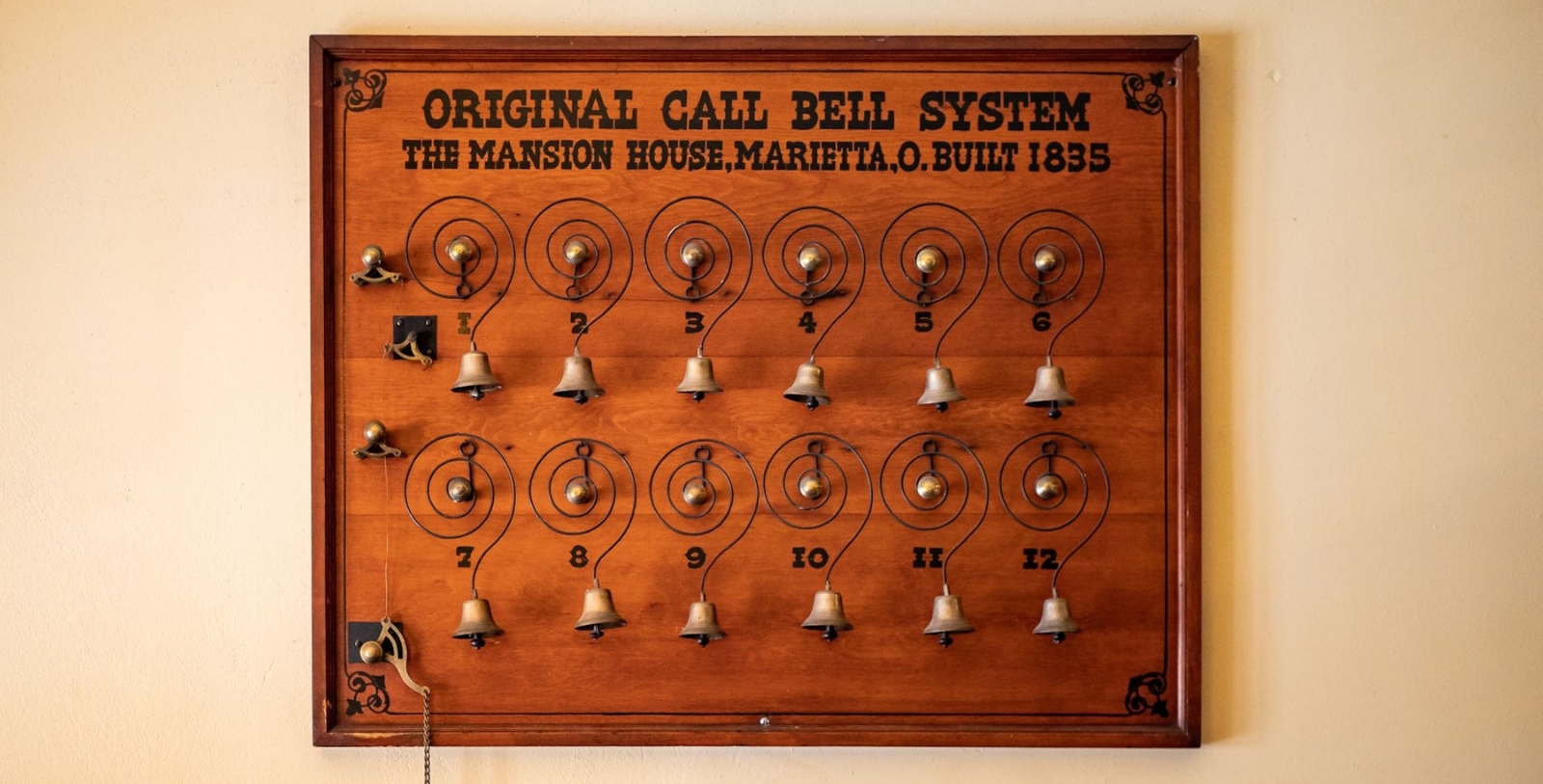
Situated at the junction of the Muskingum and Ohio Rivers, The Lafayette Hotel in Marietta, Ohio, is a living monument to the city’s rich past and enduring charm. The hotel's story does not begin with its current iteration, but with its predecessor, the Bellevue Hotel, which was created during an era when Marietta was blossoming as a hub for regional maritime commerce. Indeed, the city’s strategic location along two major rivers had long made the site a natural center for trade, with steamboats and barges ferrying all kinds of goods through its wharves since the early 19th century. This riverine activity spurred the growth of local industries in turn, including shipbuilding, agriculture, and manufacturing. By the height of the Gilded Age, Marietta had thus matured into a bustling metropolis with a vibrant downtown, a growing population, and a need for accommodation that matched its rising stature. It was in this climate that the Bellevue Hotel was erected on the corner of Front and Greene Streets. Originally built in 1892, the four-story Bellevue Hotel was an engineering marvel due to the steam-heated plumbing and call-bell service that guests could access inside each of its guestrooms. Traveling merchants and riverboat passengers found those features to be incredibly desirable in consequence, helping to give the business a respected reputation within just a few years of opening. In fact, the Bellevue Hotel eventually emerged as a symbol of the city’s very prosperity, its occupancy emblematic of the flourishing economic activity happening at the time.
The fortunes of the Bellevue Hotel shifted dramatically when a structural incident affected the building in 1916. The loss was deeply felt in the community, not only for the demise of a beloved landmark but also for the blow dealt to Marietta’s wider economy. True to the resilient spirit of the town, the site did not remain vacant for long as members of the community pooled their resources to finance its revival. Together, they formed the Marietta Hotel Company to oversee the project, which quickly commissioned construction on a replacement mere weeks later. Taking two years to complete, the second building proved to be even more grand than the Bellevue Hotel. Designed to showcase an eclectic blend of then-contemporary architectural styles, the exterior façade managed to graciously command the entire municipal skyline with its brilliant aesthetics. Terrific amenities like steel bed frames, felt mattresses, and writing tables were commonplace throughout the new guestrooms. Delicate carvings adorned the walls of the building’s expertly crafted meeting spaces, while the restaurant served only the finest culinary offerings. Even the interior layout paid homage to the region’s integral riverboat industry, featuring nautical décor that evoked memories of Marietta’s formative years as a port town.
Named “The Lafayette Hotel” after American Revolutionary War hero the Marquis de Lafayette, the revitalized business became a cornerstone of Marietta’s social life. Thrilling soirees were regularly hosted within the hotel’s ballroom, and passing travelers continued to demand reservations in large numbers. Among the most notable guests seeking accommodation were members of the local maritime trades, whose vessels had continued to dock along the city’s historic waterfront. Central to this enduring appeal was the managerial expertise of the Hoag family, who assumed control over the hotel during the 1920s. They invested heavily to ensure that the business’ popularity stayed strong, despite the harrowing global hardships that affected the nation in the decades that followed. For instance, the Hoags sponsored the development of a magnificent wing of additional guestrooms amid the Great Depression, which helped to solidify demand for the hotel’s services for years to come. Ownership remained with the Hoag family until 1973, at which point it underwent several renovations to keep with changing tastes. Yet, even as updates were made, the hotel’s character survived. Then in 1991, the Lin family of Columbus acquired the hotel and embarked on a diligent mission to preserve its historical essence. Thanks to their dedicated stewardship, The Lafayette Hotel has continued to act as a charming getaway for those visitors interested in exploring the history of the Ohio River valley.
Hotel Timeline
The Location
Located at the confluence of the Muskingum and Ohio Rivers, Marietta, Ohio, holds the distinction of being the first permanent American settlement in the Northwest Territory. In 1788, a frontiersmen named Rufus Putnam led a few dozen settlers down the Ohio River on a flatboat known as the Adventure Galley. Putnam and his band were part of the Ohio Company of Associates, a group of Revolutionary War veterans and investors who had purchased land from the Continental Congress under the auspices of the Ordinance of 1787. Their goal was to establish a foothold in the newly opened Northwest Territory, and they chose the site of modern-day Marietta due to its fertile fields. Named in honor of Queen Marie Antoinette of France (recognizing France’s support during the American Revolution) Marietta was laid out in a New England-style grid, complete with common areas and a fortified settlement known as “Campus Martius.” While the fortification itself was originally meant to protect the settlers from potential conflicts with neighboring Native America tribes, it emerged as the central social hub for the entire community. Due to its secure defenses and proximity to the Ohio River, Marietta became an important waypoint for other pioneers eager to explore further into the Northwest Territory. In fact, the acting governor of the region at the time, Arthur St. Clair, momentously elevated the town as an administrative capital just a year after it had been founded!
Flatboats, barges, and later steamboats increasingly ferried goods and people downstream, which gradually transformed Marietta into a prominent port. The heightened economic opportunities convinced many more people to move to Marietta, ultimately growing it in size by the beginning of the American Civil War. This affluence also gave Marietta more political importance, with civic leaders often deeply involved in greater statewide issues. Perhaps the best example could be drawn to the city’s widespread participation in the Underground Railroad, specifically serving as a station for escaped slaves seeking freedom in the North. Local activists used the nearby waterways as a route, and several homes in the area were closely affiliated with the clandestine network. But Marietta’s mounting prosperity affected other areas of its community, too, such as education. For instance, Marietta College, founded in 1835, became a respected liberal arts institution, as well as a renowned architectural landmark. Still in operation in the present, the school attracted all kinds of celebrated intellectuals in the years following its opening. As the 19th century progressed, Marietta continued to evolve, although its earlier prestige waned somewhat with the rise of other cities connected to the Ohio River. Still, it retained its charm and historical authenticity. Victorian-era homes, brick streets, and riverfront parks contributed to the town’s picturesque atmosphere well through the 20th and even 21st centuries.
Today, Marietta is a living museum of American history that cultural heritage travelers have adored discovering. The Campus Martius Museum has been a particularly popular attraction, housing exhibits on the settlement of the Northwest Territory, Native American cultures, and the Ohio Company of Associates. The museum includes General Putnam’s home and rare artifacts that illuminate the daily lives of his fellow settlers. Nearby, the Ohio River Museum chronicles the golden age of local riverboat travel. Its centerpiece is the W.P. Snyder Jr., the last intact steam-powered sternwheel towboat in the United States, which offers a tangible link to Marietta’s formative heritage. The Castle, a stunning Gothic Revival mansion built in the mid-19th century, provides guided tours and seasonal events that showcase the city’s Victorian life. Its architecture and furnishings provide insight into the tastes and lifestyles of its leading residents during the pre-Civil War era. Historic Harmar Village, meanwhile, is a charming district with cobblestone streets, antique shops, and preserved buildings that evoke the spirit of 19th-century Marietta. The adjacent Harmar Railroad Bridge, a pedestrian walkway, connects the village downtown and offers scenic views of the river. Finally, the Anchorage Mansion, an Italianate villa built in 1859, is open for tours and managed by the Washington County Historical Society. It stands as a testament to Marietta’s architectural legacy and the prosperity of its historic community.
The Architecture
The Lafayette Hotel possesses a unique architectural style that can best be described as “eclectic.” Dating to the mid-19th and early 20th centuries, historians today consider “eclecticism” to be part of a much larger movement to fuse together a variety of historical designs. Earlier in the 1800s, architects, particularly those in Europe, decided to rely upon their own loose interpretations of historical architecture whenever they attempted to replicate it. Such a practice appeared within styles like Gothic Revival, Italianate, and Second Empire architecture. But at the height of the Gilded Age, those architects decided to use historic architecture more literally when developing a building. A few architects went a step further by combining certain historical styles together to achieve something uniquely beautiful. And in some cases, those individuals felt inspired to add a new historical form onto a building that they were renovating. Nevertheless, the architects felt that joining such architectural forms together would give them a new avenue of expression that they otherwise did not have at the time. But they even believed that they had stayed true to the earlier forms, so long as their designs perfectly replicated whatever it was they wanted to mimic.
In Europe, this approach first appeared as a rehash of Gothic Revival-style known as “Collegiate Gothic.” The European architects then used such a mentality to influence the unfolding philosophies of both the Beaux-Arts school of design, as well as the emerging Renaissance Revival-style. Many architects in America followed suit, the most notable of which being Richard Morris Hunt and Charles Follen McKim. The American architects who embraced “eclecticism” were at first interested in the country’s colonial architecture. Much of the desire to return to the period was born from the revived interest in American culture brought on by the Centennial Exposition of 1876. More specifically, pride in preserving the nation’s heritage inspired the architects to perfect the design principles of their colonial forebearers in new and intriguing ways. This interest gradually splintered into other revival styles though, like Spanish Colonial and Tudor Revival. Some Americans even infused the approach with the popular Beaux-Arts aesthetics of France, such as Hunt and McKim. However, the birth of Modernism in the 1920s and 1930s eventually ended the worldwide love affair with “eclecticism,” for architects throughout the West becoming more enchanted with the ideas of modernity, technology, and progress.