
History
Discover the Middlebury Inn, located in charming downtown Middlebury, which has offered genuine comfort and hospitality since 1827.
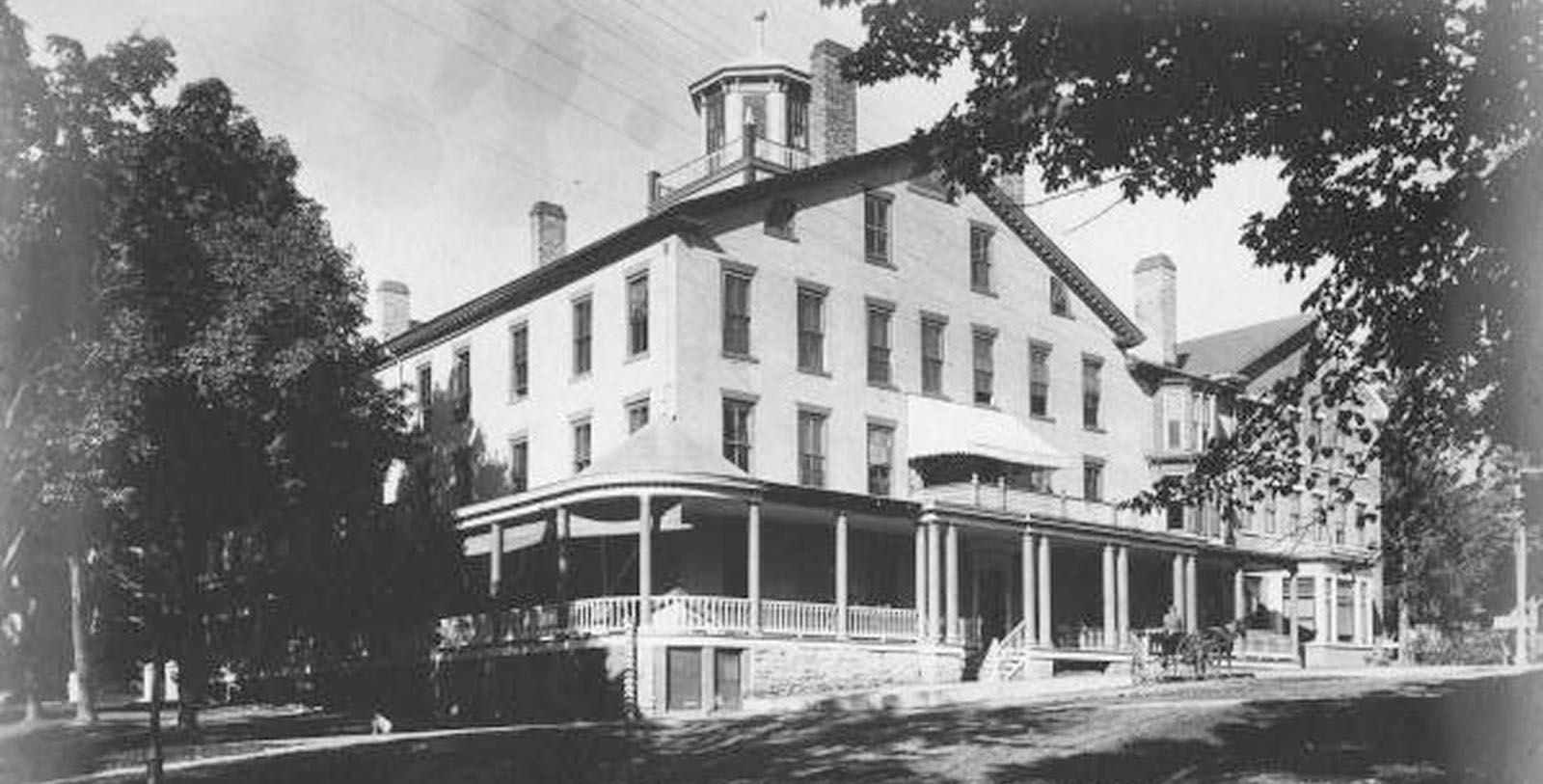
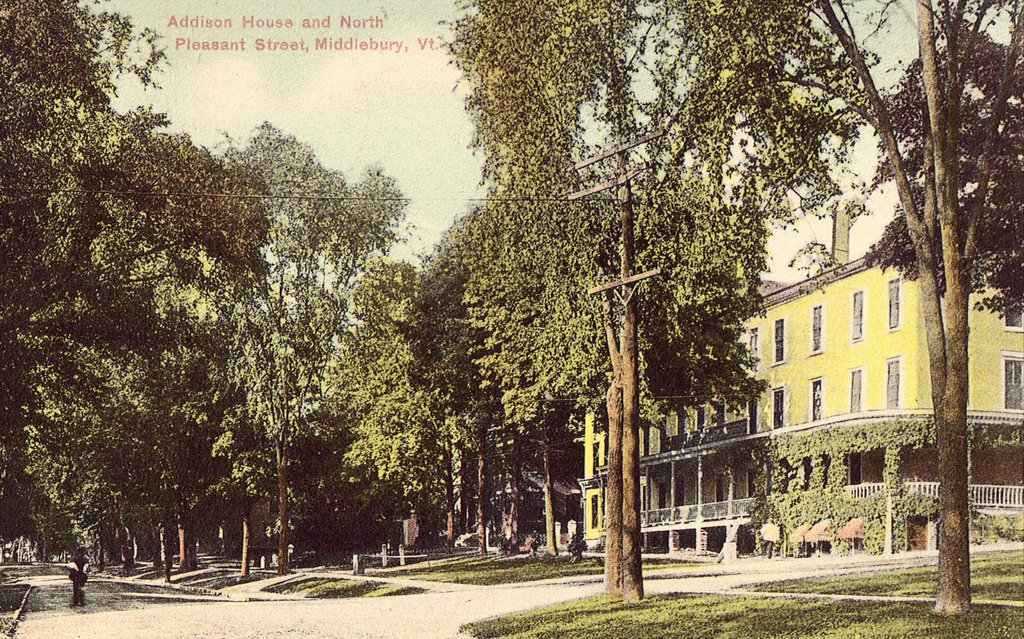
The Middlebury Inn has welcomed guests to its central Vermont shire town for nearly two centuries, establishing a tradition of hospitality and comfort rarely matched elsewhere among the historic hotels of New England. Nevertheless, the true appeal of the Middlebury Inn is its heritage. This charming historic hotel first opened when a local businessmen named Nathan Wood constructed the gorgeous Federal-style brick structure as a “public house” in 1827. Known as the “Vermont Hotel,” Wood had built the structure atop the site of an earlier tavern next to the busy Centre Turnpike. (He had actually run his personal home as a temporary inn while constructing the building.) It quickly became the main social gathering spot throughout Middlebury Vermont hotels, especially as more merchants and other travelers passed through the town along the adjacent thoroughfare. Then, in 1852, the inn was renamed as the “Addison House” and underwent renovations when Darwin Rider acquired it shortly thereafter. Rider was a gracious host, running a free carriage service to all trains and operated a large livery for guests. But in 1897, the Addison House was purchased by Robert Cartmell and Allen Calhoun, who initiated even more extensive renovations. Among the work that transpired under their watchful eye included the addition of three floors, the installation of gorgeous bathrooms, electrical lighting, and even steam heating. They also endeavored to construct a brand-new kitchen, as well as an ornate dining room.
Although still a celebrated hotel at the base of Vermont’s Green Mountains, it was nonetheless sold to a stock company called the “Middlebury Hotel Corporation” at the height of the Roaring Twenties. Comprised of local businessmen, the company started its own renovation process that modernized its amenities, while also preserving its rich architectural character. The hotel subsequently reopened as “The Middlebury Inn” some two years later, hosting a gala to celebrate the occasion. Amazingly, the inn continued to grow over the course of the next few decades. For instance, its ownership decided to integrate the two-story Porter Mansion into the business during World War II. Originally built in the early 19th century, the stately brick structure was named after one of its more prolific inhabitants, William Porter. This fantastic structure soon added an additional nine guestrooms that The Middlebury Inn quickly advertised. (The building itself was just as beautiful as inn, too, featuring such details as fine lead-glass entrances, exquisite marble fireplaces, intricate moldings, and a lovely curving staircase.) Further expansions to the building took place once the Treadway Company obtained the building in the late 1960s. It specifically developed the inn’s modern annex and refreshed its wonderful guestrooms. A member of Historic Hotels of America since 1991, The Middlebury Inn continues to be one of the best places to stay in the whole region.
Hotel Timeline
The Location
For much of the 18th century, the territory that would become Vermont was sparsely populated by Euro-American colonists. Settlement had been deterred by the presence of hostile Native Americans and French settlers further north, who frequently used the region to raid deeper into the more densely inhabited areas of New England. Perhaps the greatest series of attacks occurred during the French and Indian War—a continental fight between Great Britain and France that was part of the much larger Seven Years’ War. But the threat posed by the French and their native allies was eventually removed when the British managed to secure all of Canada at the war’s conclusion in the early 1760s. As such, the colonial governor of New Hampshire, Benning Wentworth—who claimed nominal authority over modern-day Vermont—began to assign numerous land grants in the mountainous terrain west of the Connecticut River. Wentworth’s decision was not without controversy, as neighboring New York had also laid claim to the territory. Nevertheless, immigrants from across New England subsequently poured into the region in order to obtain one of Wentworth’s assignments. Among the various bands of colonists to petition the governor for a land grant were a few families from Salisbury, Connecticut, in 1761. Wentworth accepted their request and gave a six-mile tract near a natural landmark called “Otter Creek.” In total, some 63 different people settled the area, with John Chipman clearing the first private lot at place soon to be known locally as “Chipman Hill.” The residents eventually decided to name their new town as “Middlebury,” supposedly to signify its proximity between its two sibling communities.
The first few years of Middlebury’s existence proved to be quite peaceful, until the British Army ironically ransacked the town during the American Revolutionary War. In 1778, a contingent of British soldiers under Major Christopher Carleton invaded the area by way of Quebec, intent on harassing the numerous communities that dotted the New York/New England border. They specifically headed for Lake Champlain before turning east into the Green Mountains. After hitting Raymond’s Mill in early November, the marauders quickly fell on Middlebury, where they burnt anything of value. Undeterred, the residents rebuilt much of the town once the war had ended, with the revitalized Middlebury becoming part of the newly created state of Vermont shortly thereafter. The postwar years were a time of great prosperity for the residents of Middlebury, who developed a thriving local economy based on crops like grain and hay. Furthermore, a few locals even took to opening their own small manufactories to support the nearby farms, which laid the foundation for industry to flourish in the early 19th century. In fact, by the mid-1800s, a few dozen mills and factories had lined Otter Creek and manufactured products that ranged from paper to iron. Wealth subsequently flowed into Middlebury, giving rise to many beautiful townhouses reflecting popular architectural styles, such as Federal and Queen Anne-style. The prosperity even attracted a branch of the Rutland & Burlington Railroad to start operating within the town limits, which further solidified Middlebury’s economic significance throughout Vermont.
Middlebury has very much retained the same level of prestige that first defined it three centuries ago. The town itself hosts countless businesses, including many upscale restaurants and storefronts. It is also home to several outstanding cultural institutions, the most notable of which is the renowned Middlebury College. Founded in 1800 by prominent local Gamaliel Painter, the campus has since developed a reputation as one of America’s most elite liberal arts colleges. Some of its most famous alumni to graduate are former Associate Justice Samuel Nelson of the U.S. Supreme Court, and Alexander Twilight, the first African American to receive a college degree in the nation. It is even home to the historic “Bread Loaf Writers’ Conference,” which The New Yorker has deemed to be the most prestigious event of its kind in the country today. Cultural heritage travelers will truly appreciate Middlebury’s historical charm. Indeed, the U.S. Department of the Interior has listed much of the town within the Middlebury Village Historic District, of which The Middlebury Inn is a part. Dozens of fantastic attractions are just a short drive away, too, such as the Lake Champlain Maritime Museum, Mt. Philo State Park, the Mount Independence Historic Site, and Fort Ticonderoga. Few places in New England are better for a wonderful historically themed vacation than the pastoral community of Middlebury, Vermont.
The Architecture
The Middlebury Inn still displays the same Federal-style architecture that has defined it for the better part of four centuries. Historically speaking, Federal architecture dominated American cities and towns during the nation’s formative years, which historians best identify as lasting from 1780 to 1840. The name itself is a tribute to that period, in which America’s first political leaders sought to establish the foundations of the current federal government. Fundamentally, the architectural form had evolved from the earlier Georgian design principles that had greatly influenced both British and American culture throughout most of the 18th century. The similarities between the two art forms have even inspired some scholars to refer to Federalist architecture as a mere refinement of the earlier Georgian aesthetic. Oddly enough, though, the architect deemed responsible for popularizing Federal style in the United States, was in fact, not an American. Robert Adams was the United Kingdom’s most popular architect at the time, with his work largely involved providing his own spin on the infusion of neoclassical design principles with Georgian architecture. (This is also the reason why some refer to Federal architecture as “Adam-style architecture.”) As such, his new variation spread quickly across England, defining its civic landscape for much of the Napoleonic Era. Despite the bitter resentments that most Americans harbored toward Great Britain at the time, their cultural perceptions of the world were still largely influenced by the old mother country. Adams’ new take on Georgian architecture rapidly spread across the United States, as such.
Unlike many other popular American architectural forms, Federal style is easily recognizable due to its unique symmetrical and geometric design elements. Most structures created with Federal architecture typically stand two to three stories in height and are rectangular (sometimes square) in their overall shape. While the buildings normally extended two rooms in width, larger structures would usually contain several more. In some cases, circular or oval-shaped rooms functioned as the center living space. The outside façade of a Federal-style building was simplistic in their appearance, although some detailed brass and iron decorations made their appearance, too. Perhaps the most common form that the ornamentations assumed were elliptical figures, as well as circular and fan-shaped motifs. Architects concentrated those features around the front entrance, where cornices, iron molding, and a beautifully sculpted fanlight resided. (Fanlights are a regular design element for Federalist buildings, appearing in other locations throughout the top of the structure, as well). The exterior walls themselves were primarily composed of clapboard out in the country but consisted of brick in urban areas. Palladian-themed windows also proliferated throughout the façade, installed in a way that conveyed a deep sense of balance. Roofing was also hipped and contained simple gables and dormers that allowed for natural light to more easily infiltrate the upper echelons of the structure.
Guest Historian Series

Hotel History: The Middlebury Inn (1827), Middlebury, Vermont*
The Middlebury Inn has been in continuous operation as a hotel for more than 180 years. Nathan Wood built a three-story brick building with 50 rooms in 1827, which he called the Vermont House. Since its opening, the inn has changed its name twice (Vermont House 1827-1852; Addison House 1852-1927; Middlebury Inn 1927-present). Once it had a cupola, later a wrap-around piazza, and later still was painted yellow. Perhaps the only bit of the original building, other than the basic masonry of the main block to survive all the changes, is the fan-lighted doorway with elliptical carved decorations looking out onto Pleasant Street and the Green. The basement and part of the first floor have housed at different times offices, stores, a barber shop, and the Middlebury Post Office. For all the changes, however, the building has a continuous history of service to the town as its principal inn and a favorite meeting spot since Nathan Wood's day.
CONTINUE READING