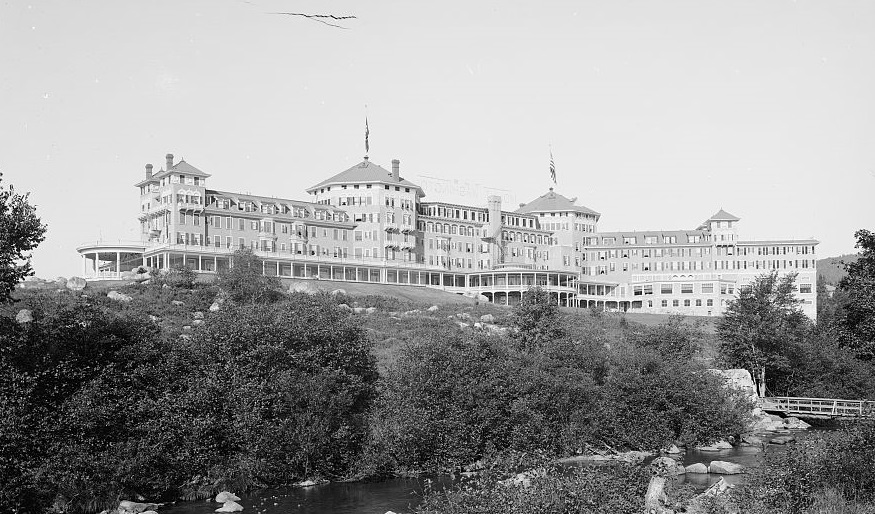

History
Discover the Omni Mount Washington Resort & Spa, site of the Bretton Woods conference of 1944 from which the International Bank for Reconstruction and Development and the World Bank were established.
Inducted into Historic Hotels of America in 2010, Omni Mount Washington Resort & Spa has been a leading holiday destination in the United States since the early 20th century. This brilliant resort is one of the few surviving historic vacation retreats erected in the White Mountains between 1850 and 1930. The idea for such a magnificent hotel originated with a railroad magnate and coal broker named Joseph Stickney. He had first come to the area to operate a rustic lodge known as the “Mount Pleasant House” during the 1880s. But Stickney decided that he needed a much grander hotel to meet the growing national interest of the region. To the end, he acquired several hundred acres of land at the base of Mount Washington and began erecting a massive Y-shaped hotel in 1900. Architect Charles Alling Gifford oversaw the design of the entire project, who had been recommended to Stickney by another celebrated 19th-century hotelier named Henry M. Flagler. It took Stickney and Gifford close to two years to complete and came at a cost of $1.7 million to complete—more than to $52 million in today’s money.
Christened as the “Mount Washington Hotel,” the location quickly became one of New Hampshire’s most exclusive resorts. Unfortunately, Joseph Stickney died roughly a year later. He left the Mount Washington Hotel to his beloved wife, Carolyn Foster Stickney, who ran it for the next three decades until her own death in 1936. Carolyn subsequently left the business to her nephew, F. Foster Reynolds. After stewarding the Mount Washington Hotel through the turbulent climate of the Great Depression and most of World War II, Reynolds decided to sell it to a conglomerate of Boston businessmen. It was around this time that the administration of President Franklin Delano Roosevelt requested that the hotel host the historic Bretton Woods Conference. Sponsored by the nascent United Nations, this international financial event discussed the founding of the International Monetary Fund and the World Bank. More than 700 delegates from 44 different nations even attended the event! The conference was so crucial to the federal government that it sent more than 150 workers to the Mount Washington Hotel in order to renovate it!
In 1955, the Fleischer family of Philadelphia acquired the Mount Washington Hotel, who managed the location for the next 15 years. They then sold it to a local real estate business called the Mount Washington Development Company. Nevertheless, its tenure as the steward for this amazing destination proved to be short-lived, as it, too, transferred control over to the Bretton Woods Corporation in 1975. The Bretton Woods Corporation invested millions into thoroughly renovating the resort back to its former glory, resulting in its inclusion in the National Register of Historic Places. The construction work was so successful that the Secretary of the Interior even recognized the Mount Washington Hotel as a National Historical Landmark in 1985. Subsequent renovations occurred during the 1990s when the Bretton Woods Corporation gave a company known as the MWH Preservation Limited Partnership its rights to operate the hotel. Under the watch of MWH Preservation Limited Partnership, the Mount Washington Hotel underwent many significant changes, including its rebirth as a year-round facility. Omni Hotels and Resorts now manages this stunning historic destination as the “Omni Mount Washington Resort & Spa” in partnership with CNL Lifestyle Properties, Inc.
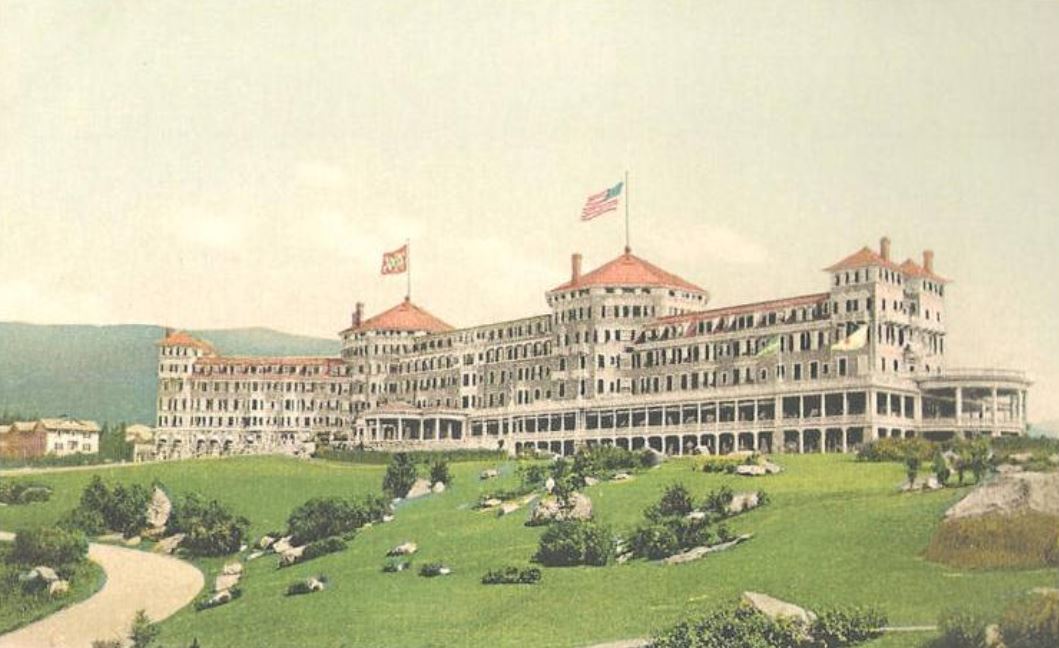
Hotel Timeline
The Location
The Omni Bretton Arms Inn faces Mount Washington, a celebrated national landmark that defines the landscape of White Mountain National Forest. The location possesses the highest point in the entire northeastern United States, with an elevation of more than 6,000 feet. Originally called “Agiocochock” by local Native American tribes, Mount Washington was named after George Washington shortly after the conclusion of the American Revolutionary War. The use of his name began a tradition in which the names of other U.S. presidents would be applied to the neighboring mountains. In all, seven other mountains bore the names of various presidents, forming a geographic location known as the “Presidential Range.” Those individuals are as follows:
- John Adams, 2nd President of the United States
- Thomas Jefferson, 3rd President of the United States
- James Monroe, 4th President of the United States
- James Madison, 5th President of the United States
- John Quincy Adams, 6th President of the United States
- Franklin Pierce, 14th President of the United States and New Hampshire’s only native son to sit in the Oval Office
- Dwight D. Eisenhower, 35th President of the United States
But local officials continued to name neighboring mountains after other prominent national figures, including Senators Henry Clay and Daniel Webster, as well as Founding Father Benjamin Franklin. The Presidential Range is one of the central features within White Mountain National Forest and can be navigated by traveling along the Presidential Traverse.
Mount Washington itself has attracted curious travelers for years due to its dominant command over the entire area. In fact, John Sebastian Cabot—one of the first Europeans to explore the New England coastline—could even see the mountain’s peak from the Gulf of Maine miles away. Americans have continuously visited Mount Washington ever since, as many have hiked through the region to experience its plant and wildlife. Mount Washington today serves as a training ground for experienced hikers who plan to climb such harrowing destinations as Mount Everest and K2. To help nature enthusiasts to traverse the steep topography of Mount Washington and the greater the Presidential Range, local outdoorsmen cut several massive trails throughout the countryside. Among the most historic of those trails is the Crawford Path, which was first developed by Ethan Allan Crawford in 1819. The pathway navigates the Crawford Notch to reach the summit of Mount Washington. Yet, there are many other novel ways to access the mountain, including the Victorian-era Mount Washington Cog Railway. Founded in 1868, it is the world’s first mountain-climbing cog railway!
The Architecture
Constructed between 1900 and 1902, Omni Mount Washington Resort & Spa cost Joseph Stickney a total of some $1.7 million to complete—more than to $52 million in today’s money. Stickney would rely on the architectural expertise of Charles Alling Gifford, whose work included the Jekyll Island Club (another member of Historic Hotels of America). Its design incorporated some of the most cutting-edge innovations of its age, including a steel-frame superstructure, an electrical power plant, and a sophisticated internal heating system. Stickney and Gifford brought in some 250 Italian artisans to raise the Y-shaped structure by working on its exterior granite and stucco masonry. The location’s brilliant façade was joined by two, five-story octagonal towers as well. But many of the interior spaces featured the same intricate attention to detail. The hotel featured more than 1,000 beautiful windows and nearly 5,000 electric lights. Intricate Italian plasterwork, crystal chandeliers, and Tiffany stained-glass accents adorned the lofty Great Hall and the neighboring Main Dining Room. The rustic brickwork in The Cave and the Conservatory’s acoustic dome were just as pleasing to the eye as the majestic geography of Mount Washington. Guests were awestruck by the columned Porte Cochere, too, as well as the subtle details of the Sun Dining Room’s carvings and the Grand Ballroom’s plasterwork.
Omni Mount Washington Resort & Spa has since undergone additional construction work over the years, with the most notable transpiring during the 21st century. The first round of renovations occurred in 2007, following Celebration Associates' acquisition of the resort a year prior. Among the areas that received the most attention was the historic Rosebrook Bar, the Great Hall, and the Veranda. Landscape architect Brian Silva also started renovating the resort’s renowned Donald J. Ross golf course, which had been in operation since 1915. Omni Hotels and Resorts continued the project two years later when it purchased the location in partnership with CNL Lifestyle Properties in 2009. The two entities spent close to $20 million on continuing the work, focusing on the resort’s wonderful accommodations and iconic red roof. The corporation also added several new facilities, which included a 25,000 square-foot spa, an equally large conference center, and several new restaurants. One of those restaurants was even restored inside a historic train station that once operated on the grounds during the Gilded Age. Many of the scenic hiking trails and skiing facilities received an overhaul, as well, such as the ones found at Mount Stickney.
The architectural style of Omni Mount Washington Resort & Spa is that of Renaissance Revival. Renaissance Revival architecture—sometimes referred to as "Neo-Renaissance”—is a group of architecture revival styles that date back to the 19th century. Spanish Renaissance Revival-style architecture was one of the many offshoots from the Neo-Renaissance movement that popularized itself among Western architects at the height of the Gilded Age. But its emergence in the United States did not truly happen until the onset of the Roaring Twenties. So, in a way, the Omni Mount Washington Resort & Spa was ahead of its time in terms of its architectural appearance. Buildings constructed with Spanish Renaissance Revival-style architecture often embraced an asymmetrical design that used multiple uneven sections to create the layout. Those segments were usually constructed with stucco and were connected by a series of stunning courtyards, arcades and hallways. Towers were also a common element, as were detailed curvilinear gables along the crestline of the roof. Many ornate carvings proliferated throughout the exterior, which gave an alluring sense of freedom and majesty.
Famous Historic Events
Bretton Woods Conference (1944): Omni Mount Washington Resort & Spa played an integral role in establishing the International Monetary Fund (IMF) and the World Bank. Both organizations came into being at the height of World War II, when 44 different countries met at the Omni Mount Washington Resort & Spa to discuss the restoration of the global economy. The gathering would go down in history as the “Bretton Woods Conference.” It was attended by some of the most noteworthy politicians of the day, including John Maynard Keyes of the United Kingdom and Henry Morgenthau Jr. of the United States. All of the representatives agreed to a project known as the International Bank for Reconstruction and Development (IBRD), whose purpose was to provide financial aid for countries heavily affected by the war. The IBRD would later give birth to the World Bank. They also consented to create an International Monetary Fund, which would regulate imbalances in international payments while also stabilizing exchange rates. The two financial organizations still exist today and have been an essential component to bolstering the global economy in times of crisis.
In preparation for the Bretton Woods Conference, the federal government sent 150 workers to the hotel in order to renovate its accommodations. Each worker received 50 cans of white paint and were told that, “if it didn’t move, it should be painted white.” As such, the mahogany doors—as well as several brass light fixtures and Tiffany windows—were completely painted white. The U.S. State Department also sent hundreds of pieces of new furniture to the hotel to give it a timeless appeal. Activity throughout the Mount Washington Hotel resembled that of a bustling beehive. In all, the federal government invested millions of dollars into the project and requested that the construction work only take two months to finish. Nevertheless, the renovations impressed the many representatives who went to the hotel that July. The continued to use the resort long after their debates had ended, as the dignitaries from the leading nations in attendance signed the official articles establishing the IBRD and the IMF within the resort’s now-famous Gold Room (the Gold Room had originally been Carolyn Foster Stickney’s private dining room).
Famous Historic Guests
- Thomas Edison, famous American inventor known for such inventions as the motion picture camera and the light bulb.
- Joan Crawford, celebrated actress known for her roles in Mildred Place and Whatever Happened to Baby Jane?
- John Maynard Keyes, economist responsible for writing The General Theory of Employment, Interest and Money.
- Princess Margaret, Countess of Snowdon (1930 – 2002)
- Henry Morgenthau, Jr., 52nd United States Secretary of the Treasury (1934 – 1945)
- Fred Vinson, 13th Chief Justice of the United States (1946 – 1953)
- Anthony Eden, Prime Minister of the United Kingdom (1955 – 1957)
- Winston Churchill, Prime Minister of the United Kingdom (1940 – 1945; 1951 – 1955)
- Franklin Delano Roosevelt, 32nd President of the United States (1933 – 1945)
- George H.W. Bush, 41st President of the United States (1989 – 1993)
Film, TV and Media Connections
- Ghost Hunters: Ghostly Conversations (2008)
- Ghost Hunters: The Princess and the EVP (2012)
Guest Historian Series
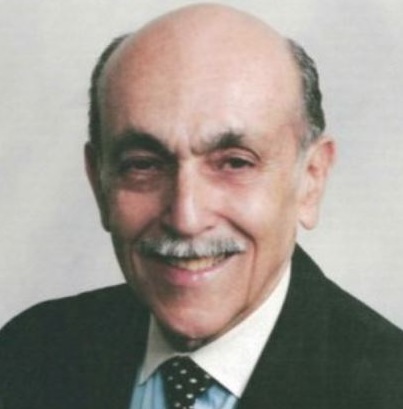
Hotel History: Mount Washington Hotel (1902), Bretton Woods, New Hampshire*
Ground-breaking for the new hotel was in 1900 and construction began in 1901. It was conceived and built by Joseph Stickney, a New York financier who owned the nearby Mt. Pleasant House. By the late 1890s, Stickney decided to build a more luxurious hotel opposite the Mt. Pleasant House. Two hundred fifty Italian craftsmen were brought in for the actual construction work. They lived in dormitories on the property, built for that purpose. Of the thirty grand resort hotels erected in the White Mountains between 1850 and 1930, only the Mount Washington Hotel was planned and built as a single entity from the start. It was designed by Charles Alling Gifford, who was recommended by Henry M. Flagler.
CONTINUE READING