








Receive for Free - Discover & Explore eNewsletter monthly with advance notice of special offers, packages, and insider savings from 10% - 30% off Best Available Rates at selected hotels. 
history
Discover InterContinental Indianapolis, which has been an iconic fixture within the nationally recognized Washington Street-Monument Circle Historic District for generations.
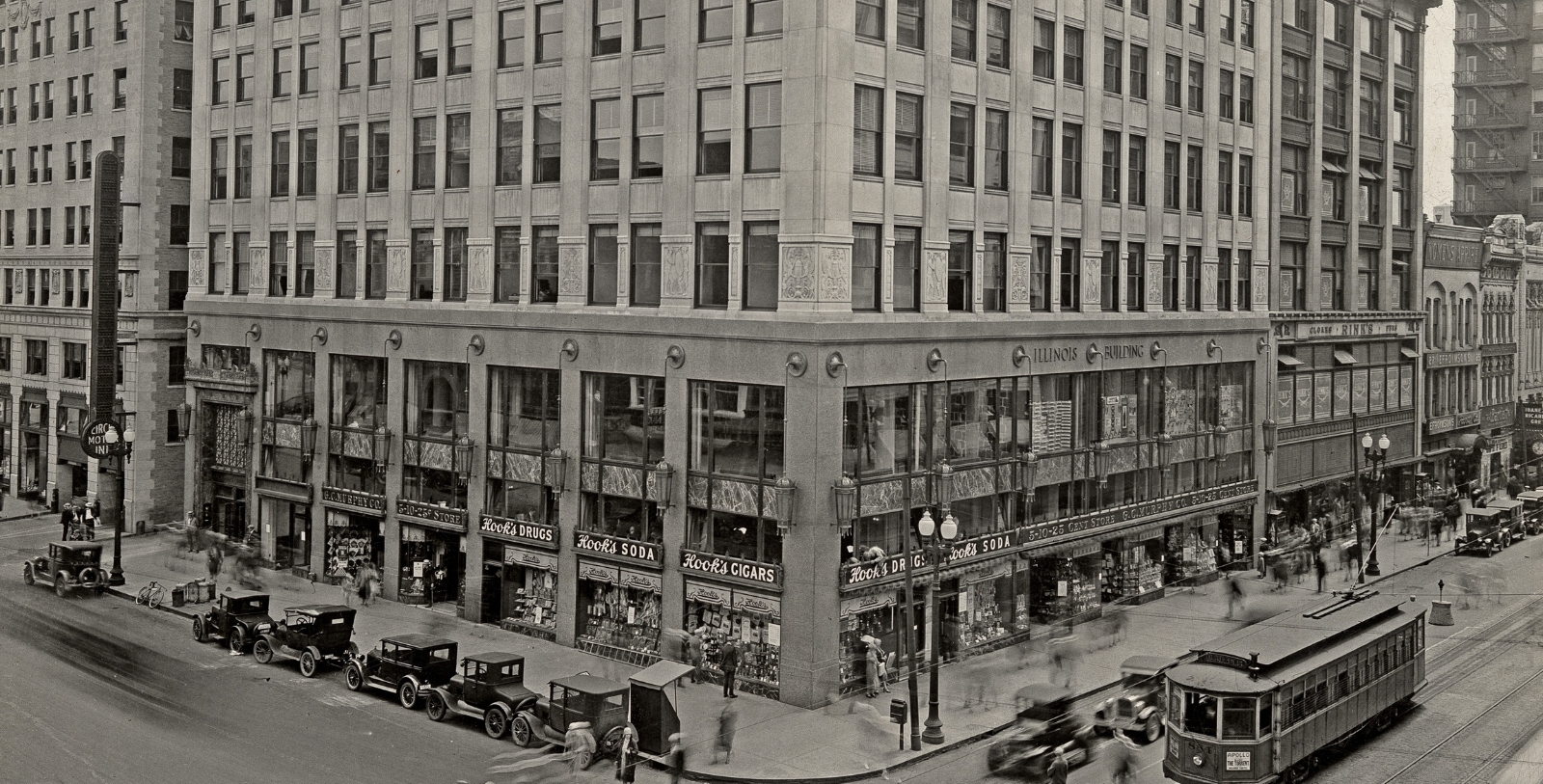
Like many other metropolises throughout the United States, the city of Indianapolis was undergoing significant economic transformations at the beginning of the 20th century. Numerous factories had begun across the community at a rapid pace that provided countless employment opportunities and drove economic growth. Soon enough, Indianapolis had become a national leader in several major industries, such as automobile manufacturing and food processing. The rush of activity enhanced the city’s infrastructure, as new housing, roads, and public services were developed to address the expanding population. Nowhere was this prosperity more apparent than the city’s downtown business district around the iconic Monument Circle, which had seen a wealth of gorgeous commercial buildings open for the first time. Among the beautiful structures to make their grand debut was an ornately crafted office complex known as the “Illinois Building,” built at the behest of L. Strauss Company president A.L. Block. Block had dreamt of creating an upscale headquarters for the corporate offices of his department store chain, hoping that its opulence would inspire his colleagues and customers alike. Block hired the talented architectural firm Rubush & Hunter to oversee the project, having come to adore its work on other buildings located around Monument Circle.
Rubush & Hunter in turn envisioned a ten-story structure with public entrances on both Illinois and Market streets. The building was designed with grandeur in mind, featuring Italian marble, African mahogany woodwork, and vitreous tile floors that included terrazzo mosaics. Special attention was given to the display windows situated on the first floor, which Block hoped would maximize the plate-glass frontage for the upscale shops he intended to occupy the area. Block had spared no expense to craft his magnificent Illinois Building either, approving Rubush & Hunter to spend more than $800,000 on construction costs—equivalent to over $100 million today! Upon its completion in June 1926, the Illinois Building emerged as a luxurious commercial hub in downtown Indianapolis. The building's proximity to both Monument Circle and the Indiana State Capitol made it a prime spot for businesspeople, who proceeded to rent its available office space for many decades. Despite its initial popularity, the Illinois Building fell into disrepair following its sale to new owners during the 1970s. The building gradually became derelict, with many unfinished architectural elements visible through its windows. In fact, the renowned Indiana Landmarks and Historic Preservation non-profit organization even listed the prestigious site among the state’s most endangered places in 2006.
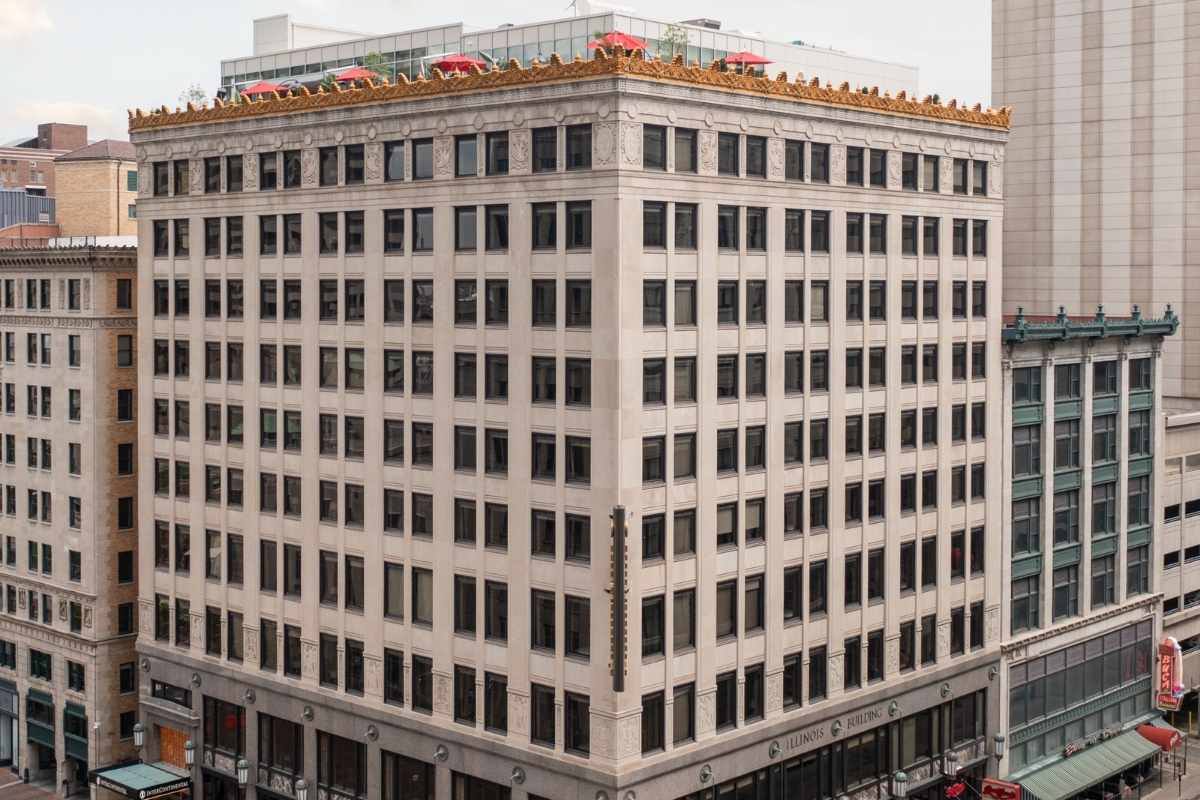
However, the Illinois Building's architectural significance prompted efforts to restore it. In a celebrated moment for the city’s hospitality landscape, the Illinois Building was dramatically transformed into the InterContinental Indianapolis following a $120 million restoration led by the locally based Keystone Group. The restoration aimed to preserve the building's historical features while adapting it for modern use. The hotel officially opened its doors in February 2025, marking the debut of the first luxury hotel in downtown Indianapolis in two decades. The InterContinental Indianapolis features 170 elegantly appointed guestrooms and suites, complemented by two new dining concepts—including Indiana’s first rooftop bar—helmed by an award-winning culinary team. But the most impressive aspect of the location’s revitalization has been the careful attention Keystone Group has paid toward ensuring the historical architecture remains intact. The company painstakingly worked alongside its architectural team to preserve many elements of the original motifs, ranging from the engraved exterior medallions to the exquisite brass moldings. This wonderfully restored historic site is thus well prepared to continue serving as a celebrated destination in downtown Indianapolis, serving as a time capsule for the city’s incredible heritage.
-
About the Location +
Listed in the U.S. National Register of Historic Places as a historic district, Monument Circle is an iconic urban space that has evolved significantly since its inception three centuries ago. More specifically, the origins of this fascinating historic site can be traced back to the founding of Indianapolis in 1821. The Indiana state legislature sought a central location for a new capital city and assigned two surveyors—Alexander Ralston and Elias Fordham—the task of designing its pending layout. Influenced by Pierre L'Enfant's plan for Washington, D.C., the surveyors created a mile-square city set upon a symmetrically drawn grid of north-south and east-west streets. The grandest of those roads was Washington Street, a 120-foot-wide thoroughfare that cut straight through the center of the settlement. Washington Street quickly became the commercial hub of all Indianapolis in turn, with lots fronting the street commanding the highest prices during the city's early years. Its role as the nexus for all local economic activity subsequently inspired state politicians to eventually incorporate the site into several important infrastructure projects, such as the arrival of the National Road in 1827 and the Jefferson, Madison, and Indianapolis Railroad two decades later. Buoyed by such prosperity, city leaders decided to commemorate the emergence of Indianapolis’s success with the creation of a gorgeous monument toward the end of the 19th century. Selecting a sizeable plot on a block north of Washington Street near the Indiana State Capitol, construction on the beautiful Soldiers’ and Sailors’ Monument thus began in earnest during the late 1880s.
Accomplished German architect Bruno Schmitz led its design, crafting a towering obelisk embellished with breathtaking sculptures and fountains. Prominent artists Rudolf Schwarz and Alexander Sangernebo created an amazing series of bronze statues and reliefs depicting scenes of battle, peace, and the everyday lives of those residents who had served. However, the most striking element was the colossal statue of Victory, which crowned the edifice. The figure, holding a sword and a torch, specifically symbolized the triumph and enduring spirit of the nation in the wake of the American Civil War. Although the monument paid specific tribute to the state’s military veterans, it nonetheless assumed an even greater meaning of representing Indianapolis itself. In fact, city ordinances soon debuted that sought to protect the site, revising building codes to prevent views of the monument. Despite the presence of those strict laws, Monument Circle—as the area became known—gradually attracted the attention of ambitious real estate developers who yearned to build their own impressive structures around the location. A dozen marvelous commercial structures appeared next to Monument Circle over the following three decades that displayed a stunning wealth of architecture styles ranging from Neoclassical to Art Deco. Three of the finest buildings to open at this time were three major department stores, L.S. Ayers & Co., William H. Block Co., and H.P. Wasson C.O.—which helped transform the area into a significant destination for high-end retail shopping.
Banks and other important regional financial institutions moved into many of the neighboring buildings, ultimately giving Monument Circle an impressive commercial character that endured for generations thereafter. But the district also earned an enviable reputation for the theaters and concert halls it began to host, such as the spectacular Circle Theatre, Indiana Theatre, and Empire Theatre. Private clubs and charitable organizations even managed to secure homes near Monument Circle, including the prestigious Columbia Club, which inhabited a fantastic clubhouse designed by the talented architectural firm Rubush & Hunter. (Rubush & Hunter would be responsible for designing most of the historic buildings around Monument Circle, including the erstwhile Illinois Building). Monument Circle has since retained its status as the cultural heart of Indianapolis, having grown to epitomize the city’s very image. Its enduring legacy has transformed the site into a prominent tourist destination in recent years, with its distinctive Soldiers’ and Sailors’ Monument serving as its most popular attraction. (There is even a military museum situated inside the base of the monument!) Cultural heritage travelers today will not only enjoy visiting the Soldiers’ and Sailors’ Monument though, but also the countless other landmarks located nearby, like the Christ Church Cathedral, the Indiana State Capitol, the Indiana State Museum, and the Indianapolis Symphony Orchestra. Nowhere else in the city captures the true essence of Indianapolis than the historic Monument Circle.
-
About the Architecture +
The renowned architectural firm Rubush & Hunter used a brilliant array of Renaissance Revival design techniques to craft its appearance. Renaissance Revival architecture itself—sometimes referred to as "Neo-Renaissance”—is a group of architectural revival styles that date back to the 19th century. Neither Grecian nor Gothic in their appearance, Renaissance Revival-style architecture drew inspiration from a wide range of structural motifs found throughout Early Modern Europe. Architects in France and Italy were the first to embrace the artistic movement, who saw the architectural forms of the European Renaissance as an opportunity to reinvigorate a sense of civic pride throughout their communities. Those intellectuals incorporated the colonnades and low-pitched roofs of Renaissance-era buildings, along with characteristics of Mannerist and Baroque-themed architecture. The greatest structural component to a Renaissance Revival-style building involved the installation of a grand staircase in a vein like those located at both the Château de Blois and the Château de Chambord in France’s Loire Valley. This feature served as a central focal point for the design, often directing guests to a magnificent lobby or exterior courtyard. But the nature of Renaissance Revival architecture meant that its appearance varied widely across Europe. Historians today find it difficult to provide a specific definition for the architectural movement. Nevertheless, Renaissance Revival architecture today remains one of the world’s most enduring, appearing in countless places across the globe. Many buildings designed in the style have even been listed in the U.S. National Register of Historic Places by the U.S. Department of the Interior!