



Receive for Free - Discover & Explore eNewsletter monthly with advance notice of special offers, packages, and insider savings from 10% - 30% off Best Available Rates at selected hotels. 
history
Discover Waldorf Astoria Versailles – Trianon Palace, which has hosted celebrated movie stars, prominent military heroes, and even iconic heads of state.

Waldorf Astoria Versailles – Trianon Palace, a member of Historic Hotels Worldwide since 2026, dates back to 1910.
VIEW TIMELINEIn 1907, entrepreneur Weill Martignan envisioned developing a grand hotel on the edge of the historic Palace of Versailles. He subsequently registered a company named “Trianon” that winter; its title was chosen deliberately to evoke the nearby Grand and Petit Trianon. To make his dream a reality, Martignan commissioned architect René Sergent to craft the nascent hotel’s physical form. The approach Sergent chose blended then-contemporary construction methods with classical elegance, a metal framework sheathed in stone, which echoed the majestic façade of the actual Versailles estate. In its earliest days, the pending hotel site occupied roughly three hectares, part of what had once been a Capuchin monastery affiliated with the palace domain. Nevertheless, the “Trianon Palace” opened its doors three years later, with local Versailles residents flocking to experience its magnificent character. This inauguration marked the beginning of its reputation as a refined destination, praised for its tranquil setting and elite service. Renowned figures were soon vying to reserve a guestroom, including writer Marcel Proust, banker Étienne de Montgolfier Lafitte, and the famed aviator Alberto Santos‑Dumont. In fact, actress Sarah Bernhardt considered the hotel to be something of a makeshift home, staying there for long periods whenever performing L’Aiglon in Paris.
The outbreak of the First World War abruptly changed the hotel’s purpose. The French government requisitioned the location, transforming it into an auxiliary hospital for wounded allied troops. Furthermore, the Inter‑Allied Military Committee installed its permanent War Council inside the building; its salons are coming to host many intricate discussions on combat strategies. But as the war neared its end, Trianon Palace played an even more direct role in shaping history. French Prime Minister Georges Clemenceau dictated the conditions of the Treaty of Versailles in a reception room that now bears his name, setting the terms for the agreement signed shortly afterward in the Palace of Versailles. Following the armistice, the hotel quickly reclaimed its place as a revered social gathering spot, particularly during the 1920s. A dedicated omnibus linked the hotel with the Place de la Concorde, enabling visitors to move easily between the capital and adjacent countryside. Writers and entertainers, including Paul Valéry, Sacha Guitry, and Marlene Dietrich, found respite within its tranquil setting, too, while business titans like John Rockefeller and J. Paul Getty made it their choice retreat when visiting France.
However, the approach of a second global conflict altered Trianon Palace’s destiny yet again. As Europe braced for more fighting, the British Royal Air Force took over the hotel’s cellars to house its service members stationed around the region. But with the fall of France in 1940, the building became the headquarters of the German Luftwaffe by order of Marshal Hermann Göring. Once Allied troops finally regained control of the area, military leaders like Dwight D. Eisenhower, George Patton, Omar Bradley, Charles de Gaulle, and Bernard Law Montgomery met inside the complex to make decisions that would shape the future postwar world. In the decades that followed the war, the hotel continued to weave its story into the broader fabric of French and international history. Its elegant salons and landscaped grounds served as a luxurious retreat, embodying the intersection of diplomacy, artistry, and society that had long defined its character. The return to peacetime also saw prominent guests travel back to Trianon Palace in great numbers, including Jacques Brel, Jean Gabin, and even Queen Elizabeth II of the United Kingdom.
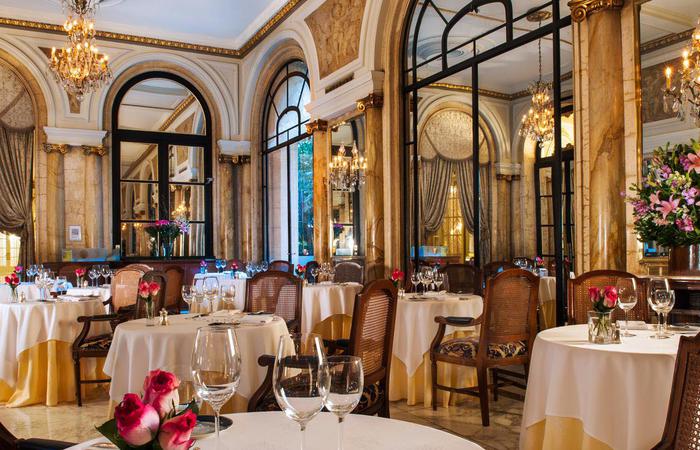
Then in 2008, interior designer Fiona Thompson oversaw a complete renovation that respected the building’s Belle Époque heritage while also introducing modern sensibility with refined colors, marble floors, and glimmering chandeliers. The next year marked another milestone as the Trianon Palace officially joined the Waldorf Astoria brand, integrating its storied legacy with one of the world’s most prestigious luxury hospitality collections. Today, the Waldorf Astoria Versailles – Trianon Palace encompasses 199 guestrooms and suites spread across its historic main building and several adjacent structures. Many accommodations offer sweeping views of the neighboring Versailles gardens, their interiors blending royal touches with modern comfort. The Waldorf Astoria Versailles – Trianon Palace stands currently not merely as a hotel but as a living monument to the very essence of French heritage. Its evolution from prewar luxury retreat to modern five-star landmark reflects the resilience and elegance that have since defined it. Contemporary guests can still feel the presence of those who shaped its story, providing a reminder that the Waldorf Astoria Versailles - Trianon Palace does not simply recount history; it embodies it.
-
About the Location +
While historical records indicate that a bucolic, pastoral community lived in the area since the early 11th century, modern Versailles did not appear until King Louis XIV constructed his magnificent Château de Versailles, or “Palace of Versailles” in the 17th and 18th centuries. Known history as the “Sun King,” Louis XIV learned of the region from tales about the hunting trips that his father, Louis XIII, had taken into the region countless times. (A local royal family called the “Gondis” had originally started inviting the king to visit the locale back in the 1610s). In fact, King Louis XIII had grown so infatuated with the area that he even built a beautiful hunting lodge that doubles as a quaint country's estate. Eager to escape the energetic, and sometimes hectic, atmosphere of Paris, Louis XIV subsequently instructed his royal architect and chief gardener to transform the retreat into a brilliant royal palace that he could call his primary home. Yet, the Sun King desired that the new estate serve as the permanent location of the French royal court, even going as far as to develop a planned community around the site throughout the 1670s and 1680s.
A beautiful tree-lined avenue acted as the town’s main thoroughfare, which was lined with dozens of outstanding buildings that included churches, markets, and aristocratic mansions. Two primary neighborhoods constituted the heart of Versailles, Notre Dame and Saint Louis, organized upon a series of street grids and preapproved building schematics created by Louis XIV’s chief engineer. Meanwhile, the king’s gorgeous palace gradually took shape. Its stunning Baroque-inspired architecture dominated the local skyline, as an intricate series of manicured gardens wrapped around the exterior. Inside, the gorgeous palace featured a number of amazing rooms, including the renowned Hall of Mirrors, which became the primary reception hall for all of Louis XIV’s grand ceremonies and receptions. When construction had concluded half a century later, it had cost the French crown millions in Livres to complete! (Louis had also sponsored the creation of another opulent palace in Versailles, as well as the Grand Trianon. Less opulent than the Château de Versailles, it was not the primary palace of any French monarch until Napoleon Bonaparte became emperor in 1799.)
At first, Versailles and its sparkling royal palace were the source of pride among Frenchmen, who pointed to the supposed power of the monarchy that the two projected together. But those attitudes changed rapidly over the course of the 18th century. The might of the Ancien Régime soon turned into a source of bitter discontent among ordinary French subjects, who seethed at the privilege of the royal court. By the time the Sun King’s distant grandson, Louis XVI, ascended the throne in 1774, that animosity was ripe to explode. Protests became frequent in front of the Château de Versailles, especially as France’s economy collapsed due to surging unemployment and rising food costs. To stem the rising anger, the kingdom’s Estates General, an informal assembly consisting of leaders from aristocracy, clergy, and general public, met at Versailles to discuss possible solutions. But the commoners in attendance remained dissatisfied with the deliberations and subsequently formed the National Assembly, thus, igniting the start of the French Revolution. And while Versailles itself did not suffer any direct hardships from the political instability at the time, it did experience a decline in its political importance with the elimination of the French crown. The area would not become culturally relevant again until the rise of Louis-Philippe to the vacated French throne during the July Revolution of 1833.
He subsequently transformed the palace into a “national museum” and invested heavily into its rehabilitation. His predecessor, Emperor Napoleon III, continued his efforts to save the structure, even going as far as to use the historic palace again as the site for official state-sponsored events. Nevertheless, Versailles remained a fairly quiet town, numbering just a few thousand people by the dawn of the 20th century. But the Château de Versailles managed restore some aspects of its earlier political prestige, going on to host various sessions of the French Parliament in the aftermath of the Franco-Prussian War. (The parliament still meets at Versailles whenever it needs to amend the French Constitution or to receive a joint address from the French president.) Yet, the palace’s greatest moment in modern history occurred when it functioned as the site for the signing of the eponymous Treaty of Versailles, which brought an end to World War I. Today, Versailles and its brilliant palace attract thousands of curious onlookers every year, who wish to immerse themselves deeply into France’s past. The fascinating connection that the Château de Versailles itself shares with French history has even earned it a listing as a rare UNESCO World Heritage Site.
-
About the Architecture +
Waldorf Astoria Versailles – Trianon Palace displays a wonderful blend of Classical Revival architecture. Also known as “Neoclassical,” Classic Revival architecture itself is among the most common architectural forms seen throughout the world today. This wonderful architectural style first became popular in Paris, specifically among French architectural students that studied in Rome in the late 18th century. Upon their return, the architects began emulating aspects of earlier Baroque design aesthetics into their designs, before finally settling on Greco-Roman examples. Over time, the embrace of Greco-Roman architectural themes spread across the world, reaching destinations like Germany, Spain, Great Britain, and even Norway. As with the equally popular Revivalist styles of the same period, Classical Revival architects found an audience for its more formal nature. It specifically relied on stylistic design elements that incorporated such structural components, like the symmetrical placement of doors and windows, as well as a front porch crowned with a classical pediment.
Architects would also install a rounded front portico that possessed a balustraded flat roof. Pilasters and other sculptured ornamentations proliferated throughout the façade of the building, as well. Perhaps the most striking features of the buildings designed with Classical Revival-style architecture were massive columns that displayed some combination of Corinthian, Doric, or Ionic capitals. With its Greco-Roman temple-like form, Classical Revival-style architecture was considered most appropriate for municipal buildings like courthouses, libraries, and schools. But the form found its way into more commercial uses over time, such as banks, department stores, and of course, hotels. Yet, the form found its way into more commercial uses over time, such as banks, department stores, and of course, hotels. Examples of the form can be found throughout many major cities, including London, Paris, and New York City. Architects still rely on Classic Revival architecture when designing new buildings or renovating historic ones, making it among the most ubiquitous architectural styles in the world.
-
Famous Historic Events +
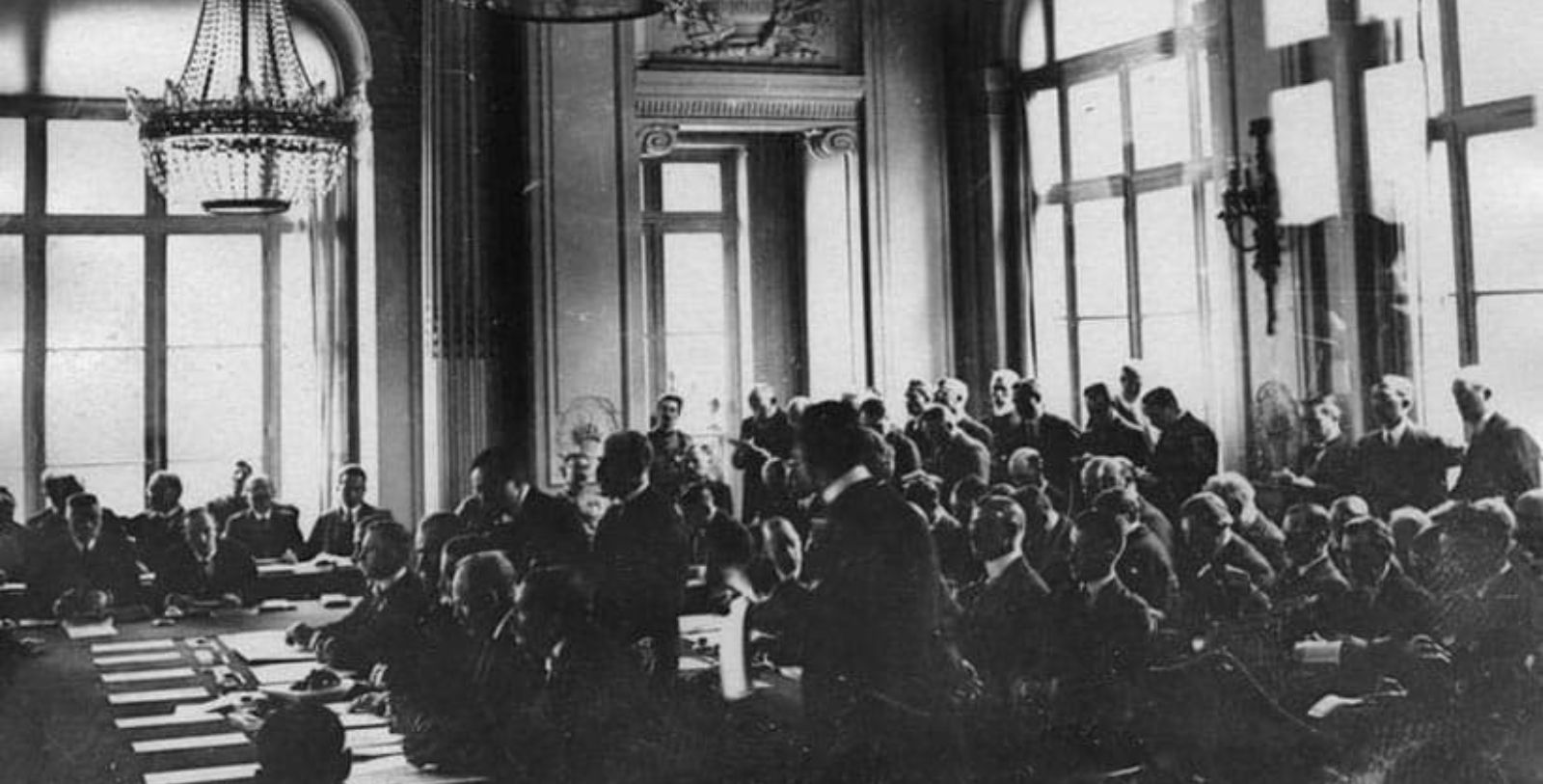
Treaty of Versailles (1918): By the time the guns fell silent in November 1918, Europe had endured four years of unprecedented destruction, and the victors faced the immense challenge of reshaping international order. Paris became the center of this endeavor in early 1919, drawing statesmen, diplomats, military advisers, and journalists from across the world. Among them, French Prime Minister Georges Clemenceau stood as one of the most formidable and uncompromising figures, determined to ensure that Germany would never again threaten France. The war had ravaged large swaths of northeastern France, leaving cities destroyed, industries shattered, and millions of lives lost. Clemenceau, known as “Le Tigre,” for his fierce temperament—embodied this national trauma. He believed that France’s security required not abstract ideals but concrete guarantees, including territorial adjustments, military restrictions, and substantial reparations onto Germany. During the Paris Peace Conference, Clemenceau made the Waldorf Astoria Versailles – Trianon Palace his base of operations. Located near the actual Palace of Versailles, the hotel offered both seclusion and proximity to the negotiations. There, Clemenceau received advisers, refined France’s negotiating positions, and prepared for the often-tense meetings with his Allied counterparts.
The Treaty of Versailles itself was shaped by the interplay of competing visions. U.S. President Woodrow Wilson arrived with his Fourteen Points, advocating self-determination, open diplomacy, and a new League of Nations to preserve peace. Meanwhile, British Prime Minister David Lloyd George occupied a middle ground, sensitive both to public demands for repayment and long-term stability. Working from his quarters at Waldorf Astoria Versailles – Trianon Palace, Clemenceau pushed relentlessly for harsher terms, arguing that France’s geographic vulnerability demanded decisive safeguards. Ultimately signed the Hall of Mirrors at Versailles that June; the treaty imposed sweeping conditions. It forced territorial losses, including Alsace-Lorraine’s return to France, limited the German army, prohibited an air force, and assigned sole responsibility for the war through the infamous “war guilt” clause. Reparations were mandated, eventually reaching immense sums that burdened Germany’s postwar economy. While Clemenceau and many in France regarded these measures as necessary justice, others worried they planted the seeds of future conflict. Even within the Waldorf Astoria Versailles – Trianon Palace, Clemenceau faced criticism from those who feared that excessive punishment would foster resentment rather than reconciliation.
The atmosphere surrounding the treaty’s creation blended ceremony with strain. Delegations traveled between Paris and Versailles, with the press chronicling every perceived development from inside the hotel. Clemenceau’s presence at the Waldorf Astoria Versailles – Trianon Palace symbolized France’s determination to maintain control over the process while standing on historic ground laden with meaning. After all, it was in Versailles that Germany had been proclaimed an empire in 1871, an event that contemporary French leaders never forgot. By choosing this setting, Clemenceau and his allies underscored the sense that history itself was being corrected—at least from their shared perspectives. In retrospect, the Treaty of Versailles stands as a paradox. It formally ended the war with Germany and attempted to construct a framework for peace, yet its provisions contributed to political instability in the years to come. Clemenceau achieved most of his immediate aims, helping France regain territory and secure temporary guarantees. However, the treaty fell short of ensuring lasting security, contributing significantly to the rise of World War II. Waldorf Astoria Versailles – Trianon Palace remains a quiet luxury hotel that has since reminded visitors that diplomacy, ambition, and the weight of memory often converge in the most intimate settings.
-
Famous Historic Guests +
- Sarah Bernhardt, stage actress known for her roles in such plays like La Tosca, Ruy Blas, and La Dame Aux Cameilas.
- Marcel Proust, author best remembered for his novel, In Search of Lost Time.
- Paul Valéry, poet and essayist, best remembered for his extensive notebooks, the Cahiers.
- Sacha Guitry, actor known for his roles in films like Le Roman d'un tricheur, Les Perles de la couronne, and La Poison.
- Marlene Dietrich, actress known for her roles in Morocco, Shanghai Express, and The Blue Angel.
- Jacques Brel, actor best remembered for his roles in films like Les risques du métier, L’aventure c’est l’aventure, and Franz.
- Jean Gabin, actor known for his roles in films like Grand Illusion, Pépé le Moko, and Le Quai des brumes.
- Jeanne Moreau, actress and director remembered for her roles in films like Seven Days…Seven Nights and Viva Maria!
- Alberto Santos‑Dumont, aeronaut and inventor best remembered for his contributions to the development of flight during the early 20th century.
- J. Paul Getty, founder of the Getty Oil Company.
- John D. Rockefeller, founder of the Standard Oil Company.
- Omar Bradley, World War II hero and 1st Chairman of the Joint Chiefs of Staff (1949 – 1953)
- George Patton, World War II hero who commanded the American Third and Seventh Armies during World War II.
- Bernard Law Montgomery, one of the most prominent and successful British commanders during World War II.
- Georges Clemenceau, Prime Minister of France (1906 – 1909; 1917 – 1920)
- Charles de Gaulle, World War II hero and President of France (1959 – 1969)
- Queen Elizabeth II of the United Kingdom (1952 – 2022)
- Dwight D. Eisenhower, 34th President of the United States (1953 – 1961), and Supreme Allied Commander Europe during World War II.